
A horse’s skin and hooves face constant abuse—girth rubs from tack, stone bruises on the trail, fence wire scrapes in the pasture. When a hot nail or an abscess blowout happens midweek, the last thing you want is a first aid kit that fails on contact or melts off in the sun. You need supplies that stay put, don’t sting, and actually match the biology of equine tissue.
I’m Mo Mahin — the founder and writer behind Furric. I’ve spent years combing through equine veterinary research, cross-referencing wound care chemistries like hypochlorous technology and ceragenin molecules, and matching each product to the real conditions horse owners report in the field.
Every supply in this guide earns its place by addressing a specific equine wound reality. After heavy analysis, this is the definitive list of equine first aid kit supplies for horse care that actually work when your animal needs them most.
How To Choose The Best Equine First Aid Kit Supplies For Horse Care
Equine skin is thicker than human skin, heals more slowly, and is prone to proud flesh (excessive granulation tissue). A wound product made for people often lacks the staying power or pH balance needed for a horse. Focus on these three factors when building your kit.
Formula Type: Spray vs. Ointment vs. Gel vs. Salve
Sprays cover large or hard-to-reach areas without touching the wound, ideal for kick wounds or bites. Gels form a clear barrier that lets you monitor healing without removing a dressing. Salves and ointments—like the gall salve originally used for draft horses—stay put under tack and resist melting in summer heat. Choose the consistency that matches where on the horse you’ll use it most.
Active Ingredients and Safety Profile
Look for hypochlorous acid, ceragenins, or silver-based technologies that tackle bacteria without damaging healthy tissue. Avoid products with steroids, alcohol, or iodine-heavy concentrates that can sting and delay healing. A non-toxic, lick-safe formula is non-negotiable for horses that can reach a hind-leg wound with their mouth.
Application Ease and Residue
A product that runs off in ten minutes is useless on a working horse. Check that the label specifically mentions staying power under heat or tack. Dry, non-greasy finishes help keep dirt and bedding from sticking to the wound site.
Quick Comparison
On smaller screens, swipe sideways to see the full table.
| Model | Category | Best For | Key Spec | Amazon |
|---|---|---|---|---|
| Veterinarius Derma GeL | Gel | Deep wounds needing protective film | 100mL tube, no secondary dressing needed | Amazon |
| Bickmore Gall Salve | Salve | Girth galls and tack rubs | 14 oz, stays on in heat | Amazon |
| Farnam Triple Action | Ointment | Itchy bellies and girth rub healing | 14 oz, contains menthol | Amazon |
| Vetericyn Plus Dressing Gel | Gel | Open wounds under bandages | 8 oz, hypochlorous technology | Amazon |
| Absorbine Hooflex Magic Cushion | Hoof Packing | Sore, overworked hooves | 2 lb tub, 24-hour heat reduction | Amazon |
| Farnam Purishield Spray | Spray | Kick wounds and large abrasions | 12 oz, ceragenin molecules | Amazon |
| Underwood Wound Spray | Spray | Economical everyday wound care | 16 oz refill, works with baking powder | Amazon |
In‑Depth Reviews
1. Veterinarius Derma GeL 100mL

This transparent gel creates a round-the-clock protective film that seals the wound bed without requiring a secondary bandage. The 100mL tube is small enough to toss in a grooming tote, yet the concentrated formula means fewer applications than typical water-based gels. The film effect is especially valuable on wounds located on the chest or shoulder where wrapping is impractical.
Customers consistently report healing on deep ulcers, post-amputation sites, and severe pressure sores across cats, dogs, and horses. The gel’s ability to cover exposed bone or granulating tissue without sticking makes it a true multi-species first aid essential. It stays active longer than conventional ointments, reducing the need for reapplication during the day.
The only practical trade-off is the tube size—at 100mL, heavy users on multiple animals may want a backup. But for the price, the healing speed and simplicity of use make this the straightest path from wound to recovery in the equine medicine cabinet.
Why we love it
- Creates a flexible, breathable film that stays in place without wrapping
- Works effectively on severe wounds including pressure sores and surgical sites
- Highly concentrated—one tube lasts through prolonged treatment
Good to know
- Small tube size may not suit large-area wounds on a single application
- Gel consistency can be slightly tacky before fully setting
2. Bickmore Gall Salve 14 oz

Developed from years of hands-on equine experience, Bickmore’s salve was engineered specifically to stay on a working horse under summer heat. While many wound creams liquefy and run off, this formula holds firm on galled shoulders, necks, backs, and mud scalds. The 14-ounce plastic jar is tough enough to survive a tack trunk.
The salve goes on dry—no greasy residue means dirt and sawdust won’t stick to the application site. This is a huge advantage when treating a horse turned out on shavings or pasture. It targets scratches, hobble chafes, and minor wounds without blistering the surrounding skin, which open salves from the last century often did.
It is a first-aid classic that has not been reformulated into obsolescence. The absence of modern customer reviews means less crowd-sourced proof, but the 14-ounce yield and heat stability speak for themselves. Keep this jammed in the trailer kit for trail rides and show weekends.
Why we love it
- Will not melt or run off even on hot, sweaty horses
- Goes on dry with zero greasy residue that attracts dirt
- Large 14-ounce size offers longevity for active stables
Good to know
- Not recommended for deep puncture wounds that need drainage
- Thick consistency requires firm pressure to apply evenly
3. Farnam Triple Action Wound Treatment 14 oz
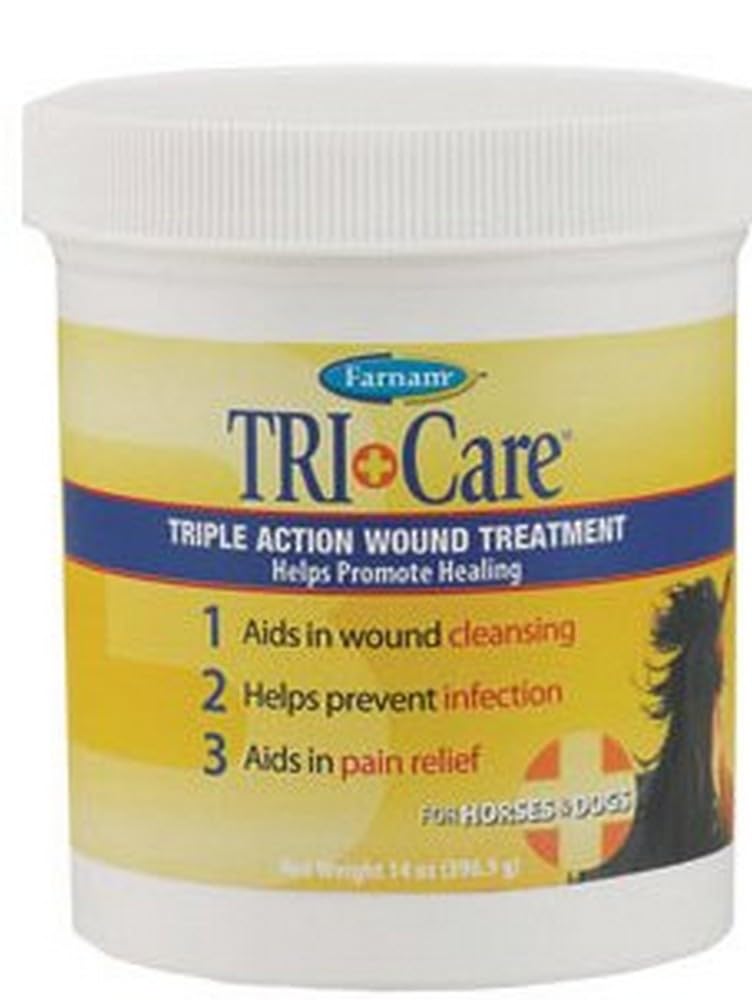
Farnam designed this ointment to attack three common equine skin problems at once: bacterial threats, inflammation, and itch. The subtle inclusion of menthol provides noticeable cooling relief, which is why multiple reviews confirm it stops midline belly itching and hot spots in horses that have failed other treatments. The 14-ounce tub offers enough volume for repeated use on persistent skin issues.
The ointment base is thick enough to stay on girth rubs even during light riding, but it does not create a waterproof seal like a gel or film spray. It works best on flat surface wounds where the cream can be massaged in. Users report it softens thickened skin around chronic itch patches while simultaneously protecting abraded areas.
It is a solid all-rounder, but the menthol may be too strong for extremely sensitive skin or open wounds with exposed tissue. For routine tack rubs, summer itch, and minor scrapes, this tub earns a permanent spot on the shelf. Pair it with a spray for larger wounds.
Why we love it
- Menthol provides immediate cooling relief for itchy, irritated skin
- Large tub size offers excellent value for chronic skin conditions
- Proven effective for girth rubs and summer hot spots
Good to know
- Menthol may cause mild stinging on deep open wounds
- Not a barrier gel—won’t hold under a wrap for long
4. Vetericyn Plus Wound Dressing Gel 8 oz

Vetericyn Plus uses hypochlorous acid technology to create a pH-balanced barrier that supports the body’s natural healing cascade. Unlike iodine or peroxide, this gel is non-toxic if licked, making it a safe choice for horses who can reach hind-leg or chest wounds with their mouth. The 8-ounce bottle is a clear gel that works well under wraps and standard wound dressings.
Customers who keep this in their stable report it clears up itchy feet and behind-the-ear scratches in days without the need for steroid creams. The thick barrier protects open cuts and abrasions from debris while keeping the wound bed moist for faster epithelial migration. A quick shake of the bottle before each use ensures the hypochlorous solution stays properly mixed.
The only knock is that some users found a basic triple-antibiotic ointment kept wounds moister for deeper lacerations. But for a non-antibiotic, veterinarian-formulated solution that won’t cause resistance, Vetericyn is the go-to for daily dressings and general skin irritations.
Why we love it
- Safe if licked or ingested—no need for elizabethan collars on dogs
- Hypochlorous technology mimics the body’s immune response
- Works great under bandages for moist wound healing
Good to know
- Bottle must be shaken very well before each use
- Less effective for drying out deep draining wounds
5. Absorbine Hooflex Magic Cushion 2 lb

Magic Cushion is not a general wound wash—it is a hoof-specific packing designed to reduce heat and inflammation in the sole and frog for up to 24 hours. The 2-pound tub provides enough material for roughly ten full hoof applications. It is particularly handy for abscess aftercare where you need to pack the void left by the drainage tract so dirt cannot re-enter.
The formula is officially show-safe and contains no substances banned by USEF or FEI, so competitive riders can use it as a preventative after hard training on firm ground. It is sticky by design, so gloves are recommended during application. The product holds firm under a pad and shoe or under a wrap and hoof boot for overnight treatment.
It is not a cure-all for lameness, but for managing stone bruises, post-trim sensitivity, and abscess holes, this tub does work that no ointment or spray can match. If your first aid kit lacks a hoof-specific solution, this is the piece that completes it.
Why we love it
- Provides measurable hoof heat reduction for a full 24 hours
- Excellent for packing abscess holes and protecting the drainage site
- Large 2-pound tub gives enough product for multiple treatment cycles
Good to know
- Sticky consistency makes a mess if not applied carefully
- Not intended for skin wounds—use only on the hoof sole and frog
6. Farnam Purishield Wound Care Spray 12 oz

Purishield uses patented Ceragenin molecules to mimic antimicrobial peptides and boost the body’s immune response at the wound site. The spray format makes it ideal for large-surface abrasions, kick wounds, and post-surgical sites where touching the injury with an applicator would cause pain. It is non-stinging, non-staining, and contains no steroids or antibiotics.
Customer feedback highlights its effectiveness on pressure sores in senior dogs and open wounds on horses that previously resisted treatment. The 12-ounce bottle provides good coverage for a 600- to 1200-pound animal. One application per day is often sufficient for minor wounds due to the 24-hour protection window.
The spray nozzle delivers a fine, even mist but can clog if not rinsed after each use. For deep puncture wounds, the gel version of the same line would be better suited, but for cleaning and treating the vast majority of external equine wounds, this spray is hard to beat.
Why we love it
- Ceragenin technology enhances natural healing without harsh chemicals
- Non-stinging formula makes application stress-free for the animal
- Single daily application covers most minor wounds
Good to know
- Spray nozzle can clog if not cleaned between uses
- Not a thick barrier—best for flat or draining wounds
7. Underwood Horse Medicine Wound Spray Refill 16 oz

Underwood takes a unique approach—the spray is meant to be paired with a light dusting of baking powder to create an artificial scab that physically seals the wound from contaminants. This is an old-school method that works well for clean cuts and scrapes where you want to prevent dirt and flies from entering the wound bed. The 16-ounce refill size makes this the most economical option per ounce in this list.
The spray itself is non-stinging and can be used on horses, dogs, cats, goats, and rabbits. It is designed for manageable wounds that don’t require a veterinarian’s surgical intervention. The trigger bottle delivers a wide spray pattern, covering a large area in a single squeeze.
The artificial scab approach means this is best on dry or slightly moist wounds—it does not work well on deep puncture wounds or abscess holes that need to drain. Keep this in the kit for quick clean-and-seal jobs on trail rides or pasture injuries where you need a simple, repeatable routine.
Why we love it
- Very economical—16 ounces provides lots of treatments
- Artificial scab method keeps wounds clean without bandaging
- Non-stinging formula suitable for nervous or sensitive animals
Good to know
- Requires supplemental baking powder for full scab effect
- Not suitable for deep puncture wounds or infected sites needing drainage
FAQ
Can I use triple antibiotic ointment from my medicine cabinet on my horse?
How often should I reapply wound spray on a pasture wound?
Is hoof packing the same thing as wound ointment?
Final Thoughts: The Verdict
For most horse owners, the equine first aid kit supplies for horse care winner is the Veterinarius Derma GeL because its protective film technology lets you treat severe wounds without wrapping. If you need hoof-specific relief for abscess holes or sore soles, grab the Absorbine Hooflex Magic Cushion. And for a no-sting spray that covers large kick wounds in seconds, nothing beats the Farnam Purishield Spray.