
When your horse starts refusing grain, pins its ears at the girth, or drops performance mid-season, gastric ulcers are often the hidden culprit. Unlike humans, horses produce stomach acid 24/7, and a modern management style with concentrated feeds, limited turnout, and trailering creates the perfect storm for stomach lining erosion. The difference between a horse that merely survives training and one that thrives often comes down to how well you manage this specific, painful condition.
I’m Mo Mahin — the founder and writer behind Furric. I’ve spent years comparing equine supplement specifications, studying gastric pH data from veterinary studies, and analyzing aggregated owner feedback on what actually moves the needle for horses with sensitive stomachs.
After breaking down the active ingredients, delivery forms, and clinical trial results behind the top-rated formulas, I’ve curated this definitive guide to the best equine ulcer treatment options available today.
How To Choose The Best Equine Ulcer Treatment
Gastric ulcers in horses affect all ages and disciplines, and the right treatment goes beyond just symptom relief. You need a formula that addresses the root cause: unregulated stomach acid. Here are the critical factors to evaluate before buying.
Gastric pH Buffering Capacity
The equine stomach is divided into two regions — the non-glandular upper portion (which has no protective mucus) and the glandular lower portion. Ulcers most commonly form in the upper region when stomach pH drops below 4.0 for prolonged periods. Effective treatments rely on ingredients like calcium carbonate and magnesium hydroxide to raise and stabilize pH, creating an environment where the stomach lining can heal. Look for products that cite pH regulation as a core mechanism rather than just a side benefit.
Delivery Form and Palatability
Horses with existing ulcers are often picky eaters. The delivery form — pellet, powder, granule, or paste — directly impacts whether your horse will actually consume the full dose. Pellets generally mix easily into grain and are less dusty, while powders allow for more even distribution across soaked hay or beet pulp. Avoid formulas that rely on artificial flavoring to mask unpalatable active ingredients; natural palatability leads to better long-term compliance.
Ingredient Source and Additional Benefits
Not all antacid minerals are created equal. Sourced bentonite clay (like the type found in Redmond salt deposits) provides a broad spectrum of trace minerals while buffering acid, offering dual benefits for digestive health and overall coat and hoof condition. Added probiotics introduce beneficial microorganisms to support hindgut fermentation, which is often compromised during ulcer treatment. Consider whether your horse also needs stress reduction benefits from magnesium glycinate or similar calming agents.
Quick Comparison
On smaller screens, swipe sideways to see the full table.
| Model | Category | Best For | Key Spec | Amazon |
|---|---|---|---|---|
| Corta-FLX U-Gard Powder | Mid-Range | Daily prevention with clinical backing | 8 lb; 73-day field study on racehorses | Amazon |
| Probios Feed Granules | Mid-Range | Digestive recovery after antibiotics | 5 lb; live microbial cultures | Amazon |
| Corta-FLX U-Gard Pellets | Mid-Range | Picky eaters who prefer pellets over powder | 10 lb bucket; calcium + magnesium buffer | Amazon |
| HealthyGut Probiotics | Mid-Range | All-natural hindgut support | 90-day supply; 20 probiotic strains | Amazon |
| AniMed Remission | Premium | Zinc-based metabolic support | 10 lb; tablet form for targeted dosing | Amazon |
| Daily Gold Stress Relief | Premium | Ulcer relief plus behavioral calming | 25 lb; Redmond bentonite clay source | Amazon |
| MagnaGard Gastric Support | Premium | Long-term 5-month treatment supply | 20 lb bucket; bentonite + electrolytes | Amazon |
In‑Depth Reviews
1. Corta-FLX U-Gard Powder

This is the only formula in our lineup that can point to a published 73-day field study conducted on actively training racehorses, and the results showed a measurable decrease in gastric ulcer severity. The powder form delivers 8 pounds of calcium and magnesium that directly buffer excess stomach acid, maintaining proper pH levels for optimal nutrient absorption and digestive comfort.
The manufacturer specifically designed U-Gard for horses under performance, show, and race conditions — exactly the animals most vulnerable to stress-induced gastric erosion. Each serving provides enough acid-buffering capacity to counteract the effects of high-concentrate diets and intermittent feeding schedules common in competitive barns.
Owners of finicky eaters report the powder mixes cleanly into wet feed without leaving a grainy residue, and the single-scoop dosing eliminates guesswork. Two caveats: it does not contain probiotics, so you may want to pair it with a separate hindgut support if your horse has a history of colonic issues. Also, at 8 pounds, the bag size is moderate for multi-horse households.
Why we love it
- Clinically proven in peer-reviewed settings
- Built for high-stress equine athletes
- Clean mineral buffer without unnecessary fillers
Good to know
- Lacks probiotic strains for hindgut health
- No resealable bag feature
2. VETS PLUS Probios Feed Granules

While many ulcer treatments focus solely on the foregut, Probios addresses the entire digestive tract by delivering live viable microorganisms that support normal digestive function in horses and foals. Each 5-pound container provides a 5-gram per head per day serving that can be blended into feed rations or top-dressed directly onto grain with minimal fuss.
This product shines as a recovery protocol — especially after antibiotic use, which disrupts the gut’s microbial balance and can worsen existing gastric inflammation. The granule texture offers a distinct advantage over powders for horses that are hesitant eaters, as it blends invisibly into moistened beet pulp or senior feed formulations.
The manufacturer specifies all life stages, from weanlings to seniors, and the single scoop included in the package simplifies feeding. However, Probios is purely a probiotic supplement — it does not contain the acid-buffering minerals (calcium, magnesium, bentonite) necessary to directly neutralize stomach pH. Tank owners treating active ulcers will need to combine this with an antacid product for complete coverage.
Why we love it
- Gentle enough for young foals and seniors
- Supports hindgut microbiome during antibiotic recovery
- Granule form mixes easily without dust
Good to know
- No direct acid-buffering ingredients
- Flavor unspecific — some horses turn up their nose
3. Corta-FLX U-Gard Pellets

If your horse is a powder skeptic, this 10-pound bucket of alfalfa-based pellets is the same trusted U-Gard formula in a crunchy delivery system. Owners who have switched from the powder version consistently report better consumption rates — horses that previously sorted out their powder now clean the bowl. The pellet form also creates less airborne dust, which matters in enclosed stable environments.
The active mechanism remains identical to the powder version: calcium and magnesium that aid in acid reduction and help maintain proper stomach pH. Each serving effectively buffers the lower and upper regions of the equine stomach, reducing the risk of squamous mucosal damage. The bucket packaging is resealable and stackable, making it ideal for barns with multiple supplement containers.
Customer feedback highlights the peace-of-mind factor — users who feed it as a daily preventive measure note improved attitude during girthing and less resistance under saddle. One trade-off: the pellet form costs slightly more per serving than the powder equivalent, so large multi-horse operations may prefer the bagged powder for volume efficiency. Still, for the horse that demands texture, this is the winning delivery method.
Why we love it
- High palatability for selective eaters
- Resealable bucket for convenient storage
- Same proven calcium-magnesium buffer as the powder
Good to know
- Slightly higher per-serving cost
- Pellet size may be too large for very small ponies
4. HealthyGut Probiotics for Horses

Equa Holistics built this formula around the concept that gut health starts with microbial diversity — and they deliver 20 different probiotic species plus prebiotic inulin in a single daily scoop. The formulation is specifically designed for horses under light to moderate workload, which covers a broad audience of recreational trail horses and amateur competitors.
The standout feature here is the manufacturing standard: human-grade ingredients processed in a human-grade facility, non-GMO, and made in the USA. For owners who scrutinize every label, that transparency matters. The dosing is tiered by horse size — half a tablespoon for small horses, one tablespoon for medium builds, and up to two tablespoons for draft-type animals — giving you precise control without waste.
This supplement excels at defending against stress-induced digestive upset and supporting hindgut health after antibiotic protocols. However, prospective buyers should note that this is not an acid buffer; it does not contain calcium, magnesium, or clay. As a standalone treatment for confirmed ulcers, it works best in combination with a pH-neutralizing base product. The 720-gram container provides roughly a 90-day supply for a medium-sized horse.
Why we love it
- 20-strain probiotic blend for microbial diversity
- Human-grade manufacturing standards
- Strain-specific dosing for size variation
Good to know
- No direct stomach acid buffering
- Daily scoop can feel imprecise without a scale
5. AniMed Remission 10 lb

AniMed Remission takes a different approach compared to the buffering supplements on this list by using zinc as its primary active ingredient. Zinc plays a critical role in tissue repair and immune function, and the tablet form allows for controlled, breakdown-resistant dosing that ensures your horse receives a consistent amount of the mineral with each serving.
The 10-pound container is substantial — enough for prolonged treatment protocols — and the flavorless tablets can be hidden in a handful of grain or crushed onto wet feed for horses that are suspicious of new supplements. This product is particularly useful for horses with concurrent skin issues or hoof concerns, as zinc supports keratin production alongside gastric lining health.
One limitation: tablets are not as immediately bioavailable as powders when it comes to rapid acid neutralization. If your goal is quick pH adjustment during a flare-up, a finer mineral powder will reach the stomach faster. Additionally, the product information lacks specific clinical data on ulcer healing rates, relying instead on zinc’s well-documented role in epithelial repair.
Why we love it
- Zinc supports tissue regeneration beyond the stomach
- Tablet form resists moisture and clumping
- Large 10-pound supply for extended use
Good to know
- Slower onset of action compared to powder buffers
- Limited direct clinical ulcer healing data
6. Daily Gold Stress Relief
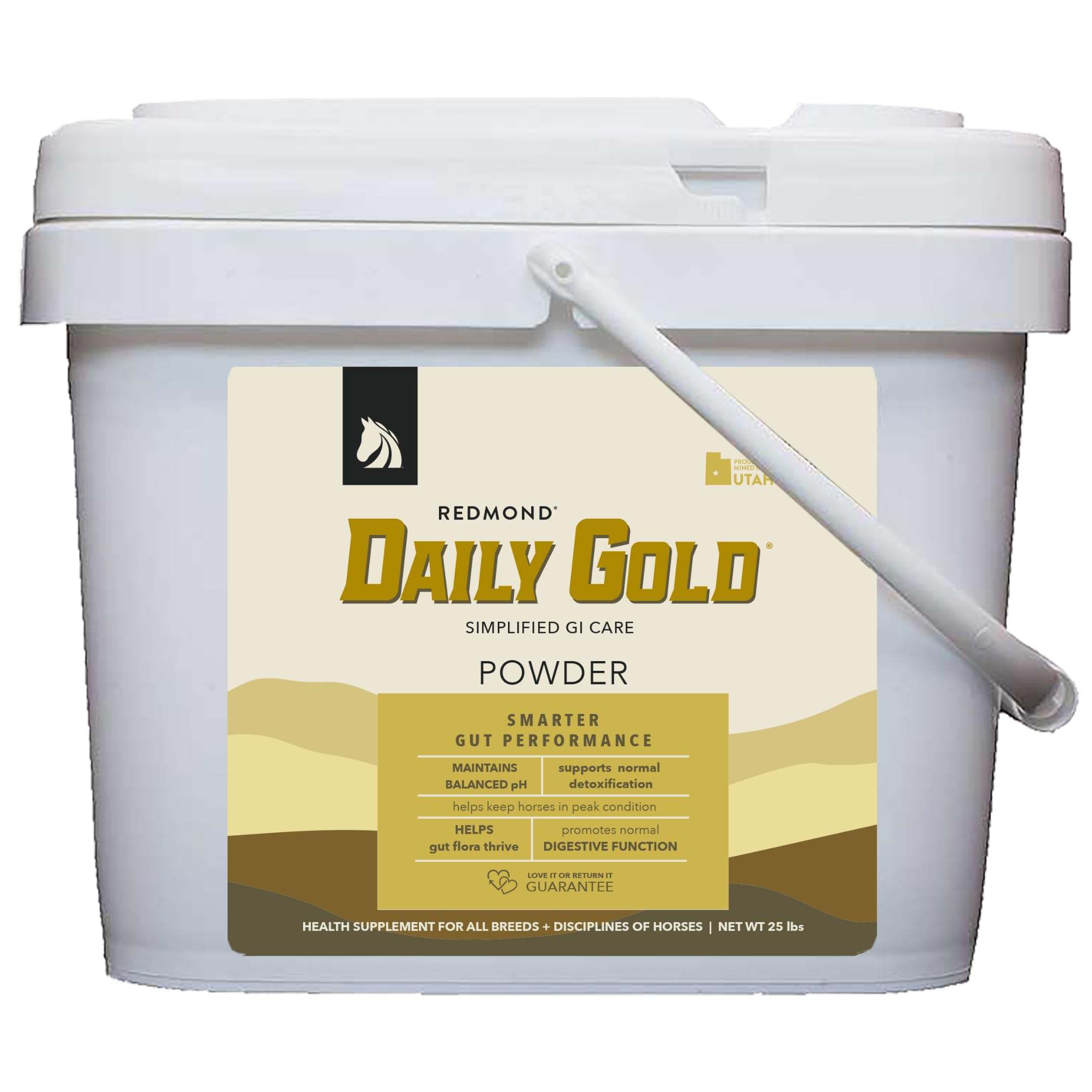
Daily Gold is the only entry on this list that addresses both the physical and behavioral dimensions of equine ulcers. The Redmond bentonite clay sourced from Utah provides a unique buffering action that binds toxins, eliminates diarrhea, and neutralizes excess stomach acid, while simultaneously delivering over 60 trace minerals that influence hormone regulation and stress response.
The 25-pound bag is the largest single-package offering here, and the value proposition is strong for owners managing multiple horses or one horse through an extended recovery. Customers frequently cite dramatic changes after trying this product last — after spending thousands on omeprazole-based treatments like GastroGard with limited success, many report that Daily Gold was the first supplement to stop chronic loose manure and restore normal appetite.
Redmond’s packaging is straightforward — a sturdy bag with a pour spout — but the bentonite clay powder is finer than typical mineral supplements, so mixing with water or wet feed is essential to avoid inhalation risk. Some horses initially object to the mild earthy flavor, though most adapt within the first week.
Why we love it
- Dual-action acid buffer and mineral supplement
- Proven to stop chronic diarrhea in resistant cases
- Generous 25-pound bag for multi-horse use
Good to know
- Fine powder requires thorough mixing to avoid waste
- Earthier taste may require initial adjustment period
7. MagnaGard Gastric Support Supplement

MagnaGard from Eagle Equine Products is the long-haul solution for barns that want to set and forget their gastric support protocol. The 20-pound bucket provides a full 5-month supply at 2 ounces per day, and the bentonite clay base delivers both acid buffering and a steady source of electrolytes — a particularly useful feature for hard-keepers and horses in heavy training who lose minerals through sweat.
The manufacturer recommends feeding 2 scoops daily (2 oz total) in either the morning or evening, with an additional pre-event dose 4 hours before competition for acute calming support and gastric protection. This flexibility makes it suitable for both daily maintenance and targeted stress-managed scenarios like show weekends or long trailer rides. The magnesium content acts as a natural calmer, helping to reduce the stress that so often triggers ulcer formation in the first place.
Every review we analyzed reported that horses ate the MagnaGard readily when mixed into grain with a splash of water. For the rare horse that refuses it, the company suggests adding apple sauce or aloe vera juice to mask the bentonite taste. The bucket lid snaps shut securely, protecting the powder from humidity and barn dust across months of use.
Why we love it
- Exceptional 5-month supply in one purchase
- Electrolytes support hydration during training
- Magnesium provides natural stress reduction
Good to know
- Large bucket is heavy to transport
- Some horses need flavoring to accept the clay taste
FAQ
How quickly will my horse show improvement after starting an equine ulcer treatment supplement?
Can I feed these supplements alongside grain or hay?
What is the difference between buffering supplements and prescription omeprazole?
Final Thoughts: The Verdict
For most horse owners, the clear winner among the best equine ulcer treatment options is the Corta-FLX U-Gard Powder because it is the only product with published clinical trial data confirming measurable reduction in gastric ulcer severity in actively training horses. If your horse is a picky eater who prefers a crunchy texture, grab the Corta-FLX U-Gard Pellets instead — same proven calcium-magnesium buffer, superior palatability. And for the owner managing multiple horses or battling stubborn chronic diarrhea alongside ulcers, nothing beats the mineral depth and detoxifying power of the Daily Gold Stress Relief by Redmond.