
A finch feeder is a specialized piece of gear, but most birders waste money on flimsy plastic tubes that crack in the sun or let rain turn a bag of Nyjer into a clumpy mess. The real test is whether the mesh resists squirrels, the ports keep out larger birds, and the whole assembly comes apart without tools for a proper scrub. This guide breaks down the metal mesh and tube feeders that solve those exact problems — and the few that don’t.
I’m Mo Mahin — the founder and writer behind Furric. I’ve spent weeks comparing mesh gauges, roof overhangs, capacity claims, and owner reports across the major finch feeder releases to isolate what actually works for house finches, goldfinches, and pine siskins.
After cross-referencing build materials, seed capacity, perching space, and real-world weather durability across dozens of models, here’s a clear-eyed look at the strongest feeders for finches you can hang right now.
How To Choose The Best Feeders For Finches
Finches are small seed-eaters that prefer clinging to mesh rather than balancing on a thick perch. A feeder built for cardinals or blue jays will scare them off. Focus on three decisions: the mesh size, the roof coverage, and how the feeder comes apart for cleaning. Mouldy seed is the number-one reason finches abandon a feeder.
Mesh Gauge and Port Geometry
Goldfinches and house finches need a mesh opening between 0.2 and 0.3 inches. Wider openings let Nyjer and thistle spill through, and they also allow house sparrows or doves to muscle in. A fine metal screen with 1.5-inch perch spacing or no perches at all (clinging-only) naturally excludes larger birds without any moving parts.
Rain Deflection and Drainage
Nyjer seed swells into a paste the minute moisture gets in. A feeder needs an overhanging roof that extends at least 1.5 inches past the seed chamber walls. Drainage holes in the base tray are non-negotiable — without them, standing water pools inside the mesh tube and ruins a full 2-pound load in one overnight storm.
Disassembly Without Tools
Every finch feeder must be cleaned every one to two weeks in warm months. The best designs use a twist-off base or a spring-button latch that releases the bottom tray. Models where the mesh slides out entirely are the easiest to rinse and scrub. Avoid feeders where the top cap and base are glued or permanently riveted — they become biohazards within a season.
Quick Comparison
On smaller screens, swipe sideways to see the full table.
| Model | Category | Best For | Key Spec | Amazon |
|---|---|---|---|---|
| Gtongoko Finch Feeders | Metal Mesh Tube | All-metal durability with 2.5 lb capacity | 2.5 lb seed, all-metal build, 6” tray | Amazon |
| Kingsyard Metal Finch Feeder | Tube Feeder | Weather-sealed ports for dry Nyjer | 1.5” perches, 6 ports, powder-coated metal | Amazon |
| LONA 3-Compartment Feeder | Multi-Seed Station | Separate chambers for mixed seed types | 3 compartments, 27 oz total, dome cover | Amazon |
| iBorn Finch Feeders | Fine-Mesh Tube | Stable hanging with large 17cm roof | 2 lb capacity, 0.6 cm mesh, 13.5” tube | Amazon |
| Kingsyard Metal Mesh Feeder | Sliding Mesh | Easy-screen-pull cleaning design | 3 lb capacity, sliding mesh, recycled plastic | Amazon |
In‑Depth Reviews
1. Gtongoko Finch Bird Feeders 2.5 LB Capacity Squirrel Proof Metal Mesh Tube
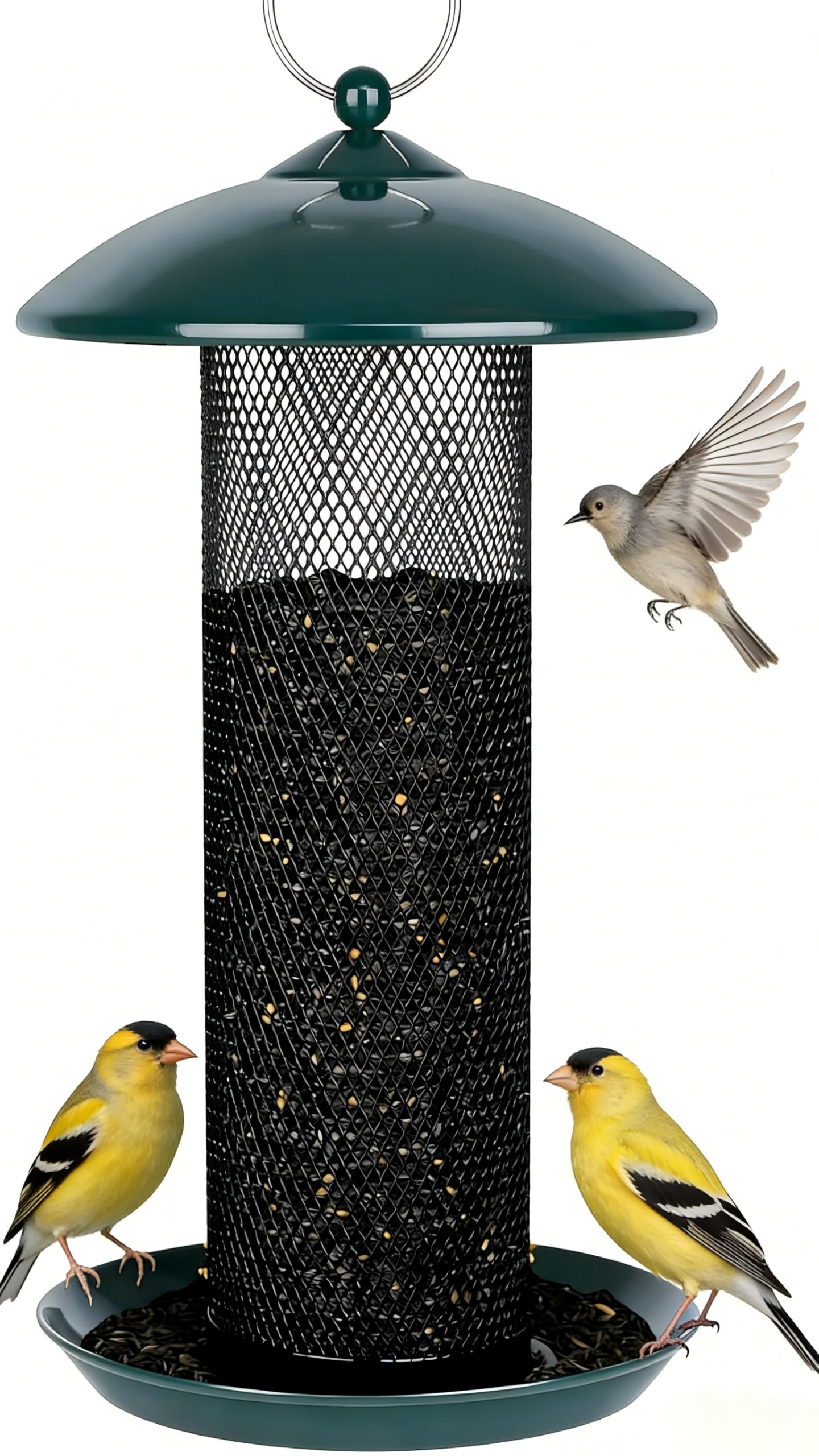
The Gtongoko hits the sweet spot between capacity and simplicity. At 2.5 pounds of Nyjer or thistle, it holds more than most mesh tubes in this category, and the all-metal construction — zero plastic — means squirrels gnaw on the same welded steel that holds the tray. The 360-degree mesh surface lets a dozen finches cling simultaneously without fighting for a perch.
The twist-off top and threaded base come apart by hand in about ten seconds. Drain holes in the 6-inch tray prevent water from sitting against the seed, and the overhanging lid provides solid rain coverage. Several owners report the feeder has stayed squirrel-free after months of hang time, though a few noted that the parts can separate if the base isn’t tightened fully.
Some isolated complaints about rust forming after four continuous months of outdoor exposure, which is typical for any painted metal feeder left unshielded from rain. A quick coat of food-grade spray wax on the lower third extends the finish. For the price and build quality, this is the most balanced all-metal finch feeder you can hang.
Why we love it
- Entirely metal construction resists squirrel damage.
- 2.5 lb capacity means fewer refills during peak feeding weeks.
- Tool-free twist-off design simplifies deep cleaning.
Good to know
- Parts may separate if base isn’t tightened securely by hand.
- Some units show surface rust after months of constant rain exposure.
2. Kingsyard Metal Finch Feeder for Thistle/Nyjer Seed
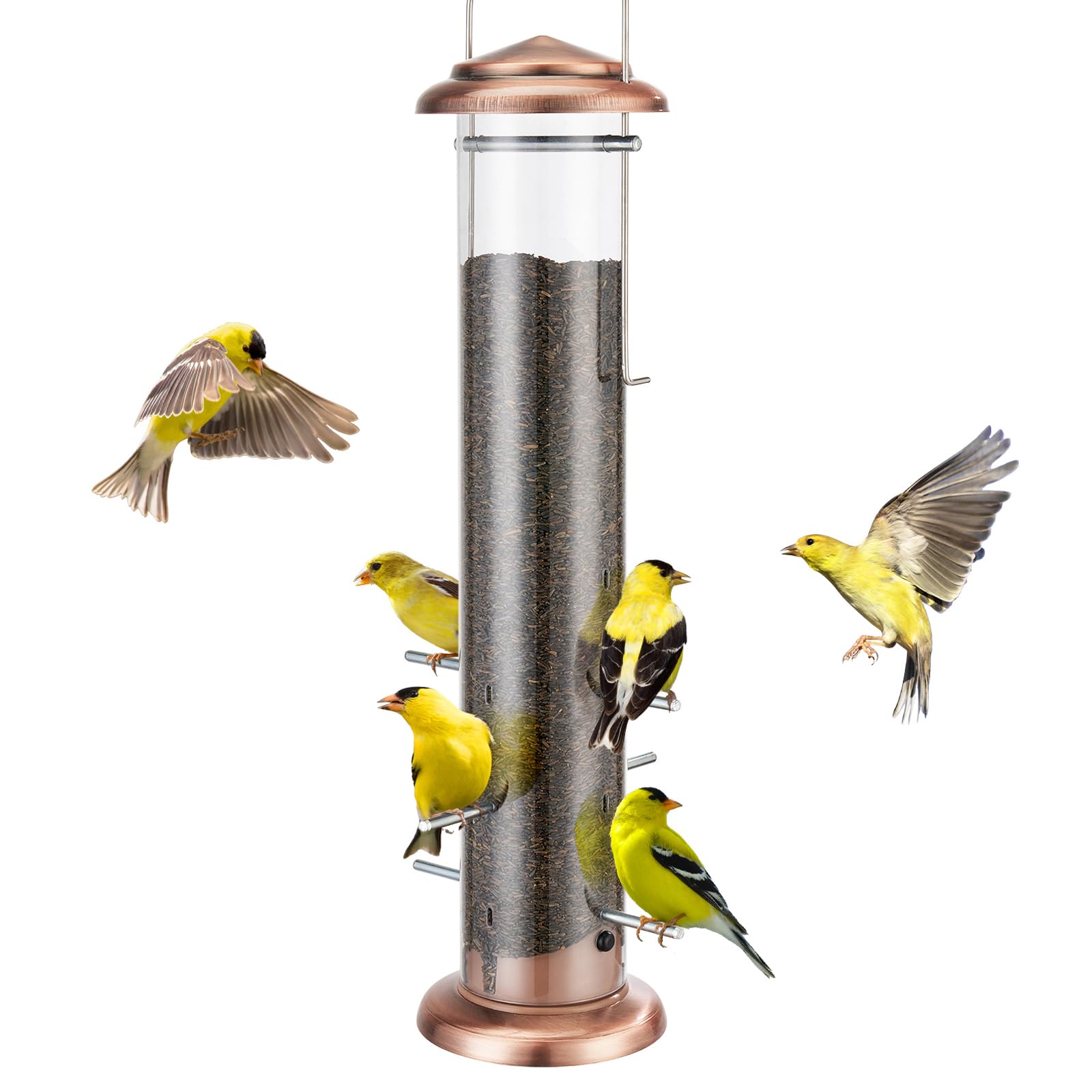
Kingsyard’s tube design focuses on keeping Nyjer dry. The narrow feeding ports are recessed enough to block splash rain, and the powder-coated metal lid and base seal against the clear seed tube without gaps. The six ports are spaced for a single finch each, which reduces crowding at the expense of total bird volume per minute.
The 1.5-inch perch length is purpose-built for small birds — larger birds like mourning doves can’t balance on them, so they don’t hang around. Owners consistently report that goldfinches and pine siskins take to this feeder within the first hour of hanging. The push-button base release is a genuine convenience for cleaning, although the clear tube can scratch if scrubbed with an abrasive sponge.
The main limitation is the 1-kilogram capacity, which is roughly 2.2 pounds. Heavy finch traffic means refilling every couple of days. The antique copper finish looks good against most yard aesthetics, but the powder coat can chip if the feeder is dropped during cleaning. For a compact, weather-sealed feeder that prioritizes dry seed over maximum volume, this is a smart choice.
Why we love it
- Recessed feeding ports block rain from reaching the seed chamber.
- Push-button base release makes cleaning fast and easy.
- Short perches naturally exclude larger bird species.
Good to know
- Clear seed tube can scratch if cleaned with rough pads.
- Capacity is lower than mesh tubes of similar size.
3. LONA Bird Feeders with 3 Separate Compartments
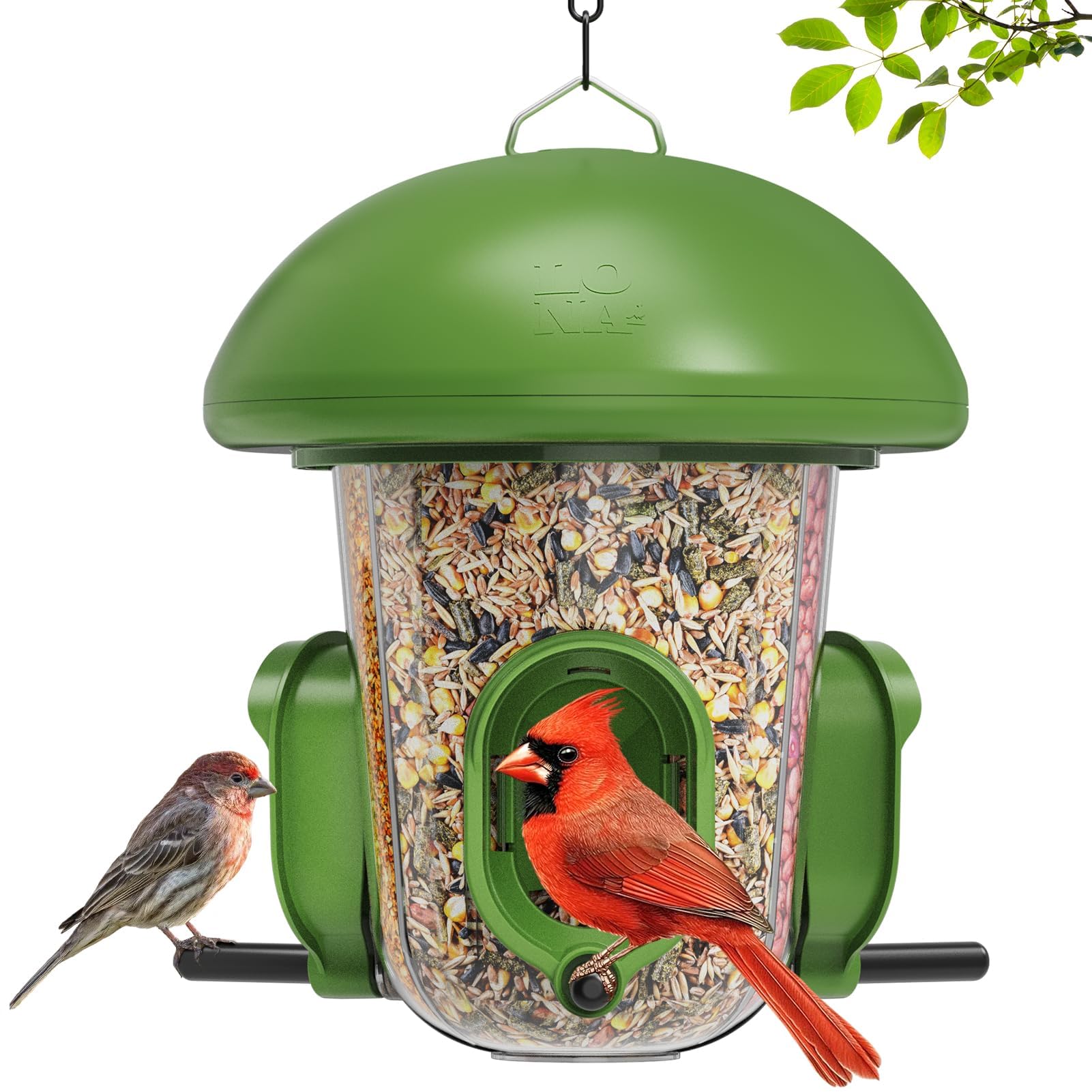
The LONA feeder approaches the finch problem differently by offering three separate seed compartments under a single dome. This is useful if you want to offer Nyjer, white millet, and sunflower chips side by side without mixing. Finches will gravitate to the Nyjer chamber, while cardinals and chickadees can eat from the other two slots without interfering.
The dome cover extends far enough to shield all three feeding ports from rain, and the drainage holes in each compartment prevent water from collecting. The metal perches are longer than typical finch-specific designs, which means larger birds can land and feed from the other compartments. Owners who want an exclusive finch-only station may find the perch length counterproductive.
The multiple hanging methods — chain, Velcro strap, or wall nails — are a real plus for tricky yard layouts. However, the feeder can separate from its top in strong wind if the compartments are fully loaded, as a few owners noted. The total capacity is about 27 ounces, which is lower than a dedicated 2-pound mesh tube. If you want to serve multiple seed types to a mixed flock, this design delivers.
Why we love it
- Three chambers keep different seed types separate and accessible.
- Dome cover provides excellent rain protection for all ports.
- Multiple hanging options work on poles, tree branches, and walls.
Good to know
- Longer perches allow larger birds to access the feeder.
- The feeder top can detach from the base in high winds.
4. iBorn Finch Feeders with 17cm Weatherproof Roof
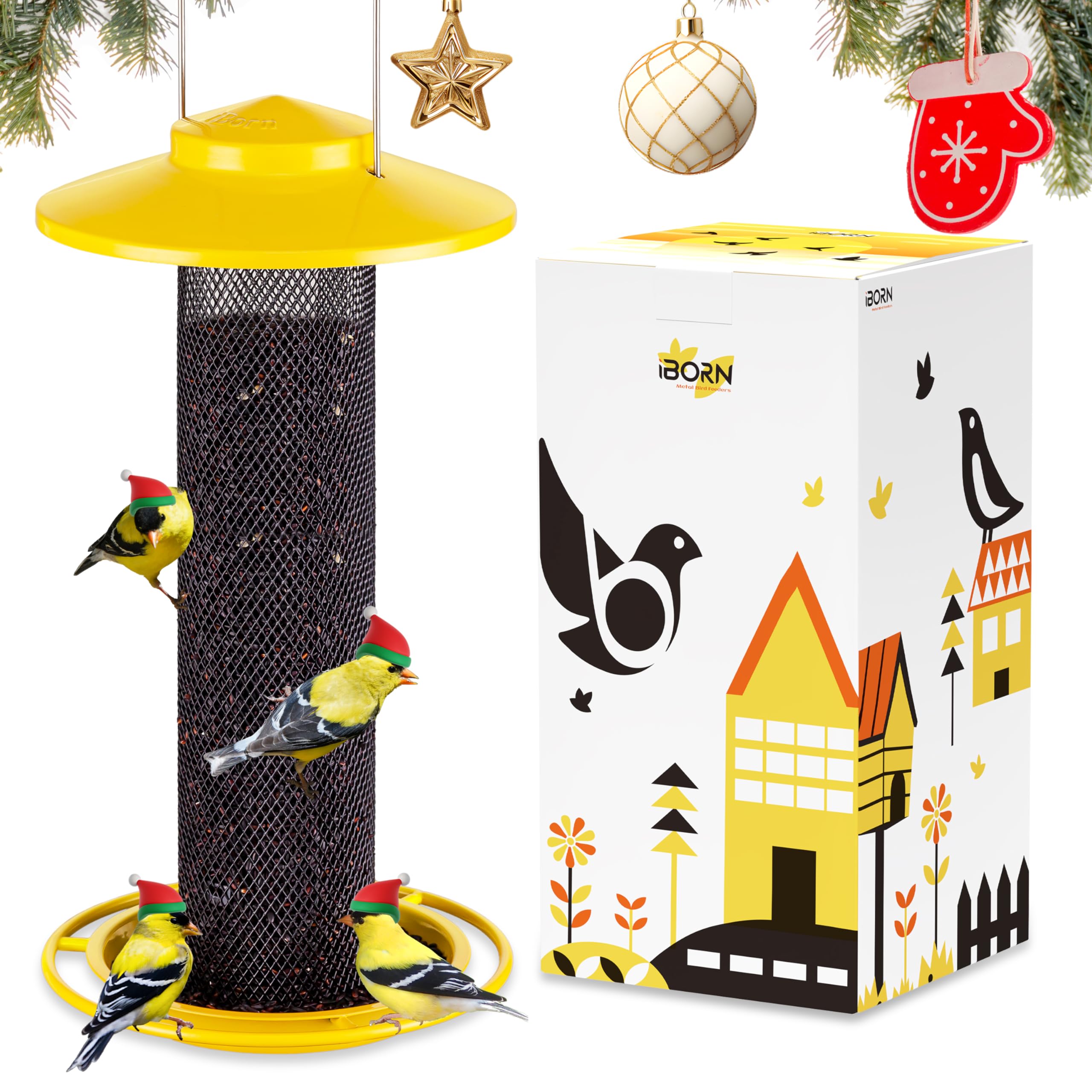
The iBorn feeder’s defining feature is its rigid metal hook closure and the 17-centimeter roof, which is about 22 percent larger than the standard 14-centimeter caps found on most mesh tubes. That extra overhang makes a real difference during slanting rain — the seed chamber stays dry when other feeders start puddling. The 0.6-centimeter fine mesh restricts entry to finch-sized birds and effectively keeps squirrels from reaching the seed.
The bottom ring tray locks in place with a wing nut, so the whole assembly stays tight even in gusty conditions. Owners report that the feeder swings less in wind than string-hung tubes, which helps nervous finches feed more confidently. The flip-top lid allows refilling without removing the feeder, a nice touch during cold winter mornings. Five-ounce fill pours are straightforward, though the Nyjer dust that collects during pouring is best handled by filling the feeder outside.
Some seed can sift through the fine mesh during the initial fill, but the bottom tray catches most of it. A few users noted minor seed waste when the feeder was shaken by birds hopping on the mesh. The bright yellow color does seem to attract goldfinches faster than green or copper. For a mesh tube that prioritizes stability and rain protection, this is a well-executed design.
Why we love it
- Larger 17cm roof keeps seed dry in slanted rain.
- Rigid metal hook eliminates swinging in wind.
- Flip-top lid allows refilling without taking down the feeder.
Good to know
- Fine mesh can lose a small amount of seed during initial fill.
- Nyjer dust is best handled by filling the feeder outdoors.
5. Kingsyard Metal Mesh Bird Feeder with Sliding Mesh
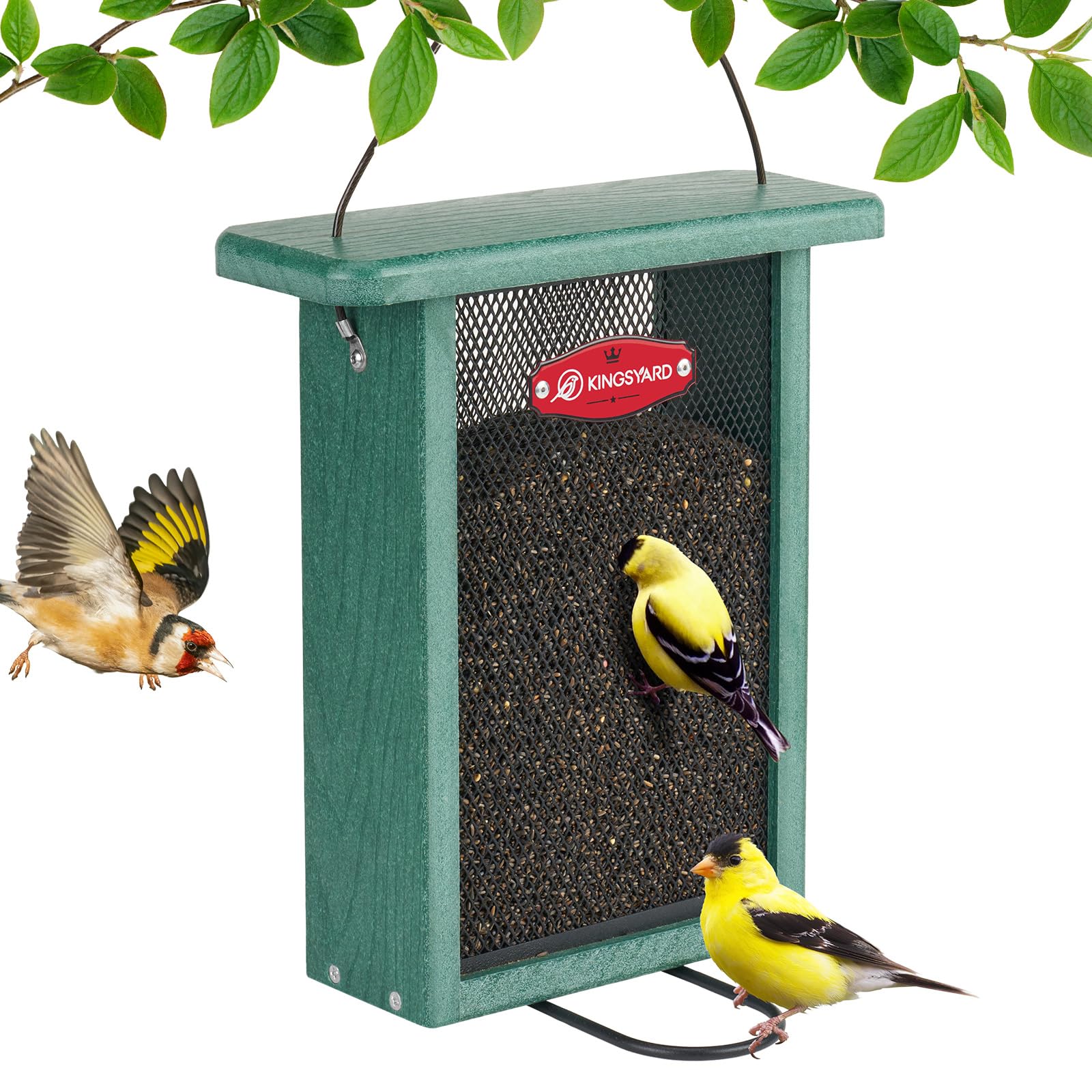
The Kingsyard metal mesh feeder uses sliding wire mesh panels that pull straight out for cleaning — a design that makes it one of the easiest finch feeders to maintain. The recycled plastic top and base hold up better against UV fading than standard polycarbonate, and the 3-pound capacity is the largest in this lineup. The U-shaped perch at the bottom can be hidden or extended, giving you flexibility depending on whether finches in your area prefer clinging or perching.
Owners consistently report that small birds — goldfinches, chickadees, titmice, and nuthatches — show an immediate preference for this feeder over standard tube designs. The mesh surface accommodates a whole flock feeding simultaneously, and the dual-side feeding doubles the available clinging area. The feeder comes preassembled, so there’s no hardware to lose.
The rotating bottom perch can be too loose for some birds, as a few owners noted that it spins when birds try to land. This is a minor annoyance rather than a dealbreaker. The recycled plastic feels slightly less premium than all-metal alternatives, but it never rusts and won’t dent if dropped. For anyone who prioritizes cleaning convenience and large capacity over absolute build heft, this is a genuinely useful feeder.
Why we love it
- Sliding mesh panels pull out for effortless cleaning.
- 3-pound capacity reduces refill frequency.
- Recycled plastic construction resists UV fading and never rusts.
Good to know
- Rotating bottom perch can feel loose for some birds.
- Recycled plastic has a slightly different feel than all-metal builds.
FAQ
What mesh size stops squirrels from reaching Nyjer seed?
Why do my finches ignore a brand new feeder?
How do I keep Nyjer seed from clumping inside the feeder?
Final Thoughts: The Verdict
For most gardeners, the feeders for finches winner is the Gtongoko because its all-metal construction, 2.5-pound capacity, and tool-free disassembly cover every priority at once. If you want a weather-sealed tube that keeps Nyjer bone dry, grab the Kingsyard Metal Finch Feeder. And for cleaning convenience and the largest seed capacity in the lineup, nothing beats the Kingsyard Metal Mesh Feeder with sliding panels.