
A planted tank that looks more like a chemistry lab than a slice of nature is a frustrating reality for many aquascapers. Balancing macronutrients, micronutrients, and trace elements while avoiding algae blooms often requires a cabinet full of separate bottles, precise pipetting, and constant water testing. The difference between a tank that thrives and one that stagnates usually comes down to one thing: choosing the right nutritional foundation that matches your light intensity, CO₂ injection, and plant selection.
I’m Mo Mahin — the founder and writer behind Furric. Over the years I’ve analyzed hundreds of aquatic fertilizer formulations, cross-referenced NPK ratios against real-world growth results, and studied thousands of verified owner experiences to understand what actually drives vibrant, algae-resistant plant growth in freshwater planted aquariums.
Whether you’re battling melting stems or chasing deeper reds on your Rotala, finding the right best fertilizer for planted tank is the single most impactful decision you can make for your underwater garden.
How To Choose The Best Fertilizer For Planted Tank
Selecting the right aquatic plant nutrition starts with understanding your tank’s specific demands. Low-tech setups with minimal lighting and no CO₂ injection have very different nutrient requirements than high-tech pressurized CO₂ systems with high light. The wrong choice can fuel algae or starve your plants.
Understand Macro vs. Micro Nutrient Needs
Macronutrients — nitrogen (N), phosphorus (P), and potassium (K) — drive stem elongation, leaf mass, and overall growth rates. Micronutrients like iron (Fe), magnesium (Mg), manganese (Mn), and zinc (Zn) influence coloration, photosynthesis efficiency, and enzyme function. If you run a high-tech CO₂ system, your plants will deplete both macro and micro nutrients rapidly, making an all-in-one formula or separate dosing essential.
Match Delivery Format to Plant Types
Root feeders like Cryptocoryne, swords, and Vallisneria absorb most of their nutrition through the substrate. Root tabs provide a slow-release depot directly in the root zone. Stem plants and floaters, on the other hand, siphon nutrients from the water column and benefit most from liquid fertilizers. A combined strategy — root tabs for heavy root-feeders plus liquid dosing for column-feeders — often delivers the best results in a densely planted tank.
Check Copper and Heavy Metal Content for Invertebrates
If your tank houses shrimp, snails, or other sensitive invertebrates, the copper content in many comprehensive fertilizers can be a dealbreaker. Even trace amounts of copper can accumulate over time and trigger molting issues or mortality. Look for formulations explicitly labeled as shrimp-safe, or supplement with separate macronutrients and a low-copper trace blend.
Quick Comparison
On smaller screens, swipe sideways to see the full table.
| Model | Category | Best For | Key Spec | Amazon |
|---|---|---|---|---|
| NilocG Aquatics Thrive+ | All-in-One Liquid | High-tech & low-tech tanks | NPK + Fe, 2500 gallon per bottle | Amazon |
| 2HR Aquarist APT 3 | All-in-One Liquid | High-tech pressurized CO₂ | Complete NPK + Micro, 600ml | Amazon |
| Seachem Flourish (2L) | Trace Supplement | Low-tech & micro dosing | Micro & trace elements, 2L | Amazon |
| Seachem Flourish Trace Elements | Trace Supplement | Frequent micro dosing | Trace minerals only, 500ml | Amazon |
| Planted Aquarium Concepts Root Tabs | Root Tabs | Heavy root feeders | NPK + Fe + trace, 40 count | Amazon |
In‑Depth Reviews
1. NilocG Aquatics Thrive+ All-in-One
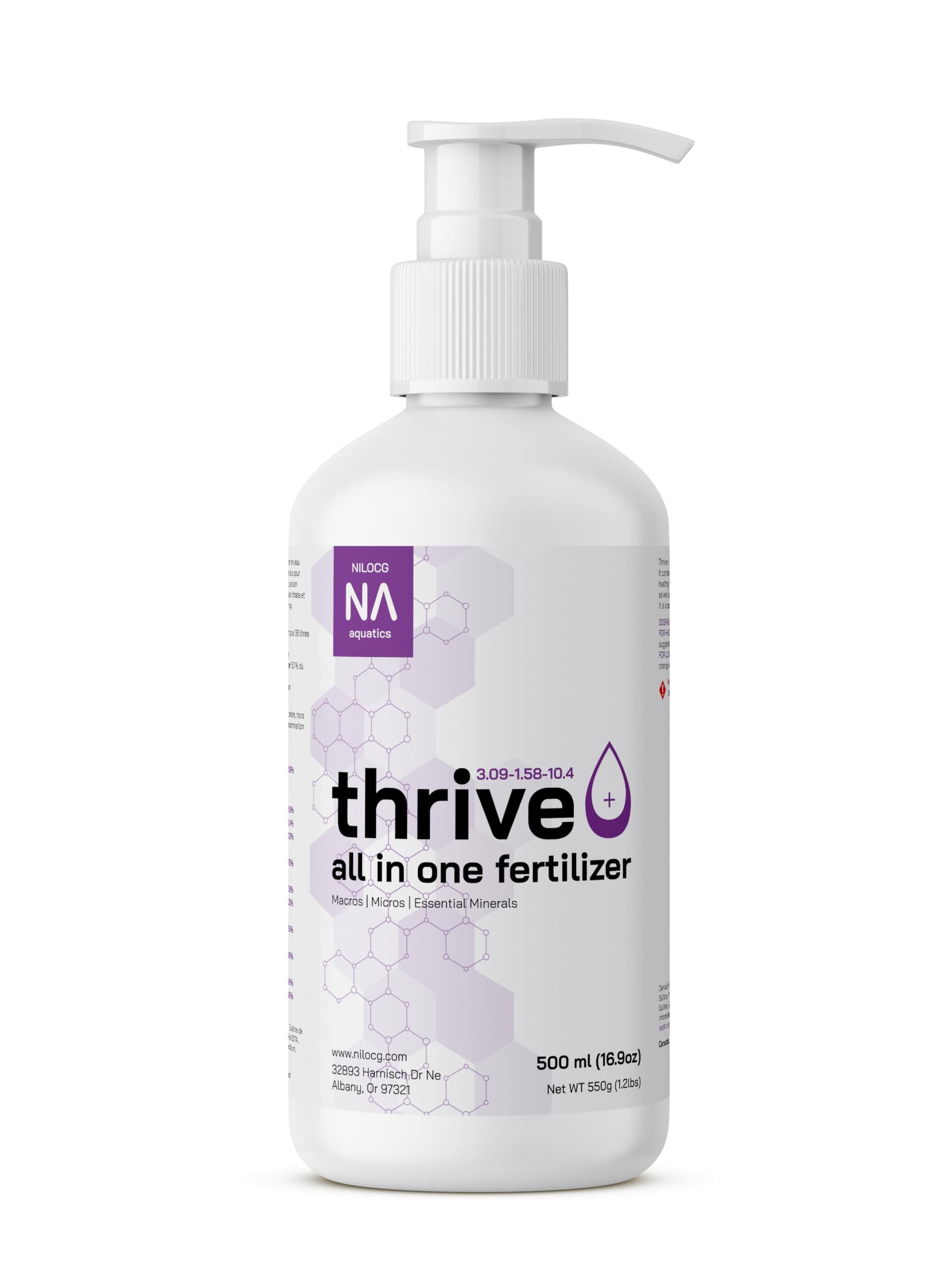
Thrive+ replaces up to five separate Seachem bottles by delivering a complete macro-and-micro profile in a single pump. The mixing ratio shows NO₃ at 7.5ppm, K at 5ppm, PO₄ at 1.3ppm, and Fe at 0.4ppm per dose — a balanced blend that works for both low-tech tanks and high-tech CO₂ setups. Owners report lush Java fern growth and explosive root development within weeks, with many noting it simplified their entire dosing routine.
The 500ml bottle treats up to 2,500 gallons, making it one of the most concentrated all-in-one options available. The dosing pump dispenses 1ml per pump, eliminating the need for graduated syringes. Some users noted that over-dosing can trigger algae blooms, particularly in low-light tanks where nutrient uptake is slower, so starting at half the recommended dose is wise for leaner setups.
A small but notable minority of reviews reported fish mortality, likely linked to excessive dosing or sensitive species. As with any concentrated aquatic fertilizer, gradual introduction and careful monitoring of water parameters is essential. For the vast majority of planted-tank keepers, however, Thrive+ delivers visible results with fewer bottles and less guesswork.
Why we love it
- Truly all-in-one — no need for separate macro and micro bottles
- Extremely concentrated; 500ml treats 2,500 gallons
- Pump bottle makes dosing clean, consistent, and fast
Good to know
- Can trigger algae if dosed too aggressively in low-tech tanks
- A small number of users reported fish sensitivity at full strength
2. 2HR Aquarist APT 3 All-in-One Fertilizer (600ml)

APT 3 is formulated specifically for high-tech pressurized CO₂ tanks where plant metabolism is running at full throttle. The blend delivers comprehensive NPK plus iron, magnesium, and a full suite of trace minerals designed to support demanding species, including Rotala and Ludwigia that need elevated nutrient levels to develop deep red pigmentation. Users switching from standard all-in-ones consistently report denser stems, larger leaves, and noticeably richer coloration within weeks of switching.
The dosage recommendation is a lean 1ml per 10 gallons, 2-3 times per week, which makes the 600ml bottle last for months in most setups. The pump system is precise and mess-free, with no measuring cups or spoons required. Multiple reviewers noted that they experienced less algae with APT 3 compared to previous fertilizers, likely because the balanced formulation matches typical high-tech consumption rates without leaving excess nutrients in the water column.
It sits at a premium tier in terms of upfront cost, but the concentration and results justify the investment for serious aquascapers running CO₂. The formula is safe for fish and shrimp when dosed correctly. If you’re running a high-light, CO₂-injected tank and want to push your plants to their genetic potential, this is the most effective single-bottle solution available.
Why we love it
- Optimized for high-tech CO₂ tanks; drives intense coloration
- Lean dosing ratio reduces waste and algae risk
- Clean pump system — no mess, no syringes needed
Good to know
- Premium price per bottle compared to entry-level options
- Less suitable for low-tech or low-light setups that don’t consume macros quickly
3. Seachem Flourish Freshwater Plant Supplement (2L)

Seachem’s Flourish is the industry standard for freshwater plant micronutrition, delivering a concentrated blend of iron, potassium, calcium, magnesium, and trace elements. It is not a complete fertilizer — it lacks the nitrogen and phosphorus that high-tech setups require in large volumes — but it is an indispensable foundation for any planted tank that already has adequate macro levels from fish waste or other sources. The dosage is incredibly low: a 20-gallon tank needs only 1.6ml per week, meaning the 2-liter bottle lasts years.
Long-term users consistently praise its ability to transform failing plant setups into healthy, growing jungles. The solution works best when paired with an iron-rich substrate like CaribSea Eco-Complete and a comprehensive water conditioner during changes. One common recommendation is to dose Flourish 24 hours after a water change to avoid the conditioner binding with the micronutrients.
An important caveat: several shrimp and snail keepers reported that Flourish killed their invertebrates, particularly trumpet snails. The copper content, while low, can accumulate to toxic levels in tanks without regular water changes. For pure plant growth and general community tanks without sensitive inverts, however, Flourish remains the most trusted trace supplement on the market.
Why we love it
- Incredibly low dose; 2L lasts years in most tanks
- Comprehensive micro and trace element profile
- Backed by over a decade of successful use in the hobby
Good to know
- Not a complete fertilizer — lacks adequate N and P for high-tech
- Copper content can harm snails and shrimp over time
4. Seachem Flourish Trace Elements (500ml)

Flourish Trace Elements is a dedicated trace-only supplement designed specifically for aquarists who already dose macronutrients separately or rely on fish waste for N and P. It provides a concentrated blend of essential trace minerals — including iron, manganese, zinc, and copper — without adding any macros that could upset a carefully balanced dosing regimen. Users running a rotation of separate ferts (like Flourish Complete and Trace on alternating days) report seeing more pronounced root growth and red coloration in stem plants within a week.
The product is particularly valuable for hobbyists using reverse osmosis or heavily filtered water, which strips out the natural trace elements that tap water provides. The half-dose every-other-week schedule recommended by experienced users keeps copper levels safe for shrimp breeders, though a copper test kit is advised for sensitive enclosures. Several reviewers noted that initial combined use with other Seachem products caused temporary cloudy water, which resolved with a 75% water change.
At a 500ml size, this is a targeted tool rather than a complete solution. It works best as part of a modular dosing strategy where you control each nutrient group independently. If your tank already has robust macros and you’re chasing that last 10% of health and coloration, Trace Elements fills the gap without overcomplicating your routine.
Why we love it
- Provides essential trace minerals without adding macros
- Ideal for RO water users who strip natural trace elements
- Can be dosed more frequently than broad-spectrum blends
Good to know
- Not a standalone fertilizer — requires separate macro source
- Contains copper; requires careful dosing in shrimp tanks
5. Planted Aquarium Concepts Root Fertilizer Tabs (40 Count)

These root tabs deliver a slow-release blend of NPK plus iron, magnesium, manganese, zinc, molybdenum, boron, cobalt, and nickel directly to the substrate — exactly where heavy root-feeders like Cryptocoryne, swords, and Vallisneria absorb nutrients most efficiently. In a 55-gallon tank with mixed plant species, users reported explosive growth over two months, with plants becoming noticeably fuller and developing deeper coloration after insertion.
The tabs sink well and stay put after placement, unlike some competitors that float up and cloud the water. The 40-count package gives you enough tabs for several substrate refreshes in a moderate-sized tank. Directions are straightforward: push a tab into the gravel near the root zone of each heavy feeder and let the slow-release mechanism do the work.
One consistent observation across reviews is that the increase in phosphate from these tabs can trigger mild brown algae outbreaks on slow-growing plants like Java fern and Anubias. Adding algae eaters such as nerite snails or otocinclus catfish is an effective countermeasure. For aquarists wanting a simple, effective way to boost root-feeding plants without daily liquid dosing, these tabs are a proven and budget-friendly solution.
Why we love it
- Comprehensive nutrient profile including chelated iron and trace minerals
- Tabs sink quickly and don’t disintegrate on placement
- Visible results in stem and root growth within weeks
Good to know
- Can trigger brown algae from phosphate release
- Best suited for root-feeders; less impact on column feeders
FAQ
Can I use all-in-one fertilizer in a low-tech tank without CO₂?
How often should I replace root tabs in a planted aquarium?
Is a trace-only supplement like Seachem Flourish Trace enough for my plants?
Final Thoughts: The Verdict
For most gardeners, the best fertilizer for planted tank winner is the NilocG Aquatics Thrive+ because it delivers a complete macro-and-micro profile in one bottle, works across both low-tech and high-tech systems, and offers exceptional concentration value. If your priority is pushing high-tech CO₂ plants to maximum color and density, grab the 2HR Aquarist APT 3. And for keeping heavy root-feeders like Cryptocoryne and swords thriving with minimal effort, the Planted Aquarium Concepts Root Tabs are the most reliable slow-release solution available.