
Choosing the wrong diet for your aquarium isn’t just a waste of money — it directly impacts water quality, fish coloration, and long-term health. Freshwater fish have wildly different digestive systems and feeding behaviors, from surface grazers to bottom-sniffing carnivores, and the perfect food matches both the nutritional profile and the sinking or floating action to your specific species.
I’m Mo Mahin — the founder and writer behind Furric. I’ve spent years dissecting ingredient panels, comparing guaranteed analyses, and cross-referencing thousands of owner reports to isolate which formulas actually deliver measurable results in freshwater tanks without ruining your water parameters.
Whether you keep finicky cichlids, growing oscars, or a community of omnivores, this guide breaks down the top picks so you can confidently grab the best fish food for freshwater fish that fits your tank and your routine.
How To Choose The Best Fish Food For Freshwater Fish
Your tank’s inhabitants dictate the food form, protein level, and ingredient quality you need. A single all-purpose flake rarely satisfies both a surface-feeding angelfish and a bottom-scavenging pleco. Focus on these three factors to narrow your search.
Protein Content and Ingredient Sourcing
Freshwater carnivores like cichlids and oscars thrive on crude protein over 35%, while community omnivores do well with 30–40%. Look for whole seafoods such as salmon, shrimp, or herring as the first ingredient — avoid meals, hydrolysates, or unnamed digests that provide lower biological value. Spirulina and kelp add plant-based nutrition for herbivorous species.
Floatation Rate and Feeding Behavior
Floating pellets let you monitor exactly how much your fish eat and keep surface feeders like cichlids visible. Slow-sinking pellets suit mid-water column feeders such as tetras and barbs. Rapid-sinking pellets or tablets are essential for bottom-dwellers like catfish and loaches. Choosing the wrong sink rate leads to uneaten food decomposing on the substrate and spiking ammonia.
Water Clarity and Waste Management
Foods with high insoluble starch content break apart quickly, clouding the water and increasing fish waste output. Premium formulas use whole ingredients that hold their shape longer, reducing the pollutant load. A guaranteed analysis showing max crude fiber below 2% and low ash content often signals a cleaner eating experience for your tank.
Quick Comparison
On smaller screens, swipe sideways to see the full table.
| Model | Category | Best For | Key Spec | Amazon |
|---|---|---|---|---|
| Omega One Cichlid Flakes | Flake | Color enhancement & low waste | 34.76% Crude Protein | Amazon |
| Ocean Nutrition Formula Two Pellets | Pellet | Herbivores & omnivores | 40% Crude Protein | Amazon |
| Ocean Nutrition Gourmet Pellets | Pellet | Soft-moist alternative to flakes | 41.1% Crude Protein | Amazon |
| HIKARI Cichlid Gold Floating Pellets (3 Pack) | Pellet | Color & growth for medium cichlids | Floating pellet design | Amazon |
| Hikari Tropical Massivore Delite | Pellet | Large carnivorous fish | X-Large sinking pellet | Amazon |
In‑Depth Reviews
1. Omega One Cichlid Flakes, 5.3 oz

Omega One leads with a raw, whole-salmon ingredient profile and zero meals or hydrolysates — a rare standard in the flake segment. The guaranteed analysis shows 34.76% crude protein with only 1.11% crude fiber, meaning your cichlids get dense nutrition from real seafood rather than filler starches.
Owners consistently report no tank clouding thanks to the naturally insoluble flake structure and minimal starch content, which directly reduces fish waste accumulation. The formula also packs natural beta carotenes from salmon to enhance reds and oranges without artificial colorants.
Some users note the flakes break quite small, which can be a double-edged sword: tiny pieces work well for juveniles but disappear quickly in a heavy surface current before larger cichlids get a bite. Still, the combination of clean ingredients, proven water clarity, and reliable color response makes this a top-tier daily option.
Why we love it
- Whole seafood first ingredient with no pre-processed proteins
- Insoluble flakes keep water crystal clear
- Natural beta carotenes improve cichlid coloration
Good to know
- Flake size is very small — might frustrate large cichlids
- Designed specifically for cichlids; limited use for community omnivores
2. HIKARI (3 Pack) 8.8-Ounce Cichlid Gold Floating Pellets, Medium
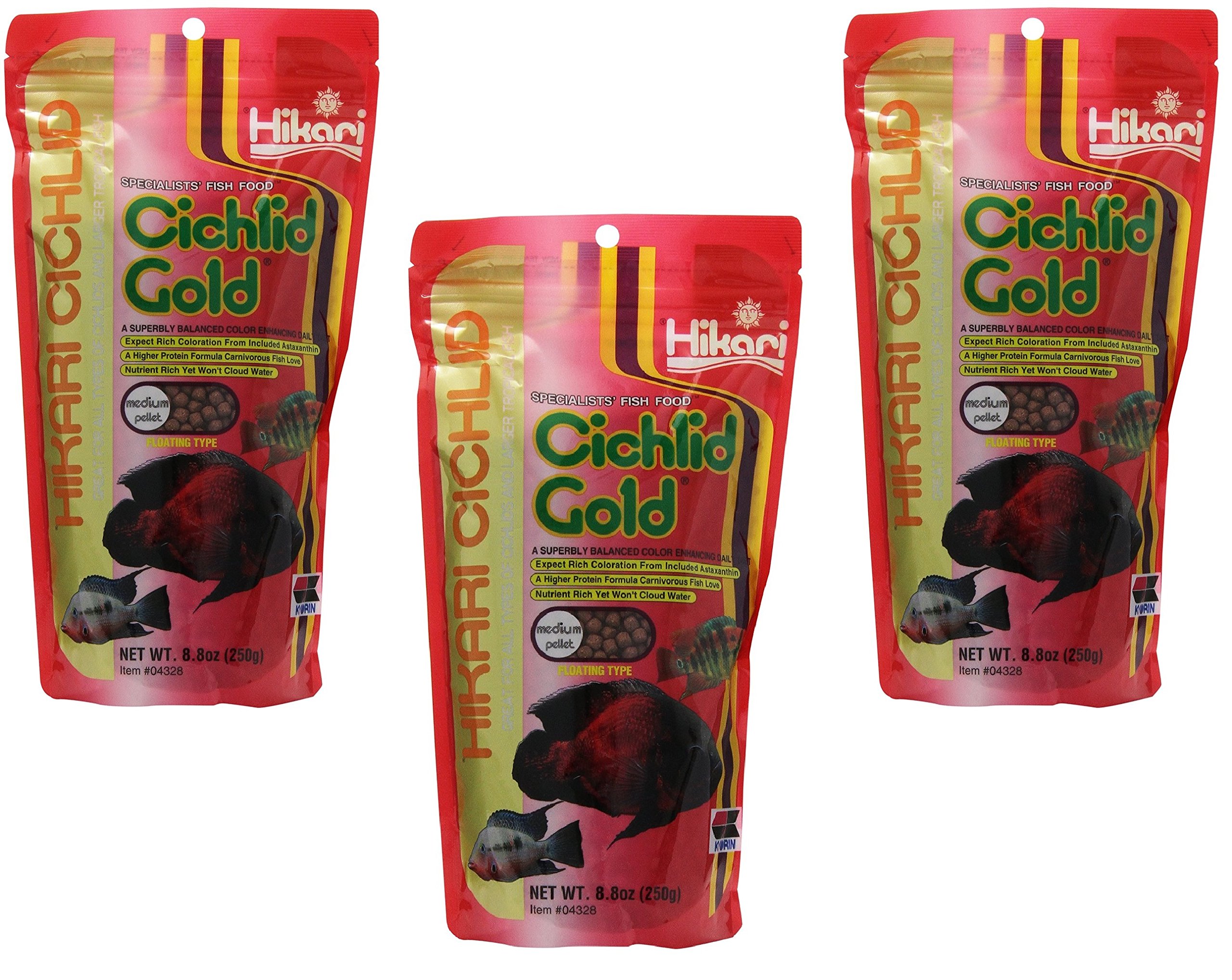
Hikari’s Cichlid Gold uses floating pellets that stay at the surface, letting you see exactly how much your fish consume and preventing uneaten food from settling into the gravel. The medium pellet size works well for adult African cichlids and similar medium-bodied species, with a phosphate-limited formula designed to avoid water clouding.
The recipe includes stabilized vitamin C and beta carotene, and owners overwhelmingly report faster growth and more intense red-orange color expression within weeks of switching. The triple-pack offers strong long-term value for aquarists with multiple tanks or large cichlid populations.
A few owners mention that the medium pellet may be too large for juvenile cichlids, requiring some presoaking or crushing. The fishy odor is also notably strong, but that reflects the protein density rather than a flaw. If you value feeding observation and predictable water chemistry, this is the benchmark floating pellet.
Why we love it
- Floating format allows easy feed monitoring and reduces waste
- Stabilized vitamin C and beta carotene boost color and immunity
- Triple-pack delivers exceptional value per ounce
Good to know
- Medium pellets are too large for small cichlid fry
- Potent fish odor may be off-putting during storage
3. Ocean Nutrition Gourmet Tropical Fish Food, 7 oz, Medium Pellet

Ocean Nutrition’s gourmet pellet stands out for its soft-moist texture — a direct alternative to hard flakes that many picky eaters ignore. The slow-sinking medium pellet targets mid-to-bottom feeders like angelfish, clown loaches, and catfish, with 41.1% crude protein supporting both carnivores and omnivores.
The oxygen-free pouch packaging preserves freshness for 3–4 months after opening, which is far longer than typical resealable bags. Owners report that fish “go crazy” for the pellets, and the non-clouding formula keeps the water column clean even after multiple feedings per day.
Some keepers note that the medium pellet sinks relatively fast, which can leave surface feeders out of the meal. If your tank is populated entirely by top-dwellers, you may want to presoak or crush the pellets to delay sinking. For mixed tanks with a bottom-feeding focus, this is an excellent choice.
Why we love it
- Soft-moist texture appeals to fussy fish and improves digestion
- Oxygen-free pouch maintains freshness for months
- 41.1% protein with high-quality ingredients from Thailand
Good to know
- Medium pellets sink quickly — not ideal for surface feeders
- May need presoaking for top-dwelling species
4. Ocean Nutrition Formula Two Pellets, 7 oz, Small Pellets

Formula Two is built specifically for herbivorous and omnivorous fish, with spirulina, dried kelp, and soybean meal as core ingredients — no artificial colors or hormones. The small pellet size works well for tangs, barbs, tetras, and smaller cichlids, and the slow-sinking action lets mid-column fish intercept the food before it hits the substrate.
The 40% protein content is impressive for a plant-based formula, and the soft-moist texture promotes easy digestion. Owners note that the pellets retain their shape in water without disintegrating, which keeps the tank clear and reduces filter maintenance.
Several users mention that the pellets sink faster than expected, which can be a problem if your fish are accustomed to floating flakes. The small size also limits larger species from getting a full meal. For planted tanks with a mix of herbivores and omnivores, though, this is a strong daily staple at a reasonable price.
Why we love it
- Spirulina and kelp provide targeted nutrition for herbivores
- Soft pellets aid digestion and don’t cloud the water
- 40% protein from plant-based sources without artificial additives
Good to know
- Pellets sink rapidly — less suitable for surface feeders
- Small size may be inadequate for large cichlids or oscars
5. Hikari Tropical Massivore Delite, 13.4 oz

Massivore Delite targets the largest freshwater predators — oscars, red tail catfish, arowanas, and bichirs — with an x-large porous pellet that softens rapidly upon contact with water. The size and texture appeal to fish that refuse smaller foods, and the fast-sinking action delivers nutrition directly to bottom-oriented carnivores without surface competition.
The formula is designed to replace live feeder fish by providing high-protein nutrition without the parasite or bacteria risk. Owners of picky fish like endlicheri bichirs and red tail catfish report immediate feeding response, and the included carotenoids help maintain natural coloration even in UV-deficient aquarium lighting.
The primary limitation is size — this pellet is genuinely large and is completely unsuited for any fish with a mouth smaller than a golf ball. Some keepers also note that the bag is resealable but not as airtight as an oxygen-free pouch, so transferring to a sealed container extends freshness.
Why we love it
- X-large porous pellet softens quickly and satisfies big carnivores
- Eliminates disease risk associated with live feeder fish
- Carotenoids enhance natural coloration in large predators
Good to know
- Only suitable for large-mouthed fish — useless for small species
- Bag resealable but not vacuum-sealed; transfer for long-term storage
FAQ
How often should I feed freshwater fish each day?
Are floating pellets better than sinking pellets for cichlids?
Can I mix different brands of fish food in the same feeding schedule?
Final Thoughts: The Verdict
For most aquarists, the best fish food for freshwater fish winner is the Omega One Cichlid Flakes because it combines whole seafood ingredients, low waste output, and reliable color enhancement in a format that works for a wide range of cichlid keepers. If you want a floating pellet that lets you watch exactly what your cichlids eat, grab the HIKARI Cichlid Gold (3 Pack). And for large carnivorous fish that need a high-protein sinking pellet, nothing beats the Hikari Tropical Massivore Delite.