
An inconsistent water temperature is one of the fastest ways to stress your aquarium inhabitants, leading to disease and shortened lifespans. A reliable heater is not an accessory; it is the core life-support system for your tropical fish, shrimp, and planted tanks. Choosing the wrong one means battling constant fluctuations or dealing with a catastrophic failure that can wipe out your entire ecosystem.
I’m Mo Mahin — the founder and writer behind Furric. I’ve spent years analyzing market trends, comparing thermal performance specifications, and studying aggregated owner feedback from thousands of hobbyists to separate genuinely effective fish tank heaters from those that cause more problems than they solve.
The right heater delivers stable, predictable warmth regardless of room temperature shifts. That is why identifying the best fish tank heaters involves more than wattage — it requires evaluating safety cutoffs, calibration accuracy, and material durability for the specific demands of your aquatic setup.
How To Choose The Best Fish Tank Heaters
Selecting a heater for your aquarium is a decision that directly impacts the health of every fish and plant inside it. Instead of guessing, you need to match the heater’s output, control system, and build to your specific tank volume, ambient climate, and livestock sensitivity.
Watts Per Gallon — The Starting Point
The standard rule is 5 watts of heating power per gallon of water. A 20-gallon tank needs roughly 100W, while a 55-gallon tank needs 250W. This rule assumes the room temperature is roughly 10°F to 15°F below your target water temp. If your tank sits in a cold basement, near a drafty window, or you keep discus at 86°F, you should push the ratio higher — closer to 7 or 8 watts per gallon. Oversizing slightly gives your heater an easier job maintaining a stable temp, but never use a heater rated more than 10W per gallon in a small tank, as the rapid on/off cycles can cause temperature swings and stress fry or shrimp.
Heating Element Material: Glass, Quartz, PTC, or Metal
Glass and quartz heaters are the most common. Quartz resists thermal shock better and heats up faster, but both can shatter on impact. PTC (Positive Temperature Coefficient) ceramic heaters regulate their own temperature — they draw less power as they get hotter, making them safer and more energy efficient, though they are typically bulkier. Metal heaters (usually titanium or stainless steel) are nearly unbreakable and ideal for large tanks or aggressive fish like cichlids, but they respond more slowly to temperature changes.
Internal vs. External Temperature Control
Heaters with the thermostat built into the glass tube are compact and cheap, but they can be inaccurate because they measure the micro-climate right next to the hot element. Heaters with a separate external controller or a probe sit outside the water or at a distance from the heating element, reading the true tank temperature. For planted tanks or sensitive species that need a precise range (within 0.5°F), an external controller is a significant upgrade. For standard community tanks, a well-regarded brand with a built-in thermostat is sufficient.
Safety Features — Not Optional
An auto shut-off when the heater is exposed to air is critical. A glass heater that is accidentally left on during a water change can explode. A thermal cutoff prevents overheating if the internal thermostat fails. A shatterproof or impact-resistant casing protects fish and your hands. If you run a tank with sensitive livestock, pairing any heater with an independent temperature controller (like the Inkbird ITC-308S) provides a redundant safety net that disconnects power if the water goes too hot or too cold.
Quick Comparison
On smaller screens, swipe sideways to see the full table.
| Model | Category | Best For | Key Spec | Amazon |
|---|---|---|---|---|
| HITOP 200W PTC Heater | Mid-Range | Large community & turtle tanks | PTC ceramic element, digital controller | Amazon |
| HiTauing 200W | Mid-Range | Reliable heater with safety cutoffs | Quartz glass, auto-off when exposed | Amazon |
| EHEIM Jager 125W | Premium | Hobbyists demanding pinpoint accuracy | TruTemp dial, shatterproof glass | Amazon |
| Inkbird ITC-308S Controller | Premium | Backup safety for any heater system | Dual stage heating/cooling, 1200W load | Amazon |
| Marineland Precision 250W | Budget-Friendly | Large tanks on a straightforward budget | Mica core mesh element, sliding scale | Amazon |
In‑Depth Reviews
1. HITOP 200W Aquarium PTC Heater with Controller

The HITOP 200W uses a PTC ceramic heating element rather than traditional glass or quartz. This technology self-regulates power draw as the temperature nears the set point, reducing the risk of thermal overshoot and providing consistent warmth for tanks between 25 and 60 gallons. The external digital controller shows both set and current temperatures with a reported accuracy within 1°F based on hobbyist measurements using multiple thermometers.
Hobbyists with over a year of use report the non-glass design survives accidental bumps and aggressive fish that would shatter a standard tube heater. The removable protective cover is a practical touch — it can be cleaned separately to remove biofilm and calcium buildup that would otherwise insulate the heating element and reduce efficiency. Five suction cups and a 5.6-foot power cord give flexibility in placement without being forced to mount it near the return pump.
The biggest risk of a PTC heater is that if the fan or water flow across it is inadequate, it can still overheat locally. The HITOP mitigates this with a wide guard that encourages passive convection. One verified user reported a unit that failed to keep temperature after a few days, falling 5°F below the set point. Because the design uses a metal bar and cage rather than thin glass, the heater is far less likely to fail catastrophically, but any heater can be defective. The 12-month warranty offers a practical safety net for the price.
Why we love it
- PTC element self-regulates, reducing temp overshoot
- Removable protective cover simplifies cleaning
- Accurate digital controller with Celsius/Fahrenheit switch
- Durable metal bar design resists breakage
Good to know
- Occasional unit reliability issues reported
- Larger physical size than glass heaters
2. HiTauing 200W Submersible Quartz Heater

The HiTauing 200W offers a strong safety-first feature set at a mid-range price point. Its intelligent water sensor automatically stops heating when the unit is fully exposed to air — a critical safety for anyone who performs water changes with the heater still in the tank. The quartz glass is rated as explosion-proof, and the black ABS outer shell protects fish from direct contact with the hot glass surface.
Multiple hobbyists report that the heater holds temperature within 0.5°F of the set point, and that it heats a 30 to 40 gallon tank to the target temperature within 30 minutes after a water change. The external digital controller uses a single button to set temperature — users must cycle through every degree to increase or decrease, which one reviewer noted required approximately 40 button presses to drop the set point by 1°F. This is a minor inconvenience for the accuracy it delivers.
The nickel-chromium heating wire embedded in silicon carbide provides rapid thermal transfer, but the unit’s reliance on a quartz tube means it remains vulnerable to cracking if dropped or struck with a rock during aquascaping adjustments. Owners of large cichlid tanks may prefer a fully metal or PTC heater. The 1-year warranty covers defects, and the majority of long-term reviews indicate consistent operation past the 6-month mark.
Why we love it
- Auto shut-off when exposed to air prevents burn-out
- Accurate digital display within 0.5°F of set point
- Explosion-proof quartz and ABS shell for fish safety
- Rapid heat recovery after water changes
Good to know
- Single-button temp setting requires cycling through all degrees
- Quartz glass can still crack from impact
3. EHEIM Jager Aquarium Thermostat Heater 125W

EHEIM’s Jager series has been a staple in the aquarium trade for decades. The 125W model is designed for tanks up to roughly 40 gallons and uses a TruTemp calibration dial that allows you to physically recalibrate the internal thermostat if it drifts over time. The glass tube is marketed as shock and shatter resistant, and hobbyists report it surviving direct blows from plecos and rock slides without cracking.
Long-term users report temperature stability within 0.125°F of the set point — an exceptional figure that is rare among all-in-one heaters. The unit must be mounted vertically to avoid floating and to ensure accurate convection. Because of its 12-inch length for the 125W version, it can be tight in shallow tanks. Owners of 10-gallon aquariums often have to mount it diagonally, which can interfere with the calibration ring’s accessibility.
There is a known drawback: the calibration ring requires trial and error. Users must turn the blue dial inside the tank or remove the heater to adjust, which disrupts the temperature. Additionally, a small number of units have failed within the first few months with no support contact available, suggesting manufacturing inconsistency. The unit also requires adequate water circulation around it — if placed in a dead zone, the local temperature reading can be inaccurate, causing the heater to overwork or underwork.
Why we love it
- TruTemp calibration dial allows fine-tuning over time
- Sub-0.2°F temperature stability under good flow
- Durable glass survives fish impacts
- Auto-off when water level drops for safety
Good to know
- Must be mounted vertically, limiting placement in shallow tanks
- Calibration is cumbersome and requires removal from water
- Inconsistent reliability across some units
4. Inkbird ITC-308S Dual Stage Temperature Controller

The Inkbird ITC-308S is not a heater itself — it is an external controller that sits between your wall outlet and your heater (or chiller). It adds a redundant temperature probe that cuts power to the heating device if the water exceeds a set maximum, and turns on a cooling device if the water gets too cold. This dual-stage capability makes it critical for reef tanks, high-tech planted aquariums, or any setup where temperature stability is non-negotiable.
The controller supports a maximum load of 1200W at 110 VAC, meaning it can handle multiple heaters or a chiller without a relay. Its LCD display shows both measured and set temperatures simultaneously, with a sensitivity of 0.1°F. One seasoned aquarist noted the 308S model is specifically optimized for aquarium use because it updates the display frequently and avoids the annoying time/alarm features found on Inkbird’s fermentation controllers.
A common complaint is the lack of mounting hardware — the controller itself is compact but does not include suction cups or a bracket. Users often need to DIY-mount it to the cabinet or stand. The manual is also notoriously dense, with several owners reporting they resorted to ChatGPT or YouTube for setup instructions. Despite these usability quirks, the ITC-308S provides a level of fail-safe protection that no heater alone can match, and the replaceable probe means the unit does not need to be replaced if the sensor dies.
Why we love it
- Dual-stage heating and cooling prevents catastrophic temp swings
- 0.1°F sensitivity and replaceable sensor probe
- 1200W max load handles multiple devices
- High/low alarms provide audible warnings
Good to know
- No included suction cups or mounting bracket
- Complex manual makes initial setup confusing
- Not Wi-Fi compatible for remote monitoring
5. Marineland Precision Submersible Heater 250W
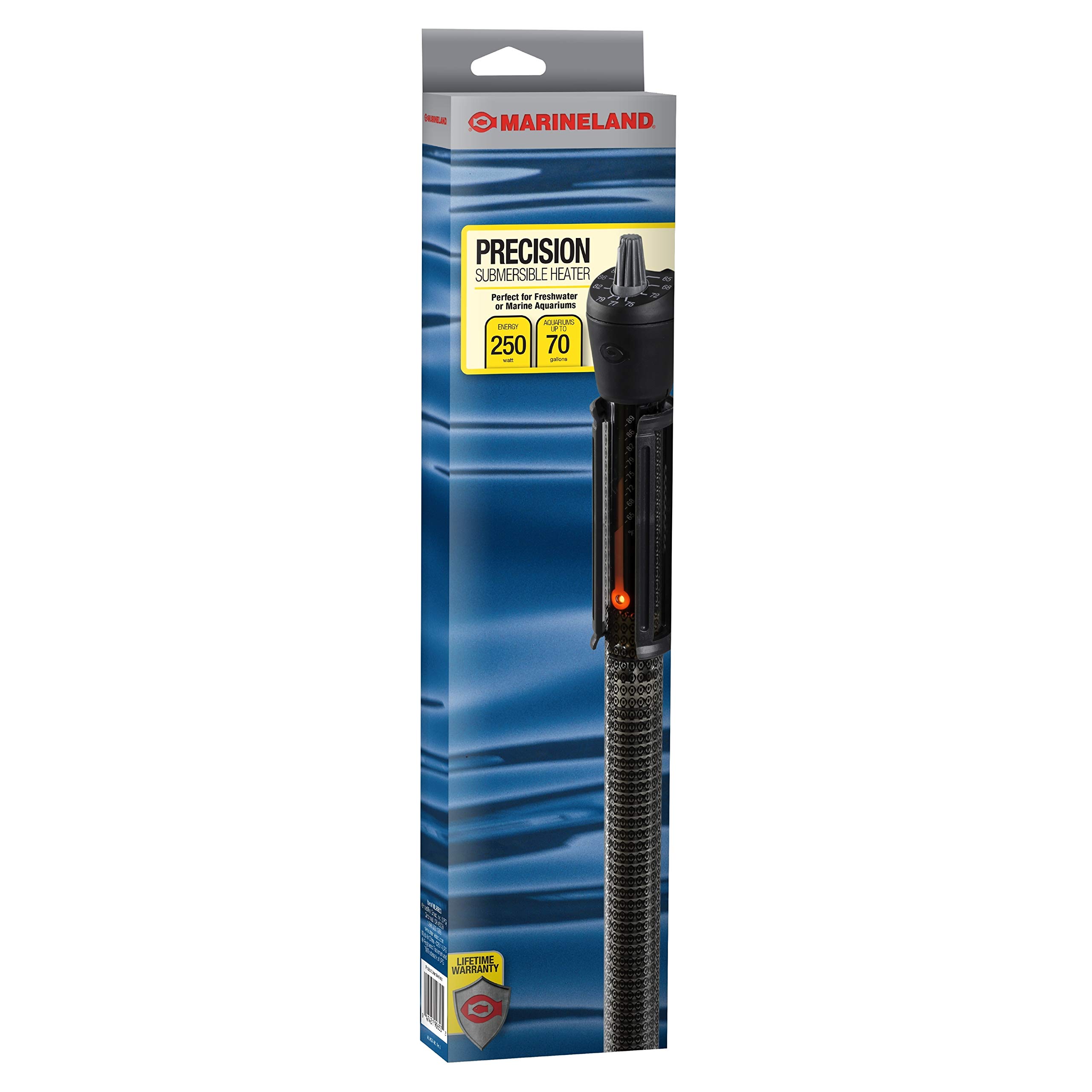
Marineland’s Precision Heater uses a mica core wrapped in a mesh heating element to distribute heat evenly across its surface. The 250W model is rated for aquariums up to 70 gallons and includes a sliding scale on the side of the body for setting your desired temperature, plus a top dial that provides a second viewing angle. The thermal switch automatically turns the element off if the internal temperature rises above a pre-set safety threshold.
Long-term impressions from the aquarium community are mixed. One owner reported the same unit lasted over 20 years across multiple freshwater and saltwater tanks, crediting the simple mechanical design with long-term reliability. On the other hand, several users report premature failure — the red indicator light stays on but the element stops producing heat within weeks or months. This inconsistency suggests quality control varies by production batch.
The mounting bracket includes three window positions for viewing the temperature display, which is a thoughtful detail for tanks where the heater sits in a corner. However, the suction cups are widely considered inadequate for the weight of the 250W unit, and several owners replaced them with heavier-duty cups. One alarming review described the heater smoking and burning overnight, indicating that while the thermal switch is intended to prevent this, not all units offer reliable protection.
Why we love it
- Low upfront cost for large tank coverage
- Mica core provides even heat transfer
- Top dial and sliding scale offer dual temp viewing
Good to know
- Significant quality control issues with premature failure
- Included suction cups may not hold the heater securely
- Safety concerns with reported smoking incidents
FAQ
Can a fish tank heater be too powerful for my aquarium?
Should I unplug my aquarium heater during a water change?
How do I know if my heater is accurate?
What is the difference between a submersible and a fully submersible heater?
How often should I replace my aquarium heater?
Final Thoughts: The Verdict
For most aquarists, the best fish tank heaters winner is the HITOP 200W PTC Heater because it eliminates the glass breakage risk, uses a self-regulating ceramic element for stable temps, and includes an accurate external digital controller at a mid-range price. If you want a heater with a proven track record of pinpoint accuracy and don’t mind the vertical mounting requirement, grab the EHEIM Jager 125W. And for absolute safety redundancy on any tank, nothing beats the Inkbird ITC-308S Temperature Controller paired with your existing heater.