
Floating aquarium plants transform a bare water column into a shaded refuge your fish and shrimp will actively seek out, but the difference between a thriving surface canopy and a slimy meltdown comes down to species selection, packaging integrity, and knowing which plants actually ship well across temperature zones. The market is flooded with bagged offerings that look promising in photos but arrive as brown mush, making the choice more tactical than you might expect.
I’m Mo Mahin — the founder and writer behind Furric. I’ve spent years analyzing owner-reported outcomes, comparing species-specific hardiness data, and studying the logistics of live plant fulfillment to separate reliable suppliers from the ones that leave you with a nutrient spike and an empty wallet.
Whether you are battling nitrate creep or simply want a natural aesthetic, this guide cuts through the claims to deliver the definitive ranking of the best floating aquarium plants for every tank size and skill level.
How To Choose The Best Floating Aquarium Plants
Floating plants are the most passive filtration you can add to a tank, but not every species suits every setup. Selecting the wrong type can lead to surface mats that block all gas exchange or delicate plants that refuse to root in your water chemistry. Focus on these four criteria before adding any floater to your cart.
Species Hardiness And Shipping Tolerance
The single biggest failure point for floating aquarium plants is transit. Species like Water Spangles (Salvinia Minima) and Giant Duckweed (Spirodela polyrhiza) are naturally robust and tolerate up to five days in a bag without melting. Dwarf Water Lettuce and Red Root Floaters are significantly more sensitive and often arrive with broken roots or yellowed leaves if not shipped with insulation or heat packs. Check the seller’s temperature disclaimer — anyone ordering above 85°F or below 35°F should expect losses unless the packaging includes climate protection.
Growth Rate And Maintenance Commitment
Floaters reproduce vegetatively, meaning one order can blanket your entire surface in weeks. Duckweed and Water Spangles double fastest and demand regular skimming to prevent light blockage below. Amazon Frogbit and Water Lettuce grow slower with larger individual leaves, making them easier to manage in display tanks. If you want a low-maintenance nitrate sink without weekly scooping, prioritize the slower multipliers.
Root Length And Fish Safety
Long trailing roots provide excellent cover for fry and shrimp but can entangle small filter intakes or create a visual mess in rimless tanks. Water Lettuce produces dramatic root curtains up to 12 inches, while Salvinia has short hair-like roots that stay tidy. Match root length to your tank’s stocking: betta keepers often prefer short roots to avoid fin tearing, while breeding setups benefit from the hide-and-seek structure of long-rooted species.
Quick Comparison
On smaller screens, swipe sideways to see the full table.
| Model | Category | Best For | Key Spec | Amazon |
|---|---|---|---|---|
| Aquarigram Floating Plant Combo Pack | Combo Pack | Four-species variety in one order | 4 species: Frogbit, Red Root, Lettuce, Spangles | Amazon |
| G & Z Floating Plants Package #2 | Combo Pack | Generous portions with live arrival guarantee | 48+ leaves across 4 species | Amazon |
| Aquarigram 12+ Leaves Water Lettuce | Single Species | Large-leaved surface cover for display tanks | 12+ leaves of Dwarf Water Lettuce | Amazon |
| Aquarigram 60+ Giant Duckweed (+Mystery Plant) | Single Species | Rapid nitrate export with bonus plant | 60+ leaves Giant Duckweed | Amazon |
| 60+ Leaves Water Spangles – Salvinia Minima | Single Species | Budget-friendly starter with highest ratings | 60+ leaves Salvinia Minima | Amazon |
In‑Depth Reviews
1. Aquarigram Floating Plant Combo Pack

This is the most thoughtful multi-species offering for aquarists who want to trial several floaters without placing separate orders. You get Amazon Frogbit, Red Root Floater, Dwarf Water Lettuce, and Water Spangles — each with its own growth habit and root profile. Frogbit and Water Lettuce form the bulk of the visual weight with broad leaves and long roots, while the Spangles and Red Root Floaters fill gaps and create texture. Buyers consistently report zero pest contamination, which matters more than most realize.
The packaging uses moisture-retaining methods that keep leaves green and firm even when transit lasts several days. Red Root Floaters are the most delicate component — some owners noted mushy stems on arrival if temperatures dipped below 40°F during shipping. Water Spangles were the clear survivor in every account, multiplying steadily even when other species stalled. The live-arrival guarantee applies across all four plants, though you should photograph any damage within a few hours of unboxing.
For a display tank that benefits from biodiversity without sacrificing aesthetics, this combo delivers the best species density per dollar in the current market. The self-multiplying nature means one order can eventually fill a 40-gallon breeder tank completely, making it ideal for keepers who want surface cover without periodic restocking.
Why we love it
- Four distinct species in one box — instant variety
- Consistently snail and parasite free in reports
- Live-arrival guarantee with replacement support
Good to know
- Red Root Floaters are temperature sensitive below 40°F
- Some orders included only 2 Frogbit and 2 Water Lettuce
- Care instructions are minimal — research each species separately
2. G & Z Floating Plants Package #2

G & Z’s package stands out for the sheer volume — 12 each of Amazon Frogbit, Dwarf Water Lettuce, Water Spangles, and Red Root Floater, totaling 48 leaves minimum. The portions are generous enough that you could split the order across multiple tanks or sell extras locally within a few weeks. Buyers praised the insulated packaging that included a heat pack, which protected the plants during cold winter transit and kept root systems intact.
The Frogbit showed the fastest recovery, with leaves growing up to an inch per day under moderate light. Red Root Floaters surprised many owners by blooming, which is a rarity in indoor setups without intense lighting. The Dwarf Water Lettuce shipped with less root mass than expected, though stems and leaves were plump and green. A small number of owners reported parasitic contamination after a few days, which is the main risk when buying mixed batches from any vendor — always quarantine new floating plants in a separate container for at least a week.
This is the best choice if you want a dense, established mat quickly without hunting for sales on individual species. The seller’s warranty offers replacement photos on dead arrivals, which adds safety for first-time floating plant buyers unfamiliar with acclimation protocols.
Why we love it
- Hefty 48+ leaf count — enough for a 55-gallon tank
- Insulated shipping with heat pack for cold climates
- Red Root Floaters often bloom under adequate light
Good to know
- Parasite risk reported in a few batches — quarantine strongly advised
- Water Lettuce arrived with minimal root development
- Shipping can take up to 5 days in some regions
3. Aquarigram 12+ Leaves Water Lettuce (Dwarf)

Dwarf Water Lettuce (Pistia stratiotes) is the quintessential showpiece floater for planted aquascapes because of its unique rosette structure and root system that can extend 6 to 12 inches downward. Aquarigram’s offering targets the serious hobbyist who wants large individual leaves rather than a mat of tiny specks. Buyers received between 8 and 12 leaves depending on the batch, with many noting the plants were well-hydrated and free of yellowing despite 30°F shipping temperatures.
The leaves are broad and velvety, creating a natural canopy that reduces light penetration and discourages algae without cutting off all PAR for stem plants below. Stems arrived with short roots in some orders, which is common for Water Lettuce that has been trimmed or recently harvested. A soak in clean filtered water with a few drops of liquid fertilizer helped those stems push new root growth within the first week. Goldfish owners specifically praised this plant because the one-inch leaves are too robust for smaller fish to shred, maintaining structural integrity even with constant nibbling.
The main limitation is the modest leaf count — you will not have immediate full coverage with 12 leaves. If your goal is a gradually expanding display centerpiece rather than a quick canopy, this is the perfect candidate. The live-arrival guarantee covers losses, but given the plant’s sensitivity, ordering when your local forecast stays between 40°F and 80°F drastically improves success rates.
Why we love it
- Large individual leaves create a striking surface aesthetic
- Robust against fish nibbling, especially goldfish
- Roots provide excellent fry and shrimp sanctuary
Good to know
- Roots may be short upon arrival — recovery time needed
- Leaf count may fall short of the advertised 12
- Temperature sensitive below 35°F in transit
4. Aquarigram 60+ Giant Duckweed (+Mystery Plant)

Giant Duckweed (Spirodela polyrhiza) is the heavy lifter of the floating plant world — it consumes ammonia and nitrates at an aggressive pace and doubles its biomass every three to four days under good lighting. This 60+ leaf portion from Aquarigram is the entry-level workhorse for anyone fighting green water or algae outbreaks. The leaves are noticeably larger than common duckweed, measuring around 5mm across, which makes manual removal easier than the tiny standard variety that gets everywhere during maintenance.
Shipping outcomes were mixed in the feedback dataset. Several owners reported vibrant green plants that were pest-free, healthy, and multiplying within days. Others received shipments with minimal roots and broken leaves after four to five days in the mail, and a small number experienced total die-off across multiple water types. The inclusion of a mystery bonus plant adds a surprise element, though the bonus species varied widely and some buyers received additional duckweed rather than a distinct plant.
At this price point, you are trading consistency for quantity and growth speed. If your tank needs a rapid nitrate sink and you are willing to accept some shipping risk, this is the most aggressive bang-for-buck grower available. Keep a lid on your tank because duckweed species are notorious for jumping out of rimless setups and surviving in sumps.
Why we love it
- Extremely fast nitrate consumption and reproduction
- Larger leaves than standard duckweed — easier to skim
- Includes a surprise bonus plant for variety
Good to know
- Shipping results are inconsistent — some orders arrive damaged
- Can overrun a tank quickly without regular thinning
- Bonus plant may be a duplicate species
5. 60+ Leaves Water Spangles – Salvinia Minima
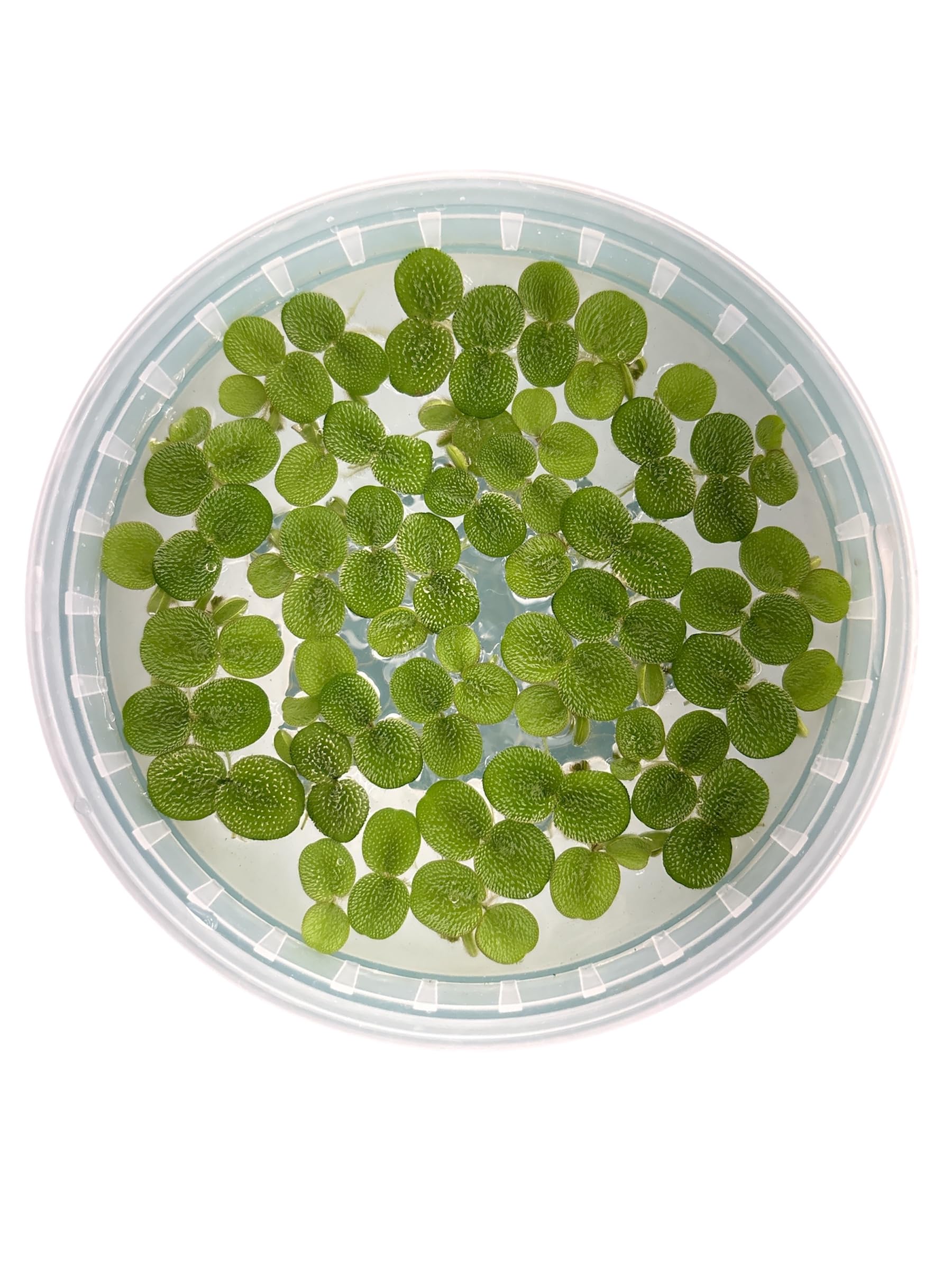
Salvinia Minima, commonly called Water Spangles, is the default recommendation for beginners because it combines extreme durability with a tidy growth habit that does not produce messy roots. This 60+ leaf portion from a generic seller is the most affordable entry point in the lineup, and the buyer feedback is uniformly excellent — every single verified review rated it 5 out of 5 stars. Owners consistently praised the packaging quality, noting plants arrived moist, clean, and perfectly green even after cross-country shipping from the East Coast.
The leaves are small, fuzzy-textured, and form a dense interconnected mat that floats just below the surface. Unlike duckweed, Water Spangles does not splinter into tiny pieces when handled, and its short hair-like roots stay under half an inch, making it compatible with nearly every filter type. Multiple reviewers reported visible new growth within the first week and successful propagation into two betta tanks from a single order. The plant is also brackish-tolerant, which is rare among freshwater floaters and useful for low-end salt setups.
This seller explicitly warns against ordering when temperatures exceed 90°F or drop below 35°F, which is a reasonable precaution for any live plant shipment. Given the track record, this is the safest blind buy in the category — if you want one species that will almost certainly arrive alive and thrive, this is it. The only trade-off is the uniform appearance; if you want diverse leaf shapes and root lengths, you will need to combine it with other species.
Why we love it
- 100% 5-star verified feedback from buyers
- Extremely compact growth — no long roots to tangle
- Brackish tolerant and pest-free in all reports
Good to know
- Uniform appearance — not ideal for visual variety
- Not pre-rinsed; inspect for debris before adding to tank
- Shipping disclaimer excludes hot and cold extremes
FAQ
How do floating plants remove nitrates from aquarium water?
Will floating aquarium plants kill my fish by using too much oxygen at night?
Why do my floating plants turn yellow and melt after I put them in the tank?
Can I use floating plants in a goldfish tank without them being eaten immediately?
Final Thoughts: The Verdict
For most aquarists, the best floating aquarium plants winner is the Aquarigram Floating Plant Combo Pack because it gives you four distinct species with verified pest-free delivery and a reliable live-arrival guarantee. If you want a single species that is virtually unkillable and budget-conscious, grab the 60+ Leaves Water Spangles — every buyer gave it a perfect rating. And for rapid nitrate export with the highest growth speed, nothing beats the 60+ Giant Duckweed from Aquarigram.