
The constant head-shaking, tail-swishing, and stomping tell the story. Flies, gnats, and mosquitoes don’t just annoy horses—they stress them, disrupt grazing, and can lead to eye infections or skin lesions. Finding a strategy that actually works isn’t just about comfort; it’s about your horse’s daily well-being.
I’m Mo Mahin — the founder and writer behind Furric. I’ve spent thousands of hours comparing specifications, studying active ingredient efficacy rates, and analyzing aggregated owner feedback on barn-tested fly control products to separate real results from marketing claims.
This guide breaks down the best physical barriers and chemical repellents so you can confidently choose the right fly control for horses that matches your turnout situation, riding habits, and your horse’s unique sensitivity.
How To Choose The Best Fly Control For Horses
With dozens of masks, sprays, and wipes lining tack shop shelves, the sheer volume can trick you into thinking the cheapest option will do. Real horse owners know better: fly control isn’t one-size-fits-all. Assessing your horse’s living environment, daily workload, and individual skin sensitivity is the only path to a solution that lasts more than a week.
Fly Masks: Physical Barrier vs. Breathability
The core trade-off in a fly mask is mesh openness. A super tight weave blocks even the smallest gnats but can trap heat and cause rubbing. An overly open mesh breathes well but lets noseeums through. Look for masks with clear UV-protected vision panels, soft fleece or felt edging to prevent pressure points, and secure double-strap closures that survive rolling and face-rubbing.
Fly Sprays: Synthetic Power vs. Natural Safety
Sprays built on permethrin offer the longest knockdown—some formulations repel biting insects for up to 14 days. The trade-off? Harsher chemical feel and potential irritation on sensitive skin. Natural oil blends (geraniol, clove, peppermint) are gentler but require more frequent reapplication, especially after rain or heavy sweat. Consider your horse’s turnout schedule: daily sprayers can get away with natural options; weekend warriors need the synthetic longevity.
Combining Systems for Maximum Coverage
No single product works perfectly for all scenarios. A high-quality fly mask protects the face, eyes, and ears—the high-traffic zones for flies—24/7. A complementary spray covers the legs, belly, and body during turnout and riding. Owners who pair a mid-range mask with a permethrin-based spray consistently report fewer flies landing and less stress behavior than those using either method solo.
Quick Comparison
On smaller screens, swipe sideways to see the full table.
| Model | Category | Best For | Key Spec | Amazon |
|---|---|---|---|---|
| Opti-Force Fly Mask | Permethrin-Infused Mask | All-day turnout with UV protection | Permethrin-treated, no-ears mesh | Amazon |
| Cashel Quiet Ride Mask | Ride-Ready Mask | Trail riding under bridle | Soft nylon mesh, bridle-compatible | Amazon |
| Harrison Howard CareMaster Mask | Fringe Mask | Pasture horses needing nose fly defense | Fleece pad + fringe nose coverage | Amazon |
| PYRANHA Zero-Bite Spray | Natural Oil Spray | Sensitive-skin horses & multi-pet homes | Water-based, 90%+ water, no-shake formula | Amazon |
| Farnam Tri-Tec 14 Spray | Synthetic Longevity Spray | Heavy-duty barns & long turnout days | Permethrin-based, up to 14-day control | Amazon |
In‑Depth Reviews
1. Manna Pro Opti-Force Horse Fly Mask

The Opti-Force mask isn’t just a physical barrier—it’s an active insecticide delivery system. The permethrin-infused mesh kills and repels flies, ticks, mosquitoes, and gnats on contact without any odor detectable by humans or horses. This dual-layer defense means even if a small gnat manages to land on the mesh near an ear opening, it doesn’t live long enough to bite.
The lightweight, tear-resistant construction stands up to nightly wither-scratching against fence posts and morning rubs on stall edges. The clear-view mesh provides full peripheral vision, so your horse can track movement without panic, and the Equi-Glo Nite reflector adds crucial visibility during early-morning turnouts or dusk grazing shifts. The standard size fits most warmbloods and quarter horses comfortably.
One important fitting note: the no-ears design means your horse’s ears stay uncovered, which some geldings appreciate for alert hearing but others may find exposes sensitive ear bases. For horses that tolerate ear coverage, the lack of ear pockets eliminates a common pressure-point complaint. The dual adjustable straps hold firm through the most vigorous head-shaking.
Why we love it
- Built-in insect repellent adds active chemical protection to physical mesh barrier
- UV-blocking mesh protects eyes and sensitive pink skin from sun damage
- Reflector patch significantly improves night safety in open pastures
Good to know
- No ears design leaves ear bases exposed to flies
- Permethrin treatment degrades with washing; hand wash gently to preserve efficacy
- Sizing runs slightly snug for draft-breed heads in standard size
2. Cashel Quiet Ride Horse Fly Mask
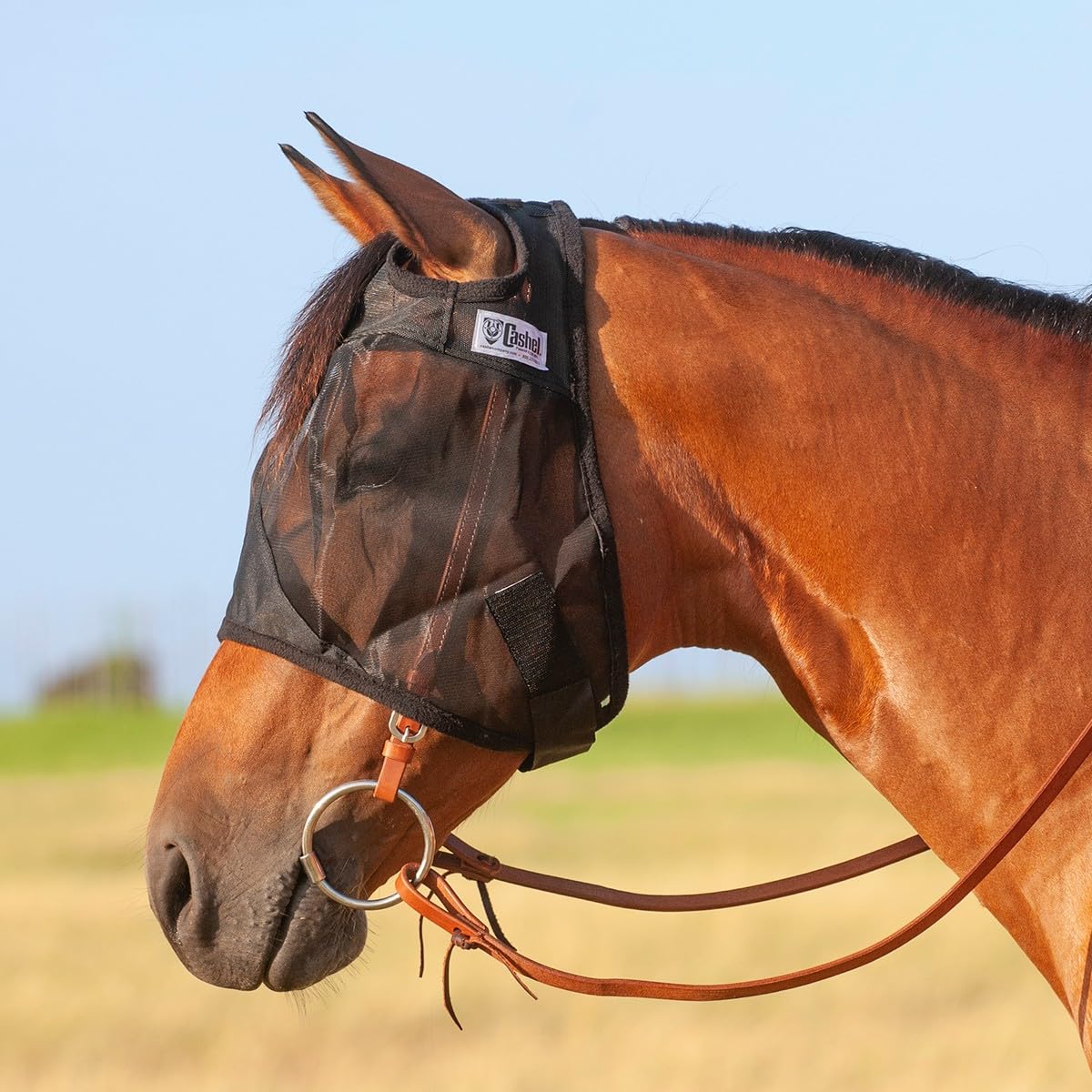
The Cashel Quiet Ride earns its name in two ways: it genuinely fits quietly under a bridle without interfering with rein aids, and it permanently quiets the fly-driven head-tossing that distracts riders mid-trail. The soft, breathable nylon mesh weighs next to nothing, making it the lightest mask in this roundup at just 0.18 pounds—a meaningful difference for a horse that wears a mask for eight-hour trail rides.
The secret is the cut. The mask is anatomically shaped to sit above the eye but below the browband, and the hook-and-loop fasteners attach behind the crownpiece, not on top of it. Owner reviews consistently report that it doesn’t rub, bunch, or shift even during canter work. The mesh offers superb visibility—hold it up to your own eyes and you’ll see through it clearly—so horses stay confident and responsive to cues.
Cashel offers sizing from Mini to Draft, and the Arabian/Small/Pony size works perfectly on standard donkeys and mules, which is a boon for multi-equine owners. The mask protects the eyes, cheeks, and forehead but does not cover the nose or ears, so it’s best paired with a body spray for full-coverage fly control during extended summer outings.
Why we love it
- Fastens securely under most bridles without affecting vision or rein contact
- Extremely lightweight and soft—horses rarely fight or rub it off
- Excellent eye-line visibility prevents trail-spooking at low light
Good to know
- No UV protection rating listed; not ideal for sun-sensitive pink skin
- Does not cover ears or nose, leaving some bite zones exposed
- Dart above the eye sits closer to the eyelid on horses with prominent eye sockets
3. PYRANHA Zero-Bite All Natural Fly Spray

Zero-Bite is the spray you reach for when your horse has sensitive skin, when you’re applying it around dogs and cats in the barn aisle, or when you simply don’t want to handle harsh chemicals. The proprietary blend of geraniol, peppermint, and clove oils delivers aggressive repellency without the greasy, oily tackiness of traditional fly sprays—it’s more than 90% water, so it dries clear and feels like nothing on the coat.
Pyranha’s Suspension Technology is the hidden engineering here: the formula doesn’t separate or settle, so you never shake the bottle. Just pump and spray. This is a massive practical advantage when you’re moving quickly through a barn of stalls or spraying down a sweaty horse before turnout. The smell is pleasantly minty, not medicinal, and dissipates quickly in open air.
The quart size is practical for regular application across one or two horses, but heavy users will need to stock up. The repellent duration is shorter than chemical options—expect peak coverage for roughly 4–6 hours—but for mid-day turnout or evening pre-riding application, that window is plenty. It’s also safe on fly-eyed dogs and even on garden plants, making it a multi-purpose barn staple.
Why we love it
- Non-greasy, non-oily formula dries fast and doesn’t attract dust
- Safe for horses, dogs, cats, and even plants—truly multi-species
- No-shake Suspension Technology saves time during busy barn routines
Good to know
- Natural oils require more frequent reapplication than synthetic alternatives
- Quart size runs out quickly for barns with multiple horses
- Not effective against ticks; permethrin-based products are better for tick season
4. Farnam Tri-Tec 14 Horse Fly Spray
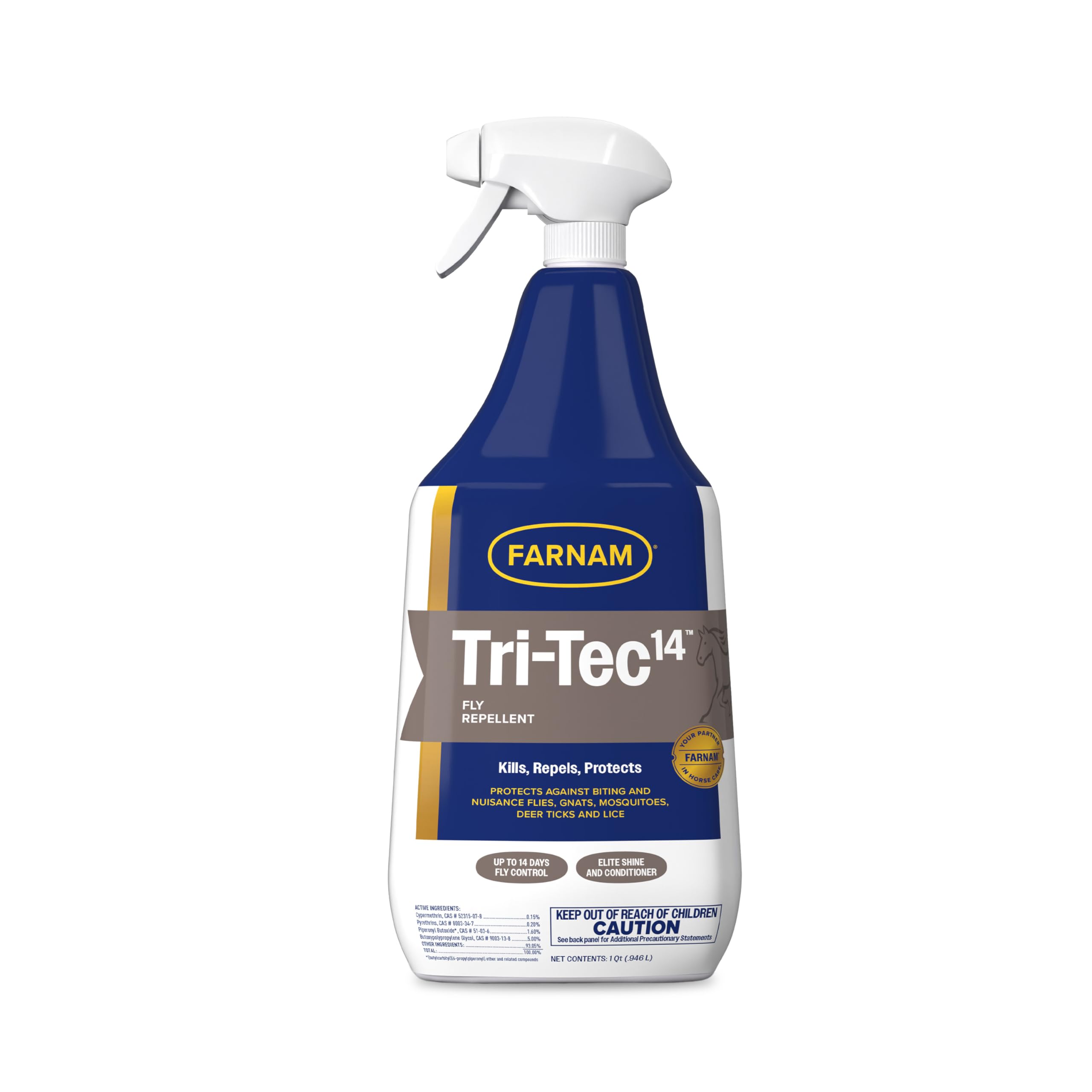
When you need a spray that works and keeps working through rain, sweat, and pasture dust, Tri-Tec 14 is the standard for a reason. The three active ingredients—permethrin kills on contact, while piperonyl butoxide and other synergists extend the repellent effect for up to two weeks. This is not a daily-spray product; it’s a weekly application that saves labor in busy barns with large turnout groups.
The real-world longevity depends on your climate. In dry, hot conditions, the 14-day claim holds true on stable horses. In heavy rain or for horses that swim through water troughs, you’ll need to reapply every 7–10 days to maintain full knockdown. The included coat conditioners leave a noticeable shine, which is a bonus for show barns but purely cosmetic for daily working horses.
Farnam offers this in a 32-ounce ready-to-use spray bottle, a 15-ounce finishing spray for touch-ups, and an economical gallon refill. The 32-ounce size covers a single horse for roughly 6–8 full-body applications. For owners managing three or more horses, buy the gallon refill and pour into your own sprayer—the cost per application drops significantly and you still get the same 14-day formula.
Why we love it
- Up to 14 days of fly, gnat, mosquito, and tick control per application
- Kills on contact, not just repels—reduces total insect population in the area
- Economical gallon refill option for multi-horse barns
Good to know
- Strong chemical smell may be off-putting in enclosed stalls
- Can sting on broken skin or open wounds; avoid spraying on scrapes
- Not suitable for horses with extremely sensitive or allergic skin
5. Harrison Howard CareMaster Horse Fly Mask
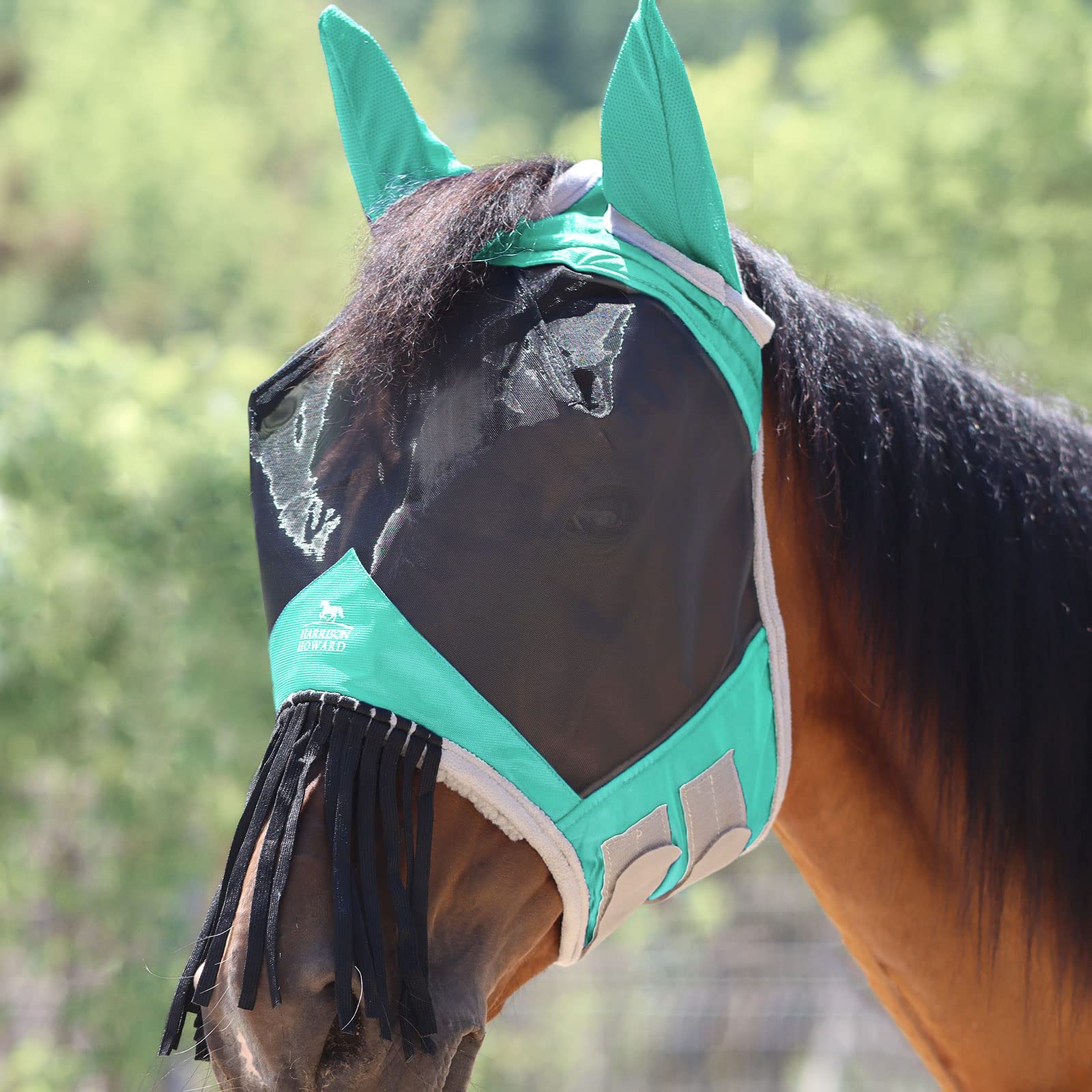
The CareMaster mask solves one of the most persistent fly problems: face flies that drive horses crazy by landing on the nose, muzzle, and cheek corners. The ingeniously simple solution is the Spanish-style tasseled nose fringe, which hangs about an inch past the muzzle and deflects flies before they can land. Owner reviews specifically mention that the fringe’s constant gentle motion keeps flies away even in heavy infestations.
The construction quality stands out. The high-tech midge-proof mesh is breathable and skin-friendly, and the thick fleece padding along the edges prevents the pressure marks common with stiff mask designs. The double velcro straps provide redundant security—if the top strap loosens during a roll, the bottom strap still holds. A full-size fits quarter horses well, though reviewers note the sizing runs large compared to other masks, so measure your horse’s face before ordering.
The practical drawback is the fringe itself around feeding time. Several owners report trimming about an inch off the tassels because they soaked up water or dipped into grain buckets during feeding. It’s a five-minute fix with scissors, and the mask remains fully functional afterward. For genuinely fly-sensitive horses that obsessively rub their noses on fence posts, the fringe provides physical relief that no spray can match.
Why we love it
- Nose fringe actively deflects flies from the muzzle—a uniquely effective design
- Thick fleece padding eliminates pressure marks and rubbing along the cheekbones
- Durable midge-proof mesh withstands years of pasture turnout wear
Good to know
- Fringe may need trimming to stay dry around feed buckets and automatic waterers
- Sizing runs large; measure your horse’s face or order down a size
- Only available in full size; no pony or draft options
FAQ
Can I use a fly mask and fly spray together on my horse?
How long does permethrin-based fly spray last on a horse?
Final Thoughts: The Verdict
For most horses, the fly control for horses winner is the Manna Pro Opti-Force Fly Mask because the integrated permethrin treatment adds active chemical kill to a high-quality physical mesh barrier, delivering 24/7 protection without daily reapplication. If you ride regularly and need a mask that works seamlessly under a bridle, grab the Cashel Quiet Ride Mask. And for barns facing heavy fly pressure where weekly spraying is practical, nothing beats the long-lasting knockdown of the Farnam Tri-Tec 14 Spray.