
A dead fish is often the first sign of a problem you never saw coming. Unlike the clear water your eyes trust, invisible shifts in pH, ammonia, and nitrite can stress or kill your livestock within hours. The single most important tool in preventing that loss is a reliable liquid reagent test kit that gives you hard numbers, not guesswork.
I’m Mo Mahin — the founder and writer behind Furric. I’ve spent thousands of hours comparing water parameter specifications, studying the chemical reaction times of reagent formulas, and analyzing aggregated owner feedback across hundreds of aquarium test kit listings to separate the accurate from the gimmicky.
Whether you are cycling a new tank or troubleshooting a sick Betta, owning a precise best freshwater aquarium test kit is the difference between reactive panic and confident daily management.
How To Choose The Best Freshwater Aquarium Test Kit
Not every kit measures the same parameters with the same precision. Before clicking buy, match the kit’s capabilities to your tank’s specific cycle stage, stocking level, and your personal tolerance for fumbling with small vials.
Liquid Reagent vs. Test Strips
Test strips are convenient for a quick weekly glance at general hardness or pH, but they are notoriously poor at detecting low levels of ammonia and nitrite — the two most lethal spikes in a freshwater tank. A liquid reagent kit, where you add drops to a water sample, gives you a distinct color change that correlates directly with parts per million. For routine maintenance strips are fine, but for cycling a new tank or diagnosing illness, you need liquid accuracy.
Which Parameters Matter Most
A basic kit should cover pH, Ammonia (NH3/NH4+), Nitrite (NO2-), and Nitrate (NO3-). A high-range pH test is a bonus that many budget kits exclude, but it is critical if your tap water runs above 7.6. Phosphate and General Hardness tests are useful for planted tanks or if you keep shrimp, but skip them if you maintain a standard community tank — they add steps without actionable insight.
Total Test Count and Bottle Shelf Life
A kit that claims “800 tests” often means 800 individual parameter tests — not 800 complete panel readings. If you test four parameters weekly, 800 tests last about 200 weeks (nearly four years). However, opened reagent bottles degrade over time, especially ammonia indicator solution, which can lose sensitivity after 12 months. A high test count is valuable only if you plan to use the kit regularly within that window.
Quick Comparison
On smaller screens, swipe sideways to see the full table.
| Model | Category | Best For | Key Spec | Amazon |
|---|---|---|---|---|
| API FRESHWATER MASTER TEST KIT | Premium | Reliable daily monitoring | 800 total tests, 7 bottles | Amazon |
| GOLD LABEL PET CARE Master Kit | Premium | Highest test count value | 950+ tests, includes strips | Amazon |
| Pawfly 5 in 1 Master Test Kit | Mid-Range | Phosphate monitoring included | 265 measurements, 5 parameters | Amazon |
| Advatec 9 in 1 Test Strips | Budget | Broad strip-only panel | 9 parameters, 100 strips | Amazon |
| API 5-IN-1 TEST STRIPS | Budget | Quick weekly strip check | 100 strips, 5 parameters | Amazon |
In‑Depth Reviews
1. API FRESHWATER MASTER TEST KIT

The API Freshwater Master Test Kit has anchored the hobby for two decades, and for good reason. Its five-in-one panel covers pH, high-range pH, ammonia, nitrite, and nitrate using trusted Nessler and colorimetric reagents. The test tube system forces you to be deliberate — you shake reagent bottles for the specified seconds, wait five minutes on the nitrate test, and compare directly against a laminated color card. That deliberate process yields readings you can trust within 0.25 ppm for ammonia.
At 800 individual tests, this kit outlasts most aquarists’ first year of fish keeping. The included high-range pH solution (0-11.0) saves you from the common panic of a “pH crash” reading when your standard test maxes out at 7.6. The kit is freshwater-only, so saltwater reef keepers will need a separate set, but for a planted 20-gallon or a 75-gallon cichlid setup, this is the gold standard reference.
One practical consideration: the nitrate test requires you to shake the #2 bottle vigorously, then shake the test tube for one full minute — skip this step and your reading can show 0 ppm even with dangerous levels present. The glass test tubes are breakable, so store the box away from the tank rim.
Why we love it
- Industry-standard accuracy with decades of hobbyist validation
- High-range pH covers alkaline tap water up to 11.0
- Massive 800-test capacity for long-term use
Good to know
- The nitrate test procedure is finicky — shake timing matters significantly
- Glass test tubes can chip or crack if dropped on a hard surface
2. GOLD LABEL PET CARE Master Kit
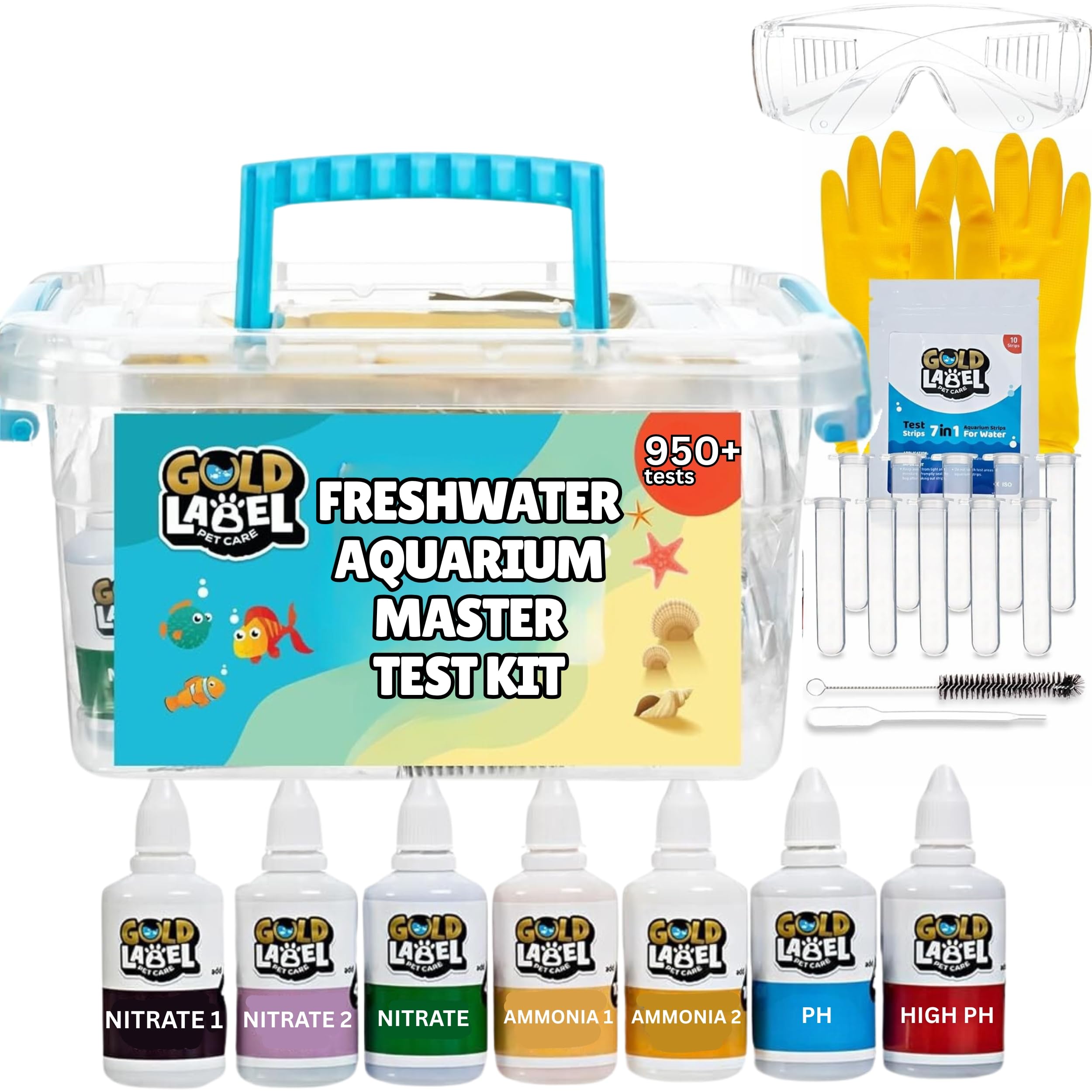
Gold Label Pet Care’s Master Test Kit pushes the test count beyond the API staple at 950+ individual tests, making it a compelling alternative for high-volume testing routines. The kit matches the same five-critical-parameter set — pH, high-range pH, ammonia, nitrite, and nitrate — delivered through liquid reagent bottles inside a compact carry case. It also includes a bonus set of 10 water test strips, a pair of protective glasses, gloves, and a cleaning pipe brush for the test tubes.
The practical advantage here is the sheer how-long-it-lasts math: if you test all five parameters weekly, this kit covers over 190 complete panels. The included safety gear is a thoughtful touch for hobbyists who test frequently or handle the ammonia reagent with bare hands. The dropper bottles dispense consistently, and the color card uses a glossy finish that resists water splashes better than matte cards.
This kit is relatively new to the market (first available August 2024), so long-term consistency data is thinner than API’s two-decade track record. A small subset of users report that the high-range pH reagent produces a hue that sits between two color patches, making exact reading slightly more interpretive than the API equivalent.
Why we love it
- Highest total test count in this comparison at 950+
- Complete accessory package includes safety glasses, gloves, and brush
- Includes bonus test strips for quick checks between liquid tests
Good to know
- Brand is newer, with less long-term validation than legacy competitors
- High-range pH color differentiation can be ambiguous at midpoint values
3. Pawfly 5 in 1 Master Test Kit
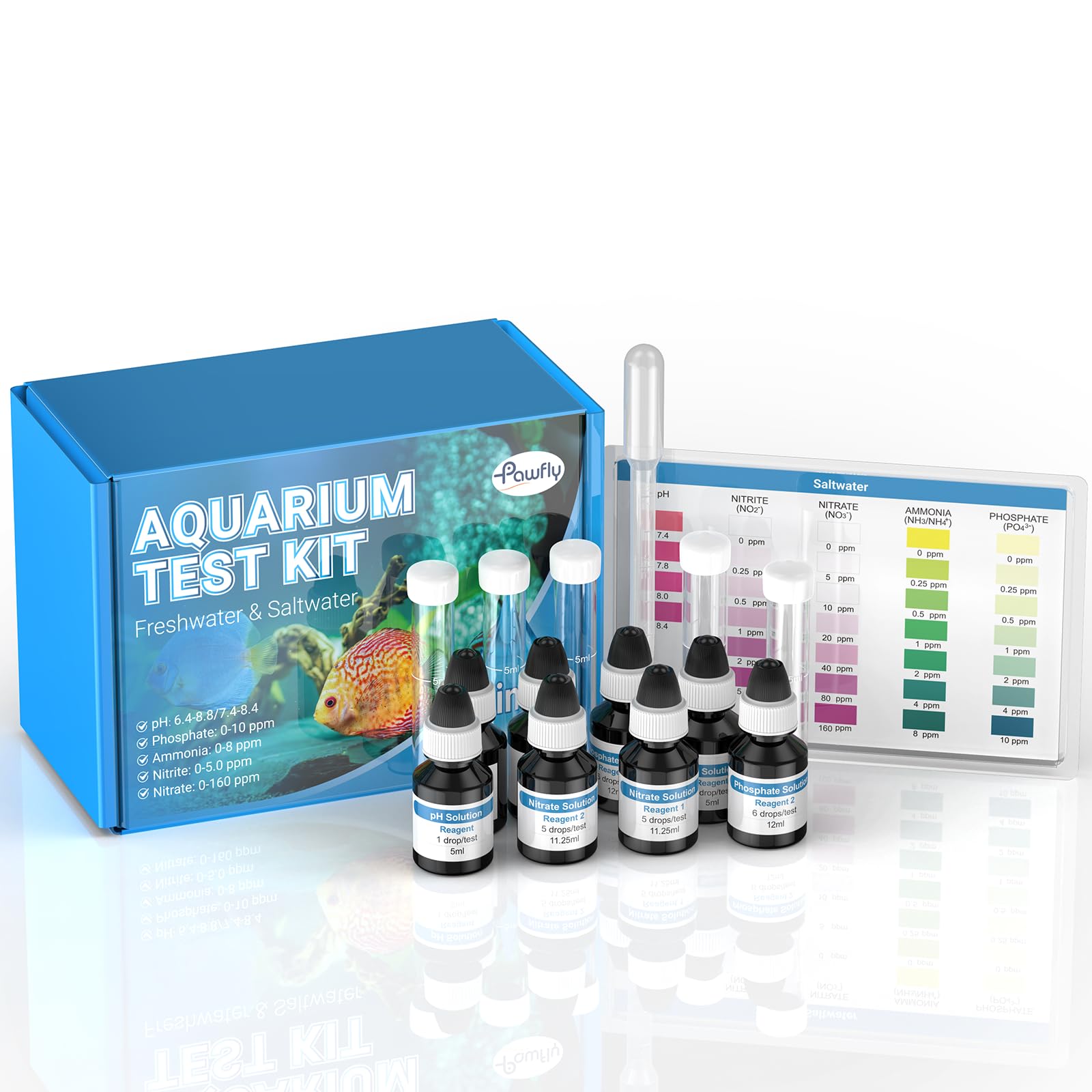
The Pawfly 5 in 1 Master Test Kit sets itself apart by including phosphate testing alongside the standard pH, nitrite, nitrate, and ammonia panel. Phosphate is a critical parameter for planted tanks and shrimp-only setups where algae blooms are directly tied to PO4 levels above 1.0 ppm. The kit uses liquid reagents for all five parameters, delivering the same accuracy advantage over strips that serious aquarists demand, with 265 total measurements — enough for several months of weekly full panels.
The ammonia reagent in this kit is sensitive down to 0.25 ppm, which is sufficient for detecting spikes before they become lethal to most community fish. The color chart uses a clean white background with distinct hue bands that make matching easier, even under LED aquarium lighting. Like the API kit, this set works for both freshwater and saltwater applications, giving reef-keepers a budget-friendly option for a secondary monitoring station.
Where it falls short is test count depth: 265 tests is about a third of the API’s capacity, so heavy testers will restock sooner. The phosphate reagent bottle is smaller than the others, and heavy algae-prone tanks may exhaust it before the rest of the kit is done. Also, no high-range pH test is included, so alkaline tap water above 7.6 still requires a separate high-range solution.
Why we love it
- Phosphate testing is a rare inclusion at this value tier
- Liquid reagent accuracy across all five parameters
- Works for both freshwater and marine tanks
Good to know
- No high-range pH test included
- Total test count (265) is lower than premium alternatives
4. Advatec 9 in 1 Test Strips
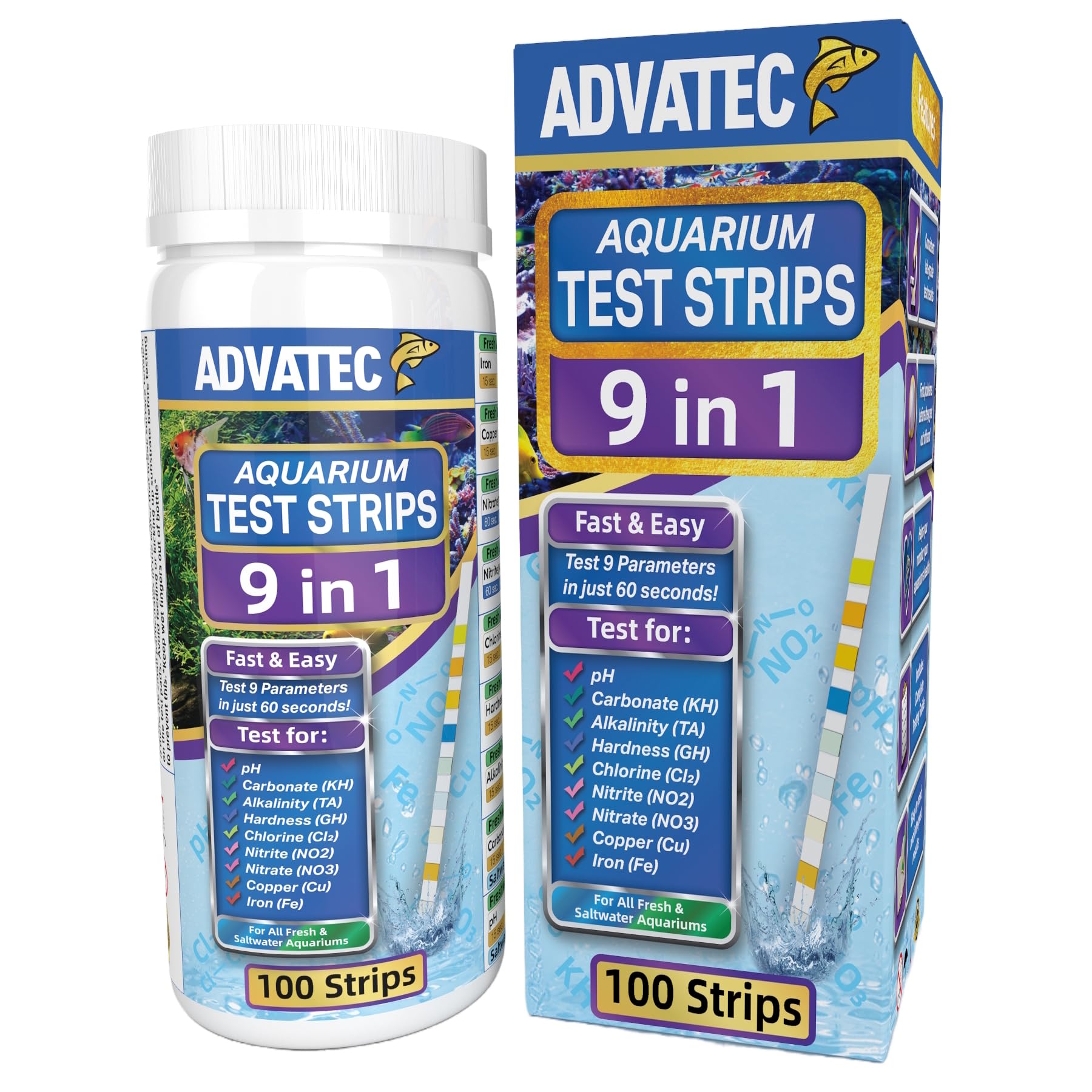
The Advatec 9 in 1 Test Strip kit casts the widest net in this lineup, measuring nine parameters from a single dip: Iron, Copper, Nitrate, Nitrite, Chlorine, Total Hardness, Total Alkalinity, Carbonate, and pH. This breadth is useful for planted tank keepers who dose iron or copper-based medications and need to track residual levels. The strip format means you get results in under 60 seconds with no shaking, waiting, or dripping reagents onto tubes.
For routine maintenance on a stable, mature tank, this kit provides a fast health snapshot without the labor of a liquid kit. The included pH range is 4.0-7.0, which covers most planted and soft-water community setups, but misses alkaline conditions above 7.0 common in African cichlid tanks or hard-tap-water regions. The copper and iron pads are genuinely unique — no other product in this comparison offers those readings without a separate, expensive ICP test.
The major trade-off is accuracy for ammonia — this kit does not measure ammonia at all. For cycling a new tank or diagnosing a sudden fish death, the absence of an ammonia reading is a dangerous blind spot. Strips are also less sensitive than liquid reagents for nitrate and nitrite at low concentrations, so use this for routine checks, not emergency diagnostics.
Why we love it
- Nine parameters from one strip, including iron and copper
- Instant results — dip and read in 60 seconds
- High strip count (100) supports frequent testing without restocking
Good to know
- Does not measure ammonia, making it incomplete for cycling or emergencies
- pH range (4.0-7.0) excludes high-alkaline freshwater tanks
5. API 5-IN-1 TEST STRIPS
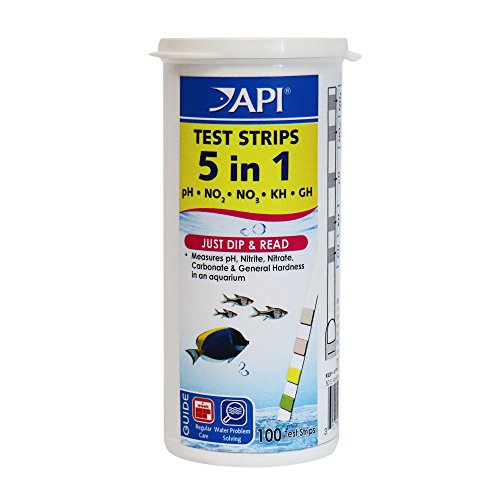
The API 5-in-1 Test Strips are the simplest entry point for a beginner who wants a weekly parameter overview without the full liquid kit workflow. Each strip tests pH, nitrite, nitrate, carbonate hardness (KH), and general hardness (GH). The KH/GH readings are genuinely useful for shrimp keepers who need to maintain specific water hardness for successful molting, and they are metrics that the liquid Master Test Kit omits entirely.
With 100 strips per box, you get about two years of weekly testing. The color chart is printed on the bottle, so you cannot lose it — a small but real convenience. The dip-and-read time is only 60 seconds, making this the fastest way to confirm that your tank parameters are in the expected zone before a water change.
The limitation is the same as all strip kits: no ammonia measurement, and the nitrate/nitrite pads are less sensitive below 5 ppm. If your tank is fully cycled and stable, this is fine, but during the first six weeks or after a medication treatment, you will need a separate liquid ammonia test to avoid blind spots. Also, the strip color patches are small, and differentiating between 0 and 0.5 ppm nitrite requires good lighting.
Why we love it
- Includes KH and GH hardness tests not found in most liquid kits
- 100 strips provide long-term weekly monitoring supply
- Zero setup — dip, wait, compare, done
Good to know
- No ammonia test included — requires a separate liquid kit for cycling
- Strip color pads are small and can be hard to read under dim lighting
FAQ
How often should I test my freshwater aquarium water?
Why does my liquid test kit show yellow for ammonia but my fish are dying?
Can I use a saltwater test kit on my freshwater tank?
Why do my nitrate test results vary depending on how long I shake the bottle?
Do test strips expire faster than liquid reagent bottles?
Final Thoughts: The Verdict
For most aquarium keepers, the best freshwater aquarium test kit winner is the API FRESHWATER MASTER TEST KIT because it combines decades of hobbyist-proven accuracy, a complete five-parameter panel including high-range pH, and an 800-test capacity that outlasts your first year of fishkeeping. If you want the highest possible test count with a bonus accessory kit, grab the GOLD LABEL PET CARE Master Kit. And for a quick weekly health check on a mature stable tank, nothing beats the simplicity of the API 5-IN-1 TEST STRIPS.