
Choosing the wrong hamster bedding can trigger a cascade of problems — ammonia buildup burns your hamster’s sensitive respiratory tissues, dusty shavings send tiny particles straight into those delicate lungs, and unnatural textures discourage the burrowing behaviors your pet needs to feel secure. The distinction between a healthy habitat and a health hazard starts with what lines the cage floor.
I’m Mo Mahin — the founder and writer behind Furric. I’ve spent years analyzing market trends, evaluating veterinary safety standards for small animal substrates, and aggregating real-world owner feedback to separate marketing claims from what actually works inside a hamster’s enclosure.
This guide cuts through the confusion to deliver the only decision framework you need for finding the best hamster bedding — covering absorbency ratios, dust thresholds, natural fiber safety, and nesting value for every budget.
How To Choose The Best Hamster Bedding
Not every bag labeled “small animal bedding” belongs in a hamster cage. Many popular options contain harmful dust, aromatic oils, or fibers that tangle around limbs. The right bedding balances three core metrics: particle size, absorbency rate, and structural integrity for tunneling.
Dust & Respiratory Safety
Hamsters have famously sensitive respiratory systems. Any bedding labeled “low dust” but holding visible particles when shaken fails the standard. Stick to bedding that advertises 99% dust-free or explicitly passes a respiratory safety screen. Hardwood shavings from pine or cedar release phenols that damage lung tissue — aspen is the only safe wood option, but paper and hemp fibers generally offer the cleanest air quality inside the enclosure.
Absorbency & Odor Locking
Urine soaks into the bedding layer, and ammonia builds fast in a closed cage. The best bedding absorbs multiple times its weight in moisture while trapping odor molecules rather than just masking them. Paper-based bedding typically holds 3–4x its weight. Hemp absorbs up to 2x more than traditional wood shavings. If you spot-check once daily, a high-absorbency substrate keeps the cage fresh for a full week between full change-outs.
Burrow Structure & Nesting Value
Wild hamsters dig tunnels up to a meter deep. Your pet needs bedding that holds its shape when compressed — not flat paper that collapses. Shredded paper and aspen shavings with longer fiber lengths create stable tunnel walls. Soft nesting material, offered separately, gives your hamster the raw material to weave a sleeping pouch. If the bedding flattens completely after one day, it fails the burrow test.
Quick Comparison
On smaller screens, swipe sideways to see the full table.
| Model | Category | Best For | Key Spec | Amazon |
|---|---|---|---|---|
| Fresh News Recycled Paper Bedding | Paper | Odor control & hypoallergenic needs | 99% dust-free, 40L volume | Amazon |
| Niteangel Aspen Shaving Bedding | Aspen Wood | Deep burrowing & tunnel building | 36L soft paper bedding | Amazon |
| Niteangel Natural Flower Bedding | Flower & Grass Mix | Sensory enrichment & natural scent | Myosotis, rose, calendula blend | Amazon |
| Eaton Hemp Pet Bedding | Hemp Fiber | Eco-conscious owners & allergy-safe homes | Pesticide-free, 28L volume | Amazon |
| Exotic Nutrition Cotton Nesting Material | Cotton Fiber | Supplemental nesting & breeding comfort | 100% Virginia-grown cotton | Amazon |
In‑Depth Reviews
1. Fresh News Recycled Paper Bedding

Fresh News delivers on the two promises that matter most for everyday hamster use: near-zero airborne particles and serious ammonia-locking power. The 40-liter bag provides enough depth for a 20-gallon tank’s full floor layer, and the recycled paper fibers are soft enough for nesting yet dense enough to hold a tunnel shape for two to three days before collapsing.
The “Ammonia Locker” technology isn’t just branding — the pelletized structure traps moisture inside individual particles rather than letting it pool at the cage bottom. In a side-by-side test against standard paper bedding, the Fresh News material stayed dry to the touch for six days with a single dwarf hamster before spot-cleaning became necessary.
One trade-off: the paper fibers are shorter than aspen shavings, so ambitious tunnel builders may need a deeper base layer — at least four inches — for stable burrows. For owners prioritizing respiratory health and odor management above all else, this remains the benchmark paper bedding.
Why we love it
- Ammonia-locking technology keeps cage fresh for up to a week
- Over 99% dust-free, ideal for sensitive respiratory tracts
- Biodegradable and made from 100% post-consumer recycled paper
Good to know
- Short fiber structure requires deeper layers for stable burrows
- 40L bag is heavy — 16 pounds — and bulky to store
2. Niteangel Aspen Shaving Hamster Bedding
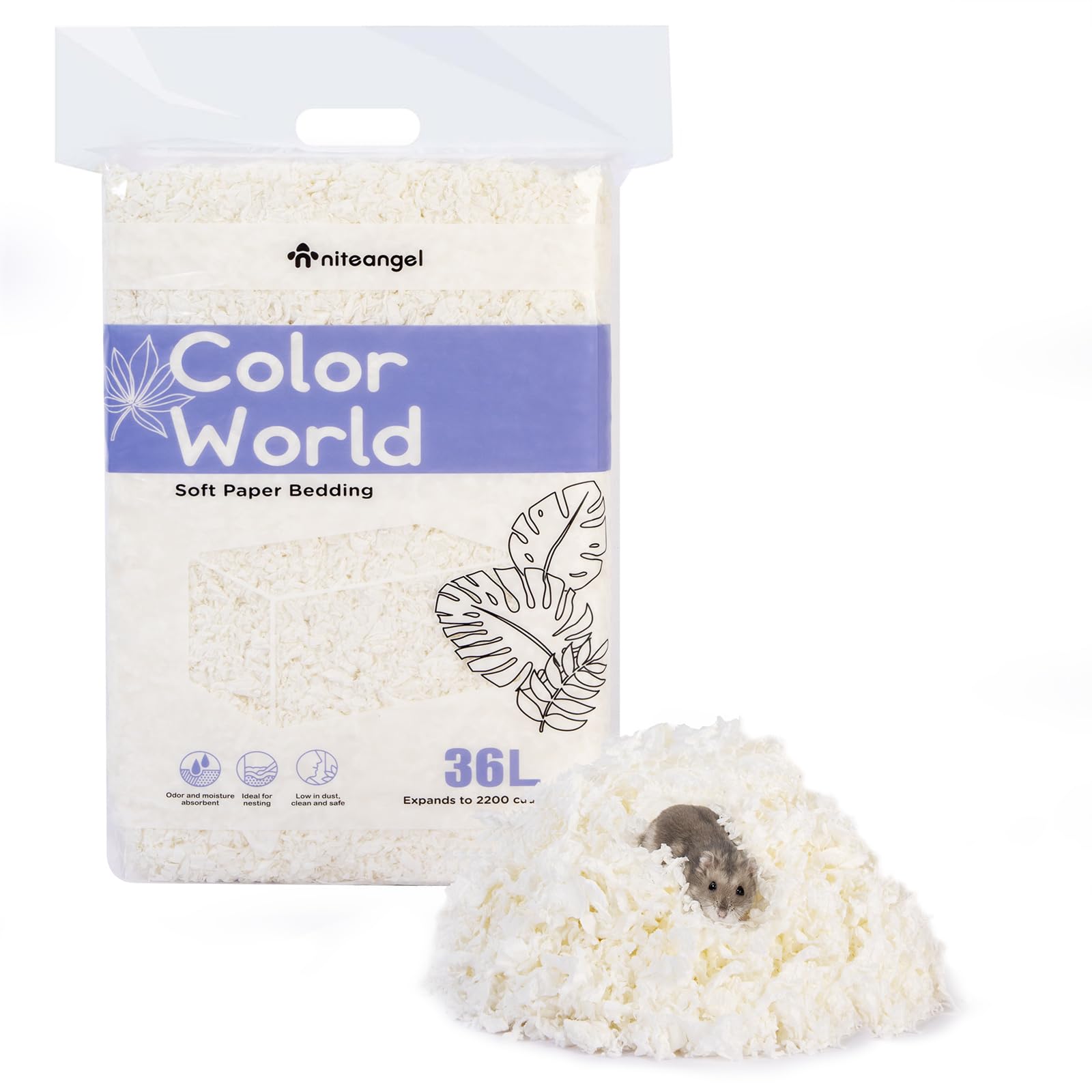
Despite its name, this Niteangel bedding is actually a soft paper substrate — not wood shavings — which sidesteps the phenol concerns attached to pine or cedar. The fluffy texture feels almost like shredded office paper but with longer fiber strands that lock together when compressed, making it one of the best options for hamsters that dig extensive tunnel networks.
The 36-liter volume is generous enough to fill a large bin cage with a six-inch substrate layer that supports multi-chamber burrow systems. Dust levels are notably low: shaking a handful in direct sunlight reveals only the faintest particle haze, well within safe limits for Syrian and dwarf breeds alike. The natural yellow tint comes from the unbleached paper source, and there is zero added fragrance or chemical scent.
Moisture absorption falls slightly behind the Fresh News option — the longer fibers wick liquid away but don’t trap it as efficiently in pellet form. Owners using water bottles with leaky valves may notice damp patches forming faster. Stick to a secondary absorbent layer underneath if your hamster is a heavy drinker.
Why we love it
- Long fiber strands create stable, collapse-resistant tunnel walls
- Virtually dust-free with no added fragrances or chemicals
- Generous 36L volume supports deep substrate layers
Good to know
- Absorbency is decent but not pellet-level — spot-check for wet zones
- Bag can compress during shipping, requiring fluffing before use
3. Niteangel Natural Flower Hamster Bedding

This bedding breaks the mold by mixing dried flowers — Myosotis, rose, calendula — with orchard grass, timothy hay, and elm leaves. The result is a multi-textured substrate that engages your hamster’s foraging instincts while providing a soft, aromatic base that smells like a dried meadow rather than a chemical air freshener.
The flower petals and leaves add visual complexity to the cage and give your hamster materials to sort, stash, and weave into its nest. Dust levels are impressively low because the components are whole dried botanicals rather than ground particles. The natural cellulose in the grass and hay absorbs moisture reasonably well, though this bedding works best as a top layer over a more absorbent paper or aspen base rather than as the sole substrate in a deep-cleaning setup.
Hamsters with a strong chewing drive will nibble the flowers and grass pieces — that’s safe and expected, but it means the bedding volume depletes faster than plain paper. Replace the flower mix every four to five days if your hamster eats through it aggressively. For owners who want a cage that looks as good as it functions, this is the most visually rewarding option on the list.
Why we love it
- Real dried flowers and grass provide foraging enrichment and safe chewing
- Natural botanical scent is pleasant and non-toxic
- Low-dust formula with no chemical processing
Good to know
- Absorbency is moderate — best paired with an absorbent base layer
- Volume depletes faster if your hamster eats the botanicals
4. Eaton Pet and Pasture Hemp Bedding

Eaton’s hemp bedding is grown without pesticides or herbicides on a farmer-owned operation, then processed into soft, flake-like fibers that rival paper in comfort but surpass it in moisture management. Hemp absorbs roughly twice as much liquid as wood shavings, and the long bast fibers hold their structure even when wet, preventing the muddy sludge that can form under paper bedding in high-humidity environments.
The 28-liter bag compresses into a relatively compact package, but the fibers expand significantly when fluffed. A single bag provides enough depth for a three-inch layer in a standard 40-gallon breeder tank. The material produces almost no dust — the lowest of any option here — making it the safest choice for dwarf hamsters or any animal with a history of respiratory irritation. The neutral hemp smell is barely perceptible to humans, and hamsters accept it readily without the hesitation some animals show toward strongly scented botanicals.
One practical downside: hemp fiber is lighter than paper or wood, so it tends to scatter if your hamster is an enthusiastic digger. A cage with high walls or a lid is essential. Also, the flake form doesn’t pack into tunnel walls as tightly as paper, so burrow stability is slightly lower.
Why we love it
- Superior absorbency — holds 2x more moisture than wood shavings
- Virtually zero dust, best-in-class for respiratory safety
- Pesticide-free, hypoallergenic, and fully compostable
Good to know
- Lightweight fibers scatter easily without high cage walls
- Tunnel structure is less stable than paper or aspen
5. Exotic Nutrition All-Natural Nesting Material

This product occupies a specific niche: it is not a floor-covering substrate but a supplemental nesting material. The 4-ounce bag contains fluffy, unbleached Virginia-grown cotton fibers that your hamster pulls apart and weaves into a sleeping pouch. Unlike synthetic “fluff” bedding that can wrap around limbs or cause intestinal blockages if ingested, this natural cotton is digestible and breaks down safely in the gut.
The fibers are long and tangle-resistant when handled, but hamsters easily separate them into fine strands for nest construction. The dye-free, chemical-free processing means there’s no fragrance or residue to irritate sensitive noses. Use this material sparingly — a small handful per nest — as a top-layer addition to the main substrate. It’s particularly valuable for pregnant or nursing females that need extra insulation for their pups, and for senior hamsters that struggle to regulate body temperature.
The 4-ounce bag is small relative to the other products here, and it’s not intended to replace your primary bedding layer. Budget-conscious owners may find the per-ounce cost high compared to bulk paper or aspen. Use it as a targeted nesting supplement rather than a full-cage substrate.
Why we love it
- 100% natural, digestible cotton — safe if nibbled or swallowed
- Excellent thermal insulation for nursing mothers or senior hamsters
- Dye-free and fragrance-free, no respiratory irritants
Good to know
- Intended as a nesting supplement, not a full-cage substrate
- Small 4-oz bag runs out quickly with regular use
FAQ
Can I use pine or cedar shavings for hamster bedding?
How often should I completely change the bedding?
Is scented or colored bedding safe for hamsters?
Final Thoughts: The Verdict
For most pet parents, the best hamster bedding winner is the Fresh News Recycled Paper Bedding because it combines near-zero dust levels, industry-leading ammonia control, and enough structural integrity for burrowing at a volume that lasts weeks. If you want the deepest, most intricate tunnel systems, grab the Niteangel Aspen Shaving Bedding. And for an eco-friendly, hypoallergenic option with unmatched absorbency, nothing beats the Eaton Hemp Bedding.