
Choosing a hay for your goats means balancing high protein for milk or growth against enough long-stem fiber to keep the rumen working properly. Many keepers grab the first bale they see only to end up with a feed that’s either too rich or too stemmy, leading to bloat or wasted dry matter. The right hay delivers a correct calcium-to-phosphorus ratio, a protein level matching the goat’s life stage, and a texture that encourages natural chewing without dust or mold.
I’m Mo Mahin — the founder and writer behind Furric. My deep market research involves comparing protein and fiber specifications from dozens of alfalfa and grass hay lots, studying nutritional data from extension services, and analyzing aggregated owner feedback on palatability and waste rates across multiple seasons.
After carefully weighing protein content, leaf-to-stem ratio, packaging freshness, and sourcing location, I’ve identified the most reliable options for your herd. This guide covers the standout choices for the best hay to feed goats so you can pick with confidence and keep your animals thriving.
How To Choose The Best Hay To Feed Goats
Hay isn’t a one-size-fits-all bag. A lactating doe needs much more crude protein than a dry adult wether, and the wrong hay can throw off rumen pH or cause urinary calculi. Focus on these three factors before you order.
Protein Level Matching Life Stage
Alfalfa hay typically runs 15 to 22 percent crude protein, making it ideal for pregnant or nursing goats, growing kids, and animals recovering from illness. For dry adult goats or bucks, a grass hay like good-quality Timothy hay with 8 to 12 percent protein is often safer, preventing overly rapid weight gain and reducing the risk of enterotoxemia.
Leaf-to-Stem Ratio and Cutting
Leafy alfalfa is more digestible and palatable than coarse, thick-stemmed hay. Look for bales with a high proportion of leaves and fine stems — this signals an early cutting harvested before the plant fully bloomed. Later cuttings produce tougher stems that goats often leave behind as waste, increasing your cost per pound of actual intake.
Moisture Content and Storage
Hay baled with more than 15 percent moisture is prone to mold and heat damage during storage. Moldy hay can cause respiratory issues and mycotoxin poisoning. Always open a bale immediately upon arrival — it should smell sweet, not musty — and store it in a dry, well-ventilated area off the ground.
Quick Comparison
On smaller screens, swipe sideways to see the full table.
| Model | Category | Best For | Key Spec | Amazon |
|---|---|---|---|---|
| Gold Buckle Co 9lb Alfalfa Hay | Alfalfa | Large herd / higher volume | 9 lb. hand-selected, USA grown | Amazon |
| Gold Buckle Co 5lb Alfalfa Hay | Alfalfa | Small herd / trial order | 5 lb. organic, freshly packaged | Amazon |
| Viking Farmer 1st Cut Timothy Hay | Timothy Grass | Dry adult goats or wethers | 8 lb. bag, high fiber content | Amazon |
| Oxbow Western Timothy Hay | Timothy Grass | Daily roughage / dental health | 90 oz., veterinarian recommended | Amazon |
| Grandpa’s Best Alfalfa Hay | Alfalfa | Entry-level / small quantity | 5 lb. compact bale, additive-free | Amazon |
In‑Depth Reviews
1. Gold Buckle Co 9lb Farm Fresh Alfalfa Hay
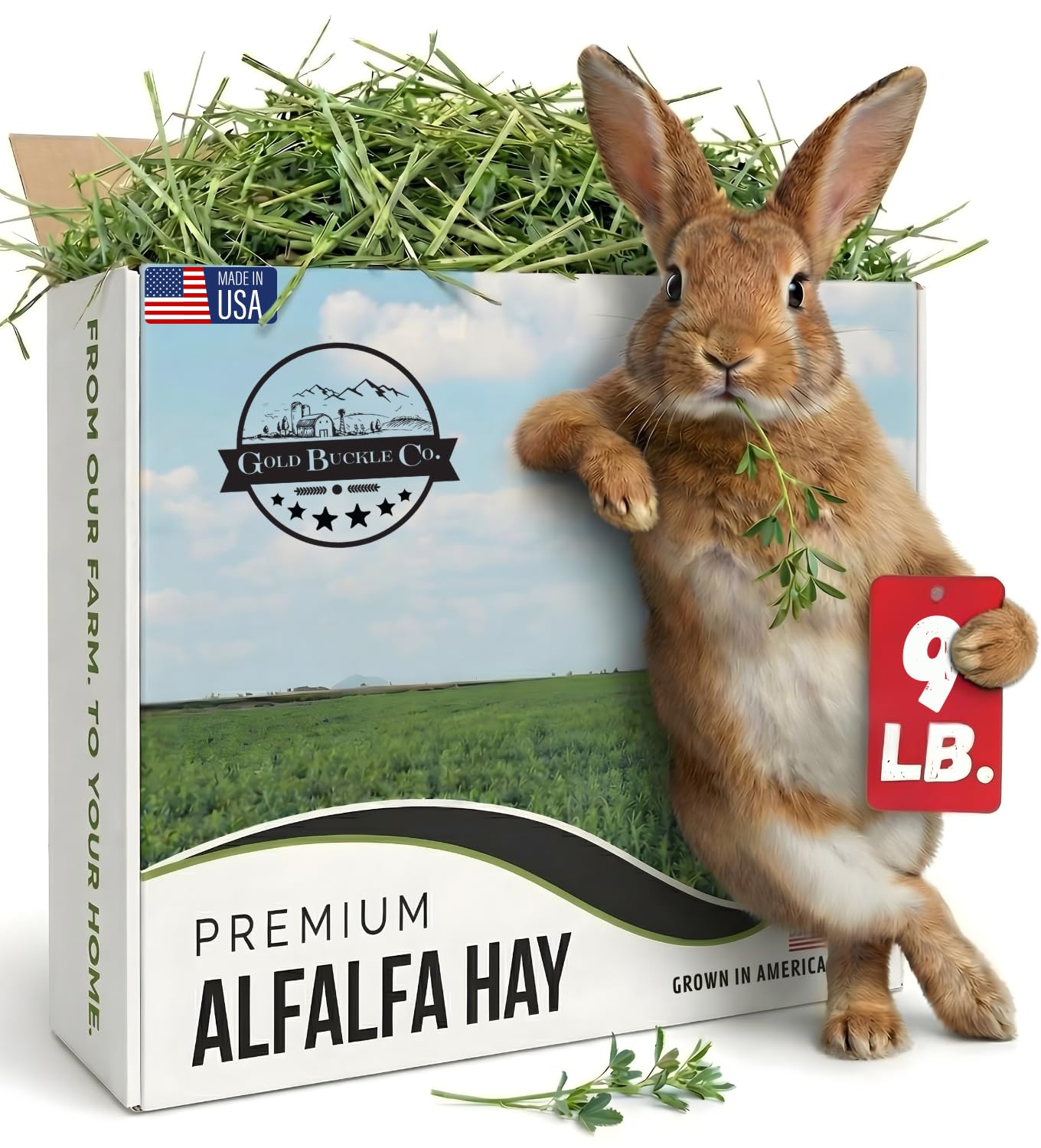
This 9-pound offering from a fourth-generation Utah family farm represents the ideal balance of volume and freshness for goat keepers. Grown in the High Desert where hot days build rich leaf growth and cool nights lock in nutrients, this alfalfa arrives with a visibly high leaf-to-stem ratio that goats eagerly consume with minimal waste. The crude protein level typical of early-cut alfalfa supports lactation and kid growth without requiring heavy grain supplementation.
The premium packaging uses a carton designed to retain moisture content (keeping the hay supple rather than brittle) and block out the environmental contaminants that degrade cheaper hay during transit. At 9 pounds, this is the largest single-package option here — enough for a small herd of two to three goats for roughly a week, depending on supplementary grazing. Each bale is hand-selected and hand-sorted on the farm, so you consistently receive alfalfa that smells sweet rather than dusty.
Owners consistently report that even picky eaters clean up these leafy flakes without leaving behind coarse stems. Keep in mind that the total weight includes the packaging, but the actual hay volume still outperforms most 5-pound competitors on a cost-per-fiber basis. For goat keepers who want a reliable source of high-protein alfalfa from a farm with genuine agricultural roots, this is the strongest choice in the lineup.
Why we love it
- High leaf-to-stem ratio reduces waste
- 9 lb. quantity suits small-to-medium herds
- Family-grown with transparent sourcing
Good to know
- Packaging adds some weight to the stated 9 lb.
- Only available in a carton format, not compressed bale
2. Gold Buckle Co 5lb Farm Fresh Alfalfa Hay

This is the same premium High Desert alfalfa as the 9-pound option, but in a smaller 5-pound carton that works perfectly for keepers with one or two goats or for those wanting a trial run before committing to a larger volume. The crude protein and calcium levels remain identical — rich enough to support growing kids and nursing does — and the hand-picked, hand-sorted process ensures you get leafy flakes rather than stemmy leftovers that goats simply ignore.
Being from the same fourth-generation Utah farm, the consistency between batches is stronger than what most commercial hay suppliers offer. The 5-pound carton also makes storage easier if you lack a dedicated hay shed or have to rotate feed quickly to maintain freshness. Because the carton is sealed with freshness in mind, the moisture content stays higher than open bales, preserving the soft texture that goats prefer over brittle, aged hay.
One practical note: because this is a denser carton than a loose bale, you’ll need to break the flakes apart by hand before feeding to prevent greedy eaters from swallowing too fast. It’s a small step that pays off in reduced gorging risk. The “organic” label gives extra peace of mind for owners who manage herds with feed sensitivities or who want to avoid pesticide residues in their milk or meat animals.
Why we love it
- Certified organic and additive-free
- Same farm quality as the 9 lb. but easier to store
- High leaf content drives strong palatability
Good to know
- 5 lb. goes fast with two goats
- Smaller volume costs more per pound than bulk options
3. Viking Farmer 1st Cut Timothy Hay, 8 Lbs

First-cut Timothy is harvested earlier in the season than later cuttings, which means it contains more fiber and slightly lower protein — typically in the 8 to 12 percent range — making it an excellent staple hay for dry adult goats and wethers that don’t need alfalfa’s calcium punch. This 8-pound bag from Viking Farmer offers a consistent, stemmy texture that encourages proper rumination and dental wear without overloading the animal with energy-dense nutrients.
Goat owners who have dealt with urinary calculi in bucks often switch to a grass hay like this to lower the calcium-to-phosphorus ratio. The bag format also makes it easier to gauge how much you’re feeding compared to a loose bale, which helps prevent overfeeding. The odor test is reliable here — Viking Farmer’s innovative farming process yields a sweet, fresh scent that indicates low mold risk and proper field drying.
One detail that sets this apart from other Timothy hays is the long-stem length; goats have to chew it thoroughly, which is exactly what their rumen needs to function correctly. The fiber length also reduces the risk of bloat compared to finely chopped or pelleted feeds. Keep this on hand as a base hay and offer alfalfa as a supplement for lactating does — your feed costs will drop without sacrificing overall herd health.
Why we love it
- Low calcium ideal for bucks and wethers
- Long-stem fiber promotes healthy rumination
- Sweet smell indicates low mold risk
Good to know
- Not enough protein for lactating or growing animals
- Coarse stems may be rejected by very selective eaters
4. Oxbow Western Timothy Hay, 90 oz.

Oxbow’s Western Timothy Hay is a staple in the small-pet world, but it works well as a grass hay option for goats in maintenance mode. At 90 ounces (5.6 pounds), this bag provides a moderate supply of long-stem fiber that supports dental health and slows the passage rate through the rumen. Hand-sorted and packed on U.S. farms, the consistency from bag to bag is exceptional for a mass-produced hay product.
The nutritional profile — roughly 8-9 percent crude protein — is appropriate for adult goats that are not producing milk or finishing for meat. Owners who transition their herd onto this hay report that the stalks are fine enough for small goats but still provide the mechanical abrasion needed to prevent overgrown teeth. Because it’s a grass hay, you can free-feed it without worrying about your goats developing urinary calculi from excess calcium.
Be aware that this is marketed primarily toward small pets like rabbits and guinea pigs, so the bale is not compressed like a farm bale. You’ll need to fluff it before feeding to avoid clumping. For a mixed herd where a few animals need alfalfa and others need grass, this Timothy hay makes an excellent base roughage that you can rotate with a protein-rich alfalfa option for the high-demand goats in your barn.
Why we love it
- Veterinarian-recommended quality control
- Fine stems work well for smaller goat breeds
- Can be free-fed without causing calcium overload
Good to know
- Only 5.6 lb. — small for a multi-goat herd
- Not nutrient-dense enough for lactating does
5. Grandpa’s Best Alfalfa Hay, 5 lbs

Grandpa’s Best offers a compact 5-pound block of alfalfa hay that’s soft-stemmed and leafy, making it a serviceable entry-level option for goat keepers who are just starting to add hay as a primary roughage. The hay is grown on U.S. farms without added binders or preservatives, and the block format measures roughly 6x6x12 inches — small enough to slip into tight storage spaces or to carry out to the pasture without wrestling with a full-size bale.
Because the hay is described as “soft-stemmed,” it’s easier on young kids transitioning from milk to solid feed and on older goats with worn teeth. The protein levels are typical of mid-grade alfalfa, meaning it’s high enough to support moderate production but not as leaf-dense as the hand-selected Gold Buckle Co. products. For owners who just need to supplement pasture grazing rather than feed hay as the sole ration, this 5-pound block fills the gap without a big commitment.
One trade-off is consistency — some bags arrive with a higher proportion of stems than leaves, which leads to more waste if your goats are picky. The dense block also requires some manual breaking apart to prevent a goat from taking one big bite that could compact in the rumen. For a first hay purchase or for keeping a small emergency stash, this is a perfectly adequate pick, but serious goat operations will want to move up to the Gold Buckle Co. or Viking Farmer options for better uniformity.
Why we love it
- Compact 6x6x12 block fits tight storage
- Additive- and preservative-free
- Soft stems gentle on young or senior goats
Good to know
- Leaf-to-stem ratio can vary between bags
- 5 lb. block is a small quantity for daily feeding
FAQ
Can I feed only alfalfa hay to my goats?
How do I know if the hay is too stemmy for goats?
Is Timothy hay better than alfalfa for goats?
Final Thoughts: The Verdict
For most goat keepers, the best hay to feed goats winner is the Gold Buckle Co 9lb Farm Fresh Alfalfa Hay because it delivers a consistent high leaf-to-stem ratio in a generous 9-pound volume backed by honest U.S. farm sourcing. If you want a lower-calcium option for bucks or wethers, grab the Viking Farmer 1st Cut Timothy Hay — its high-fiber, long-stem texture supports healthy rumen function without overloading protein. And for a smaller trial order that’s easy to store, nothing beats the Gold Buckle Co 5lb Alfalfa Hay.