
A hoof wall that looks like a dry riverbed is more than cosmetic — it’s a structural failure waiting to cause lameness. When the hoof wall loses its moisture balance, the keratin layers separate, creating vertical cracks and splits that invite bacteria and worsen with every stride on hard ground. The right topical treatment penetrates the tubules, restores pliability, and seals the surface against further moisture loss.
I’m Mo Mahin — the founder and writer behind Furric. I’ve spent countless hours cross-referencing veterinary podiatry journals and farrier forums, analyzing the absorption rates and film-forming properties of over a dozen commercial hoof dressings, and stacking owner-reported outcomes against manufacturer claims to isolate what actually reverses crack propagation.
Whether you need a daily maintenance oil, a wax-based sealant, or a nutrient-packed conditioner that rebuilds integrity from the outside in, this guide breaks down the best formulations for keeping the hoof capsule intact and resilient. Here is our complete analysis of the best hoof conditioner for cracked hooves.
How To Choose The Best Hoof Conditioner For Cracked Hooves
Not every bottle on the tack shelf will stop a crack from running up the hoof wall. The core mechanism of a true conditioner is its ability to replace displaced water molecules inside the keratin matrix without over-saturating the hoof. You need to evaluate three things before you buy.
Base Composition: Oil vs. Wax vs. Petroleum
Oil-based conditioners (mineral oil, neatsfoot oil, pine tar) penetrate the hoof wall’s tubules and restore internal flexibility without creating a non-breathable barrier. Wax-heavy or petroleum-based products sit on the surface — they offer a shiny finish and short-term water resistance, but they may trap moisture against the sole and prevent the hoof wall from releasing excess humidity. For actively cracked hooves, oil-based penetration is the priority; wax-based products are better suited for hoof maintenance after the crack has sealed.
Humidity Swings: The Climate Match
Dry, arid environments pull water out of the hoof wall faster than the horse’s body can replace it via the coronary band. In these conditions, a thicker conditioner with a higher percentage of lanolin or petroleum oil helps retain every drop. In wet, muddy climates, a thin oil that allows moisture vapor to escape is critical — sealing water inside an already wet hoof wall encourages bacterial thrush. Match the conditioner’s film thickness to your local rainfall average.
Bacterial & Fungal Barriers
A crack is an open door to microbial invasion. The best conditioners double as topical antiseptics. Pine tar has been used for over a century as a natural antifungal and antibacterial agent. Formulas with added tea tree oil, iodine-based complexes, or chlorhexidine offer extra protection. If your horse has a history of white line disease or thrush, choose a conditioner with an active antimicrobial component rather than a purely moisturizing formula.
Quick Comparison
On smaller screens, swipe sideways to see the full table.
| Model | Category | Best For | Key Spec | Amazon |
|---|---|---|---|---|
| SOUND Hoof Conditioner | Premium | Dry climate daily conditioning | Wax-free, petroleum-free | Amazon |
| Farnam Rain Maker | Premium | Triple-action moisture retention | 32 oz with neatsfoot & glycerine | Amazon |
| Fiebing’s Hoof Oil | Mid-Range | Mineral oil saturation for splits | 32 oz with built-in brush | Amazon |
| Absorbine Hooflex | Mid-Range | Fast-absorbing all-natural care | 15 oz no-grease formula | Amazon |
| Bickmore Pine Tar | Value | Antimicrobial crack protection | 32 oz 100% natural pine tar | Amazon |
In‑Depth Reviews
1. SOUND Hoof Conditioner

The SOUND Hoof Conditioner occupies a unique space — a premium oil that refuses to rely on wax or petroleum as a carrier. This matters because wax and petroleum can suffocate the hoof wall’s ability to regulate its own humidity cycle; without them, the conditioner penetrates the keratin tubules deeply and uniformly. Owner reports consistently note a visible reduction in small vertical cracks within two weeks of daily application, particularly in arid environments where humidity drops below 30%.
The 10-ounce bottle is smaller than most competitors, but the high viscosity and dense nutrient load mean a single washcloth swipe per hoof per day is sufficient. The formula includes essential vitamins that support coronary band health, attacking the crack problem from the source. Users describe the smell as vanilla or cake-like — a welcome departure from heavy-tar or medicinal odors that some horses resent.
One repeated observation from long-time customers is that switching to this product from a wax-based dressing initially makes hooves look less glossy, but the internal flexibility gains are noticeable at the farrier’s next visit. The lack of petroleum also means it won’t stain concrete or tack room flooring as aggressively. For anyone managing cracks in dry conditions, this is the most targeted tool on the shelf.
Why we love it
- Penetrates deeply without leaving a waxy surface seal that blocks respiration
- Pleasant vanilla scent makes application easy even for sensitive horses
- Zero petroleum or wax means no staining and no interference with hoof moisture regulation
Good to know
- 10-ounce bottle provides less total volume than budget alternatives at this price tier
- Best suited for dry climates — may not provide enough film thickness for extremely wet environments
2. Farnam Rain Maker Triple Action Hoof Moisturizer
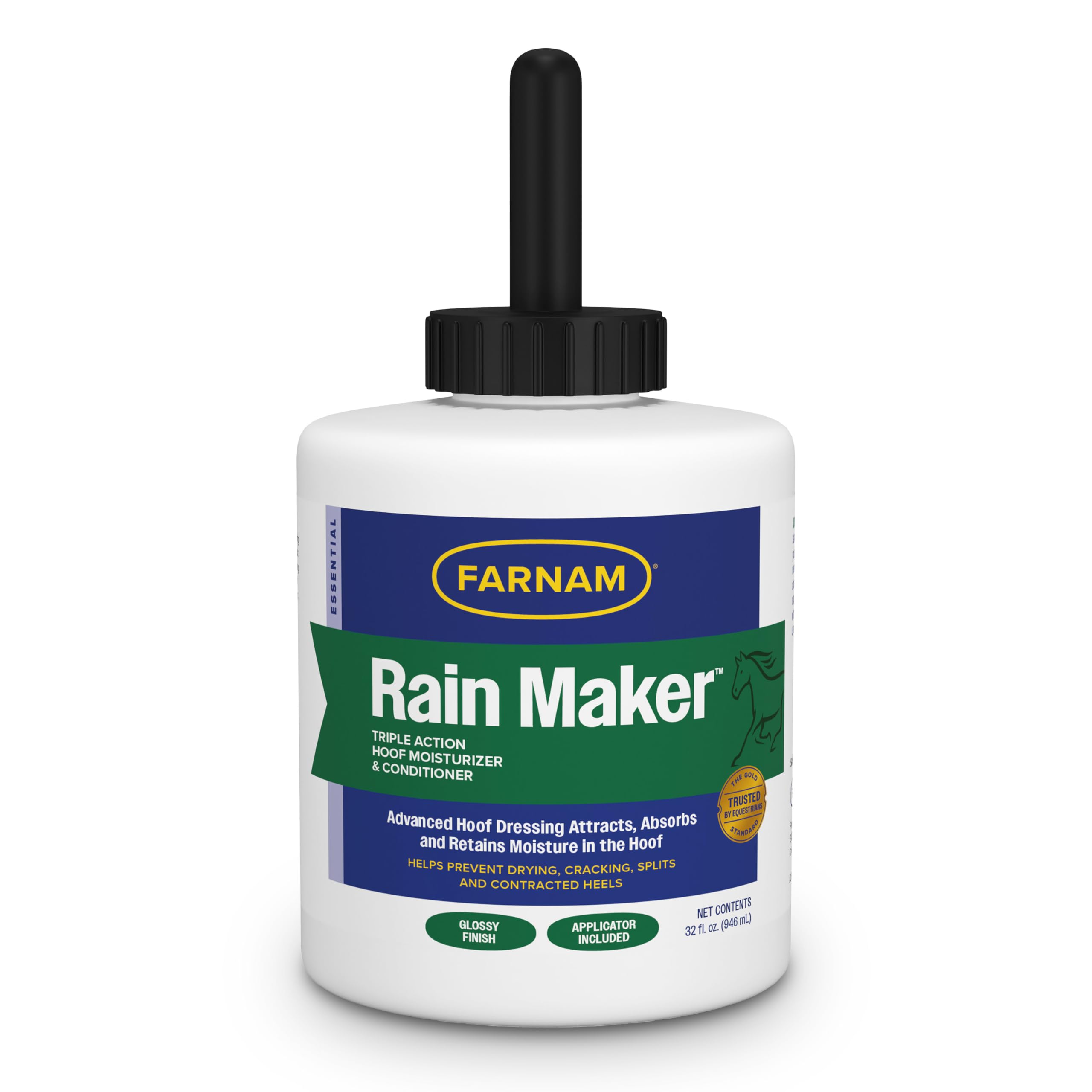
Farnam’s Rain Maker is a legacy product that has earned recommendations from equine podiatrists for its triple-action mechanism: it attracts moisture from the environment, absorbs it into the hoof wall layers, and then locks it in with a glossy surface film. The 32-ounce container with a built-in brush is the largest volume-per-dollar option in the premium tier, making it a favorite for multi-horse barns or heavy-use scenarios.
Users frequently cite the presence of neatsfoot oil as the key differentiator — neatsfoot oil is a highly refined animal fat that mimics the natural oils of the hoof wall better than mineral oil alone. The blend also includes petrolatum, which sets it apart from the petroleum-free formulas above; this means Rain Maker shines best when applied in dry, desert-like conditions where moisture escape is the primary enemy. The consistency is thick enough to stay on vertical hoof walls without dripping.
The main trade-off is the scent — reviews consistently describe it as “BBQ sauce” or “strange vinegar” that lingers. A few owners noted that when the temperature drops below 40°F, the formula becomes stiff and difficult to spread without warming the bottle. For owners dealing with deep cracks in arid environments who prioritize volume and vet-endorsed performance, Rain Maker remains the benchmark.
Why we love it
- Vet- and farrier-recommended pedigree with a track record for preventing split heels
- Large 32-ounce bottle offers the best total value per application in the premium range
- Triple-action mechanism (attract, absorb, retain) is ideal for extreme dry weather hoof management
Good to know
- Strong BBQ-like odor may be unpleasant in enclosed barn spaces
- Petrolatum content means it won’t fully absorb into the hoof wall and can stain surfaces
3. Fiebing’s Hoof Oil for Horses

Fiebing’s has been on ranch shelves since 1895, and this mineral-oil-based formula remains a staple for good reason: it is straightforward, effective, and priced to use liberally. The 32-ounce bottle comes with a large integrated applicator brush that makes daily application fast — one pass on the hoof wall and one on the sole and frog area is all it takes to maintain moisture balance in climates that oscillate between wet and dry.
Reviewers consistently praise how easily the oil spreads across the hoof surface and how quickly it soaks in without leaving a tacky residue. The satin finish it leaves is a visual indicator that the hoof has absorbed enough product — a glossy shine means saturation has been achieved. Several farriers have noted that using Fiebing’s 2–3 times per week helps retain shoe adhesion in Thoroughbreds with brittle feet. The formula resists running in warmer weather, staying where it is brushed.
The main drawback is that as a pure mineral oil blend, it lacks the antimicrobial or antifungal properties found in pine tar or the enriched vitamins in the SOUND formula. It is a pure moisturizer — excellent for preventing cracks from forming, but less targeted as a repair agent for existing deep vertical separations. If your horse has a confirmed infection in the crack line, you will need a separate topical antiseptic.
Why we love it
- Century-old manufacturing pedigree trusted by U.S. Cavalry and modern farriers alike
- Generous 32-ounce volume with a user-friendly brush cap for rapid daily application
- Mineral oil base absorbs quickly and leaves a satin visual indicator of proper saturation
Good to know
- Stains concrete surfaces — apply on grass or over a catch mat to avoid clean-up
- Lacks built-in antimicrobial or antifungal properties for treating infected cracks
4. Absorbine Hooflex All Natural Dressing & Conditioner
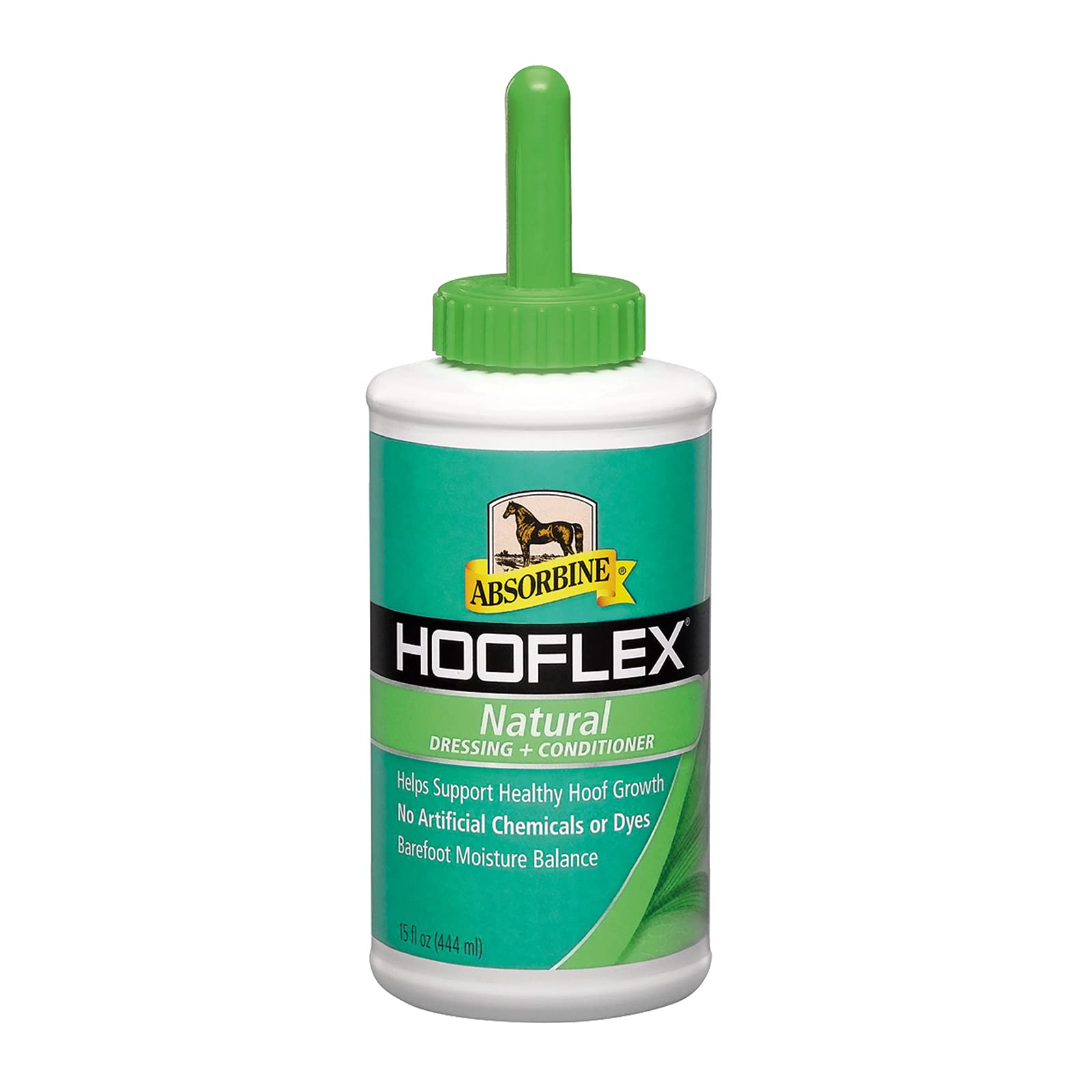
Absorbine Hooflex is the answer for owners who need a no-mess, low-odor daily dressing that won’t interfere with riding or stall bedding. The formula is all-natural — free from artificial colors and dyes — and penetrates fast enough that you can brush it on and lead the horse outside immediately without worrying about slipperiness. The 15-ounce bottle is modest in size, but the liquid’s low viscosity means a little covers a lot of hoof surface.
Customers moving their horses from humid to dry climates have specifically reported that Hooflex prevented the chipping and cracking that often appears during the first 30 days of climate transition. The dressing is designed to support the hoof’s natural moisture balance rather than forcing moisture in — this makes it a strong choice for owners who want to maintain healthy hooves without over-conditioning. Farriers often recommend it for daily use between farrier visits because it does not soften the hoof excessively.
The primary limitation is that the all-natural oil blend is lightweight — it excels at maintenance but is not designed to tackle existing deep cracks that require a heavy sealant or antimicrobial barrier. For recovery scenarios where a crack has already opened, you may want to alternate Hooflex with a thicker, tar-based product. For routine prevention, this is the most convenient option in the lineup.
Why we love it
- Fast-absorbing, non-greasy finish that works well under riding boots and wraps
- No artificial dyes or chemicals — ideal for sensitive horses and organic-conscious owners
- Excellent transition tool for horses moving between drastically different climates
Good to know
- Lightweight formula lacks the viscosity needed to seal deep vertical cracks
- 15-ounce bottle requires more frequent replacement than larger alternatives
5. Bickmore Pine Tar 32oz

Bickmore Pine Tar is not a modern conditioner — it is a 100% natural tree distillate that has been used in equine care for generations, and it remains one of the few products on the market that simultaneously conditions the hoof wall and provides active antimicrobial protection. Owners report curing thrush within a week of daily application, and the same pine tar compounds that fight bacteria also help retain hoof moisture by forming a breathable film on the surface.
The 32-ounce container is entry-level pricing, but the product’s versatility extends beyond hoof care — reviewers use it for baseball bat grip, fence post preservation, and even cold-process soap making. For cracked hooves specifically, its thick, sticky consistency allows it to be packed into the crack itself, sealing out dirt and bacteria while the tar’s antiseptic properties prevent infection from taking hold inside the separation.
There is one catch: this is straight pine tar with no added vitamins, oils, or conditioners. It will not make the hoof look glossy or smell pleasant — the smoky, medicinal scent is strong and hangs around. The texture can also be messy if applied carelessly. For owners dealing with cracked hooves complicated by bacterial involvement, thrush, or white line disease, this budget-friendly tar is a powerful tool that outperforms many fancier conditioners in infection control.
Why we love it
- Naturally antimicrobial — actively fights thrush, fungus, and bacteria in open cracks
- Incredibly versatile and budget-friendly for the value it provides across multiple uses
- Thick consistency can be packed directly into crack fissures as a sealant
Good to know
- Strong smoky odor is persistent and may be unappealing in enclosed storage
- Sticky, tar-like texture is messier to apply than traditional oil or cream conditioners
FAQ
Can I use hoof oil on a hoof that has thrush or white line disease?
How long does it take for a hoof conditioner to close a crack?
Should I avoid conditioners with wax if my horse lives in a wet climate?
Does a hoof conditioner need to smell good to be effective?
Can I alternate two different conditioners for better results?
Final Thoughts: The Verdict
For most owners managing cracked hooves, the hoof conditioner for cracked hooves winner is the SOUND Hoof Conditioner because its wax-free, petroleum-free formula penetrates the hoof wall deeply without blocking natural moisture regulation, making it ideal for reversing and preventing cracks in dry conditions. If you need a wide-volume triple-action approach for multi-horse barns in extreme arid climates, grab the Farnam Rain Maker. And for antimicrobial power at an entry-level price, nothing beats the Bickmore Pine Tar for cracking with bacterial or fungal complications.