
The single biggest mistake homeowners make with allergies is assuming their standard furnace filter is doing the heavy lifting. Most builders-installed filters stop at MERV 4 or MERV 8—fine for protecting the blower motor, but nearly useless for capturing the pollen, mold spores, pet dander, and dust mite debris that trigger your sinuses the moment you walk through the door. Switching to a proper allergy-grade filter is the only way to turn your HVAC system from a particle circulator into a whole-home air purifier.
I’m Mo Mahin — the founder and writer behind Furric. Over the past decade I’ve analyzed tens of thousands of owner reviews, cross-referenced MERV vs. MPR vs. FPR ratings across more than 200 furnace filter SKUs, and studied the airflow-resistance tradeoffs that determine whether a high-efficiency filter actually hurts your system instead of helping it.
This guide narrows a crowded shelf down to the five hvac filters for allergies that genuinely balance capture efficiency with acceptable static pressure drop for most residential systems.
How To Choose The Best HVAC Filters For Allergies
Selecting an allergy filter isn’t just about grabbing the highest number on the package. The wrong choice can restrict airflow so severely that your evaporator coil freezes or your blower motor burns out prematurely. Here are the three factors that matter most when you buy HVAC Filters For Allergies.
MERV Rating — The Filtration Benchmark
Minimum Efficiency Reporting Value (MERV) is the industry-standard scale from 1 to 16. For residential allergy relief, MERV 13 is the consensus sweet spot: it captures 90% of particles between 1 and 3 microns (pollen, dust mite debris, mold spores, pet dander) without the excessive pressure drop of MERV 14–16 that many 1-inch residential filters aren’t designed to handle. MERV 8, by contrast, catches only about 35% of those same 1–3 micron particles.
Airflow Resistance — The Hidden Tradeoff
Each filter has a rated pressure drop measured in inches of water column. A high-MERV filter with dense pleating can restrict airflow by 30–50% compared to a basic fiberglass model. If your HVAC system uses a PSC motor (most older units), excessive resistance reduces airflow and can cause short-cycling or frozen coils. ECM motors handle higher static pressure better, but even then, you need a filter that balances capture with breathability. Look for electrostatic media with a low-pressure-drop design—those often advertise “low airflow resistance” explicitly.
Actual Fit vs. Nominal Size
A filter labeled 16x20x1 almost never measures exactly 16x20x1. Expect the actual dimensions to be about ¼ to ½ inch shorter in length and width, and roughly ¼ inch thinner. A filter that’s too small lets unfiltered air bypass the media entirely, rendering your MERV rating useless. The “actual size” is always printed somewhere—match that to your filter slot, not the nominal label. Brands that include beverage-board frames with dual wire backing resist warping better than cardboard, especially in humid climates.
Quick Comparison
On smaller screens, swipe sideways to see the full table.
| Model | Category | Best For | Key Spec | Amazon |
|---|---|---|---|---|
| Filtrete 20x20x1 MERV 14 4-Pack | Premium | Highest allergen capture in a 1-inch media | MERV 14 / MPR 2500 | Check Price |
| Chenzhit 16x24x1 MERV 13 6-Pack | Premium | Large-volume DIY filtration (Corsi-Rosenthal boxes) | MERV 13 / MPR 1900 | Check Price |
| PuroAir MegaFilter 16x20x1 MERV 13 | Mid-Range | Odor + particle capture for allergy sufferers | MERV 13 + Carbon Tech | Check Price |
| Qingzhug 14x14x1 MERV 13 6-Pack | Mid-Range | Best value per filter for MERV 13 in odd sizes | MERV 13 / MPR 1900 | Check Price |
| Filterbuy 20x20x1 MERV 8 6-Pack | Budget | Routine replacement for minimal airflow restriction | MERV 8 / MPR 700 | Check Price |
In-Depth Reviews
1. Filtrete 20x20x1 AC Furnace Air Filter MERV 14, 4-Pack
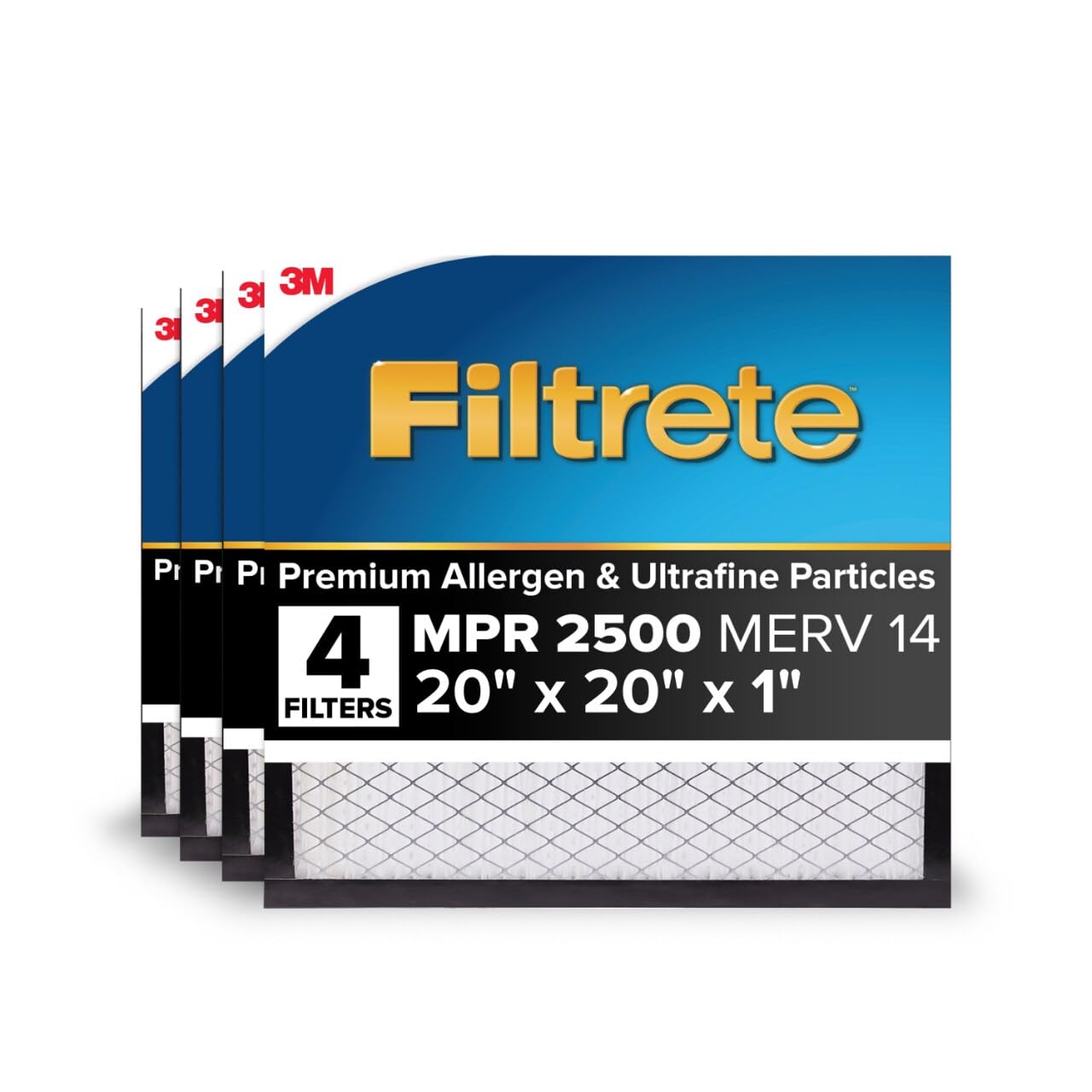
This is the premium benchmark for a reason. Filtrete’s MERV 14 media—equivalent to MPR 2500—captures 77% of particles in the 0.3–1.0 micron range, meaning ultrafine smoke, bacteria, and virus carriers are trapped alongside the larger pollen and dust mite debris. The 3M proprietary 3-in-1 electrostatic media maintains that capture rate while keeping airflow resistance low enough for most residential ECM and PSC systems, provided you replace at the recommended 90-day interval.
Owner feedback consistently mentions a tangible drop in visible household dust within the first week, plus noticeable relief for spring and fall allergy seasons. The 4-pack configuration covers a full year for a single return. Actual dimensions are 19.63 x 19.63 x 0.78 inches—slightly under nominal 20x20x1, but within standard tolerances for a snug seal. The rigid frame uses a dense beverage-board material with visible metal mesh backing that holds its shape even in humid basements.
The tradeoff is the upfront investment, which lands above commodity MERV 8 packs. Also, owners with older PSC blowers on 1-ton systems should verify their manual can handle MERV 14 static pressure—if airflow drops noticeably, stepping down to MERV 13 (Filtrete’s MPR 1900 variant) is a safer play.
Why we love it
- Near-HEPA particle capture in a 1-inch residential media
- Certified Asthma & Allergy Friendly by AAFA
- Metal mesh backing prevents frame warping in high humidity
- Smart app reminders reduce the chance of missed change dates
Good to know
- Premium cost; budget shoppers may prefer MERV 13 alternatives
- May be too restrictive for very small PSC systems
- Not ideal for heavy odor control (no carbon layer)
2. Chenzhit 16x24x1 MERV 13 Pleated Air Filter, 6-Pack
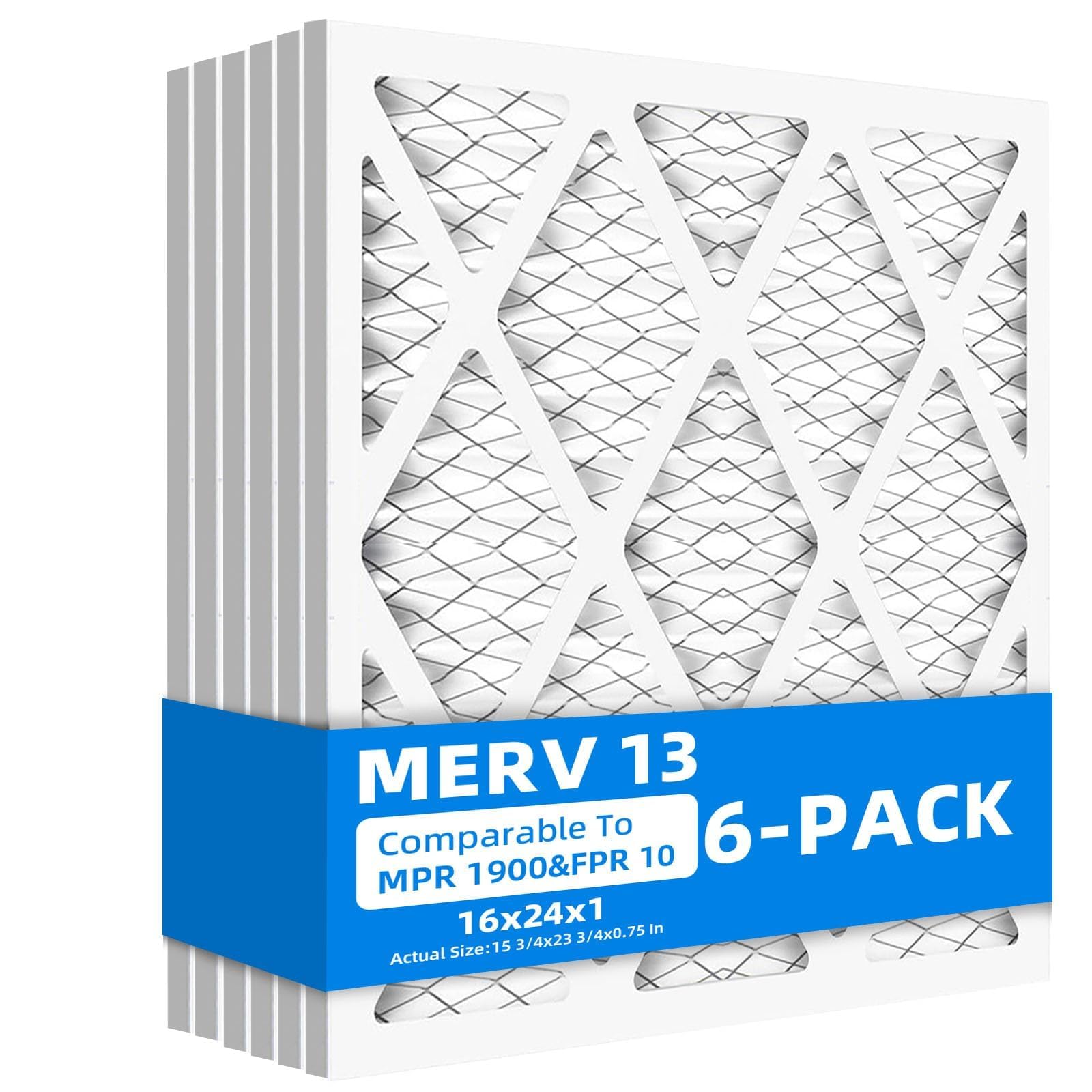
This 6-pack delivers MERV 13 performance at a cost per filter that makes it ideal for homes with large filter grilles and for DIY air purifier builders. The synthetic electrostatic media is rated at MPR 1900 (FPR 10), meaning it captures 90%+ of 1–3 micron allergens—pollen, mold, dust mite debris—without the density that makes MERV 14 a risk for marginal blowers. Owner reviews confirm it lasted six months in a Corsi-Rosenthal box, which speaks to the media’s dust-loading capacity.
Actual dimensions of 15.75 x 23.75 x 0.75 inches are consistent with industry standards for nominal 16x24x1. The pleats are deep and evenly spaced, with a cardboard frame that holds shape decently in moderate humidity. Multiple verified buyers noted the fit was snug against their filter rails with no air bypass. For the price of a 6-pack, you’re paying roughly half what name-brand MERV 13 filters cost per unit.
The material quality is solid for the price point, though the cardboard frame isn’t as rigid as the beverage-board construction on the Filtrete or PuroAir options. If your return grill is in a damp crawlspace or basement, consider checking the frame for softness after a few weeks. A few owners also noted that the packaging could be more protective—filters arrived with minor corner dents, though this didn’t affect performance.
Why we love it
- Exceptional value per filter for MERV 13 performance
- Lasts up to 180 days in low-dust environments
- Works well for Corsi-Rosenthal DIY air purifiers
- Low airflow resistance suitable for PSC motors
Good to know
- Cardboard frame is less durable than beverage-board options
- Packaging could be more puncture-resistant during shipping
- No activated carbon layer for odor removal
3. PuroAir MegaFilter 16x20x1 MERV 13 with Activated Carbon
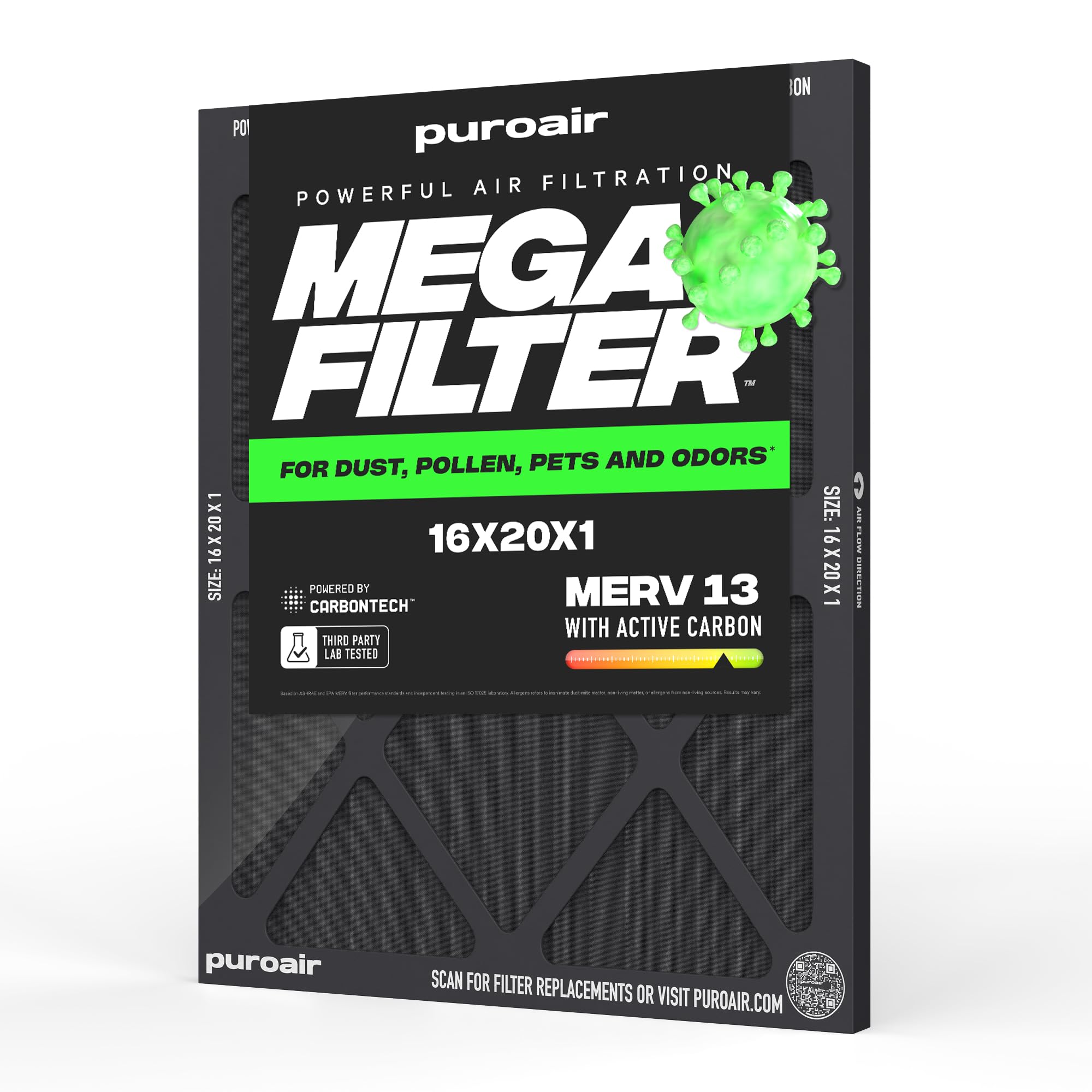
The PuroAir MegaFilter stands out because it layers activated carbon onto a MERV 13 electrostatic media—a rare combination in a 1-inch filter. Most allergy filters focus purely on particle capture, leaving VOCs, cooking odors, and smoke untouched. PuroAir’s CarbonTech layer uses a proprietary blend of activated carbon to adsorb a portion of those gaseous irritants while the MERV 13 pleats catch pollen, dander, and dust. The three-layer design (prefilter, MERV 13 media, carbon layer) means it can handle larger lint and hair on the upstream side before the fine particulates hit the charged media.
Owner reports consistently highlight a noticeable improvement in air freshness within the first day, plus a reduction in visible dust accumulation on surfaces. Several verified buyers specifically mention relief from seasonal hay fever symptoms and less sneezing in pet-heavy homes. The filter’s actual dimensions (15.75 x 19.75 x 0.75 inches) match standard 16x20x1 slots precisely, and the beverage-board frame with wire backing resists warping better than cardboard alternatives.
The carbon layer does add some airflow resistance compared to a plain MERV 13 filter—this is the physics of gas adsorption. Owners with very small furnaces (under 2 tons) or restrictive ductwork should monitor static pressure after installation. A few buyers also noted that the carbon layer is less effective against strong food odors like fish or curry, which is consistent with the limited carbon mass possible in a 1-inch depth.
Why we love it
- Combines MERV 13 particle capture with activated carbon for odors
- 3-layer design extends filter life by catching large debris upstream
- Beverage-board frame with wire backing resists moisture warping
- Noticeable improvement in air freshness per owner feedback
Good to know
- Carbon layer adds airflow resistance—check static pressure
- Not as effective against strong cooking odors as a dedicated carbon filter
- Higher cost per filter than plain MERV 13 options
4. Qingzhug 14x14x1 MERV 13 Pleated Air Filter, 6-Pack
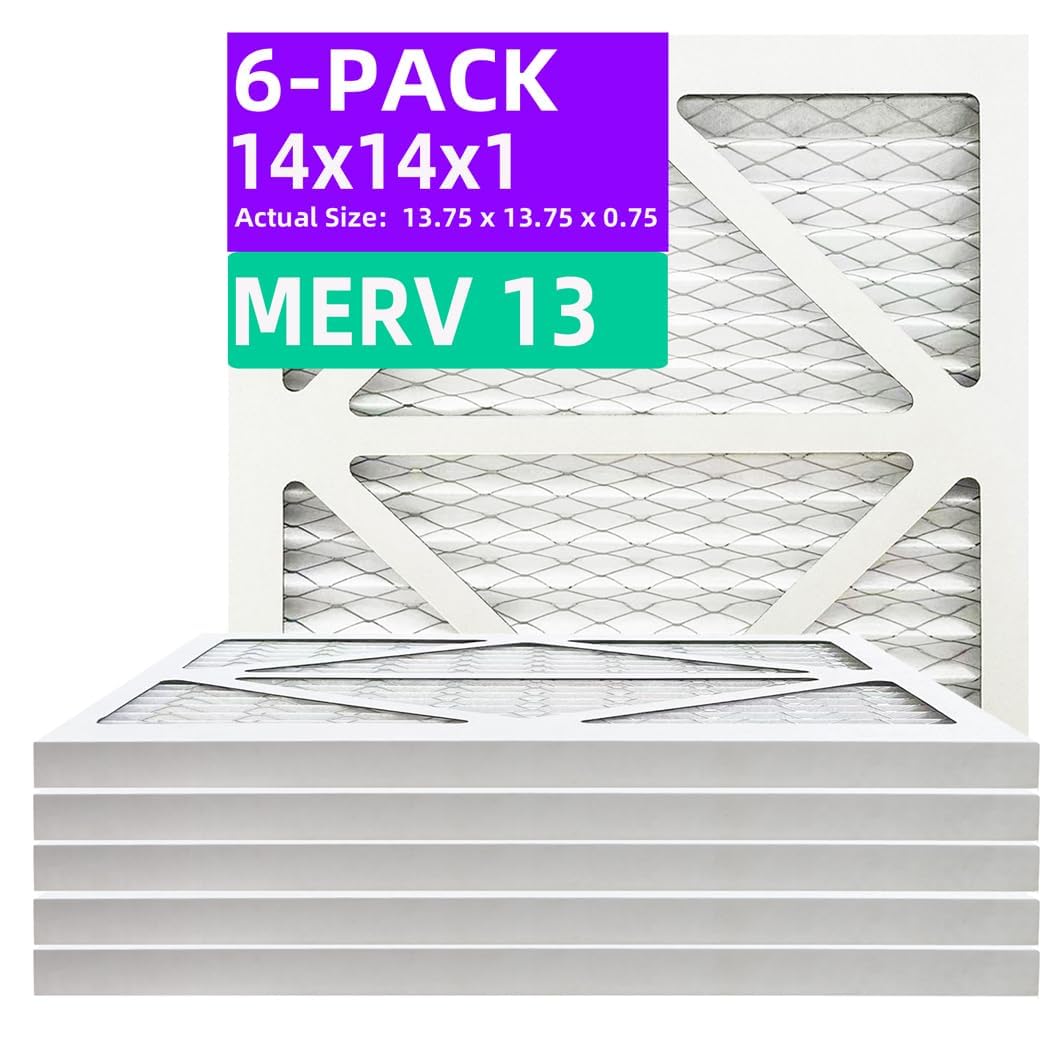
For homeowners with non-standard filter sizes (14x14x1 is common in apartment units and small return grilles), this 6-pack offers MERV 13 performance at a per-filter cost that rivals many lower-grade MERV 8 packs. The 100% synthetic electrostatic media is equivalent to MPR 1900 and FPR 10, meaning it captures the same 1–3 micron allergen range as premium name brands for a fraction of the price. Verified owners with pets and allergy-sensitive visitors specifically noted that the filter trapped enough debris to keep evaporator coils clean between seasonal swaps.
Actual dimensions are 13.75 x 13.75 x 0.75 inches—standard for nominal 14x14x1. The pleats are dense but not overly tight, allowing adequate airflow for PSC motors. Multiple reviews mention the filter is “thick enough to feel durable” but doesn’t choke the system. The cardboard frame is adequate for dry interior environments, though owners in humid regions should inspect for softness after 60 days of use.
The main compromise is brand recognition and packaging. The frames use standard cardboard rather than the beverage-board material found on premium options. A few early reviews noted that the included “frame reinforcements” are minimal, so careful handling during installation is recommended to avoid bending the edges. Still, for the price of a 6-pack, this is the most accessible entry point to genuine MERV 13 protection for allergy sufferers.
Why we love it
- Lowest cost-per-filter for MERV 13 among the picks
- 6-pack covers 12–18 months for a single return
- Works well with PSC motors per owner feedback
- Fits uncommon 14x14x1 slots that many brands skip
Good to know
- Cardboard frame less durable in humid environments
- Minimal frame reinforcement; handle gently during install
- No odor-reducing carbon layer
5. Filterbuy 20x20x1 MERV 8 Dust & Allergy Defense, 6-Pack

Not every HVAC system can handle MERV 13. Older furnaces with 1-ton PSC blowers or very restrictive ductwork may restrict airflow dangerously with dense pleated media. For those systems, Filterbuy’s MERV 8 provides a practical middle ground that still captures 90% of particles larger than 3 microns—pollen, lint, dust mites, and mold spores—without choking the blower. At MPR 700 and FPR 5, it’s roughly twice as efficient as a basic fiberglass filter while imposing minimal static pressure drop.
The construction stands out: a beverage-board frame with dual wire backing that outperforms the flimsy cardboard used on many budget filters. The media has 14 pleats per foot, which is denser than typical MERV 8 filters and extends the useful life to the recommended 90-day change interval. Verified owners in dusty climates and homes with cats specifically noted they could see the filter darkening month over month, indicating good capture. Many also commented that the price for a 6-pack is lower than a single name-brand MERV 8 filter at retail stores.
The tradeoff is obvious: MERV 8 simply doesn’t capture the smallest particles (1–3 microns) that trigger allergic rhinitis in sensitive individuals. If your blower can handle MERV 13, you should absolutely step up. But for owners with finicky systems, a MERV 8 changed every 30 days during high-pollen season is a safer strategy than a MERV 13 that starves the unit of airflow.
Why we love it
- Beverage-board frame with dual wire backing resists warping
- Lowest airflow resistance—safe for older PSC systems
- 6-pack price beats retail store single-filter costs
- 14 pleats per foot for extended service life
Good to know
- MERV 8 misses most 1–3 micron allergy particles
- Not ideal as a standalone defense for severe allergy sufferers
- No carbon layer for odor control
FAQ
Will a MERV 13 filter damage my furnace?
How often should I change my HVAC filter during high-pollen season?
What is the difference between MERV, MPR, and FPR?
Do I need a carbon layer in my allergy filter?
Final Thoughts: The Verdict
For most households, the hvac filters for allergies winner is the Filtrete 20x20x1 MERV 14 4-Pack because it delivers the highest particle capture available in a 1-inch residential media without sacrificing airflow for ECM systems. If you need odor control alongside allergy relief, grab the PuroAir MegaFilter with CarbonTech. And for budget-conscious shoppers or homes with smaller blower capacity, the Qingzhug MERV 13 6-Pack provides genuine MERV 13 protection at a per-filter cost that’s hard to beat.