
You bring home a Labrador puppy and within 48 hours your favorite pair of running shoes has been reduced to shredded foam. This is not a failure of training — it is a failure of toy strategy. Lab puppies possess a unique combination of powerful jaw mechanics and relentless determination. They do not merely mouth things; they process objects with the force of a small hydraulic press. The difference between a peaceful afternoon and a trip to the emergency vet lies entirely in the specific material, shape, and durability of the chew object you put in front of them. General puppy toys, designed for a Maltese or a Cavalier, will disintegrate within minutes against a Lab’s bite force. You need armaments, not accessories.
I’m Mo Mahin — the founder and writer behind Furric. I specialize in cross-referencing manufacturer tensile-strength claims against verified owner behavior data, particularly for high-bite-force breeds, to separate marketing fluff from genuine durability metrics.
After analyzing hundreds of owner cases and material-composition reports, I have isolated the five configurations that actually hold up. This guide is your surgical strike for finding the best labrador puppy toys that match the specific stage of dental development and chewing drive your pup is exhibiting right now.
How To Choose The Best Labrador Puppy Toys
The engineering challenge of a Lab puppy is their rapid growth from a delicate 8-week-old with needle-sharp baby teeth to a 6-month-old with adult teeth and a jaw capable of 230 PSI of bite force. Your toy strategy must shift accordingly.
Material Density vs. Dental Stage
Before adult teeth fully erupt (roughly 16–20 weeks), a Lab’s gums are tender. Rock-hard nylon at this stage can cause gum abrasion or discourage chewing entirely. Softer nylon blends (like Benebone’s puppy line) or natural digestible chews (bully sticks) are appropriate. After 20 weeks, you want high-density nylon tested for aggressive adult chewers. Check the manufacturer’s age range — a toy marked “adult dogs” will likely be too hard for a 10-week-old.
Flavor Delivery System
A Lab’s olfactory system contains roughly 225 million scent receptors. A toy that loses its scent after two minutes of chewing is a toy that ends up ignored under the couch. Look for flavor-infused nylon where the scent is impregnated into the material matrix, not just coated on the surface. Real animal protein (salmon, bacon, peanut butter) as a base creates a substantially longer engagement window than synthetic flavors.
Size Scaling for Jaw Geometry
Labrador puppies have a distinct jaw structure — a broad muzzle and a scissor bite. A toy that is too small becomes a choking risk and is often swallowed whole. A toy that is too large (designed for a Mastiff) frustrates the pup and prevents proper grip. For a Lab puppy, the ideal length is between 5 and 7.5 inches with a curve or bone shape that allows the pup to pin it with a paw while gnawing on one end. Straight sticks without a grip point often get dropped in favor of furniture legs.
Quick Comparison
On smaller screens, swipe sideways to see the full table.
| Model | Category | Best For | Key Spec | Amazon |
|---|---|---|---|---|
| Benebone Puppy Fishbone | Nylon Chew | Early teething relief | 7.5-inch length, puppy-soft nylon | Amazon |
| PawsAion 20-Pack | Variety Set | Interactive play variety | 1.85 lbs total, 20 pieces | Amazon |
| Kseroo 3-Pack Nylon Bones | Heavy Chew | Aggressive adult-stage chewers | High-density nylon, bacon flavor | Amazon |
| Toozey 7-Pack Small Dog Toys | Plush Combo | Gentle play & fetch | PP cotton plush, squeaker inside | Amazon |
| WOOF Bully Sticks 5-Pack | Digestible Chew | High-value treat training | 6-inch sticks, grass-fed beef | Amazon |
In‑Depth Reviews
1. Benebone Puppy Fishbone Dog Chew Toy
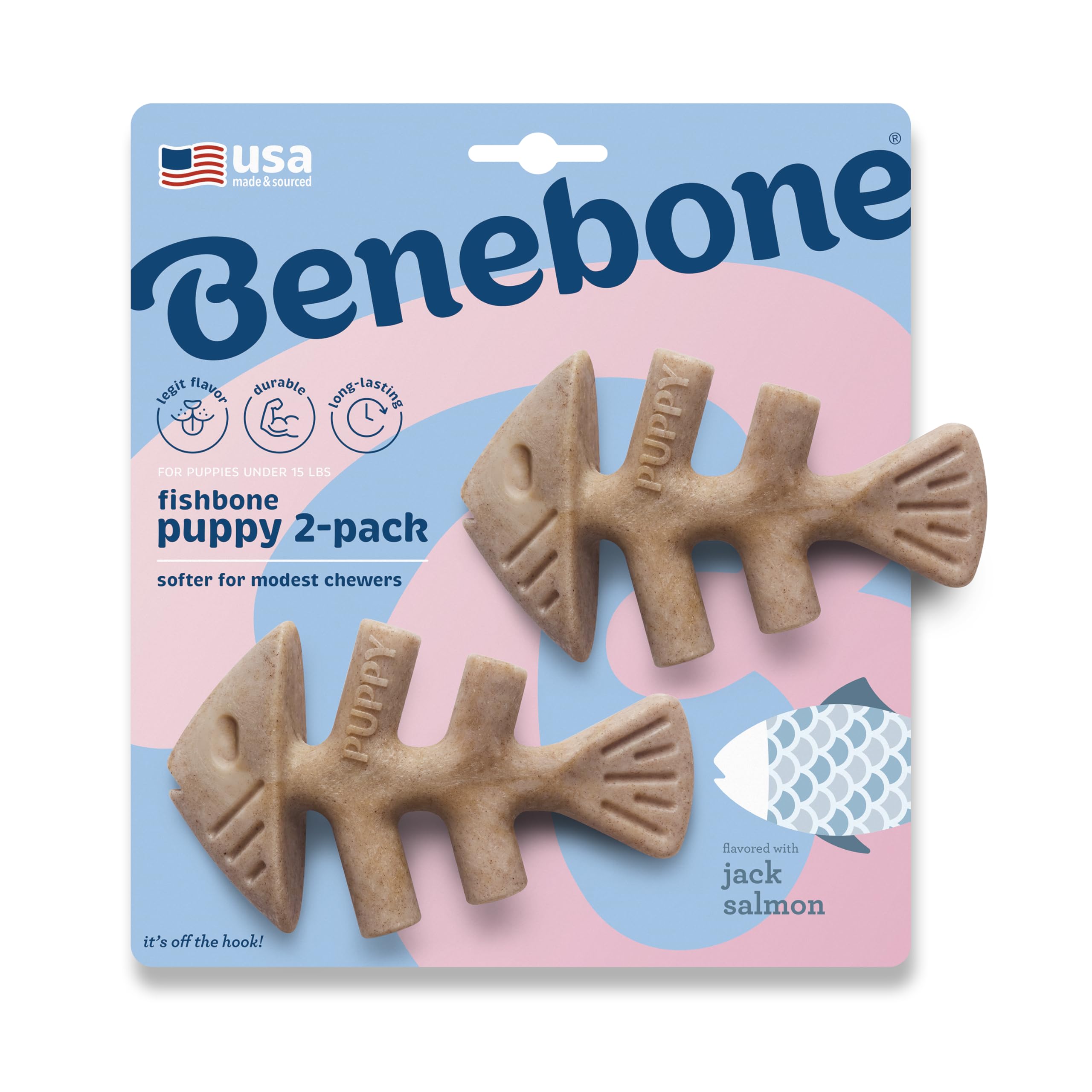
The Benebone Puppy Fishbone hits the precise density sweet spot for a Labrador in the 8-to-20-week window. The nylon compound is firmer than a rubber teething ring but has enough flex to avoid damaging tender gums. At 7.5 inches long with a pronounced curve, the fishbone shape allows a Lab puppy to grip one fin with their molars while holding the body with their front paws — a critical mechanical advantage that keeps the toy in the mouth rather than on the floor.
The flavor delivery system here uses real Jack Salmon protein infused into the nylon matrix. Owners report that the scent remains detectable to the dog weeks into use, unlike surface-coated alternatives that fade after three chew sessions. This is especially relevant for Labs, whose olfactory drive keeps them engaged with a toy longer than visual or auditory cues alone.
The “puppy” formulation is engineered to produce micro-fragments rather than large splinters when worn down, a safety feature that matters when your Lab is still in the “swallow-everything” phase. The manufacturer recommends supervision and replacement once the nubs wear flat. In practical terms, a determined Lab puppy will get 3 to 6 weeks of daily use before the bone requires replacement — reasonable durability for a teething-stage product.
Why we love it
- Real salmon infusion keeps Labs engaged for weeks
- Curved fishbone shape maximizes grip for broad-muzzled breeds
- Durable enough to survive daily chewing but soft enough for sore gums
Good to know
- Not suitable for aggressive adult chewer stage — switch to a harder nylon after 6 months
- Some owners report the tiny size is too small for Labs with poor impulse control
2. PawsAion Puppy Chew Toys 20 Pack
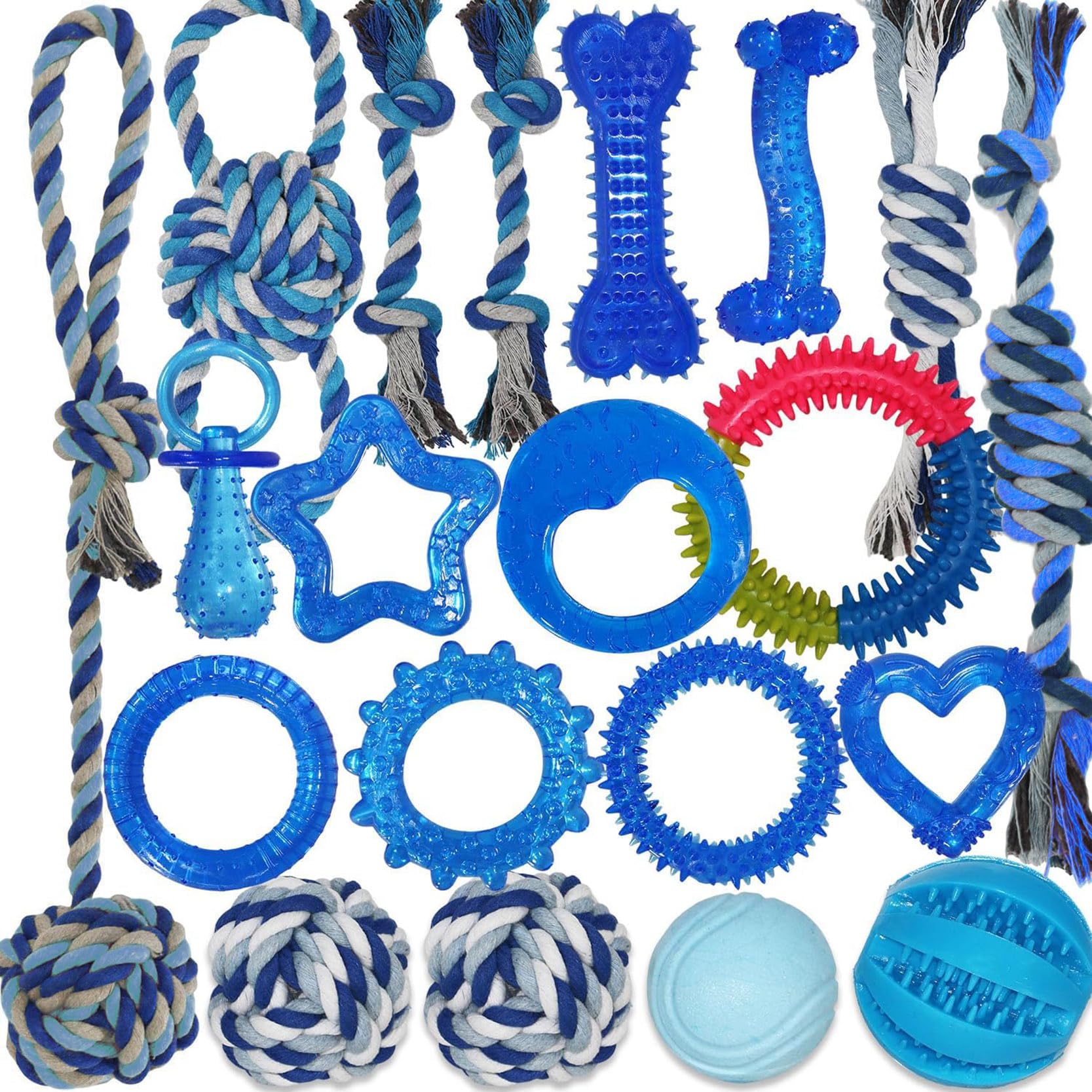
The PawsAion 20-Pack is not about individual toy longevity — it is about environmental enrichment through variety. At 1.85 pounds total, the set includes rope toys for tug-of-war, rubber rings with soft spikes for gum massage, a treat-dispenser ball for feeding-time engagement, and a pacifier-shaped teether. For a Lab puppy, whose attention span at 10 weeks averages roughly 2–4 minutes per object, having 20 options in rotation prevents boredom-driven destruction of baseboards and table legs.
The rope toys in this set are made from natural cotton, which provides dental abrasion that helps dislodge the puppy premolars as they loosen. The rubber components are formulated without BPA and are intentionally softer than adult-grade nylon — appropriate for the 8-to-16-week stage. The treat-dispenser ball adds a cognitive challenge layer that is particularly effective for Labs, a breed prone to boredom when mental stimulation is lacking.
The critical limitation here is that these toys are not designed for aggressive or sustained chewing. The manufacturer explicitly warns that the set is for moderate chewers and that damaged toys should be replaced immediately. For a Lab entering the destructive jaw stage (usually around 5 months), the rubber rings will show significant wear within a single session. This set works best as a supervised enrichment rotation for puppies under 4 months.
Why we love it
- Massive variety keeps a Lab puppy’s short attention span engaged
- Rope toys provide natural dental abrasion for loose baby teeth
- Treat-dispenser ball adds mental enrichment for a problem-solving breed
Good to know
- Not durable enough for aggressive chewers past 4 months
- Some pieces (ropes, small rings) are too small for larger Lab pups — supervise closely
3. Kseroo 3-Pack Indestructible Dog Chew Toys
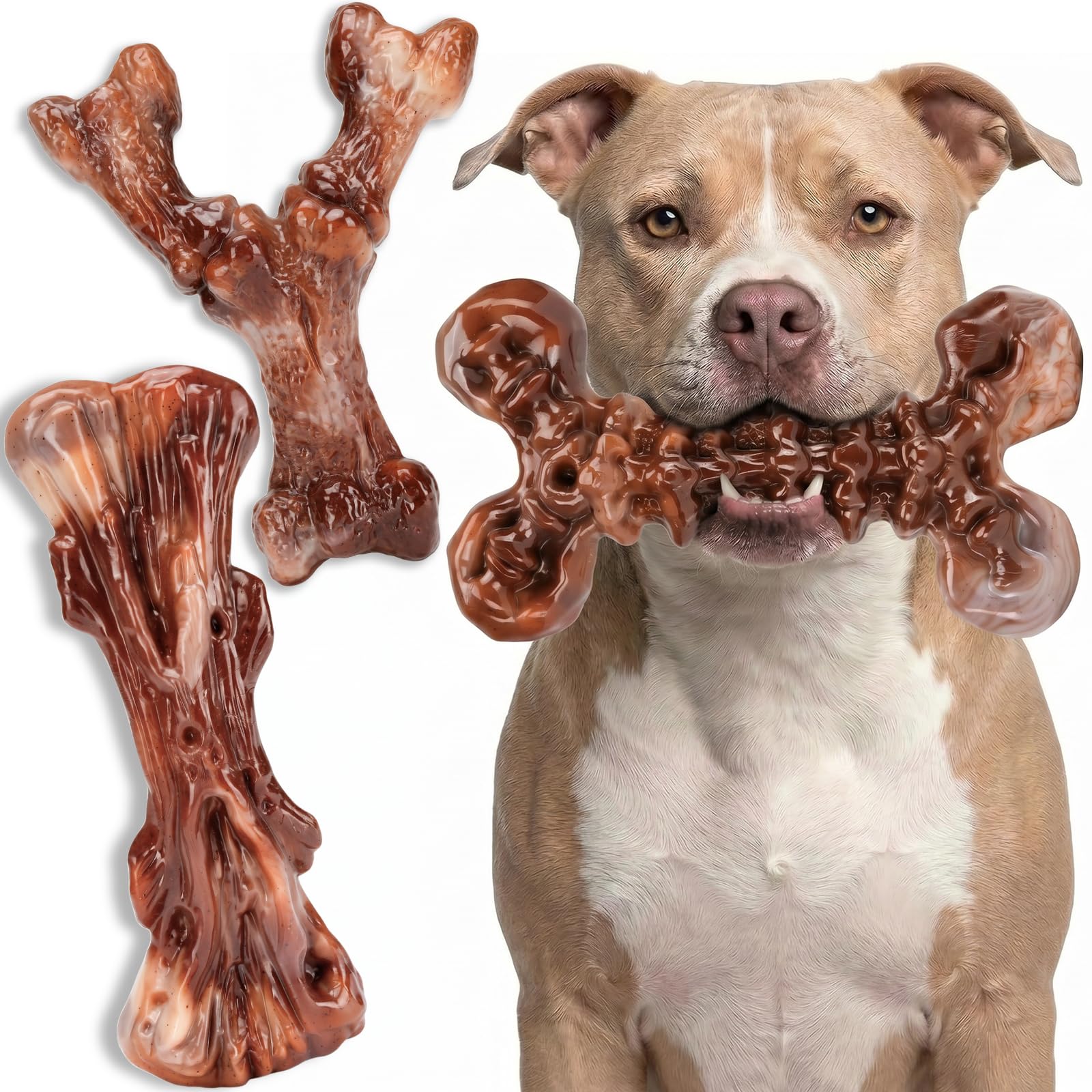
The Kseroo 3-Pack enters the lineup for the moment your Lab transitions from teething puppy to adolescent power-chewer — typically between 5 and 8 months. These are not beginner toys. Each bone is manufactured from high-density nylon that requires serious bite force to deform.
The bacon flavor is impregnated into the nylon rather than applied as a coat. Owners report the scent remains detectable to the dog for several weeks of active chewing. The grooves on each bone can be packed with peanut butter or wet food, extending engagement time by adding a foraging challenge. The set is designed for dogs weighing 25 to 90 pounds, which places a growing Lab squarely in the target range. The bones measure 6 inches long, which is large enough to prevent swallowing but small enough for a Lab to manipulate with their paws.
The manufacturer recommends 15 to 30 minute chew sessions and regular inspection for wear. In practice, even heavy chewers take weeks to wear down the nubs significantly. The nylon does not produce large sharp splinters — it wears down in a dust-like pattern, reducing the risk of intestinal blockage compared to softer nylon products. This set should not be used for puppies under 5 months whose teeth are still developing, as the hardness can cause gum damage.
Why we love it
- Three distinct shapes provide varied texture and resistance for sustained interest
- Bacon scent lasts weeks even under aggressive daily chewing
- Grooved surface doubles as a treat-dispensing puzzle for extended play
Good to know
- Too hard for teething puppies under 5 months — wait for adult teeth
- Heavier and larger than average — not suitable for small breeds or cautious biters
4. Toozey 7 Pack Small Dog Toys

The Toozey 7-Pack operates in a completely different category from the nylon chewers above. This set includes five plush squeaky toys — a cow, duck, carrot, donut, and others — plus rope toys. The primary function here is not jaw exercise but interactive bonding: fetch, tug, and retrieval games. For a Lab puppy, whose breed instinct is strongly oriented toward mouth-retrieval, these toys satisfy the genetic drive to pick up, carry, and shake objects.
The plush toys are filled with PP cotton and covered in premium polyester plush with double-stitched seams. Owners report the squeaker survives approximately 2 to 4 weeks of moderate play before failing, which is respectable for this construction. The rope toys provide a textured surface for dental cleaning and a safe tug-of-war option that does not put excessive pressure on a puppy’s developing neck. The entire set is machine-washable, which is important given that Lab puppies produce a significant amount of drool during play.
The naming here is slightly misleading — “small dog toys” refers to the size of the toy, not the breed. The plush items are roughly 5 to 7 inches long, which is appropriate for a Lab puppy up to about 4 months. Past that age, a growing Lab may be able to puncture the seams and access the stuffing. The manufacturer notes that destroyed toys should be dealt with immediately to prevent ingestion of filling, so these are not unsupervised toys for a heavy chewer.
Why we love it
- Plush-and-rope variety targets retrieval instincts in Labs
- Machine-washable construction handles drool and outdoor dirt
- Squeaker engagement encourages active play and bonding
Good to know
- Plush seams can fail under a determined chewing session past 4 months
- Squeaker longevity is limited — expect it to stop working after 2–4 weeks
5. WOOF Bully Sticks Dog Treats 5-Pack

The WOOF Bully Sticks serve a distinct role in the arsenal: high-value, fully digestible enrichment for supervised sessions. Each 6-inch stick is made from free-range, grass-fed beef pizzle, dried and processed without chemical preservatives. For a Lab puppy, whose food drive is often higher than their toy drive, bully sticks provide a reward-density that surpasses any nylon bone. This makes them exceptionally useful for crate training, separation-anxiety management, and high-stakes training scenarios.
The sticks are thick and dense enough that a moderate chewer takes 30 to 60 minutes to finish one. They abrade plaque from the molars through the mechanical action of gnawing. The manufacturer processes these to reduce odor — a significant improvement over traditional bully sticks that produce a pungent barnyard smell. Owners report that the sticks do not splinter or produce sharp fragments; they soften and break down in a chewy consistency that is safe for ingestion.
The key operational constraint is caloric density. A single 6-inch stick contains roughly 80 to 100 calories, which is a substantial portion of a young Lab puppy’s daily intake. One stick per day is generally the ceiling for a growing puppy to avoid weight imbalance. Additionally, bully sticks are not a replacement for durable chew toys — they serve best as a time-limited, high-value reward that is removed once consumed. They are suitable for all life stages, from 10-week-old puppies through adult dogs.
Why we love it
- Fully digestible — no risk of nylon fragment ingestion
- Grass-fed beef source with minimal processing and low odor
- 30 to 60 minutes of engagement per stick for crate training or alone time
Good to know
- Calorie-dense — limit to one stick per day for growing Labs
- Not a durable toy — consumed and gone, not for all-day unsupervised play
FAQ
How do I know when my Lab puppy has outgrown a teething toy?
Can I use bully sticks as my Lab puppy’s only chew toy?
Why does my Lab puppy ignore expensive chew toys and destroy baseboards instead?
Final Thoughts: The Verdict
For most owners, the labrador puppy toys winner is the Benebone Puppy Fishbone because it matches the precise nylon density for the critical teething window and uses real salmon infusion to hold a Lab’s olfactory interest. If you want a fully digestible high-value training aid, grab the WOOF Bully Sticks 5-Pack. And for the adolescent power-chewer stage when your Lab’s jaw strength peaks, nothing beats the Kseroo 3-Pack Nylon Bones for raw toughness.