
The difference between a planted aquarium that thrives and one that turns into a string-algae swamp often comes down to one decision: the light bar you mount above the glass. Too weak and your stem plants etiolate, too much of the wrong spectrum and you’re scrubbing green water every weekend. The right fixture delivers a targeted photosynthetic photon flux density (PPFD) across the entire substrate while keeping your water column stable — no guesswork, no stunted rotala.
I’m Mo Mahin — the founder and writer behind Furric. I’ve spent years cross-referencing spectral distribution charts, teardown photos, and owner-reported PAR readings across dozens of planted-tank fixtures to understand what actually separates a fine mid-range bar from a true high-irradiance powerhouse.
Choosing the right fixture means balancing spectrum bandwidth, dimming control, and physical coverage for your specific tank depth. That’s exactly where a well-researched led lighting for planted aquarium guide helps you avoid wasted money and stunted growth.
How To Choose The Best LED Lighting For Planted Aquarium
Not every bright light grows plants. A fixture that looks blindingly white to your eye can still lack the 660nm red and 460nm blue peaks that drive photosynthesis in aquatic species. Focus on three pillars: spectral composition, control flexibility, and fixture length matching your tank’s footprint.
PPFD (Photosynthetic Photon Flux Density) Over Lumen Ratings
Lumens measure human-perceived brightness; PPFD measures how many photons in the 400–700 nm range land on a given square meter each second. For a low-tech tank (no injected CO2), a PPFD of 25–40 µmol/m²/s at the substrate is plenty. High-tech pressurized setups can handle 60–100 µmol/m²/s without triggering algae, but you need a dimmable fixture to dial that in. Ignore lumen claims — they mislead planted-tank buyers every time.
Spectral Bandwidth and Color Rendering Index (CRI)
Look for fixtures that explicitly list discrete red (620–660nm) and blue (440–460nm) LEDs alongside a white channel. A CRI above 90, like the 90 CRI and 89 CRI models in this guide, indicates that the white LEDs produce a balanced spectrum that makes fish and plants look natural while still delivering photosynthetically active radiation. A 6500K–10000K range gives you flexibility — cooler temps favor strong growth, warmer temps improve visual contrast.
Programmability and Timer Functions
Plants need a consistent photoperiod, typically 8–10 hours. Fixtures with built-in sunrise/sunset ramping and a memory function that survives power outages save you from resetting schedules weekly. The best controllers allow you to set multiple time points (up to 24 in the more advanced units) to mimic seasonal daylight changes — a feature that reduces algae shock and keeps your plants on a natural rhythm.
Quick Comparison
On smaller screens, swipe sideways to see the full table.
| Model | Category | Best For | Key Spec | Amazon |
|---|---|---|---|---|
| Fluval Plant 3.0 (48-60 in) | Premium | High-tech planted tanks with CO2 | 6 discrete spectral bands | Amazon |
| Finnex Planted+ 24/7 KLC (30 in) | Premium | Customizable sunrise-sunset cycles | 4 controllable color channels | Amazon |
| FZONE Light 90 (35-43 in) | Premium | App-controlled spectrum tuning | 60W, 6 rows of LEDs | Amazon |
| hygger 30-36 in Programmable | Mid-Range | Mid-tech setups needing DIY scheduling | 48W, 144 LEDs at 89 CRI | Amazon |
| NICREW C10 (36-48 in) | Mid-Range | Day/night cycle automation | 27W full spectrum with timer | Amazon |
| hygger 18-24 in Programmable | Budget | Small planted tanks & nano aquariums | 26W, 77 LEDs, 10 brightness steps | Amazon |
| GLOWRIUM Full Spectrum (48-53 in) | Budget | Long-tank coverage with minimal cost | CRI 90, 5 rows of full spectrum | Amazon |
In‑Depth Reviews
1. Fluval Plant 3.0 LED Planted Aquarium Lighting (59 Watts)

The Fluval Plant 3.0 is the fixture that serious aquascapers reference when they talk about “controllable spectrum.” Instead of lumping all colors into a single white or RGB channel, Fluval provides six individual wave bands — including discrete 660nm red and 450nm blue peaks — that you can adjust independently. That level of granularity means you can dial in exactly the PPFD your plants need at substrate level without oversaturating the water column with unwanted wavelengths. The 120-degree beam angle also ensures uniform coverage across a 48–60 inch footprint, preventing the dim edges that plague narrow-bar designs.
The controller hosts pre-set habitat modes (Planted, Tropical, Lake Malawi) that serve as a great starting point, but the real power is the 24-hour customizable cycle with sunrise, midday, sunset, and night segments. The extendable mounting brackets fit rimmed and rimless tanks easily, and the aluminum housing keeps heat well below 120°F even at full output. At 59 watts, this is not a power-saving fixture — it’s a light designed for high-tech tanks running CO2 injection and demanding stems like Rotala macrandra or Ludwigia super red.
Community consistency is a strong point here: owners report that PAR readings match Fluval’s published curves closely, which is rare in this price tier. The IP rating on the LED board is solid for the inevitable splash, and the touch-switch interface feels more premium than push-button alternatives. For a tank where you’re optimizing every variable, the Plant 3.0 removes lighting from the equation.
Why we love it
- Six independent spectral bands allow precise tuning for specific plant pigments.
- 120-degree beam angle eliminates shadowing in deep, wide tanks.
- Pre-set habitat modes simplify startup for beginners moving to high-tech.
Good to know
- Premium pricing positions it as a long-term investment rather than an entry-level option.
- No native Wi-Fi or app control — programming is done via the onboard controller.
2. Finnex Planted+ 24/7 KLC LED (30 Inches)

Finnex refined its Planted+ series with the 24/7 KLC version 2.0, addressing early-adopter complaints about power supply durability and water-sealing. The result is a fixture that delivers four customizable color channels — white, red, green, and blue — each fully dimmable, giving you the ability to create a sunrise transition from a fiery red dawn to a deep blue starry night without touching a phone app. The IR remote control handles mode switching instantly, and the built-in sensor automates the 24-hour cycle once you set the initial time.
The spectral mix uses a 7000K multi-color blend that pushes growth in low-tech tanks while still producing rich visual contrast for fish. The water-resistant LED coating and polished aluminum housing are built to survive the condensation common on glass lids. A key distinction between this and the earlier version is the redesigned LED strip guard that prevents moisture ingress at the end caps — a failure point that plagued the original. Owners running it on 29-gallon and 55-gallon tanks report that the auto-cycle simulates dawn-to-dusk naturally enough that fish behavior adjusts predictably.
One trade-off: the custom ramp periods lock into roughly three-hour increments, so you cannot fine-tune a 30-minute sunrise. If that level of precision matters, the Fluval is the better choice. But for a set-it-and-forget-it planted tank that rewards you with consistent growth and dramatic color shifts at dawn and dusk, the KLC remains a strong contender at its price point.
Why we love it
- Four-channel dimming with IR remote provides intuitive color control without Wi-Fi.
- Water-resistant LED coating and redesigned end caps improve longevity over earlier models.
- The built-in 24-hour cycle reduces user intervention once programmed.
Good to know
- Custom ramp settings are constrained to ~3-hour increments, limiting flexibility.
- A small number of units have reported early failure — confirm seller warranty policies.
3. FZONE Aquarium Light for Plants (60W, 35-43 in)
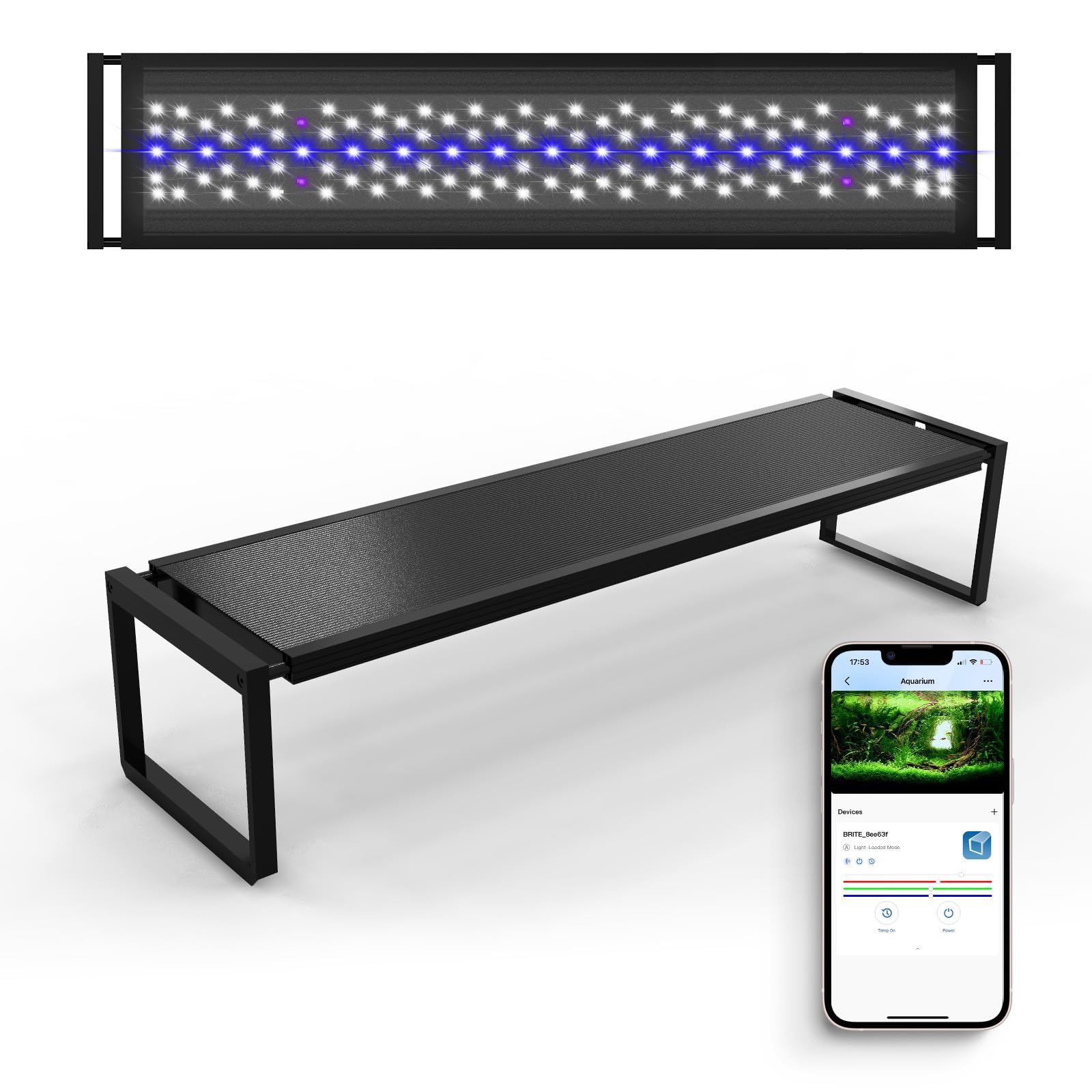
The FZONE Light 90 brings smart-phone programmability to the planted-tank category at a wattage level — 60 watts — that usually requires a separate controller box. Bluetooth pairing through the FZONE app lets you adjust brightness and color across the 3-in-1 RGB, white, and UV channels. The UV LEDs are a genuine addition for enhancing plant pigment saturation and simulating deeper water conditions, while the 6-row arrangement (wider than the typical 4-row bar) evens out the light spread across the full 35–43 inch span, minimizing hot spots.
Three operating modes cover the workflow: Manual gives you instant slider control for maintenance; Auto cycles through cloud, rain, and sunny simulations that shift every few hours; Custom allows up to 24 time points for a personalized sunrise-to-sunset curve with a memory function that survives power cuts. The temporary light feature is a thoughtful detail — it turns on at a low brightness for feeding or inspection without disturbing your saved schedule. The aluminum alloy housing keeps temperatures below 120°F even during extended 10-hour photoperiods, which directly reduces LED drift and maintains PAR output over years.
Spec-wise, the 3950-lumen maximum and 6500–12000K color temperature range place it in the high-output tier suitable for medium-depth tanks (around 18 inches tall) with CO2 injection. Owners praise the even spread at medium brightness settings, though the power cord is permanently attached, which can complicate cable management on rimless tanks with open backs. The polished finish and slim 1.2cm profile keep it visually unobtrusive above the tank.
Why we love it
- Bluetooth app control with 24-point custom sunrise schedule and weather simulation.
- UV LEDs enhance red-plant coloration without stressing fish when used during the main photoperiod.
- Wide 6-row LED arrangement and 4-inch light emission reduce shadowing at the tank edges.
Good to know
- Permanent power cord limits routing flexibility — no detachable connector.
- No physical remote is included, so app dependency may frustrate users who prefer hardware controls.
4. hygger Programmable LED Light (30-36 in, 48W)

Hygger’s 30-36 inch model packs 144 LEDs — more than many fixtures in its price tier — into a slim aluminum-and-plastic frame that produces 2365 lumens with an 89 CRI. The 6500–10000K color temperature range covers the cool-white to actinic-blue shift that many planted-tank keepers prefer, and the LCD display gives you real-time feedback on the local time and programmed timer stages. The four-button interface is not the most intuitive layout — some owners report a learning curve around the DIY mode — but once set, the power-off memory function holds your schedule through outages.
The four modes (Default, DIY, Gradient, and All-day All-optical) cater to different confidence levels. In Default mode, the light ramps brightness gradually over the day and transitions to a blue moonlight at night. DIY mode unlocks eight stages (L1–L8) with ten brightness levels for each, letting you create a custom light curve for a high-tech tank with demanding stem plants. The IP68-rated lamp beads mean you can wipe down the surface without fear of moisture shorting the board — a real advantage in humid environments.
One consistent feedback point: at 100% power, this light is strong enough to trigger algae in new tanks that have not yet established a bacterial cycle. Running it at 60–80% during the first few weeks is a smart strategy. The extendable bending bracket accommodates aquariums with exactly 30 to 36 inches of outer width, but tanks with thick rims may need slight bracket adjustment. At this price, the feature density — full programmability, high LED count, and a bright output — makes it a solid choice for intermediate hobbyists moving beyond fixed-spectrum lights.
Why we love it
- High LED count (144) delivers even light spread across the 30–36 inch footprint.
- IP68-rated lamp beads allow safe cleaning and resist moisture damage.
- Eight-stage DIY mode with 10 brightness levels offers deep customization for advanced layouts.
Good to know
- Full brightness out of the box can cause algae in uncycled tanks — plan to start at 60% power.
- Programming instructions are printed very small, making initial setup difficult for some users.
5. NICREW C10 Plants LED Aquarium Light (36-48 in, 27W)

NICREW positions the C10 as a straightforward alternative to overly complicated programmable lights. It skips the LCD menus and phone apps in favor of a single-button dimmer with three brightness levels and a built-in timer that cycles through a consistent 9-hour day followed by a blue night mode. For the planted-tank keeper who wants stable growth without spending hours tweaking eight-stage schedules, this simplicity is a genuine advantage — less can go wrong with firmware glitches or lost remotes.
The 27-watt full-spectrum LED array produces a clean 7000K white light that supports low-to-moderate light plants like Anubias, Java fern, and Cryptocoryne species. The timer’s memory function holds your settings through power interruptions, and the adjustable brackets extend to fit both rimmed and rimless tanks in the 36–48 inch range. The aluminum alloy casing dissipates heat efficiently, and the slim profile sits flush against glass lids without blocking access for feeding.
Where the C10 falls short is peak output: at 27 watts, it cannot push enough PAR through a 20-inch-deep tank to sustain a high-tech carpet of Monte Carlo or Dwarf baby tears without CO2 supplementation. Owners targeting deep, heavily planted aquariums should look at the hygger or FZONE fixtures instead. But for a standard 55-gallon community tank with moderate plant density, this is a reliable, no-fuss fixture that won’t cause algae spikes from overpowering.
Why we love it
- Simple three-level dimming and automatic day/night timer reduce programming headaches.
- Stable 7000K full spectrum supports low-to-moderate light plants without overheating.
- Adjustable brackets accommodate rimmed and rimless tanks in the 36–48 inch range.
Good to know
- 27-watt output is insufficient for deep high-tech tanks or demanding carpet plants.
- No custom color channels or sunrise/sunset ramping — the cycle is fixed.
6. hygger Programmable LED Light (18-24 in, 26W)

This 18–24 inch version of the hygger programmable series brings the same LCD interface, seven-color palette, and four-mode architecture as its larger sibling but scales down to 77 LEDs at 26 watts — ideal for nano planted tanks, desk aquariums, or 10-gallon breeder setups. The CRI of 89 and color temperature range of 6500–10000K produce the same crisp rendering as the 30-36 inch model, so your Rotala indica and Pogostemon helferi get the same spectrum quality in a smaller footprint.
The extendable bending bracket lets you adjust to fit rimmed and rimless tanks between 18 and 24 inches, and the IP68 lamp bead coating provides splash protection. The separable adapter is a practical upgrade — if the power brick fails, you replace just the adapter rather than the whole light assembly. Owners running it on low-tech betta tanks and small shrimp setups report that the default mode’s gradual brightness transition prevents spooking livestock during the early morning.
The 4.9-foot power cord can be short for larger stands, but for standard small-tank setups it reaches a nearby outlet without an extension. The LCD display, while informative, is small enough that users with larger hands may find the four function keys fiddly during setup. Once the schedule is programmed, however, the memory function removes the need for daily interaction. For its price point, this offers the same programmable sophistication as larger lights in a size that fits the fastest-growing segment of the planted-tank hobby.
Why we love it
- Same full-featured LCD programming and 89 CRI spectrum as the larger hygger models.
- IP68 lamp bead coating and separable adapter reduce long-term replacement costs.
- Compact 45cm length fits nano and mid-size planted tanks without overhanging.
Good to know
- 4.9-foot cord may require a power strip on taller aquarium stands.
- Small buttons on the LCD panel can be difficult to press accurately during programming.
7. GLOWRIUM Aquarium Light Full Spectrum (48-53 in)
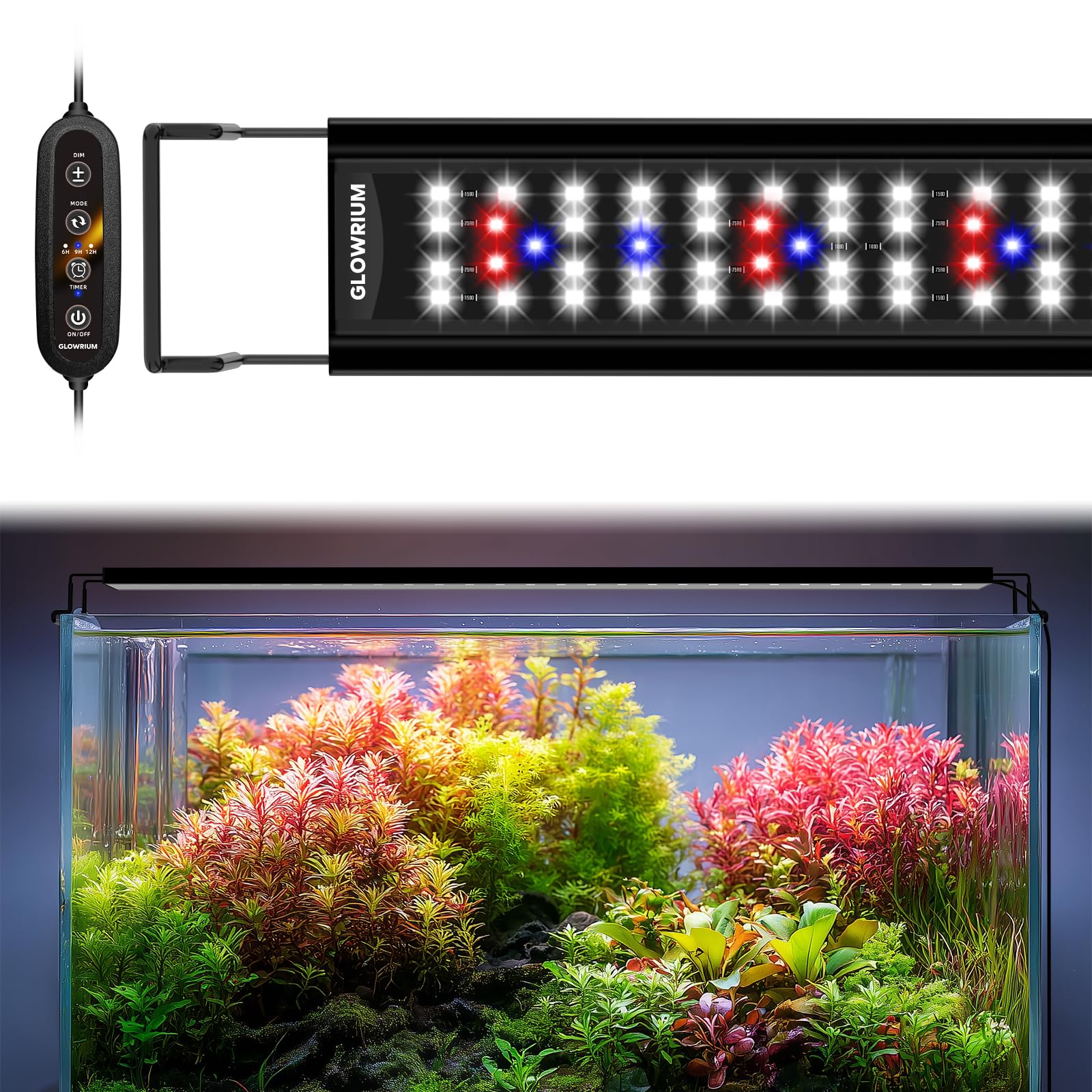
The GLOWRIUM Full Spectrum light targets a specific gap in the market: budget-conscious owners of 48–53 inch tanks who want a full-spectrum bar with a CRI above 90 and three timer options without paying premium-tier prices. The 5000K white LEDs combined with 460nm blue and 660nm red channels produce a broad PAR curve suitable for stem plants and low-light crypts. Five rows of surface-mount LEDs ensure the light hits the front, middle, and rear of a standard 125-gallon footprint without the dark bands that narrow single-row fixtures produce.
The all-in-one aluminum body acts as a passive heatsink, and the extendable bracket slides to fit rimmed aquariums from 36 to 41 inches — note that the manufacturer lists the bracket range separately from the light body length, so always measure your tank’s outer width before purchasing. The day/night switching is handled by a straightforward button: Day mode runs the full white/red/blue array, and Night mode switches to a gentle blue moonlight that is subdued enough not to disturb nocturnal fish species.
At its price point, you sacrifice programmability — there is no sunrise ramp, no DIY schedule, and no smartphone app. The timer offers three fixed durations (6, 8, or 10 hours) plus a memory function that retains the last setting through power loss. For a beginner setting up their first 55-gallon planted tank or a budget-minded hobbyist lighting a long display tank, this represents the simplest path to adequate PAR coverage. The 2-year warranty provides some confidence, though the powder-coated finish is more prone to scratching than the anodized aluminum on premium units.
Why we love it
- CRI 90 provides accurate color rendering and strong PAR for low-to-moderate light plants.
- Five rows of LEDs eliminate shadowing across the full length of long tanks.
- Three fixed timer options and power-off memory keep operation simple for beginners.
Good to know
- No customizable sunrise/sunset or DIY programming — the light functions on a fixed schedule.
- Powder-coated finish is less durable than anodized or polished aluminum alternatives.
FAQ
Can I use a standard white LED shop light instead of a planted aquarium light?
What does the color rendering index (CRI) number actually tell me for plant growth?
Why does my new planted aquarium light cause an algae bloom?
Should I buy a light with a sunrise/sunset feature or a fixed on/off timer?
Final Thoughts: The Verdict
For most planted-tank keepers, the led lighting for planted aquarium winner is the Fluval Plant 3.0 because its six discrete spectral bands and 120-degree beam angle give you the control needed to dial in growth for both low-tech and high-tech setups without guesswork. If you want smart-phone convenience and UV-enhanced coloration without entering premium pricing territory, grab the FZONE Light 90. And for a compact nano tank where programming depth matters, nothing beats the hygger 18-24 inch programmable for its feature-per-dollar ratio in a small footprint.