
A ball python’s enclosure is a thermal puzzle. Get the hot-side basking surface to 88–92°F and the ambient air to 78–80°F and your snake thrives. Miss those marks and you risk regurgitation, respiratory infections, or a snake that refuses to eat. The fixture you choose — whether a ceramic heat emitter for 24-hour radiant warmth or a deep dome for a focused basking spot — determines whether that puzzle solves itself or leaves you chasing temperatures with a temp gun every morning.
I’m Mo Mahin — the founder and writer behind Furric. I’ve spent over a decade analyzing reptile product data, cross-referencing wattage curves with enclosure volumes, and studying aggregated owner feedback to separate fixtures that hold a steady gradient from those that create dangerous hot spots.
After comparing seven top-rated models, I’ve narrowed down the options that deliver consistent thermal performance for ball pythons. This guide walks you through the specs that matter — dome depth, socket type, thermostat compatibility, and wattage limits — so you can confidently choose the best light for ball python enclosures without second-guessing your setup.
How To Choose The Best Light For Ball Python Enclosures
Ball pythons are nocturnal ambush predators that need a distinct thermal gradient — a warm basking zone around 90°F and a cool hide around 78°F — but they do not require bright white light at night. The fixture you select must deliver heat without disrupting their day/night cycle, which means choosing between ceramic heat emitters (zero light) and deep domes that accept dimmable bulbs. Understanding four core specs will prevent the most common setup failures.
Dome Depth and Reflector Design
A shallow dome (5 inches or less) spreads heat and light over a wide area, making it suitable for ambient heating in large terrariums. A deep dome (5.5 inches or more) focuses the beam into a tight basking spot — critical for ball pythons that need a concentrated hot zone. Look for a polished aluminum or mirrored interior; a dull reflector can cut UVB and infrared output by as much as 30%, forcing you to run higher wattages that stress the socket.
Socket Material and Wattage Capacity
Ceramic sockets resist heat creep and won’t melt or discolor after months of continuous operation. Plastic or bakelite sockets degrade when paired with 100-watt-plus bulbs running 24/7. For a ball python, a 150-watt ceramic heat emitter or basking bulb produces enough radiant energy for a 40-gallon tank. Confirm the fixture’s maximum wattage rating — a fixture labeled “max 100W” cannot safely run a 150W bulb, and pushing that limit creates a fire hazard.
Thermostat Compatibility (Dimming vs. On/Off)
Ceramic heat emitters and deep heat projectors must be paired with a proportional dimming thermostat, not an on/off thermostat. On/off thermostats cycle the bulb to full power then off, causing basking surface temperatures to swing by 10–15°F — enough to trigger stress-related fasting in ball pythons. A dimming thermostat smoothly adjusts power to hold a target temperature within 1–2°F, extending bulb life and stabilizing the thermal gradient.
Quick Comparison
On smaller screens, swipe sideways to see the full table.
| Model | Category | Best For | Key Spec | Amazon |
|---|---|---|---|---|
| REPTI ZOO 8.5″ Dimming Fixture | Premium Fixture | Precision temp control with dimming thermostat | 150W max / E26 ceramic socket | Amazon |
| REPTI ZOO 5.5″ Dimming Fixture | Premium Fixture | Small enclosures needing a built-in thermostat | 100W max / integrated dimmer | Amazon |
| Zoo Med Combo Mini Deep Dome | Double Dome | Dual bulb setup for day/night cycling | Two 5.5″ domes / separate switches | Amazon |
| ReptiKing Dual Light Fixture | Double Dome | Budget dual-bulb setup with ceramic sockets | 150W per socket / E26 ceramic | Amazon |
| T5 UVB Reptile Light Combo Kit | Linear UVB Kit | Supplemental UVB for bioactive or day-lit enclosures | 12-inch T5 HO / 10.0 UVB | Amazon |
| MECESOR 2-Pack Deep Dome | Value 2-Pack | Outfitting multiple enclosures on a budget | 5.5″ deep dome / 160W max | Amazon |
| Zoo Med CHE 150W | Heat Emitter | 24-hour silent night heat with zero light | 150W / 5-year life / no light | Amazon |
In‑Depth Reviews
1. REPTI ZOO 8.5 Inch Deep Dome Fixture with Dimming Thermostat

This is the closest thing to a “set it and forget it” setup for a ball python enclosure. The 8.5-inch deep dome focuses radiant heat into a tight basking spot, and the built-in PID dimming thermostat holds temperature within 1–2°F of your target. Owners running 150-watt ceramic heat emitters report steady 90°F basking surfaces even when ambient room temps drop into the upper 60s — exactly what a ball python needs during winter months.
The E26 ceramic socket handles sustained high heat without degradation, and the polished aluminum reflector boosts infrared output noticeably compared to budget domes. Users testing with a temp gun and ambient thermometer confirmed the dimmer prevents the 8–10°F temperature swings common with on/off thermostats. The trade-off: there is no physical on/off switch, so you will need an external timer or smart plug for day/night cycling.
For a standard 40-gallon breeder tank, this fixture paired with a 100W deep heat projector or 150W CHE delivers an ideal thermal gradient. The one-year warranty adds peace of mind for a component that runs 24/7. If you want temperature precision without buying a separate thermostat, this is the most complete kit available.
Why we love it
- Integrated dimming thermostat eliminates temperature swings
- 8.5-inch deep dome creates a concentrated basking spot
- ETL-certified ceramic socket handles 150W sustained use
Good to know
- No on/off switch — requires external timer or smart plug
- Bulb not included; must purchase separately
2. REPTI ZOO 5.5 Inch Deep Dome Fixture with Dimming Thermostat

If you keep your ball python in a 20-gallon long or a 36-inch PVC enclosure, the 8.5-inch dome may be overkill. This 5.5-inch version packs the same PID dimming thermostat into a smaller footprint, rated for 100W max. It is ideal for smaller tanks where you need a single basking spot without overwhelming the enclosure with radiant heat.
The dimming thermostat holds the basking area at a constant 94°F per owner reports, and the polished reflector still delivers strong UVA/UVB output if you switch to a mercury vapor bulb. The LED digital screen shows both the ambient temp and the set point, and you can toggle between Celsius and Fahrenheit. Users running this with a 60W or 80W deep heat projector achieved stable gradients without needing a separate thermostat module.
Note that the 100W limit means you cannot drop a 150W ceramic heat emitter into this fixture. For ball pythons in 20–30 gallon tanks, the lower wattage is sufficient, but larger glass tanks may struggle to reach 90°F on the basking surface if room temperature drops below 68°F. Check your enclosure size before purchasing.
Why we love it
- Built-in dimmer keeps temps stable in small enclosures
- Digital display with Celsius/Fahrenheit toggle
- ETL-certified with ceramic socket for safety
Good to know
- 100W max limits bulb choice — no 150W CHE
- No on/off switch
3. Zoo Med Combo Mini Deep Dome Clamp Lamp Fixture 2 x 5.5 Inch
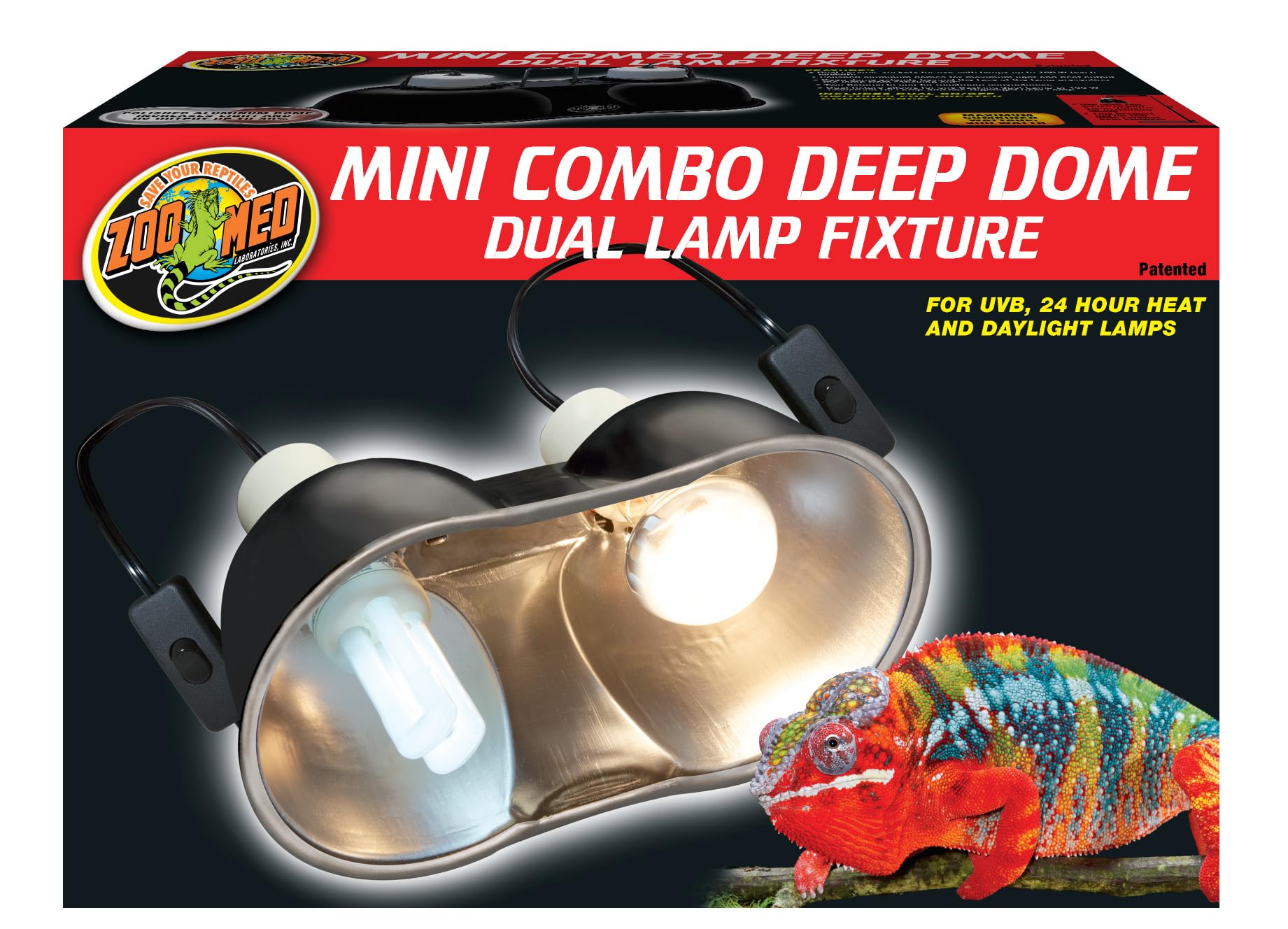
Ball pythons benefit from a day/night heat cycle, and this double-dome fixture makes it simple: run a basking bulb on one side during the day and a ceramic heat emitter on the other for nighttime ambient heat. Each dome has its own on/off switch and a 5.5-inch polished aluminum reflector that increases light and UV output by up to 30% compared to unreflective domes.
The clamp design attaches securely to tank rims up to 1 inch thick, and the 6-foot power cords give flexibility in placement. Owners using this for 40-gallon tanks pair a 100W daylight bulb with a 100W CHE for nighttime, noting the dual switches eliminate the need for separate timers if you prefer manual control. The E26 ceramic sockets on both domes handle sustained heat without melting.
At this price tier, the lack of a built-in thermostat means you must add an external dimming thermostat for the CHE side. Without it, the CHE will run at full power and potentially overshoot your target. For keepers who already own a thermostat, this is a versatile dual-zone solution.
Why we love it
- Two independent domes for day/night heat cycling
- Polished reflector boosts UV and infrared output
- Separate switches per dome for easy control
Good to know
- No built-in thermostat — requires external dimmer
- Domes are smaller than they appear in listing photos
4. ReptiKing Dual Light Fixture, Double Deep Dome
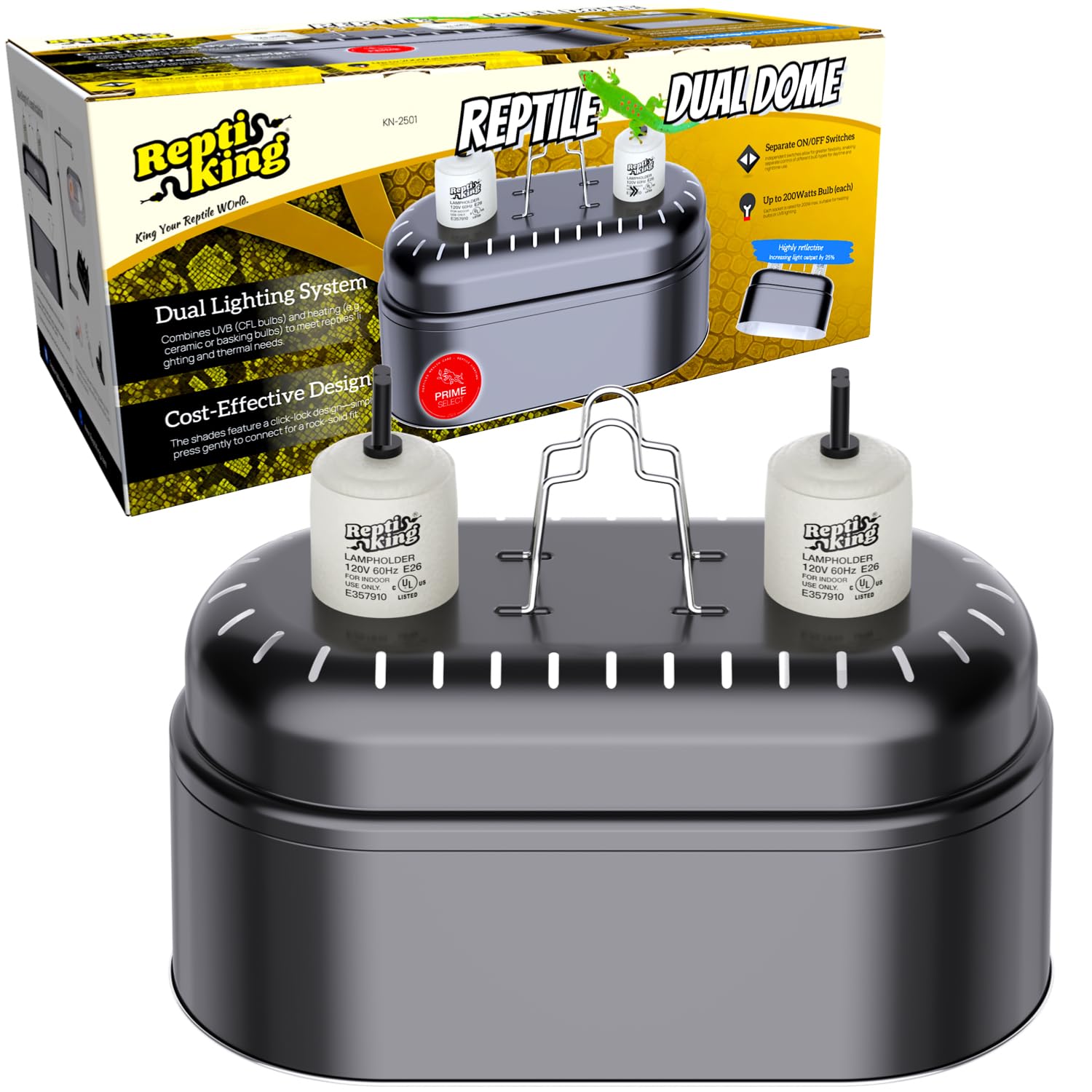
The extra-deep reflector design concentrates heat effectively, and users report even heat distribution without hot spots that could burn a ball python resting directly below.
Each socket has an individual on/off switch mounted on the 6-foot power cord, and the dome fits standard E26 bulbs including mercury vapor, halogen, and ceramic emitters. Owners using this for 40-gallon tanks with a 100W CHE and a 75W basking bulb achieved a stable 90°F basking surface when paired with a separate thermostat. The aluminum body feels dense and well-constructed, with no wobble when clamped to the tank rim.
The drawback is the same as the Zoo Med Combo — you must budget for an external dimming thermostat. The switches are also mounted inline rather than on the dome itself, which some users find less convenient for quick adjustments. If you need a dual-dome platform and plan to add your own thermostat, this represents solid value.
Why we love it
- Two UL-listed ceramic sockets rated for 150W each
- Extra-deep reflector for focused heat delivery
- Budget-friendly dual-dome option
Good to know
- Switches are on the cord, not the dome
- Requires separate dimming thermostat
5. T5 UVB Reptile Light Fixture HO UVB Bulb Lighting Combo Kit, 10.0 8W 12 Inch
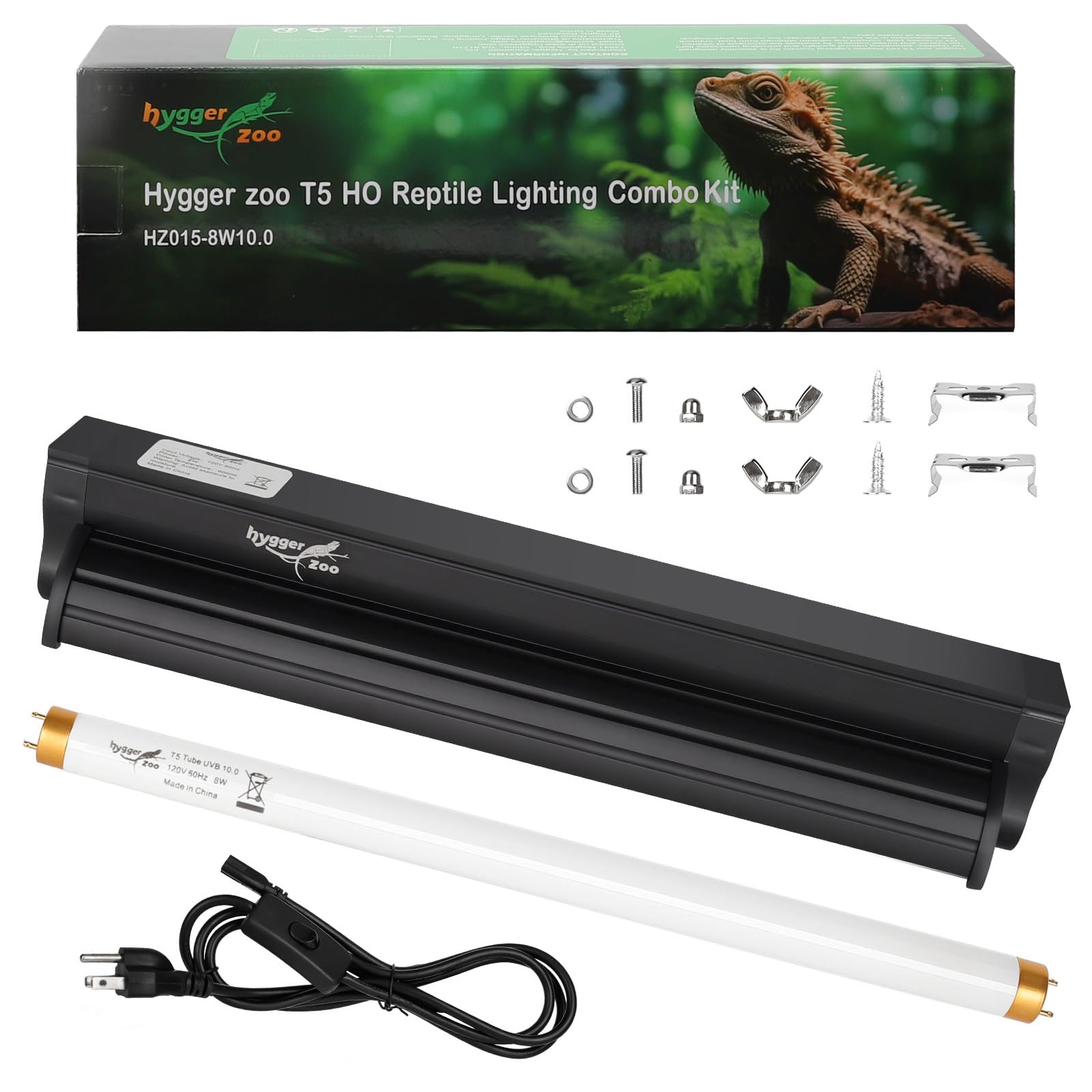
Ball pythons are crepuscular and do not require UVB light for vitamin D3 synthesis the way diurnal lizards do, but keepers running bioactive enclosures or wanting a naturalistic day cycle will find value in this T5 HO kit. The 12-inch fixture produces a strong 10.0 UVB output that promotes plant growth in live terrariums and supports the behavioral enrichment of a natural photoperiod.
The curved polished reflector maximizes UVB output, and the aluminum housing dissipates heat effectively to prevent bulb degradation. Users testing with a Solarmeter 6.5 reported strong readings at 12–18 inches, which is safe for a ball python that typically stays on the ground. The kit includes mounting hardware for both atop-mesh and inside-tank installation.
Owners should note the bulb contains solid mercury that produces a rattling sound when off — this is normal per the manufacturer. A minority of users reported bulb failure within months, so have a backup on hand if you rely on this for UVB-dependent bioactive cleanup crews. This is a supplement, not a primary heat source, and must be paired with a separate CHE or basking dome for thermal gradient.
Why we love it
- Strong T5 HO 10.0 UVB output for bioactive setups
- Aluminum housing with good heat dissipation
- Includes inside-tank mounting hardware
Good to know
- Not a heat source — requires separate CHE or dome
- Bulb rattles when off; some users report early failure
6. MECESOR Reptile Light Fixture, 2 Packs 5.5 Inch Deep Dome Lampshade
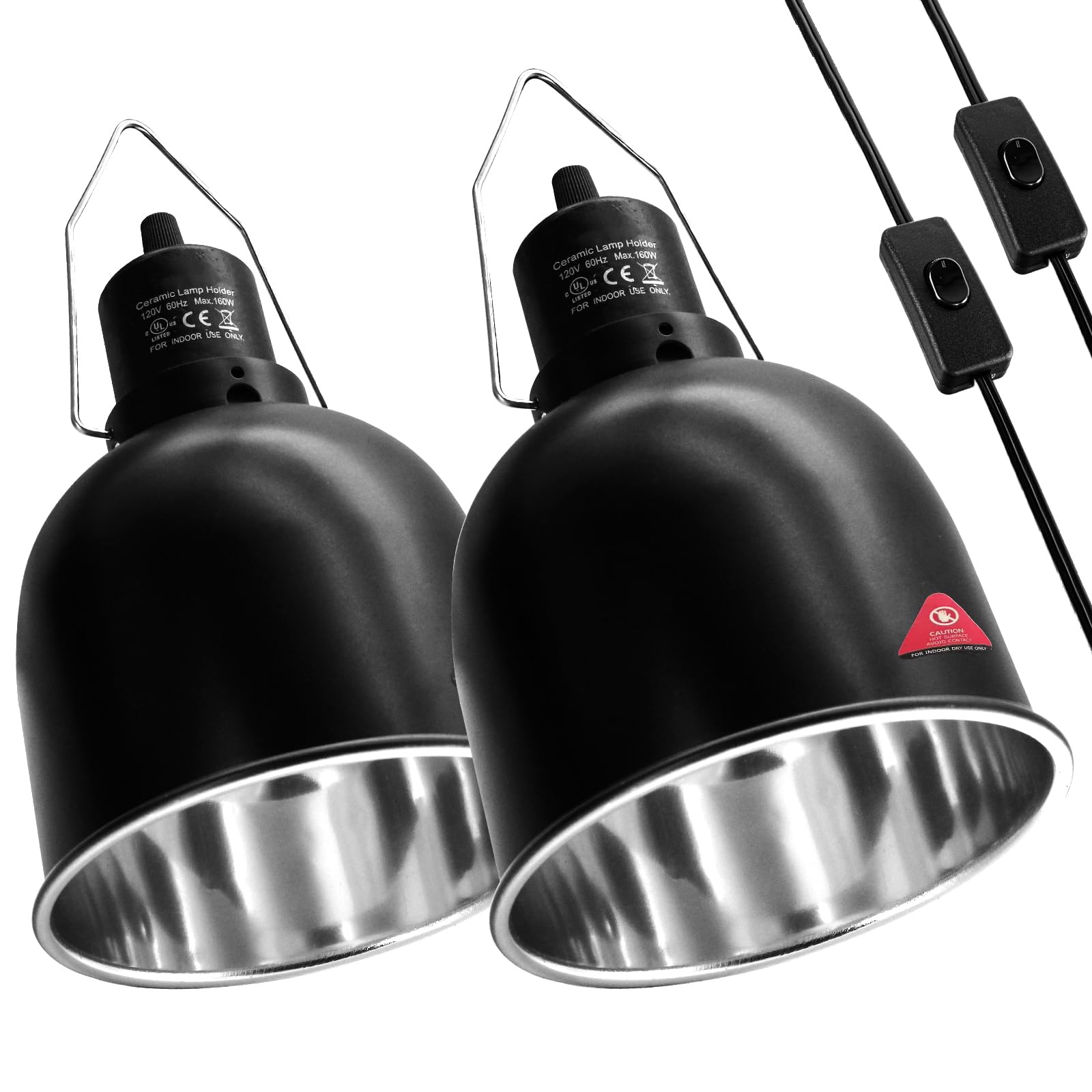
If you maintain multiple enclosures or want a dedicated CHE dome and a separate basking dome, this two-pack delivers the lowest per-fixture cost in the lineup. Each 5.5-inch deep dome features a polished aluminum interior, a UL-safety-certified ceramic socket rated for 160W, and independent on/off switches so you can control each dome without unplugging.
The multi-hole ventilation top prevents heat buildup that can degrade socket contacts over time, and owners who have run these continuously for 3+ months report no performance loss. The included S-hooks allow multi-angle mounting inside wooden vivariums or on screen tops. Buyers using these for ball pythons pair one dome with a 100W CHE for night heat and the other with a 75W daylight bulb for daytime basking.
The trade-off is build quality compared to Zoo Med or REPTI ZOO — the aluminum feels slightly thinner, and the switch housing is plastic rather than metal. They work reliably but may not survive the same abuse if moved between enclosures frequently. For a stationary setup in a dedicated tank, they perform admirably at a fraction of the cost of premium brands.
Why we love it
- Two domes at one budget-friendly price
- 160W capacity gives headroom for larger bulbs
- Ventilation top prevents overheating
Good to know
- Aluminum feels thinner than premium brands
- Plastic switch housing is less durable long-term
7. Zoo Med Repticare Infrared Ceramic Heat Emitter 150W

This is the benchmark ceramic heat emitter for ball python keepers. The 150W version emits zero visible light — pure infrared heat — making it the safest choice for 24-hour use without disrupting your snake’s circadian rhythm. The UL/CUL listing is meaningful: many imported CHEs lack certification, and a failed unlisted heater can crack or short. Zoo Med’s unit is rated for up to 5 years of continuous operation under normal use.
In a 40-gallon breeder tank with a dimming thermostat, this CHE raises ambient air temperature from 68°F to 82°F and creates a basking surface of 90°F directly below. Owners who moved frequently or misted the enclosure reported the bulb still held up for over two years before the element finally gave out — longer than most competing emitters. The water-resistant design adds a layer of protection against accidental spray from misting systems.
This is a bulb, not a fixture. You need a compatible deep dome with a ceramic socket (E26 base) to house it. Running it without a dimming thermostat is risky — a 150W CHE at full power can drive basking temps past 110°F in a small enclosure. When paired with the REPTI ZOO 8.5-inch dimming fixture, it becomes a rock-solid, zero-light heat source that will run for years.
Why we love it
- Zero visible light — ideal for 24-hour night heat
- UL/CUL certified for safety and compliance
- Reported lifespan of 2–5 years with normal use
Good to know
- Requires a ceramic-socket dome and dimming thermostat
- 150W may overpower small enclosures under 20 gallons
FAQ
Does a ball python need a UVB light or just heat?
Can I use a red or blue night light bulb for a ball python?
What wattage CHE should I use for a 40-gallon ball python tank?
How do I know if my dome fixture is creating a dangerous hot spot?
Can I leave a ceramic heat emitter on 24/7?
Final Thoughts: The Verdict
For most ball python keepers, the best light for ball python enclosures is the REPTI ZOO 8.5 Inch Deep Dome Fixture with Dimming Thermostat because it combines a focused deep-dome reflector with a built-in PID dimmer that eliminates temperature swings — no second thermostat purchase required. If you need a zero-light heat source for overnight ambient temps, pair the Zoo Med Repticare Ceramic Heat Emitter 150W with that fixture for a bulletproof 24-hour thermal system. And for keepers running bioactive setups who want a complete day/night cycle, the Zoo Med Combo Mini Deep Dome lets you run a basking bulb by day and a CHE by night with independent control of each zone.