
A betta’s labyrinth organ means it must breathe from the surface, so broad, sturdy leaves near the top aren’t just decoration — they’re a resting spot your fish will use daily. The wrong plant choice, however, can rot the rhizome, spike ammonia, or simply fail to survive submerged conditions.
I’m Mo Mahin — the founder and writer behind Furric. After comparing dozens of tissue-culture and potted specimens by leaf hardiness, root structure suitability for soft substrate, and documented survival rates in warm, low-flow betta tanks, I’ve narrowed down the selections that actually work.
From rhizome-clinging epiphytes that never need substrate to miniature foreground bunches that soften a bare-bottom setup, this guide covers only the species that pass both the visual and biological test for live plants for betta.
How To Choose The Best Live Plants For Betta
Most betta plants die because the buyer buries the rhizome — the thick horizontal stem — under gravel. Rhizome plants like Anubias and Java Fern must be attached to hardscape, not planted in substrate. Understanding this one rule prevents ninety percent of early failures.
Rhizome vs. Stem vs. Bulb: What Buries and What Binds
Rhizome plants (Anubias, Java Fern) have a fleshy horizontal stem that absorbs nutrients from the water column, not the substrate. Tie them to driftwood or rocks with thread or gel superglue. Stem plants (Water Sprite, Hornwort) can be floated or planted in gravel. True bulbs (Dwarf Lily, Aponogeton) require nutrient-rich substrate and often go dormant — unpredictable in a bare-bottom betta tank.
Leaf Thickness and Fin Safety
Betta fins are delicate, especially in long-finned varieties. Soft, broad leaves like Anubias nana leaves (about 1–2 inches wide) allow a resting betta to drape its tail without snagging. Sharp, needle-like leaves or rough edges can tear fins and cause rot over time. Avoid stiff stem plants with jagged margins near the resting zone.
Shipping Stress and Live Arrival Guarantees
Tropical plants shipped below 30°F often arrive with brown, mushy leaves — a condition called cold damage that rarely reverses. Check the seller’s live arrival policy before ordering. A guarantee is only useful if you inspect the plant immediately, photograph it in the unopened bag, and send a clear shot showing the damaged tissue.
Quick Comparison
On smaller screens, swipe sideways to see the full table.
| Model | Category | Best For | Key Spec | Amazon |
|---|---|---|---|---|
| Marcus Fish Tanks Anubias Nana Petite | Rhizome | Small tanks, foreground | 20–30 leaves per pot | Amazon |
| Marcus Fish Tanks 3X Java Fern | Rhizome | Background, mid tanks | 7–12 inch leaf height | Amazon |
| CANTON AQUATICS Java Fern Mat | Rhizome Mat | Instant carpet, low-tech | Coconut coir base mat | Amazon |
| Marcus Fish Tanks 3X Anubias Barteri | Rhizome Bundle | Multiple resting spots | 3–7 inch bare root plants | Amazon |
| Greenproaquatic Java Fern & Anubias Bundle | Rhizome Combo | Diverse aquascape | Two species, 5 inch height | Amazon |
In‑Depth Reviews
1. Marcus Fish Tanks Anubias Nana Petite Live Aquarium Plants Potted Freshwater Aquatic Plant

This Anubias nana petite pot delivers 20 to 30 leaves on a single compact rhizome, making it one of the best foreground choices for a 5 or 10 gallon betta tank. The leaf surface is broad and smooth — a genuine resting ledge a betta uses daily, not just hides behind. Because it’s grown as a potted specimen, the roots are already established when it arrives, reducing the melting phase that bare-root Anubias sometimes suffers in new tanks.
Every verified review emphasizes “healthy and vibrant” condition on arrival, with one buyer noting the plant broke into two separate colonies after a month. The live arrival guarantee covers cold damage only if temperatures stay above 30°F during shipping — check your local forecast before ordering during winter to avoid a refund hassle. The pot can be placed directly into a tank; just remove the rock wool and glue the rhizome to a small stone if you want it to stay put.
For betta keepers wanting a leaf that won’t tear fins and stays small enough to leave swimming room, this petite Anubias delivers the highest consistency of any single-specimen pot in this price tier. The only catch is patience: initial growth is slow until the plant acclimates, typically two to three weeks before you see new leaf tips.
Why we love it
- Comes potted with established root mass
- Ideal resting perch for long-finned bettas
- Very consistent live arrival historically
Good to know
- Slow to show new growth in first 2–3 weeks
- Winter shipping risk if temps drop below 30°F
2. Marcus Fish Tanks 3X Java Fern Microsorum Pteropus Easy Live Aquarium Plants

Three Java Fern plants ranging from 7 to 12 inches tall give a betta keeper immediate background structure without needing substrate. The long, tapering leaves create vertical shade lines that a betta will swim through during exploration, and the rhizome structure means you wedge the base between two rocks or tie it to a suction cup — no buried stems, no rot.
Buyers consistently report “vibrant green” arrival even with shipping delays, and several confirmed that the plants stayed green through a holiday extension. The cold shipping threshold here is lower: the seller guarantees down to 20°F, not 30°F, which is a meaningful safety margin for northern winter orders. One reviewer noted a plant arrived slightly yellow but greened up within days of tank placement — typical for Java Fern during acclimation.
Compared to the single-pot Anubias above, this triple-pack gives you more total leaf mass for the same budget, but the taller leaves are better suited to the back or side of a 10-gallon tank rather than a nano tank. For a betta in a 5-gallon, trim the tallest leaves or position them near the filter outflow to avoid overwhelming the swimming area.
Why we love it
- Three plants per order at a very accessible entry
- Guaranteed live arrival down to 20°F
- Fast color recovery after shipping
Good to know
- Can outgrow 5-gallon tanks quickly
- Leaves may arrive slightly yellow but recover
3. Live Plants for Fish Tank Java Fern Mat with Coconut Coir, Microsorum Pteropus

This Java Fern mat uses a coconut coir base that acts as both anchor and nutrient buffer, letting you lay a shallow green carpet across the tank floor without individual planting. The coir holds moisture and slowly releases trace elements, which reduces the initial melt common when bare-root ferns are introduced to a new aquarium. For a betta tank with a bare bottom, this mat offers the closest thing to a natural substrate look without gravel.
Canton Aquatics markets this as a “pet friendly” product, and the reviews consistently describe the plants as “deep green” and “snail-free.” One buyer separated rhizomes and glued them to lava rock for a more structured aquascape, showing the mat can be divided if you prefer individual clumps instead of a full carpet. The coconut coir does trap debris over time, so running a turkey baster over the mat during weekly water changes keeps detritus from accumulating between the fibers.
The main tradeoff is that a mat is less flexible for rearrangement — once it’s weighted down and the roots begin weaving through the coir, moving it will tear the new root tips. Place it intentionally from day one, ideally in the front half of the tank where the low-growing fern won’t block your view of the betta.
Why we love it
- No individual planting into substrate needed
- Coir mat provides gentle nutrient support
- Consistently snail-free per buyer reports
Good to know
- Debris collects in coir between water changes
- Mat is not easily repositioned once rooted
4. 3 Aquatic Plants Bundle Live Plants for Freshwater Aquariums (3 X Anubias VAR Nana Plants)
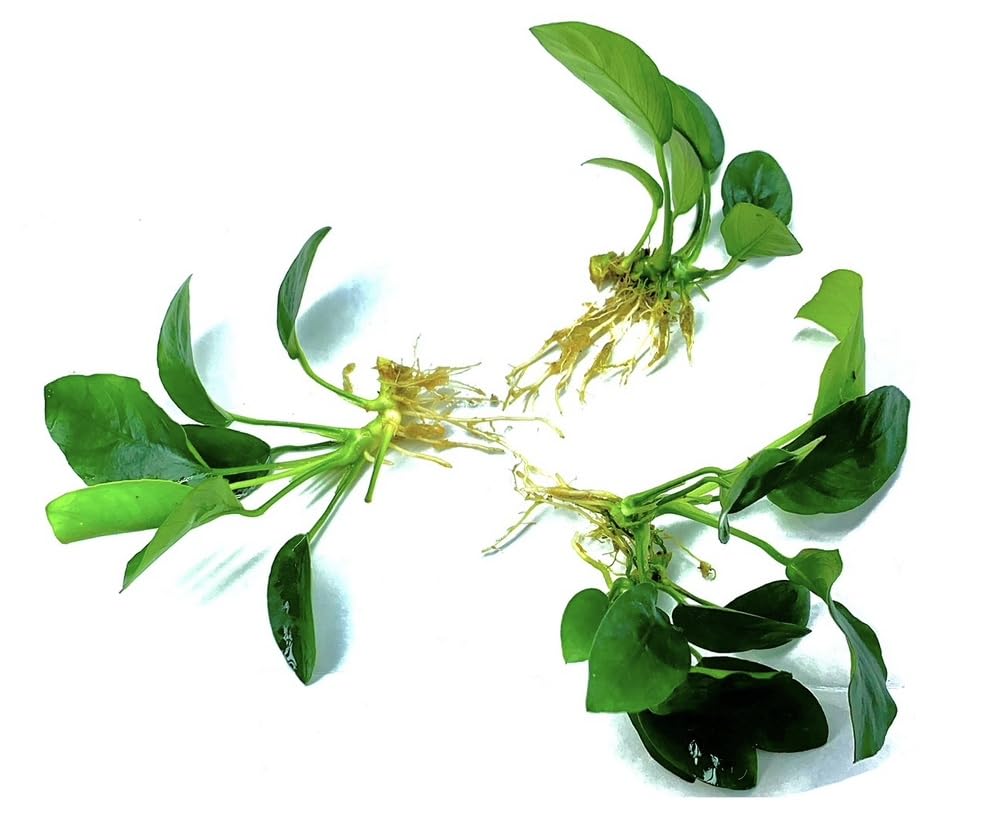
Three bare-root Anubias barteri plants ranging from 3 to 7 inches give you multiple placement options across the same tank — one on driftwood, one suction-cupped to the back wall, one weighted near the substrate. Because all three are the same species, their care is identical: low light, no CO₂, rhizome above the substrate. This consistency simplifies maintenance compared to mixed-species bundles where Java Fern and Anubias may compete for space.
Buyers describe the plants arriving with “strong root systems” and “great color,” though one reviewer noted the size was smaller than expected. At 3–7 inches, these are starter-sized Anubias that will need two to three months to reach the full leaf spread of a mature specimen. The roots are the real advantage here — bare-root shipping means you can inspect the rhizome for rot before introducing it to the tank, unlike potted versions where the rock wool hides the base.
Because all three are Anubias barteri, they share the same leaf texture and thickness, creating a uniform look that reads as deliberate aquascaping rather than a random collection. For a betta keeper who wants multiple resting ledges at different heights without mixing plant types, this bundle achieves that with no substrate, no supplement, and minimal guesswork.
Why we love it
- Three identical plants for uniform aquascaping
- Bare-root permits rhizome inspection before planting
- Strong root systems confirmed by buyers
Good to know
- Leaves start small and need months to mature
- No rock wool means careful handling during acclimation
5. Java Fern and Anubias Aquarium Plant Bundle Live Freshwater Plants for Aquascaping

This bundle gives you one Java Fern and one Anubias plant, offering two distinct leaf shapes — the broad, rounded Anubias leaf for resting and the tall, wavy Java Fern leaf for background texture — all in a single, entry-level purchase. Both species are rhizome-based and thrive in low to medium light without CO₂ injection, making this the most accessible bundle for a beginner betta keeper who wants variety without complexity.
Shipping reviews are mixed: several buyers report “healthy” and “beautiful” plants that arrived “damp and sealed,” but others received an Anubias with “leaves fallen off” or “rotten-looking stems.” The variance points to batch-dependent packaging quality from Greenproaquatic. If you order, inspect the Anubias rhizome immediately — firm and green is fine; soft and brown means you should file for the arrival guarantee within hours of unboxing.
For the price, having two different species in one order is convenient if you want to test both Anubias and Java Fern before committing to larger single-species purchases. The Java Fern is the more resilient of the two in this bundle and will likely outlast the Anubias if both arrive in good condition. Plant the Anubias on hardscape and let the Java Fern float until it attaches naturally.
Why we love it
- Two species for one price gives visual variety
- Both plants need zero CO₂ or strong light
- Low barrier to entry for new aquascapers
Good to know
- Anubias shipping condition is inconsistent
- Anubias often loses leaves during transit
FAQ
Can I plant live plants directly in gravel for a betta tank?
How do I quarantine a live plant before adding it to a betta tank?
Why are the leaves on my new Anubias turning yellow or brown?
Final Thoughts: The Verdict
For most betta keepers, the live plants for betta winner is the Marcus Fish Tanks Anubias Nana Petite because its compact, broad leaves give your betta a stable resting perch without crowding the swimming area. If you want tall background coverage with a lower shipping risk, grab the Marcus Fish Tanks 3X Java Fern. And for a no-fuss carpet in a bare-bottom tank, nothing beats the CANTON AQUATICS Java Fern Mat.