
The difference between a standard room purifier and a true medical-grade air purifier isn’t marketing — it’s the thickness of the filter media, the seal quality around the frame, and the CADR (Clean Air Delivery Rate) certification that guarantees independent lab validation. When your household includes asthma, COPD, severe allergies, or chemical sensitivities, the unit you choose becomes an active medical device, not a comfort appliance.
I’m Mo Mahin — the founder and writer behind Furric. I’ve spent over a decade analyzing indoor air quality data, cross-referencing HEPA-class filter specifications against independent lab results, and cataloging real owner feedback from homes with documented respiratory conditions to separate genuine medical-grade performance from clever marketing claims.
This guide breaks down the nine most serious contenders on the market so you can confidently select a best medical grade air purifier that matches your room size, filtration depth needs, and long-term maintenance budget without guessing.
How To Choose The Best Medical Grade Air Purifier
Medical-grade air purification isn’t a regulated term in the consumer market, but the hardware specifications that make a unit suitable for clinical environments are measurable. You need to understand three pillars: filter classification, total surface area of the media, and the carbon bed depth for gas-phase filtration. A unit that scores high on particle capture but uses a thin carbon pad won’t handle VOCs or cooking odors.
Particle Retention Rating: HEPA vs. UltraHEPA
True HEPA, by definition, captures 99.97% of particles at 0.3 microns. That standard was developed in the 1940s. Modern medical-grade units often push beyond that — the AirDoctor line, for instance, uses UltraHEPA filtration rated at 99.99% capture efficiency at 0.003 microns. That’s a 100x smaller particle threshold, which matters for capturing viruses, bacteria, and ultrafine smoke particulates. If your primary concern is wildfire smoke or bioaerosols, the sub-0.1 micron capture rate becomes your most critical spec.
CADR and Room Size Matching
Clean Air Delivery Rate (CADR) is the only standardized metric for comparing how quickly a unit cleans a given room. Each AHAM Verifide unit publishes separate CADR numbers for smoke, dust, and pollen. A unit rated for 1,800 square feet on the box may have a smoke CADR of 250 CFM — adequate for a 625 sq ft room at 4 air changes per hour, but insufficient for that same 1,800 sq ft at a single air change per hour. Always calculate your room volume and match it to the smoke CADR, not the marketing coverage number.
Carbon Filter: Weight, Depth, and Chemistry
The carbon stage is where most consumer purifiers cut corners. A medical-grade unit should use a carbon filter with at least one pound of media, preferably impregnated with potassium permanganate for chemical oxidation of VOCs like formaldehyde, MMA, and toluene. Thin foam pads coated with a carbon dust spray — common in sub- units — saturate within weeks. Look for cartridge-style carbon filters that are at least one inch thick, and check whether the manufacturer offers a dedicated gas-phase filter as an option.
Ozone Safety and Ionizer Controls
Some HEPA purifiers include an ionizer or PlasmaWave-style feature that claims to kill pathogens. For true medical-grade use, especially in households with asthma or COPD, you want a unit that produces zero ozone. Check for CARB certification in California and look for units that allow you to permanently disable any ionizer function. The Coway Mighty, for example, includes a Vital Ion feature that can be turned off, while the AirDoctor and Alen BreatheSmart lines operate without any ozone-generating component in their standard filtration path.
Quick Comparison
On smaller screens, swipe sideways to see the full table.
| Model | Category | Best For | Key Spec | Amazon |
|---|---|---|---|---|
| AirDoctor AD5500 | UltraHEPA | Whole-home VOC control | 99.99% at 0.003 microns | Amazon |
| AirDoctor AD2000 | UltraHEPA | Bedroom chemical sensitivity | 99.99% at 0.003 microns | Amazon |
| Alen BreatheSmart 35i | H13 HEPA | Odor neutralization + sleep | 0.1 micron retention | Amazon |
| Blueair DustMagnet 5440i | HEPASilent | Dust capture + quiet operation | 7W on low speed | Amazon |
| Coway Airmega AP-1512HH | True HEPA | Medium room value | CADR Smoke 233 CFM | Amazon |
| Coway Airmega 200M | True HEPA | Open floor plan coverage | 1,748 sq ft in 60 min | Amazon |
| Levoit Core 400S-P | 3-Stage HEPA | Smart home integration | CADR Smoke 231 CFM | Amazon |
| Winix 5520 | True HEPA | Budget large-room coverage | 23.5 dB on low speed | Amazon |
| Levoit Vital 200S-P | 3-Stage HEPA | Pet allergen reduction | CADR Smoke 250 CFM | Amazon |
In‑Depth Reviews
1. AirDoctor AD5500
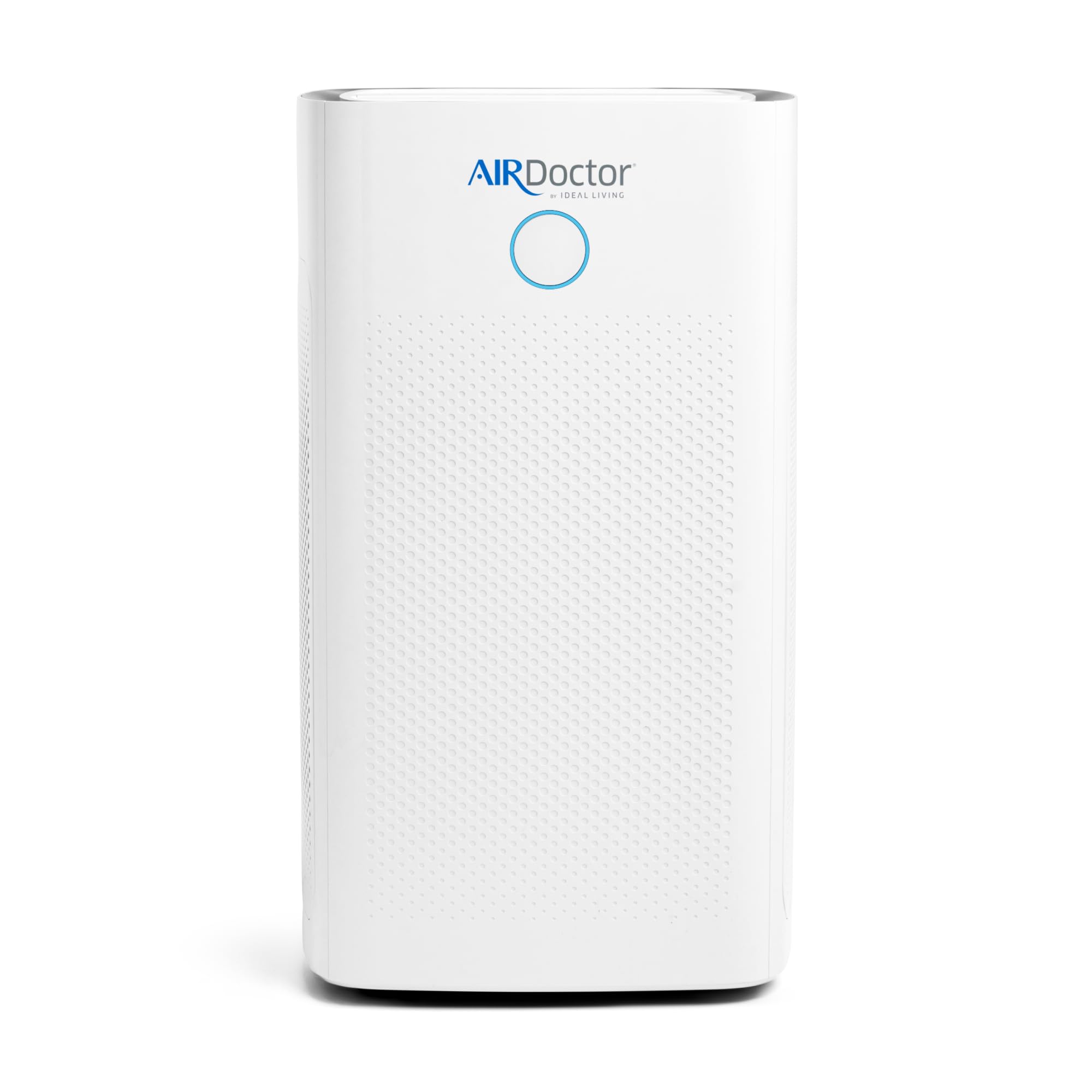
The AirDoctor AD5500 is the unit you buy when chemical sensitivity, heavy VOC loads, or post-construction off-gassing are your primary concern. Its UltraHEPA media captures 99.99% of particles at 0.003 microns — 100x smaller than the HEPA 0.3-micron threshold — and the dual-action carbon filter uses potassium permanganate to chemically break down formaldehyde, MMA, and toluene rather than simply adsorbing them until saturation. With a maximum coverage of 4,172 square feet, it cleans open-concept homes and basement workshops at four air changes per hour.
The six-speed fan system includes a Boost mode that the AirDoctor Halo PM2.5 sensor triggers automatically when it detects a spike — the color-coded LED ring shifts from blue to yellow to red to confirm conditions are degrading. Owners report that the unit eliminates new-furniture VOC smells within 24 hours and that dust accumulation on surfaces drops noticeably within the first week. The 60-watt max draw is modest for the air volume it moves, and the 12-month filter interval on the UltraHEPA cartridge is reasonable given the filtration depth.
A small subset of users with extreme chemical sensitivities have reported a light odor from the filter media itself during the first 48 hours, though this off-gassing dissipates. The unit measures 16 x 16 x 28.75 inches, so it requires dedicated floor space. For anyone managing asthma, COPD, or multiple chemical sensitivities in a larger home, this is the single most complete medical-grade air purification package available at the consumer level.
Why we love it
- 99.99% capture at 0.003 microns exceeds standard HEPA by 100x
- Potassium permanganate carbon filter handles VOCs other units miss
- Auto-mode sensor triggers Boost from real-time PM2.5 readings
Good to know
- Large footprint requires dedicated corner or wall space
- Replacement UltraHEPA filters cost more than standard HEPA
- A few users report initial off-gassing from new filter media
2. AirDoctor AD2000
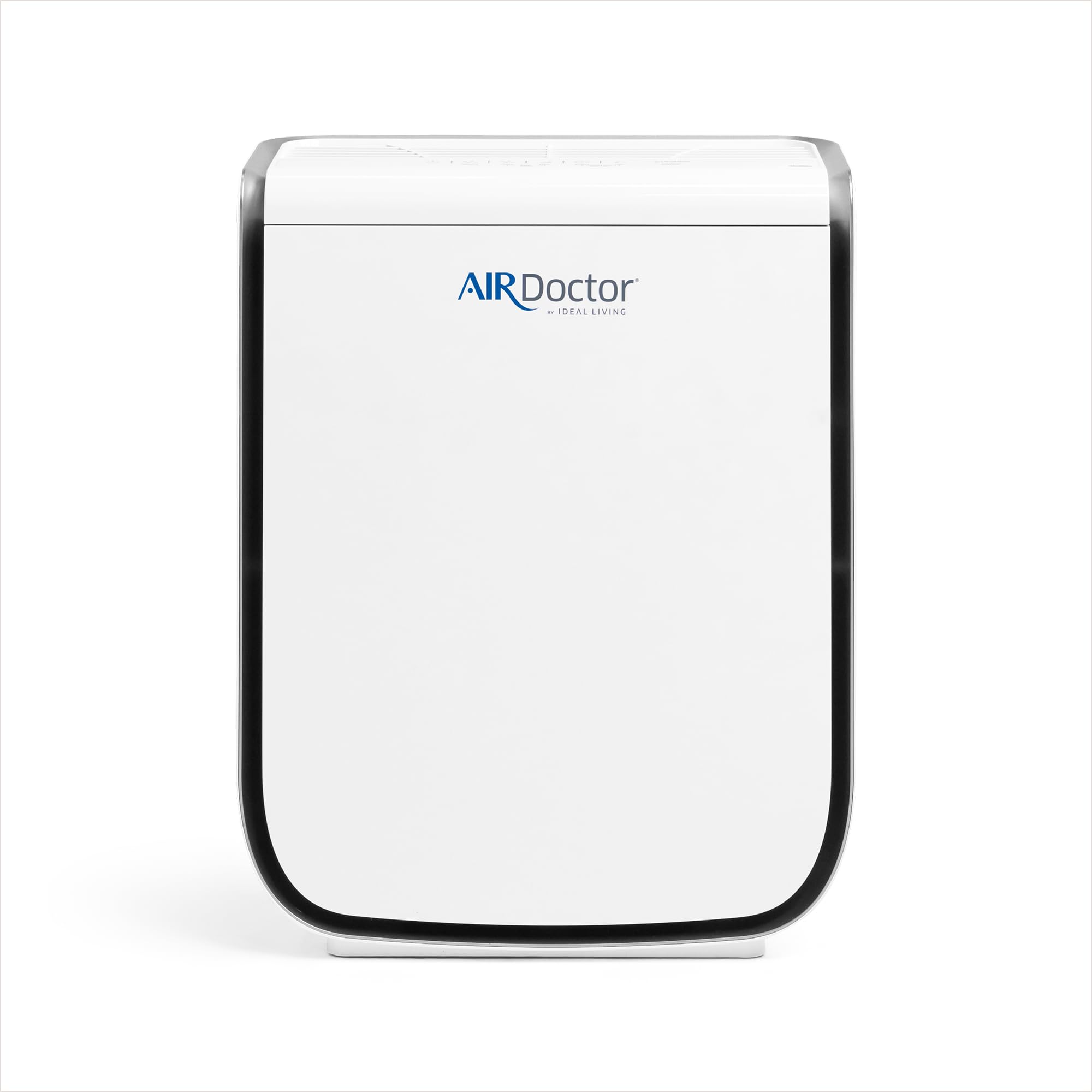
The AirDoctor AD2000 delivers the same UltraHEPA filtration and potassium permanganate carbon chemistry as the AD5500 but in a package sized for bedrooms, nurseries, and home offices up to 1,220 square feet. It cleans a 305 sq ft room in 15 minutes, and the Halo sensor provides the same real-time color-coded feedback as its larger sibling. For households where a single room needs the highest level of VOC reduction — a nursery near a newly painted room, a home office with a laser printer emitting ozone, or a bedroom for someone with chemical sensitivities — this unit concentrates medical-grade filtration where it matters most.
The four-speed fan system runs whisper-quiet on setting one, and the night mode turns off all indicator lights for zero light pollution during sleep. Owners with severe allergies report that the AD2000 noticeably reduces the need for antihistamines within days. The pre-filter is washable, extending the life of the UltraHEPA cartridge to 12 months under normal use. The carbon filter, which uses a blend of activated coconut-shell carbon and potassium permanganate, should be replaced every six months to maintain VOC adsorption performance.
At 12.9 pounds and 9.1 x 16.3 x 20.7 inches, it’s portable enough to move between rooms but substantial enough to stay stable on a nightstand or desk. The initial unit sold in 2022 had sensor reliability complaints, but the current production run has resolved those issues. For buyers who need UltraHEPA-level protection but don’t have the square footage to justify the AD5500, this is the precise middle ground.
Why we love it
- Same UltraHEPA 0.003-micron capture as the AD5500 in a smaller chassis
- Carbon filter actually reduces formaldehyde and MMA, not just odors
- Night mode eliminates all indicator lights for undisturbed sleep
Good to know
- Carbon filter requires biannual replacement to maintain VOC performance
- Maximum coverage is limited to 1,220 sq ft per unit
- No app-based remote control like some smart-home competitors
3. Alen BreatheSmart 35i
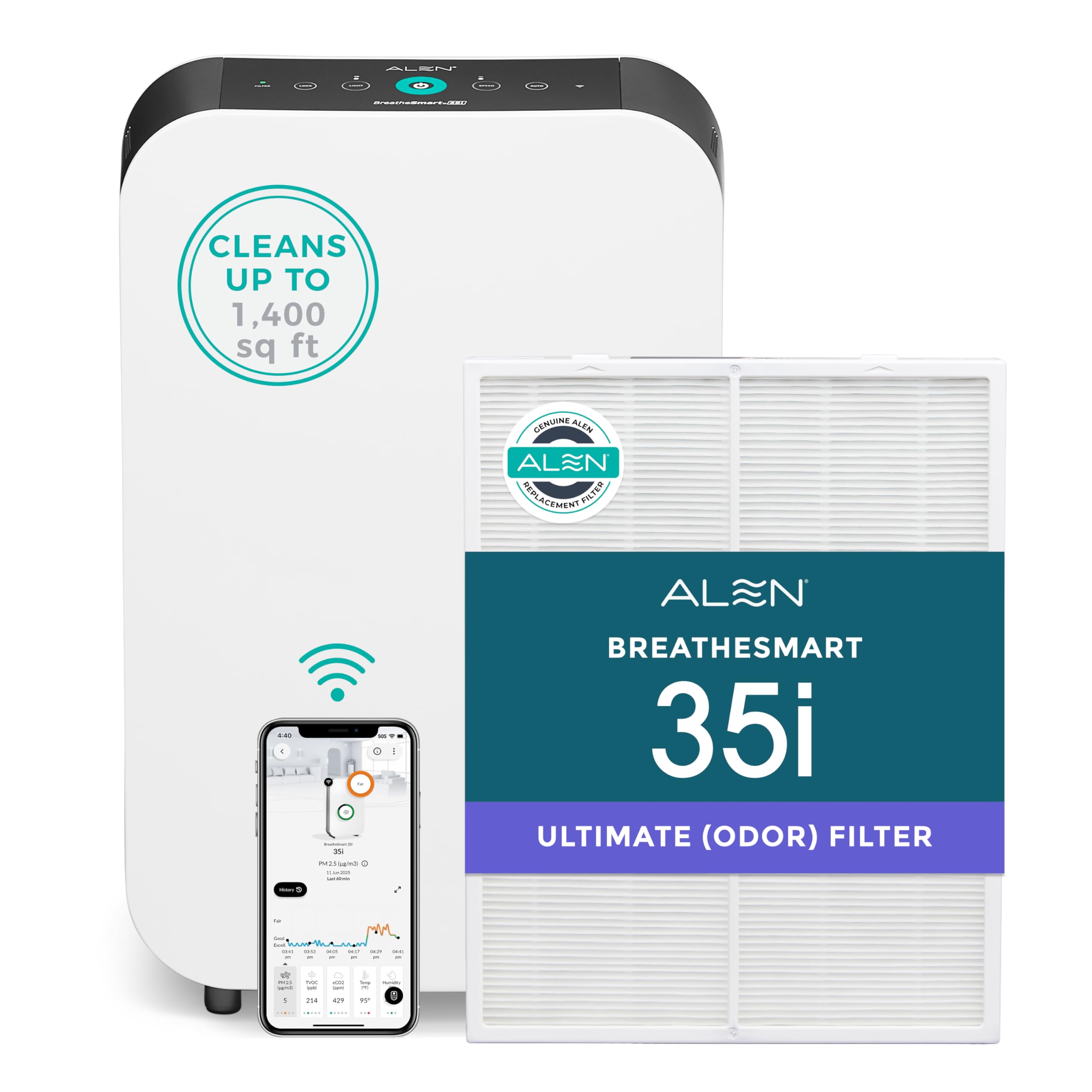
The Alen BreatheSmart 35i takes a different approach to medical-grade filtration: instead of simply capturing particles, its dedicated Odor H13 HEPA filter uses a molecular neutralization layer that chemically bonds with odor molecules from cooking, pet dander, and litter boxes. The H13 rating means it captures 99.97% of particles down to 0.1 microns — slightly less aggressive on the ultrafine end than UltraHEPA, but the real value here is the carbon-fiber-and-zeolite blend that handles heavy household smells other units struggle to adsorb with standard carbon pads.
The SmartSensor adjusts fan speed based on real-time air quality readings, and the color-coded LED ring provides instant feedback — blue for excellent, purple for elevated particles. Alen partnered with SleepScore Labs to validate that the unit’s acoustic profile (pink noise in the lower octaves) improves sleep quality, making this the best option for a bedroom used during the day for activities that generate odors. The 40-watt max draw and per day running cost are among the lowest in this class.
At 7.6 x 13 x 20.6 inches and only 10 pounds, the 35i is the most compact unit in the premium tier. Owners note that filters last 6 to 12 months depending on odor load, and the replacement cost is higher than standard HEPA cartridges due to the proprietary carbon-zeolite blend. Some users report that the auto-sensor is less responsive to fine dust than to VOCs, so manual high-speed mode may be necessary during wildfire events.
Why we love it
- Odor-specific H13 filter neutralizes smells at the molecular level
- Clinically validated pink noise profile supports deeper sleep
- Extremely low 10-pound weight makes room-to-room relocation effortless
Good to know
- Odor HEPA replacement filters cost more than standard H13 cartridges
- Auto-sensor prioritizes VOCs over fine dust particles
- Maximum room coverage of 1,000 sq ft limits whole-home application
4. Blueair DustMagnet 5440i

The Blueair DustMagnet 5440i uses electrostatic charging technology in its HEPASilent dual filtration system to capture 99% of airborne dust before it settles on surfaces. The charged stainless steel pre-filters attract particles like a magnet, and the vortex airflow design keeps particles airborne long enough to capture them rather than letting them fall back to the floor. This is the only unit in this guide that explicitly addresses the problem of settled dust — owners report vacuuming furniture biweekly instead of every few days after installation.
The in-app real-time tracking shows PM2.5, temperature, and humidity, and the 5-color LED ring provides immediate air quality feedback. Night Mode lowers fan speed and dims all indicator lights, and the Welcome Home feature uses geofencing to pre-purify the room before you arrive. The 30 dB noise level on low is verified by Quiet Mark as the quietest in its class.
The carbon filter is a lightweight foam pad rather than a thick carbon cartridge, so VOC reduction is limited to light household odors — not heavy chemical off-gassing. The electrostatic pre-filters are washable, but the main HEPA-style filter must be replaced every 6 to 12 months. For households where visible dust is the primary complaint and noise sensitivity is high, this is the single most effective unit at reducing surface dust accumulation.
Why we love it
- Electrostatic pre-filters capture dust before it settles on surfaces
- 7-watt power draw on low is the most energy-efficient in class
- Geofencing Welcome Home feature pre-purifies before arrival
Good to know
- Carbon pad is thin — limited VOC and heavy odor capacity
- Manual is unclear about filter orientation during installation
- Replacement HEPASilent filters cost approximately each
5. Coway Airmega AP-1512HH (Mighty)
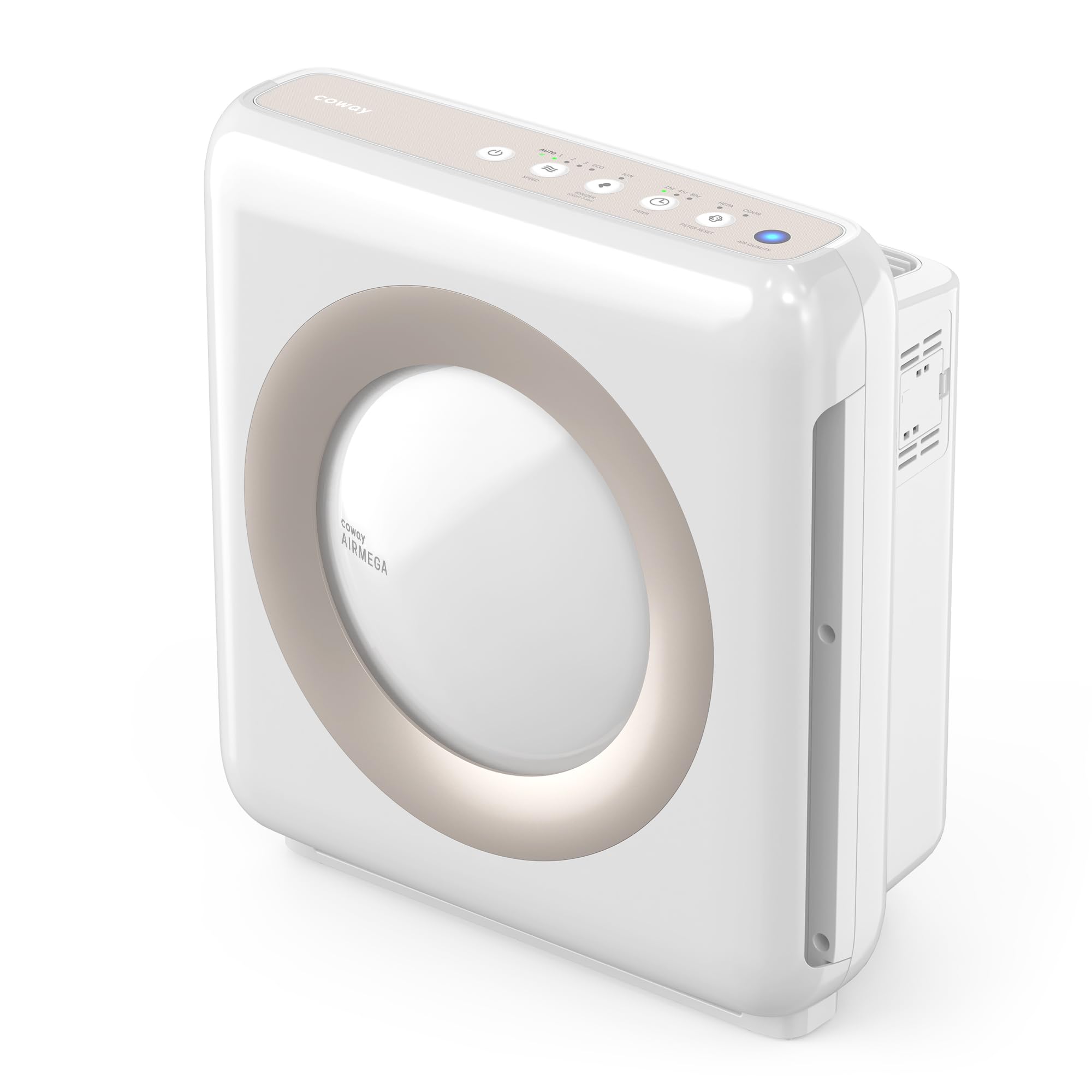
The Coway Airmega AP-1512HH, often called the Mighty, has been the Wirecutter-recommended best air purifier since 2018 for good reason. It uses a four-stage filtration system — pre-filter, deodorization carbon filter, True HEPA filter, and a Vital Ion option — to deliver a smoke CADR of 233 CFM, a dust CADR of 246 CFM, and a pollen CADR of 240 CFM. For a unit rated at 361 square feet, those CADR numbers are exceptional, translating to four air changes per hour at that room size.
The real-time pollution sensor communicates indoor air quality via a brightly colored LED ring that shifts from blue to red depending on particle load. Auto mode adjusts fan speed across three stages based on the sensor reading, and when no pollution is detected for 30 minutes, Eco mode turns the fan off automatically to conserve energy. The timer allows 1/4/8 hour run intervals, and separate filter replacement indicators track both the pre-filter and the HEPA filter independently. Noise level ranges from 24.4 dB on low to 53.8 dB on high — the low setting is nearly silent.
Owners consistently report that the Mighty clears wildfire smoke within minutes and prevents kitchen smoke detectors from triggering by capturing particulate before it spreads. The unit is 12.5 pounds with dimensions of 9.6 x 16.8 x 18.3 inches — compact enough for a side table. The Vital Ion feature can be turned off, making it ozone-free for sensitive users. The only common complaint is that the auto mode defaults to low speed rather than medium, so manual override is sometimes needed during heavy pollution events.
Why we love it
- Industry-leading CADR numbers for its compact 361 sq ft rating
- Four-stage filtration with washable pre-filter extends HEPA lifespan
- Wirecutter recommended consistently for over 6 years of continuous testing
Good to know
- Auto mode defaults to low speed — manual adjustment needed for heavy smoke
- No smart app control for remote monitoring or scheduling
- Maximum effective coverage is limited to 361 sq ft at 4 ACH
6. Coway Airmega 200M

The Coway Airmega 200M extends the same HyperCaptive filtration system found in the Mighty to a larger room size — 1,748 square feet in 60 minutes. The three-stage system combines a washable pre-filter, a deodorization carbon filter, and a True HEPA filter that captures 99.97% of particles at 0.3 microns. For open-concept living spaces or combined kitchen-dining-living layouts, the 200M provides single-unit coverage where the Mighty would require two or three units working in parallel.
Auto Mode monitors air quality in real-time and adjusts the fan across three manual speed settings. Eco Mode shuts the fan off after 30 minutes of clean air, then reactivates when the sensor detects a pollutant spike. The filter replacement indicator tracks both the pre-filter and the HEPA filter separately. Owner feedback consistently highlights the unit’s ability to handle cooking odors from an open kitchen — the carbon filter in the 200M uses a denser media than Coway’s smaller units, extending effective odor adsorption.
At 12.3 pounds and 10 x 17 x 18 inches, the 200M is deceptively lightweight for its coverage area. A small number of users report a chemical smell from the new HEPA filter that persists for days, though this off-gassing appears to be batch-dependent rather than a design flaw. For households with open floor plans and moderate VOC loads, this is the most efficient single-unit solution from a trusted medical-grade brand.
Why we love it
- Covers 1,748 sq ft with a single unit — ideal for open-concept homes
- Denser carbon media handles cooking odors from open kitchens
- Eco Mode saves energy without sacrificing responsiveness
Good to know
- Some production batches have a new-filter smell that takes days to clear
- No app control or voice assistant compatibility
- Filter replacement costs are higher than the smaller Mighty model
7. Levoit Core 400S-P

The Levoit Core 400S-P brings AHAM Verifide certification and True H13 HEPA filtration (99.97% at 0.1 to 0.3 microns) to a smart-home package at a price point that undercuts most premium medical-grade units. Its smoke CADR of 231 CFM, dust CADR of 240 CFM, and pollen CADR of 259 CFM are AHAM-verified, and the 360-degree intake design allows placement anywhere in the room without directional orientation constraints. The AirSight Plus laser dust sensor provides a live PM2.5 readout on the display, updating continuously as conditions change.
The VeSync app enables scheduling, filter life tracking, and integration with Alexa and Google Assistant. Votexair Technology creates a vortex airflow pattern that maximizes room coverage, and the patented ARC Formula handles VOCs and cooking odors — owners report that fish and spice smells disappear within minutes. Sleep Mode drops to 24 dB, quieter than a whisper, and the light sensor automatically dims the display in a dark room. The 2.4 GHz WiFi requirement is the only connectivity friction, as the unit won’t connect to 5 GHz networks.
The 3-in-1 filter is a pre-filter, activated carbon layer, and True HEPA layer combined into a single cartridge. This simplifies replacement but means the carbon media is thinner than standalone cartridge systems. For households that prioritize smart controls and AHAM-verified performance at a mid-range price, the Core 400S-P delivers medical-grade particle capture with app convenience that higher-end units lack.
Why we love it
- AHAM Verifide CADR ratings with H13 HEPA capture at 0.1 microns
- 24 dB Sleep Mode is among the quietest in the medical-grade category
- Full VeSync smart app with Alexa and Google Assistant integration
Good to know
- Requires 2.4 GHz WiFi — incompatible with 5 GHz networks
- Combined 3-in-1 filter means thinner carbon layer than separate cartridges
- Air quality sensor can occasionally miss smoke detection in auto mode
8. Levoit Vital 200S-P

The Levoit Vital 200S-P is specifically engineered for households with pets, and its design choices reflect that focus. The U-shaped air inlet, in addition to the traditional intake, is positioned to capture low-lying pet hair and dander before they settle — owners report that the pre-filter catches visible clumps of fur that would clog standard flat-panel units. The smoke CADR of 250 CFM, dust CADR of 254 CFM, and pollen CADR of 289 CFM are all AHAM Verifide, and the unit covers up to 1,875 square feet.
The Pet Mode in the VeSync app automatically selects the optimal fan speed for dander and odor removal, and the light sensor adjusts the display brightness based on ambient room light — useful for pets that sleep in the same room as their owners. The 3-stage filter captures 99.97% of particles at 0.1 to 0.3 microns, and the washable pre-filter can be vacuumed or rinsed to extend HEPA filter life. The color-coded air quality ring provides immediate visual feedback, and owners consistently report noticeable improvement in allergy symptoms within days.
At 13.2 pounds and 15.6 x 8.5 x 19.8 inches, the Vital 200S-P has a taller, narrower profile than many competitors, which makes it easier to tuck into corners or between furniture. The maximum fan speed is loud, but lower speeds are whisper-quiet. For multi-pet households where fur volume and litter-box odors are the primary air quality challenge, the extra intake geometry and Pet Mode make this the most targeted solution in the mid-range.
Why we love it
- U-shaped air inlet captures low-lying pet hair that clogs standard intakes
- CADR Smoke 250 CFM is competitive with units twice its price
- Dedicated Pet Mode optimizes fan speed for dander and odor control
Good to know
- Washable pre-filter is effective but needs weekly cleaning in heavy-shedding homes
- High fan speed is noticeably louder than mid-range competitors
- Smart app requires 2.4 GHz WiFi connection
9. Winix 5520
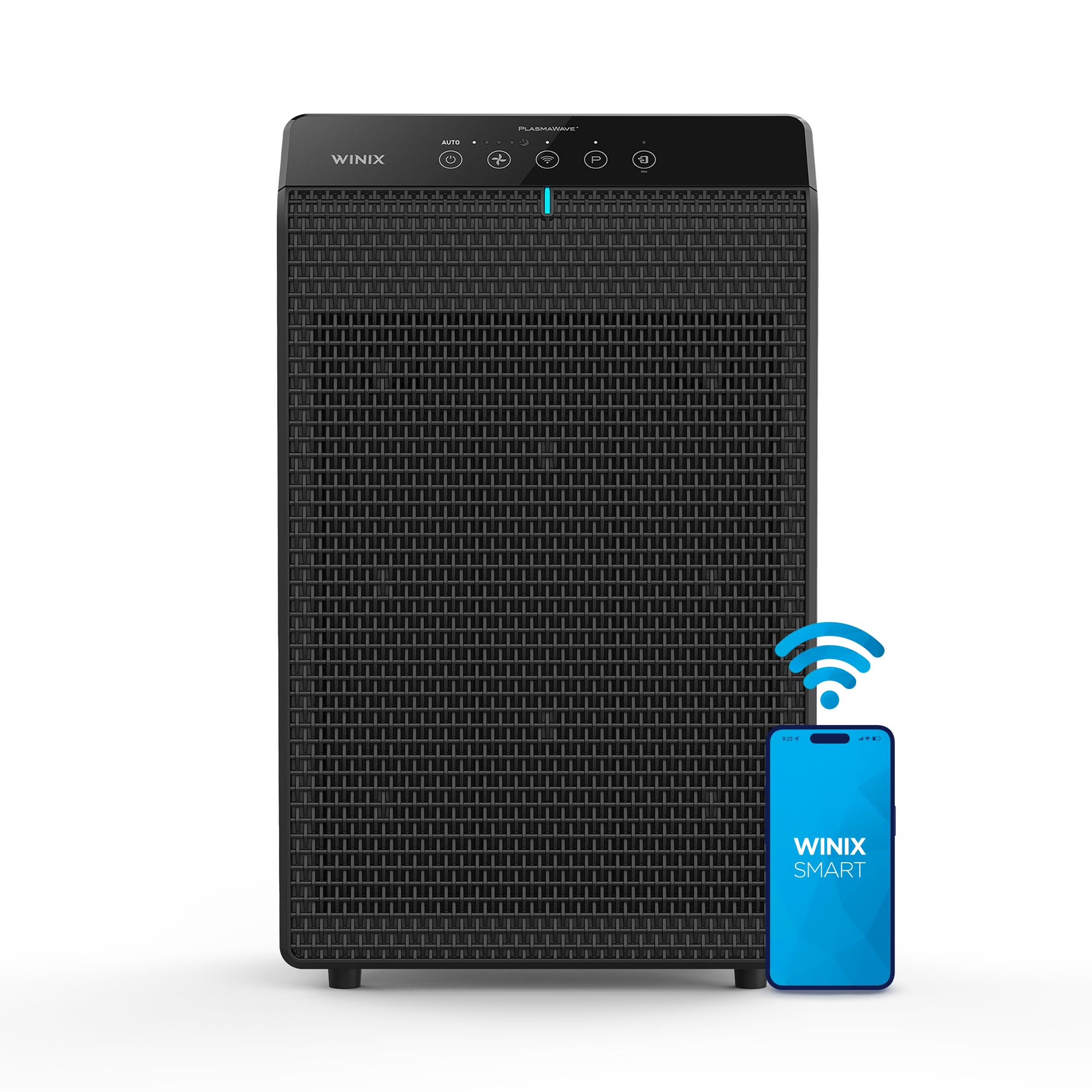
The Winix 5520 enters the large-room medical-grade space with an AHAM Verifide rating at 392 square feet while capable of cleaning up to 1,882 square feet in one hour. The four-stage filtration system includes a washable fine mesh pre-filter, a washable AOC (Advanced Odor Control) carbon filter, a True HEPA filter that captures 99.99% of particles as small as 0.01 microns, and a PlasmaWave option that the user can disable for zero-ozone operation. The 0.01-micron particle retention rating is notably tighter than standard True HEPA’s 0.3-micron threshold.
The built-in air quality sensor feeds real-time data to a color-coded LED indicator and Smart Sensors that adjust fan speed in Auto Mode. Sleep Mode activates automatically when the room darkens, switching to near-silent operation at 23.5 dB and turning off indicator lights. The Winix Smart App provides remote control and monitoring, and the unit works with Amazon Alexa for voice commands. The washable AOC carbon filter is a significant cost-saver — owners report rinsing it monthly and replacing it annually rather than every 3 to 6 months like disposable carbon pads.
Owner feedback consistently notes that the 5520 effectively reduces airborne pet hair and visible dust within 30 minutes. The unit’s 13.3-pound weight and 8.3 x 13.6 x 22.7-inch dimensions make it easy to move, though the vertical intake grilles on the sides can allow larger pet hair and dust to bypass the pre-filter if not cleaned weekly. The two-year warranty from a manufacturer with a South Korean production base adds confidence. For budget-conscious buyers who need large-room coverage and want to minimize ongoing filter costs, the Winix 5520 offers the best total cost of ownership.
Why we love it
- Washable AOC carbon filter saves money compared to disposable competitors
- 0.01-micron HEPA retention exceeds standard True HEPA requirements
- 23.5 dB Sleep Mode is the quietest in the large-room category
Good to know
- Vertical intake grilles allow some pet hair and dust to bypass pre-filter
- PlasmaWave ionizer must be manually disabled for zero-ozone operation
- LED air quality light lacks detailed numerical PM data
FAQ
What particle size does a medical-grade HEPA filter actually capture?
How do I calculate the right CADR for my room?
Are air purifiers with ionizers safe for people with asthma?
Can one medical-grade purifier clean an entire house?
How often should I replace the carbon filter in a medical-grade purifier?
Final Thoughts: The Verdict
For most households seeking a best medical grade air purifier, the comprehensive winner is the AirDoctor AD5500 because it combines UltraHEPA filtration (99.99% at 0.003 microns), a thick potassium permanganate carbon cartridge for real VOC reduction, and whole-home coverage up to 4,172 square feet in a single ozone-free unit. If you need focused chemical protection in a smaller space like a bedroom or nursery, grab the AirDoctor AD2000 for the same filtration in a more compact chassis. And for budget-conscious buyers who need large-room coverage with the lowest ongoing filter cost, nothing beats the washable-carbon Winix 5520.