
The challenge with a nano reef tank isn’t the size of the water column — it’s the speed at which water parameters swing when filtration, lighting, and flow aren’t working in harmony. A 10-gallon cube can crash faster than a 75-gallon system, which means the tank’s build quality, sump design, and included components dictate whether your first coral survives the first month. This guide focuses on all-in-one and kit-style nano aquariums where the filtration is integrated, the glass is ultra-clear, and the lifecycle of your miniature reef depends on engineering decisions made at the factory.
I’m Mo Mahin — the founder and writer behind Furric. Over the past fifteen years, I have analyzed thousands of aquarium product listings, compared filtration flow rates against biological load capacities, and studied owner-reported failure patterns across glass thickness, silicone seams, and pump reliability to separate genuine nano reef systems from decorative fishbowls.
Choosing the right system means matching the tank’s integrated filtration volume and lighting spectrum to the coral types you plan to keep rather than the gallon count printed on the box. This article evaluates the top contenders in the nano reef tank category using real builder specs and verified owner experiences rather than marketing claims.
How To Choose The Best Nano Reef Tank
A nano reef tank is a closed-loop system where every component — glass clarity, filtration chamber layout, pump flow rate, and light spectrum — directly affects the health of stony corals and sensitive invertebrates. Picking a system requires evaluating three structural decisions first, then matching the lighting to your coral ambition level.
Glass Type and Joint Construction
Standard float glass has a greenish tint that shifts the perceived color of corals, making white LED light appear slightly yellow-green. Low-iron glass, often called ultra-clear or diamond glass, transmits 91-92% of visible light without the green hue, which matters when you are keeping SPS corals that demand every lumen of PAR. The joint method is equally critical: 45-degree mitered edges distribute pressure more evenly than 90-degree butt joints, which reduces the risk of silicone failure over repeated thermal expansion cycles from the heater cycling on and off every hour.
All-in-One Filtration Chamber Design
The rear sump on an all-in-one nano reef tank is the engine room. Look for at least three distinct chambers: a mechanical sponge compartment that catches detritus before it reaches the biological media, a biological media section large enough to hold a ceramic brick or bio-rings without cramming, and a return pump chamber wide enough to fit an aftermarket pump upgrade if the stock unit under-delivers. The height of the baffle walls determines your emergency overflow margin — a baffle set 1/4 inch below the rim gives you enough wave room without flooding the floor if the return pump backs up.
Lighting Spectrum and PAR Performance
Stock LED hoods on nano reef tanks typically offer two-channel lighting: cool white and actinic blue. That spectrum is sufficient for soft corals like zoanthids and mushroom corals, and moderate LPS such as acans and frogspawn. If your goal includes Acropora or montipora, you need a system with programmable intensity, at least three independent channels (daylight, royal blue, UV), and a 24-hour sunrise/sunset cycle that prevents the algae blooms common when lighting runs at full power for eight hours straight. The presence of a dimming function is non-negotiable for SPS tanks.
Return Pump Flow Rate and Head Pressure
The stock return pump in many budget-friendly nano reef tanks moves between 50 and 80 gallons per hour at zero head height. After accounting for the 90-degree elbows and vertical rise inside the rear sump, that number drops by 30-40 percent. A true reef-ready system needs at least 100 GPH after friction losses to turn the display volume over eight to ten times per hour. If the pump chamber can accept a replacement unit rated for 150 GPH or higher, you have upgrade room as the coral colony grows and the biological load increases.
Quick Comparison
On smaller screens, swipe sideways to see the full table.
| Model | Category | Best For | Key Spec | Amazon |
|---|---|---|---|---|
| Ultum Nature Systems Dual AIO 17G | Premium AIO | Serious nano reef builders wanting low-iron glass and triple-chamber filtration | 91% light transmittance, 45-degree mitered edges | Amazon |
| Coralife BioCube 16G | Kit Standard | Beginners wanting complete kit with programmable three-channel LED lighting | Sunrise/sunset timer, three independent light channels | Amazon |
| Coralife SMART BioCube Jr 14G | Smart System | Users wanting Wi-Fi control via app for remote lighting scheduling | Wi-Fi/Bluetooth, programmable 24/7 schedule | Amazon |
| Fluval Sea Evo V 5G | Entry AIO | Desktop nano reef for soft corals and inverts in very small spaces | Three-stage filtration, 759 lumens | Amazon |
| Coralland 8G AIO | Glass AIO | Hobbyists wanting ultra-clear low-iron glass at a mid-range price point | Low-iron glass, 45-degree angled joints | Amazon |
| Aqueon 10G Starter Kit | Kit Value | Freshwater-only starter; not ideal for reef, but listed for context | SmartClean filter, preset 78°F heater | Amazon |
| Wonderfactory 10G Kit | Freshwater Kit | Freshwater tropical tanks, not suitable for reef | HD glass, 92% light transmittance | Amazon |
| biOrb Halo 15 4G | Desktop Sphere | Low-biomass desktop display with 16-color remote lighting | 5-stage bottom filtration, acrylic construction | Amazon |
In‑Depth Reviews
1. Ultum Nature Systems Dual AIO 17 Gallon
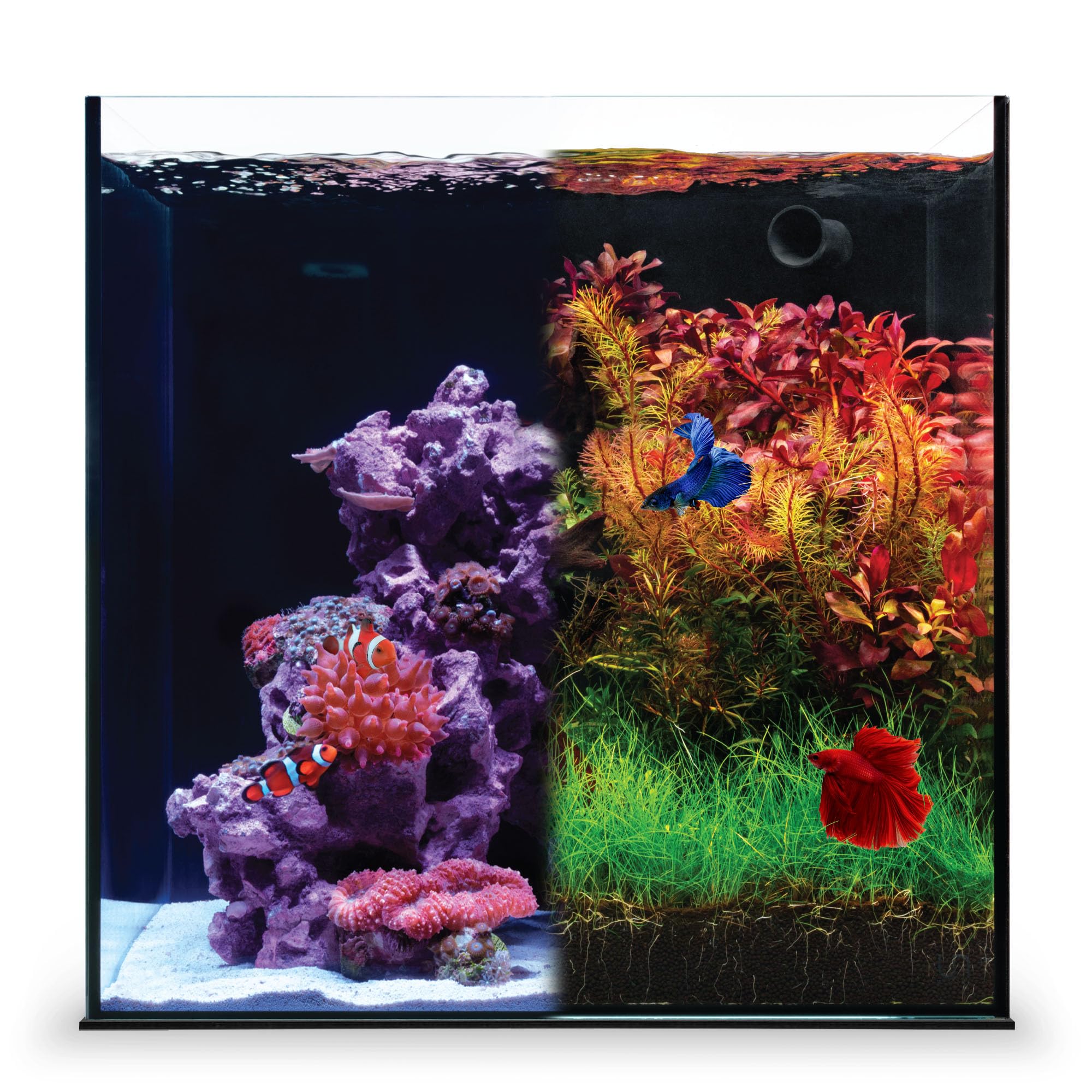
This 17-gallon cube from Ultum Nature Systems sits at the intersection of high-end rimless aesthetics and functional all-in-one engineering. The low-iron diamond glass transmits 91 percent of visible light, which eliminates the green tint that masks the true coloration of LPS corals like acans or favia. The 45-degree precision-cut mitered edges distribute thermal stress more evenly than butt-jointed tanks, a crucial detail given the daily temperature swing of 2 to 3 degrees Fahrenheit that a nano reef experiences during the heater cycle.
The triple-chamber filtration system includes a coarse sponge in the first chamber, two UNS Bio Brick ceramic media blocks in the second, and a submersible return pump in the third. Owner reports confirm the pump runs silently enough for a bedroom setup, though the intake slots are wide enough to trap neon tetras — adding a pre-filter sponge is mandatory if you plan to keep small fish. The media riser tray lifts the biological media off the bottom, preventing dead spots where anaerobic bacteria could produce hydrogen sulfide.
The 15.75-inch cube footprint gives you a square aquascaping canvas that accommodates a shallow sand bed and two to three rock structures without crowding the front glass. Owners note that adjusting flow rate requires removing the pump from the chamber, a minor inconvenience compared to the build quality. The included leveling mat prevents point-load stress on the bottom pane, which is especially important for a rimless tank sitting on an uneven desk or stand.
Why we love it
- Low-iron diamond glass with 91% light transmittance delivers true coral colors
- 45-degree mitered joints reduce silicone stress compared to standard 90-degree builds
- Triple-chamber sump includes coarse sponge, bio-bricks, and a quiet submersible pump
- 15.75-inch cube footprint provides a square canvas for balanced hardscaping
Good to know
- Intake slots are wide enough to trap small fish — a pre-filter sponge is necessary
- Flow adjustment requires removing the pump from its chamber
- Premium price reflects the low-iron glass and mitered construction, not included livestock
2. Coralife BioCube 16 Gallon

The low-profile hood houses independent white, blue, and color-enhancing LED arrays with a built-in 24-hour timer that runs a 30-minute sunrise and 60-minute moonrise simulation. Owners with LPS and soft coral setups report that the stock spectrum supports moderate growth without the immediate need for an aftermarket light upgrade, though SPS keepers still swap the hood for a dedicated pendant.
The internal filtration chamber runs a three-stage setup: a mechanical sponge, a chemical media cartridge, and a biological media tray with a quiet submersible pump. The dual-intake strainers on the back wall pull water from the bottom and middle of the display, reducing surface biofilm accumulation. Owners have noted that the back chambers are tight when adding a protein skimmer or UV sterilizer — the InTank media basket mod and Tunze 9001 skimmer are popular upgrades that fit within the existing footprint.
At 16 gallons, the display provides enough water volume to buffer pH swings better than a 5-gallon pico, but the 21.75-inch width requires a stand at least 22 inches wide. The rounded-edge glass hood gives the tank a softer silhouette than the sharp-edged cubes. Multiple long-term owners report keeping the system running for over three years with only sponge rinses and cartridge swaps as routine maintenance, which speaks to the filtration durability when stocking stays moderate — two small clownfish and a handful of zoanthid polyps.
Why we love it
- Three-channel LED hood with sunrise/sunset timer reduces algae bloom risk
- Dual-intake strainers pull surface and mid-water debris
- Decade-long community support with well-documented mods like InTank baskets
- 16-gallon volume provides enough water stability for a pair of clownfish and soft corals
Good to know
- Back chambers are cramped when adding skimmers or UV sterilizers
- Stock media cartridge should be replaced with a cut-to-fit sponge for better longevity
- Stand is not included despite the tank’s weight at 30 pounds when filled
3. Coralife SMART BioCube Jr 14 Gallon
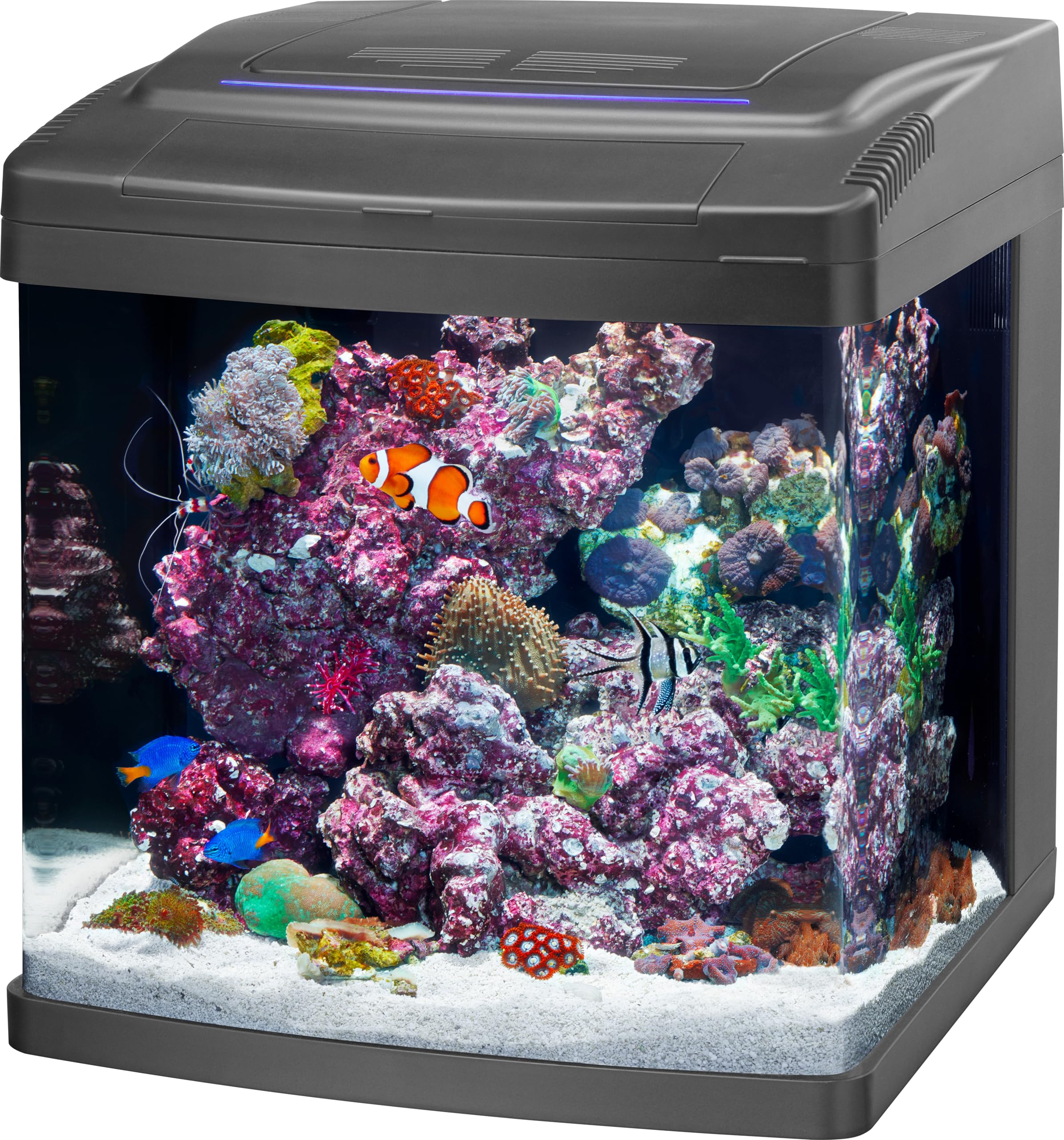
The SMART BioCube Jr is Coralife’s attempt to bring app-based light scheduling to the nano reef market, and it succeeds where many first-generation smart aquariums fail. The Aqueon BlueIQ app connects via Wi-Fi or Bluetooth, allowing you to toggle between the white and blue LED channels, set a programmable 24-hour schedule with separate sunrise and sunset ramp times, and push feeding reminders directly to your phone. The three BioZone lighting zones produce distinct light intensity and spectrum regions within the same 14-gallon footprint, which lets you place high-light SPS on the top rock shelf and low-light LPS in the shaded corners.
The integrated filtration includes a mechanical sponge, a chemical filter cartridge, and a quiet pump with dual intakes and an adjustable return nozzle. The 14-gallon display is acrylic rather than glass, which makes it lighter — 30 pounds compared to the low-iron glass tanks that weigh more empty — but acrylic scratches more easily during cleaning. The hood houses the LED array in a sleek, modern shroud that blends into a living room or office environment better than the boxy BioCube 16 hood.
Owner feedback highlights the silent pump fan as a major advantage over older BioCube models — the fan rubbing sound that plagued some units is resolved by a firmware-side fan speed adjustment. The app supports feeding reminders that pause the pump for ten minutes, preventing food from being sucked into the filter before fish can eat. The tank’s 18.1-inch length fits on standard desks, though the 16.7-inch depth means a dedicated stand is still recommended for stability.
Why we love it
- Wi-Fi and Bluetooth app control for remote lighting scheduling and feeding reminders
- Three distinct BioZone lighting zones let you place different coral types in the same tank
- Quiet pump and fan operation suitable for bedroom or office use
- Silent feeding pause function prevents filter intake of uneaten food
Good to know
- Acrylic scratches more easily than glass — use a plastic-safe algae pad
- App occasionally disconnects from Wi-Fi and requires re-pairing
- Stand not included, and the 30-pound filled weight needs a stable surface
4. Fluval Sea Evo V 5 Gallon

The Fluval Sea Evo V is the most popular pico reef tank on the market, and its design DNA shows why Fluval dominates the desktop saltwater category. The 5-gallon display is built from standard glass with a black silicone bead that hides the rear sump compartment behind a honeycomb-pattern shroud. The three-stage filtration uses oversized mechanical, chemical, and biological media relative to the display volume — the chemical media chamber fits a standard-sized carbon bag that would normally go into a 20-gallon tank, giving you higher filtration capacity than the water volume suggests.
The stock return pump moves 60 gallons per hour at zero head, which drops to roughly 40 GPH after the 90-degree elbow into the display. That flow rate is adequate for soft corals and mushroom polyps, but owners upgrading to LPS or SPS consistently replace the pump with an Aquatop NP302 or Cobalt MJ606 (discontinued, so watch for alternatives). The stock LED produces 759 lumens at 10 watts, which is sufficient for zoanthids and Ricordea mushrooms but dim for Acropora — most serious reefers add a second light fixture or swap the hood entirely.
The long, narrow profile — 20.5 inches long by 7.5 inches deep — gives swimming fish more linear space than a cube of the same gallon count. Owners who upgraded from Marineland Portrait tanks report that the Evo V’s shape allows better rock stacking without the scape touching both side panes. The aluminum waterproof casing around the LED unit prevents corrosion from salt creep, a failure point on cheaper fixtures that use painted plastic housings.
Why we love it
- Long narrow footprint provides more swimming length than cube-shaped pico tanks
- Oversized three-stage filtration handles bioload better than the 5-gallon volume suggests
- Aluminum LED housing resists salt creep corrosion
- Honeycomb sump shroud hides water line and equipment for a clean desktop look
Good to know
- Stock return pump is underpowered for LPS and SPS flow requirements
- Standard glass has a slight green tint compared to low-iron alternatives
- Plastic screw for the LED light bar strips easily — metric replacement size is 5 x 0.80
5. Coralland 8-Gallon AIO Saltwater Aquarium
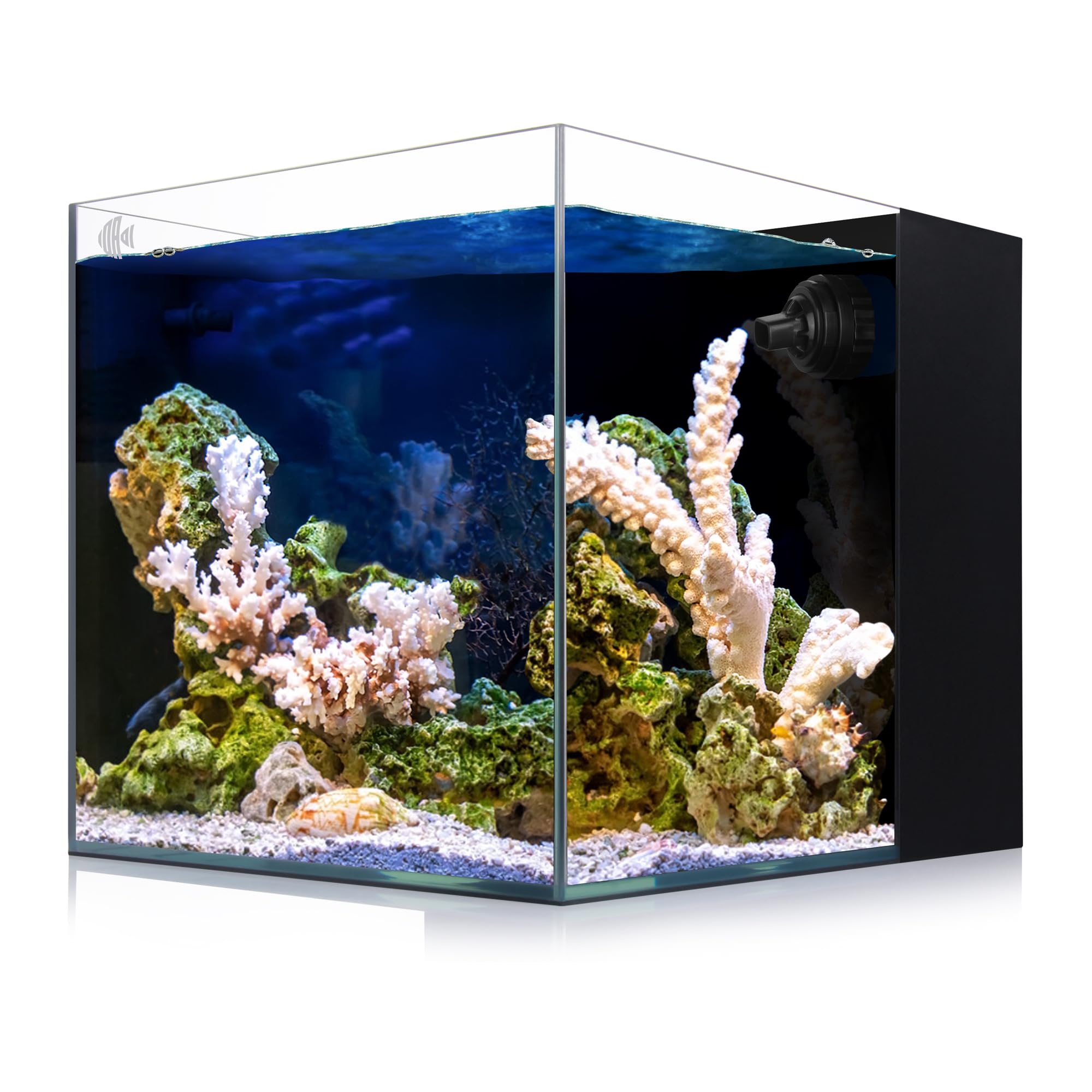
The Coralland 8-gallon delivers low-iron ultra-clear glass at a price point that undercuts most competitors by 40 to 50 percent. The 45-degree angled joint design mirrors the premium mitered construction found on Ultum Nature Systems tanks, giving you the same crystal-clear viewing panel without the green tint that standard glass introduces. The display measures 13.8 inches square with an 11.8-inch height, creating a cube that fits comfortably on a desk or small stand while still providing rear sump space for a heater and return pump.
This is a tank-only kit — it ships with the glass aquarium, a return nozzle, a filter sock, and the sump chamber dividers, but no pump, light, or heater. Owners consistently praise the packaging as the best they have seen for a shipped aquarium: triple-boxed with foam corner protectors, which is critical when ordering a rimless glass tank that has no plastic frame to absorb impact. The rear chamber is divided into four sections, giving you room for a heater, chemical media, biological media, and a return pump without the cramped conditions typical of sub-10-gallon sumps.
The low-iron glass clarity transforms how soft corals and live rock appear under a standard LED fixture — the 91-percent light transmittance means less of the PAR value is absorbed by the glass itself. The filter sock included with the tank fits the first chamber but the permanent silicone mounting of the sock holder limits alternative filtration options. The four-chamber layout also means the middle divider can block the center mounting bracket of certain light fixtures, so measure your light’s mounting clamp width before purchasing.
Why we love it
- Low-iron ultra-clear glass at a significant discount compared to premium brands
- 45-degree mitered joints reduce silicone stress and improve viewing clarity
- Four-chamber rear sump provides room for heater, media, and pump without crowding
- Exceptional triple-box packaging for safe shipping of rimless glass
Good to know
- Filter sock holder is permanently silicone-mounted, limiting alternative filtration methods
- No pump, light, or heater included — budget separately for a return pump and reef LED
- Middle divider in the sump can block center-mounted light fixture brackets
6. Aqueon 10-Gallon Aquarium Starter Kit
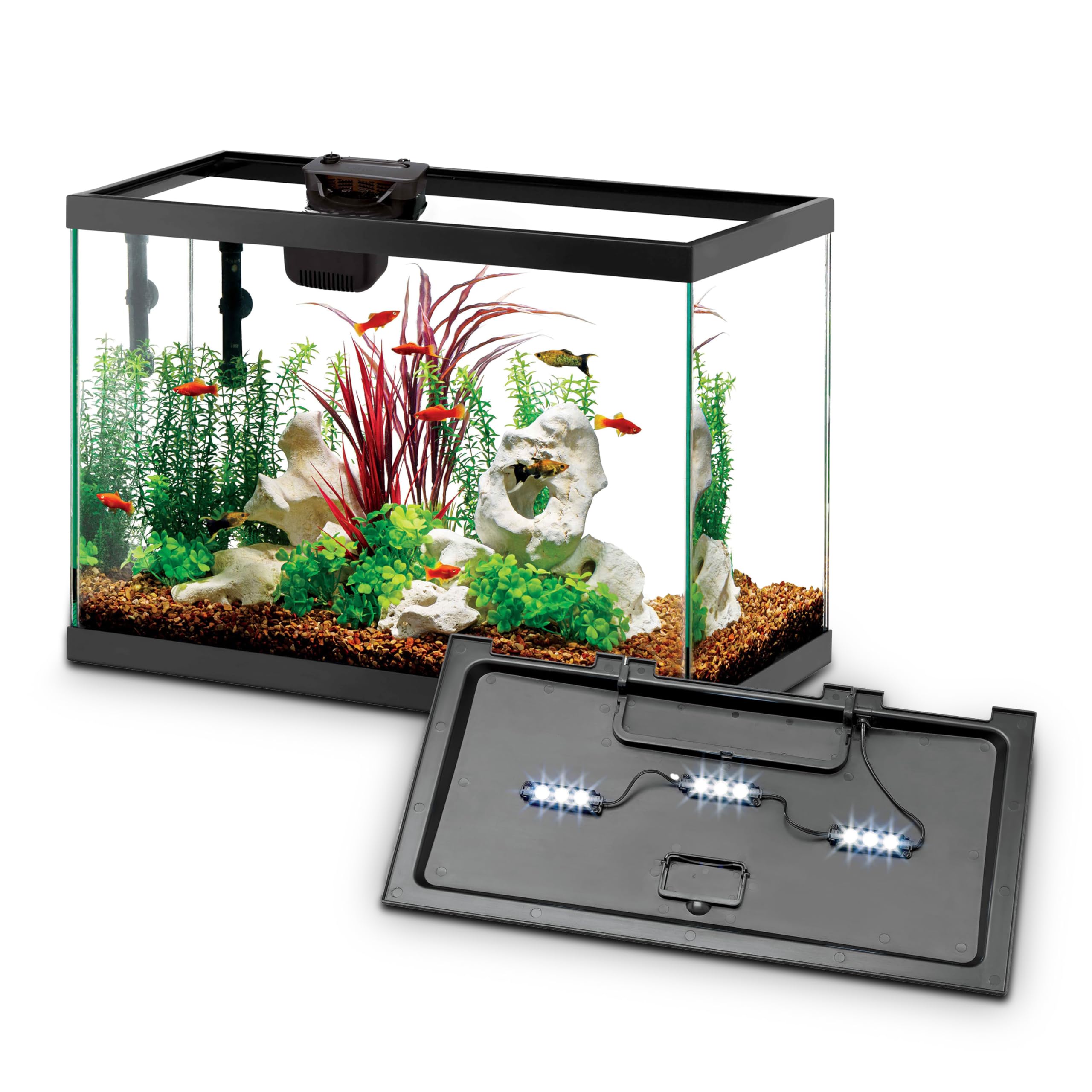
The Aqueon 10-gallon starter kit positions itself as a freshwater system, and the SmartClean internal power filter with EcoRenew cartridges is designed for low-bioload tropical fish rather than coral reefs. The filter includes a sponge for mechanical debris and a ceramic ring section for biological conversion, but the EcoRenew cartridges need replacement every four weeks — an ongoing consumable cost that reef keepers would rather avoid by using cut-to-fit sponge blocks. The preset 50-watt heater holds the tank at 78 degrees Fahrenheit, which is within the acceptable range for soft corals but lacks the adjustability needed for species-specific temperature management.
The low-profile LED hood provides cool white light with a feeding door, but the spectrum is daylight-only with no actinic blue channel. Freshwater plants may survive under this light, but any attempt to keep photosynthetic corals will fail because the PAR output drops below 20 micromoles at the sand bed in a 10-gallon tank. The glass used is standard float glass with the greenish tint typical of budget kits, and the silicone seams show slight unevenness at the corners on some units.
Seasoned reef owners would not use this kit for saltwater, but for a freshwater quarantine tank or a dedicated macroalgae pod-culture system, the SmartClean filter’s easy water change mechanism — you twist the filter cartridge to drain water directly into a bucket — reduces the time spent on weekly maintenance. The thermometer, fish net, and water conditioner included in the box add real value for someone starting from zero equipment inventory.
Why we love it
- SmartClean filter design allows quick water changes without removing cartridges
- Complete kit includes heater, thermometer, net, food, and water conditioner
- Low-profile hood with feeding door reduces evaporation and prevents fish jumping
Good to know
- Standard float glass has a visible green tint that masks coral coloration
- LED hood provides daylight spectrum only — no blue or actinic channels for corals
- EcoRenew cartridges must be replaced monthly, creating ongoing consumable costs
7. Wonderfactory 10-Gallon Aquarium Set
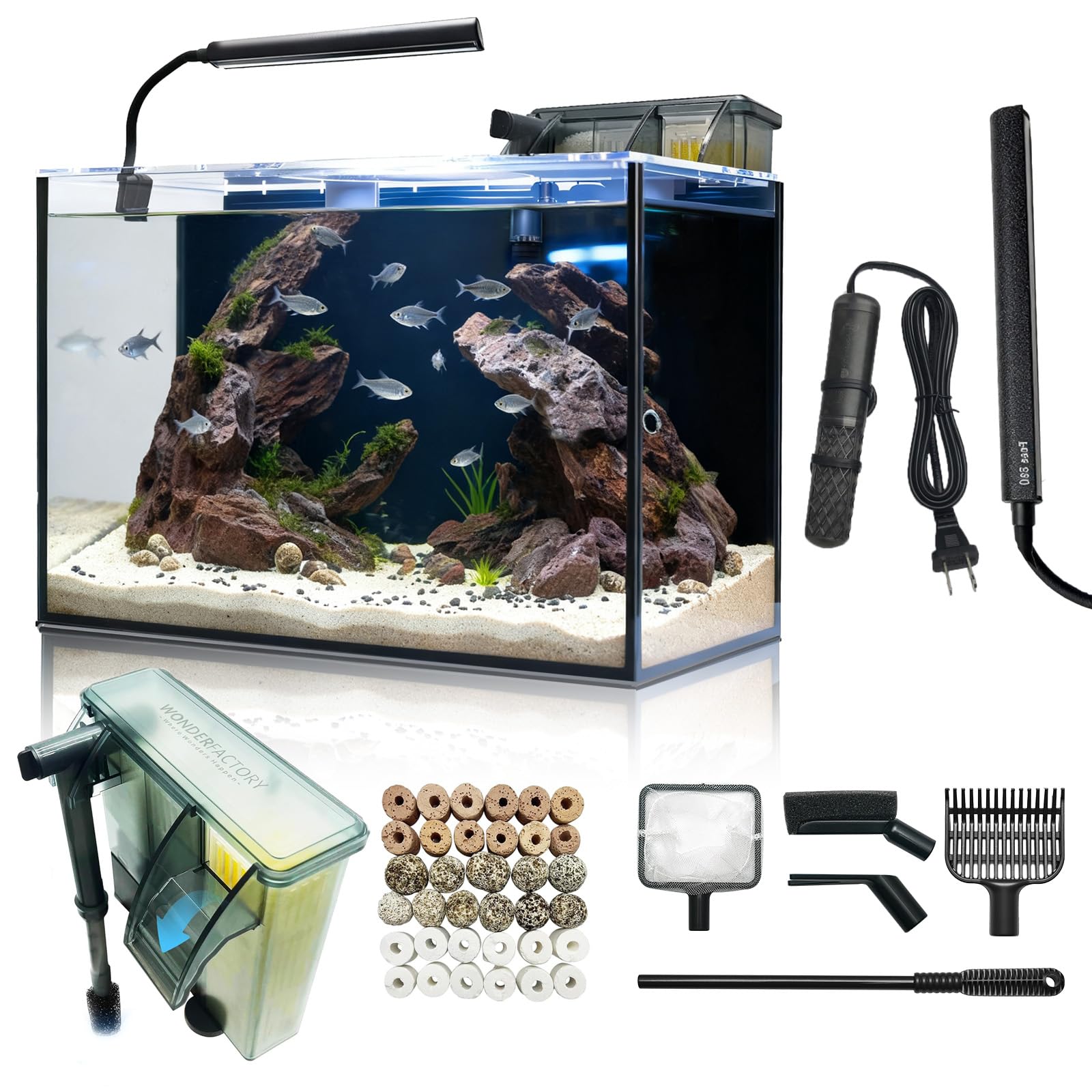
The Wonderfactory 10-gallon kit is a freshwater starter system that uses 4-millimeter thick HD glass with 92 percent light transmittance rating — notably higher than the standard float glass used in the Aqueon kit. The hang-on-back filter includes both a sponge for mechanical debris and ceramic rings for biological filtration, and the filter uses a washable media design rather than disposable cartridges, which aligns with the reef-keeping philosophy of maintaining a stable bacterial colony. The included 5-in-1 cleaning tool set (algae pad, gravel rake, siphon, scraper, and net) reduces the number of separate purchases a new aquarist needs to make.
The preset heater in this kit runs at 80 degrees Fahrenheit, which is 2 degrees higher than the Aqueon heater. Owners report the heater is non-adjustable but maintains temperature within 1 degree of the set point, which is acceptable for freshwater fish like bettas and tetras. The filter lacks an oil film removal device, meaning surface protein scum can accumulate if there is no surface agitation from an airstone or additional pump.
For a nano reef application, the 4-millimeter glass thickness at 10 gallons is borderline — the water pressure on the bottom seams at full volume requires careful leveling to prevent stress fractures. The rimless design adds aesthetic appeal but also increases the risk of seam failure compared to a braced or rimmed tank of the same volume. Reef keepers looking for a quarantine tank or a dedicated frag grow-out system could repurpose this kit by replacing the LED hood with a reef spectrum fixture and adding a circulation pump, but the kit’s design intent is clearly freshwater display.
Why we love it
- HD glass with 92% light transmittance reduces the green tint of standard float glass
- Washable HOB filter with ceramic media supports stable bacterial colonization
- 5-in-1 cleaning tool set provides everything needed for basic maintenance
Good to know
- Preset heater runs at 80°F without adjustability
- 4mm glass at 10 gallons requires precise leveling to avoid seam stress
- No oil film removal device — surface scum may accumulate without additional circulation
8. biOrb Halo 15 4-Gallon Acrylic Aquarium

The biOrb Halo 15 breaks from the rectangular tank convention with a spherical acrylic body that provides a 360-degree viewing angle — the water line is hidden inside the top rim, creating the illusion that the aquatic environment is floating in the room. The 4-gallon capacity (15 liters) is the smallest in this roundup, and the acrylic construction is 10 times stronger and 50 percent lighter than glass of equivalent thickness, which makes the Halo easy to move and resistant to impact cracking. The five-stage bottom filtration system uses an air-pump-driven lift tube to pull water through a ceramic media base that sits below the substrate, promoting aerobic bacterial growth across a larger surface area than a standard hang-on-back filter.
The multi-colored LED lighting system with a remote control offers 16 preset colors plus a fade-through-spectrum mode, which creates dramatic visual effects for a desktop display. The 12-volt transformer and quiet air pump keep electrical noise low, though the air stone does produce a constant bubbling sound that some owners find meditative and others find intrusive. The 4-gallon volume is critically small for saltwater — the water chemistry swings faster than in any larger tank, and even a single small hermit crab can contribute enough bioload to spike nitrate within 48 hours if the ceramic media is not fully colonized.
The small top opening — roughly 4.5 inches in diameter — restricts hardscaping to small live rock pieces and makes cleaning the curved acrylic interior a challenge. Owners who attempted a saltwater setup in the Halo report that evaporation at 2-3 percent of total volume per day raises salinity measurably, requiring daily top-offs with RO/DI water. The system is better suited for a low-light freshwater planted tank with a single betta or shrimp colony than for a stable nano reef, though experienced aquarists have successfully kept a single mushroom coral and a barnacle blenny with diligent water management.
Why we love it
- 360-degree spherical viewing angle creates a stunning floating visual effect
- Acrylic is 10x stronger and 50% lighter than glass for easy repositioning
- Five-stage bottom filtration with ceramic media supports biological colonization
- 16-color remote LED with fade mode offers dramatic ambient lighting
Good to know
- 4-gallon volume is extremely difficult to stabilize for saltwater reef keeping
- Small 4.5-inch top opening restricts aquascaping and cleaning access
- High evaporation rate in saltwater setups requires daily RO/DI top-offs
- Filter accessories are proprietary and significantly more expensive than standard aquarium parts
FAQ
What size nano reef tank is best for a first-time saltwater aquarist?
Can I keep SPS corals in a nano reef tank under 10 gallons?
Why do some all-in-one nano reef tanks include a filter sock while others do not?
How often should I replace the biological media in a nano reef tank’s filter sump?
Can a freshwater starter kit be converted into a nano reef tank?
Final Thoughts: The Verdict
For most reef keepers, the nano reef tank winner is the Ultum Nature Systems Dual AIO 17 Gallon because it combines low-iron diamond glass with 45-degree mitered joints and a triple-chamber sump that supports serious coral growth without requiring immediate modifications. If you want a complete out-of-the-box kit with programmable lighting and a decade of community mod support, grab the Coralife BioCube 16 Gallon. And for a desktop pico reef that maximizes viewing space in a narrow footprint, nothing beats the Fluval Sea Evo V 5 Gallon for its long profile and oversized filtration chamber.