
A stray dog appears on your porch or a cat wanders into the shelter with no collar. The difference between a fast reunion and a lost animal often comes down to having the right tool in hand. A reliable pet microchip scanner turns those few seconds of uncertainty into a direct line back to the owner, making it an essential piece of gear for veterinarians, shelter staff, rescue volunteers, and even alert pet owners who want to help strays in their neighborhood.
I’m Mo Mahin — the founder and writer behind Furric. I’ve spent years analyzing the technical specifications, reading ranges, protocol compatibilities, and data-storage capabilities of dozens of scanner models to understand what separates a tool that works every time from one that leaves you staring at a frozen screen.
After comparing the latest models across multiple price tiers, I’ve identified the options that balance speed, durability, and compatibility. This guide breaks down everything you need to know before buying a pet microchip scanner for professional or personal use.
How To Choose The Best Pet Microchip Scanner
Not all scanners read all chips. The wrong purchase can leave you unable to identify a microchipped animal, rendering the tool useless when it matters most. Focus on these three areas to lock in a model that performs reliably across the widest range of pets.
Protocol Compatibility: The Make-or-Break Spec
The global standard for pet microchipping is ISO 11784/11785 using the FDX-B protocol at 134.2 kHz. Most scanners listed in this guide support this along with EMID (125 kHz) for older chips. However, proprietary formats like AVID FriendChip or AKC microchips require specific hardware support. Always cross-check your scanner against the chips common in your region — a model that omits FDX-A or AVID support will miss a meaningful percentage of animals.
Read Range, Battery Life, and Storage Capacity
A scanner with a 5-30cm read range covers most scenarios, but the real-world speed of detection matters. Look for units that register a chip within one to two seconds of passing over the shoulder blade area. Battery life should exceed 12 hours of continuous use for a full shelter shift. Data storage matters if you scan multiple animals in a day — a unit that saves 128 records is fine for personal use, but professionals will want 1024 or more records exportable via USB or Bluetooth.
Connectivity and Screen Readability
Some models offer Bluetooth or wireless 2.4G transmission for uploading scan logs directly to a computer or smartphone. This is a time-saver for clinics that need digital records. The display type also matters: a high-brightness OLED screen is easier to read in direct sunlight than a basic LCD. Avoid models with no data-export capability if you plan to track histories or share information with colleagues.
Quick Comparison
On smaller screens, swipe sideways to see the full table.
| Model | Category | Best For | Key Spec | Amazon |
|---|---|---|---|---|
| NetumScan 206C | Premium | Professionals needing high data storage | 1024 records, OLED display, Zodiac lights | Amazon |
| Symcode Q30 | Mid-Range | Versatile field use with Bluetooth upload | 240 records, Bluetooth 6.1, 1.44in TFT | Amazon |
| NetumScan Bluetooth | Mid-Range | High-volume data management on the go | 2048 records, 24h battery, TFT screen | Amazon |
| Tera W90B | Budget-Friendly | Portable personal carry with carrying bag | 128 records, OLED, 120g weight | Amazon |
| Halo 014PTS | Budget-Friendly | Simple scanning without data management | No data storage, USB charge, 8 oz | Amazon |
In‑Depth Reviews
1. NetumScan Upgraded Pet Microchip Reader 206C

The NetumScan 206C is engineered for high-volume environments where every second counts. Its dual-frequency support for ISO 11784/11785 (FDX-B at 134.2 kHz) and EMID (125 kHz) covers the vast majority of modern pet microchips, while the 0.91-inch OLED screen remains perfectly legible under direct sunlight — a critical advantage for outdoor rescues or shelter intake yards.
Where this scanner genuinely separates itself is the 1024-record onboard storage paired with Type-C export to Excel. For a veterinarian scanning 30+ animals per day, that capacity eliminates the need to manually log each ID. The automatic shutdown after 120 seconds of inactivity conserves battery between scans, and the unique Zodiac ring lights add a small but appreciated visual cue that the unit is actively reading.
The one-button operation keeps things simple under pressure, but the lack of Bluetooth or wireless 2.4G means your data transfers require a physical cable connection. Also note that this model explicitly does not read FDX-A or AVID protocols, so if your region uses those older chips, you will need a secondary solution.
Why we love it
- Massive 1024-record storage for professional workflows
- High-brightness OLED readable in full sunlight
- Dual-frequency support covers most U.S. pet chips
Good to know
- No Bluetooth or wireless 2.4G connectivity
- Does not support FDX-A or AVID protocols
2. Symcode Animal Microchip Scanner Q30

The Symcode Q30 brings three-way connectivity — USB, wireless 2.4G, and Bluetooth 6.1 — making it the most versatile option for users who need to transfer scan data to multiple device types without being tethered to a desk. Its 1.44-inch high-brightness TFT display shows scan history, format settings, and battery status clearly, and the multilingual software support broadens its appeal for international rescue networks.
User reports consistently praise its recognition speed. Multiple verified reviews confirm that the Q30 reads 15-digit FDX-B microchips on the first pass, with one reviewer noting it worked on every cat and neighbor’s cat they tested. The 240-tag storage capacity is modest compared to premium models, but for a solo rescuer or small shelter, it covers a full day’s work without needing to offload data.
A few owners have reported the unit freezing or crashing within minutes of first use, which suggests quality control can vary between units. The wireless receiver has no designated storage slot on the device itself, making it easy to misplace if you are not careful. The audible beep volume — described as obnoxiously loud by one user — is adjustable to zero in settings, but the default setting may startle nervous animals.
Why we love it
- Triple connectivity (USB, 2.4G, Bluetooth 6.1) for flexible data upload
- Fast, accurate first-pass reads on FDX-B chips
- Multilingual software support
Good to know
- Reports of occasional freezing/crashing in early units
- No onboard storage slot for the wireless receiver
3. NetumScan Pet Microchip Scanner Reader Bluetooth

The NetumScan Bluetooth model is built for professionals who manage large numbers of animals. With a massive 2048-tag storage capacity and a 1.44-inch TFT screen that displays battery level, working mode, and connection status, it is effectively a portable database. The 24-hour battery life on a single 1200mAh charge means it can last through multiple shifts without needing a recharge.
The 5-30cm read range is standard, but the scanning speed is genuinely fast — verified users report it reads every microchipped cat or dog on the first sweep. The dual data output in hexadecimal and decimal formats is a practical touch for clinics that log chips across different record-keeping systems. The inclusion of a 2.4G wireless dongle in the package makes PC connection straightforward out of the box.
Reliability concerns temper the enthusiasm. Multiple reviews describe units that stopped charging entirely after a short period, with no response from the manufacturer after contacting support multiple times. This pattern raises a red flag for durability. Additionally, the scanner does not support FDX-A or AVID protocols, so it will miss older or non-ISO chips entirely.
Why we love it
- 2048-record storage is best-in-class for this price tier
- 24-hour battery life supports full-day field use
- TFT screen displays all critical status info clearly
Good to know
- Multiple reports of charging failure and unresponsive support
- No FDX-A or AVID protocol support
4. Tera Portable Pet Microchip Scanner W90B
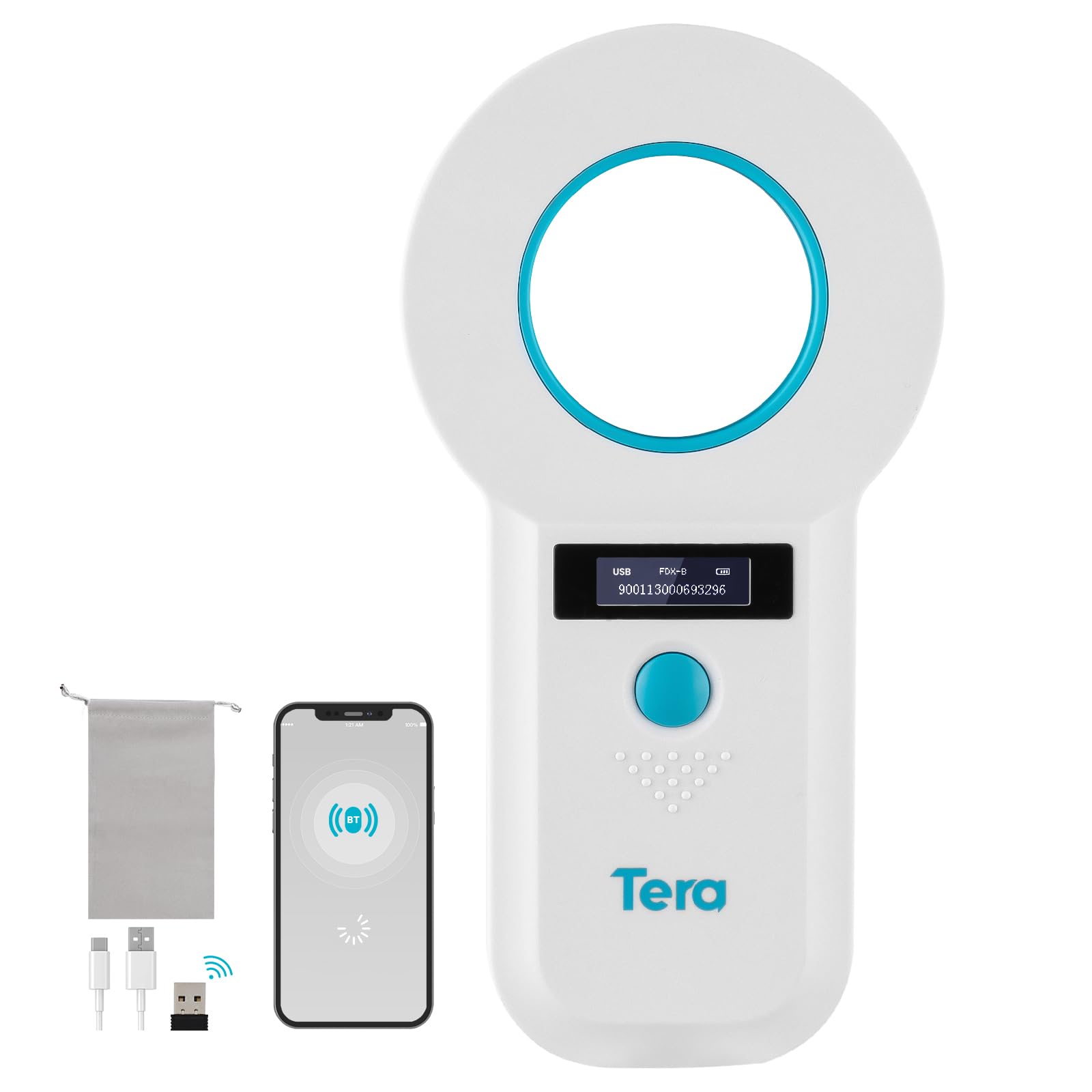
The Tera W90B prioritizes portability above all else. Weighing just 120 grams (4.2 ounces) and measuring 6.6 x 3.5 x 0.6 inches, it slips easily into a glove compartment or purse — exactly where you want it when you encounter a stray animal unexpectedly. The built-in 800mAh rechargeable battery supports extended use, and the automatic shutdown after 120 seconds of inactivity prevents accidental drain.
This scanner supports ISO 11784/11785 (FDX-B at 134.2 kHz) and EMID (125 kHz), covering the chips found in most companion animals. The three-way connectivity (USB, wireless 2.4G, Bluetooth) mirrors the Symcode model, giving you flexible upload options. The included carrying bag is a thoughtful addition that keeps the device and dongle together.
The 128-tag storage is the smallest capacity on this list, limiting its usefulness for high-volume professionals. Some users have noted that the scan timeout window could be longer to accommodate fidgety animals who don’t hold still for the first pass. Overall, it is best suited as a backup or personal carry unit rather than a primary shelter tool.
Why we love it
- Ultra-light 120g design for everyday carry
- Includes carrying bag and three connectivity modes
- Automatic shutdown saves battery life
Good to know
- Only 128 records of onboard storage
- Scan timeout could be too short for anxious pets
5. Halo Pet Microchip Reader Scanner 014PTS

The Halo 014PTS takes a minimalist approach: no Bluetooth, no data storage, no complex menus. It reads most 10-digit microchips and displays the ID number on its screen. It also detects 9-digit AVID FriendChips, though it only shows a detection indicator rather than the full number. For users who simply need to know whether an animal has a chip and then manually write down the number, this unit delivers that basic function without extra cost or complexity.
Owner testimonials confirm its real-world impact. One rescue volunteer reported reuniting multiple dogs with their owners after scanning strays, finding more information than local shelters could provide. The USB rechargeable lead works with standard wall adapters and car 12V USB chargers, meaning you can top it off during transport. Several reviewers noted it also reads some AKC chips despite the product description stating otherwise, though this is inconsistent.
The Halo does not store any data internally, so every scan must be manually recorded. It is not compatible with Mac systems, only Windows 98 and later. The AKC microchip incompatibility is a known limitation that may be a dealbreaker for breeders or shelters that use AKC-registered chips. The proprietary charging cable has also been cited as difficult to replace if lost.
Why we love it
- Straightforward operation with no complex setup
- USB rechargeable via wall or car charger
- Detects AVID FriendChips and some AKC chips
Good to know
- No data storage or export capability
- Not compatible with Mac systems
- Proprietary charging cable is hard to replace
FAQ
Will a pet microchip scanner read all brands of microchips?
How close do I need to hold the scanner to the pet for it to work?
Can I upload scan data from the scanner to my computer or phone?
Final Thoughts: The Verdict
For most veterinarians and shelter workers, the pet microchip scanner winner is the NetumScan 206C because its 1024-record storage, sunlight-readable OLED, and dual-frequency support cover the core needs of high-volume animal identification. If you want Bluetooth convenience and a lightweight profile for field rescues, grab the Symcode Q30. And for a budget-friendly backup unit that fits in any pocket, nothing beats the compact Tera W90B.