
A horse’s digestive tract is a 100-foot fermentation vat where the difference between a thriving athlete and a colic emergency is often invisible until it’s too late. Selecting the right equine probiotic means looking past marketing labels and understanding which bacterial strains, CFU counts, and delivery formats actually survive the acidic stomach to colonize the hindgut.
I’m Mo Mahin — the founder and writer behind Furric. I’ve spent the last 15 years analyzing supplement formulation data, comparing CFU viability across storage conditions, and studying owner-reported outcomes to identify which probiotics deliver measurable improvements in stool quality, feed efficiency, and colic reduction.
This guide breaks down seven tested formulations so you can confidently choose the most effective probiotic for horses based on your specific horse’s age, workload, and digestive sensitivities.
How To Choose The Best Probiotic For Horses
Equine probiotics vary dramatically in strain selection, CFU density, and delivery technology. The wrong choice can waste months of feeding without observable results. Focus on these four criteria to match a formulation to your horse’s specific digestive challenge.
Strain Diversity and CFU Viability
Horses benefit from multi-strain blends because different bacterial species occupy different niches along the gastrointestinal tract. Bacillus subtilis and Bacillus licheniformis are spore-forming strains that survive stomach acid and bile salts, making them ideal for equine supplements. Look for at least 150 million CFU per serving — this threshold ensures enough viable organisms reach the hindgut to shift the microbial balance toward fermentation efficiency.
Delivery Format: Chews vs. Pellets vs. Powder
Soft chews offer superior compliance for horses that refuse top-dressed powders, but they typically contain lower total CFU per bag due to the binding agents required for texture. Pelleted formulations allow higher bacterial concentrations and are less prone to moisture degradation inside a resealable bag. Powders mix evenly into wet feed and work well for horses that clean their bucket, but they require careful storage at stable temperatures to maintain viability.
Prebiotic Synergy and Specialized Technologies
Probiotics alone cannot correct a dysbiotic gut if the existing microbiome lacks the fermentable substrates needed for recolonization. Prebiotic fibers such as inulin, fructooligosaccharides, and proprietary blends like ADEPPT provide the specific food sources that beneficial bacteria require to outcompete pathogenic strains. Supplements that pair probiotics with digestive enzymes also help break down roughage, reducing undigested fiber that contributes to loose stool and gas colic.
Targeted Indications: Sand Clearance, Ulcer Support, and Stress Scenarios
Different digestive challenges demand different mechanisms. Psyllium-based products physically bind sand and debris for elimination from the ventral colon, whereas live-culture probiotics recolonize the hindgut after antibiotic use or transport stress. Gastric ulcer supplements require buffering agents like bentonite and magnesium to neutralize stomach pH, not just probiotic bacteria. Choose based on your horse’s primary symptom — loose stool, recurrent colic, poor coat condition, or weight maintenance difficulty — rather than assuming one probiotic addresses all issues.
Quick Comparison
On smaller screens, swipe sideways to see the full table.
| Model | Category | Best For | Key Spec | Amazon |
|---|---|---|---|---|
| Probios Soft Chews | Soft Chew | Picky eaters, daily maintenance | 150M CFU/chew, dual Bacillus strains | Amazon |
| Formula 707 4lb | Pellet | Loose stool, weight gain issues | Microencapsulated probiotics + enzymes | Amazon |
| MagnaGard Plus | Powder | Ulcer-prone, anxious horses | Bentonite + magnesium + omega 3s | Amazon |
| Farnam Equi Aid Psyllium | Pellet | Sand colic prevention, colon cleansing | Natural psyllium husk fiber | Amazon |
| Formula 707 8lb | Pellet | Multi-horse operations, chronic scours | 8lb bulk, same enzyme blend | Amazon |
| HealthyGut Probiotics | Powder | Full immune support, post-antibiotic recovery | 20 probiotic species + inulin prebiotic | Amazon |
| Ramard Total Gut Health | Powder | Gastric ulcer recovery, colic reduction | BioFlavex + Beta Glucan + herbs | Amazon |
In‑Depth Reviews
1. HealthyGut Probiotics for Horses

HealthyGut delivers 20 different species of probiotic organisms alongside inulin prebiotic fiber — a diversity level that surpasses most equine supplements on the market. The human-grade powder formulation provides 90 days of servings per container, with dosing scaled by horse size: half a tablespoon for small horses up to two tablespoons for large breeds. Customer reports consistently describe firming of loose stools within two feedings and a noticeable reduction in undigested grain particles in manure within four to five feedings.
The non-GMO, US-manufactured formula is particularly effective for horses under stress from competition, transport, or recent antibiotic treatment. Owners of senior horses over 25 years old report maintained immune function and improved coat quality when using HealthyGut as a daily maintenance supplement. The powder mixes readily into wet feed, and even picky older horses accept it without refusal.
One limitation is the powder format — it requires stable, cool storage to maintain CFU viability through the three-month usage period. Horses that are messy eaters or leave wet feed may not consume the full dose consistently. For owners willing to manage proper storage and feeding technique, the strain diversity and prebiotic support make this the most comprehensive single-formulation option available.
Why we love it
- Highest strain diversity (20 species) of any supplement reviewed
- Inulin prebiotic enhances colonization efficiency
- Firms loose stool within 2 feedings per verified owner reports
Good to know
- Powder format requires cool, dry storage for CFU stability
- Not suitable for horses that leave wet feed in the bucket
2. Ramard Total Gut Health Equine Digestive Support

Ramard Total Gut Health takes a multi-mechanism approach by combining BioFlavex — a proprietary flavonoid complex that supports intestinal comfort — with Beta Glucan to promote normal bowel motility. The formula also includes natural herbs to support the stomach’s mucosal lining, making it one of the few supplements on this list that directly addresses both gastric and hindgut health in a single powder. Owners report that within four to six weeks, horses with a history of gas colic show more uniform manure consistency and reduced belly sensitivity.
The 30-day supply (1.12 lb) is designed for targeted intervention rather than indefinite daily feeding. Many owners use Ramard as a seasonal treatment during training periods, transport stress, or after dietary changes. The all-natural ingredient profile contains no banned substances, making it competition-safe for show and performance horses. Customer feedback particularly highlights its effectiveness for mares with stall sensitivity issues — one owner noted a 96.7% reduction in flank itching after 1.5 months of use.
The primary drawback is the higher cost per serving compared to other powder formulations. While the ingredient quality justifies the premium, owners managing multiple horses may find the 30-day supply runs out quickly. Additionally, some horses require a longer adjustment period before observable results appear — up to two months for chronic cases.
Why we love it
- BioFlavex targets both gastric and hindgut simultaneously
- All-natural, no banned substances — competition safe
- Reduces belly sensitivity and flank itching in mares
Good to know
- Higher cost per serving than comparable powders
- Some horses require 6-8 weeks for observable results
3. Probios for Horses Soft Chews
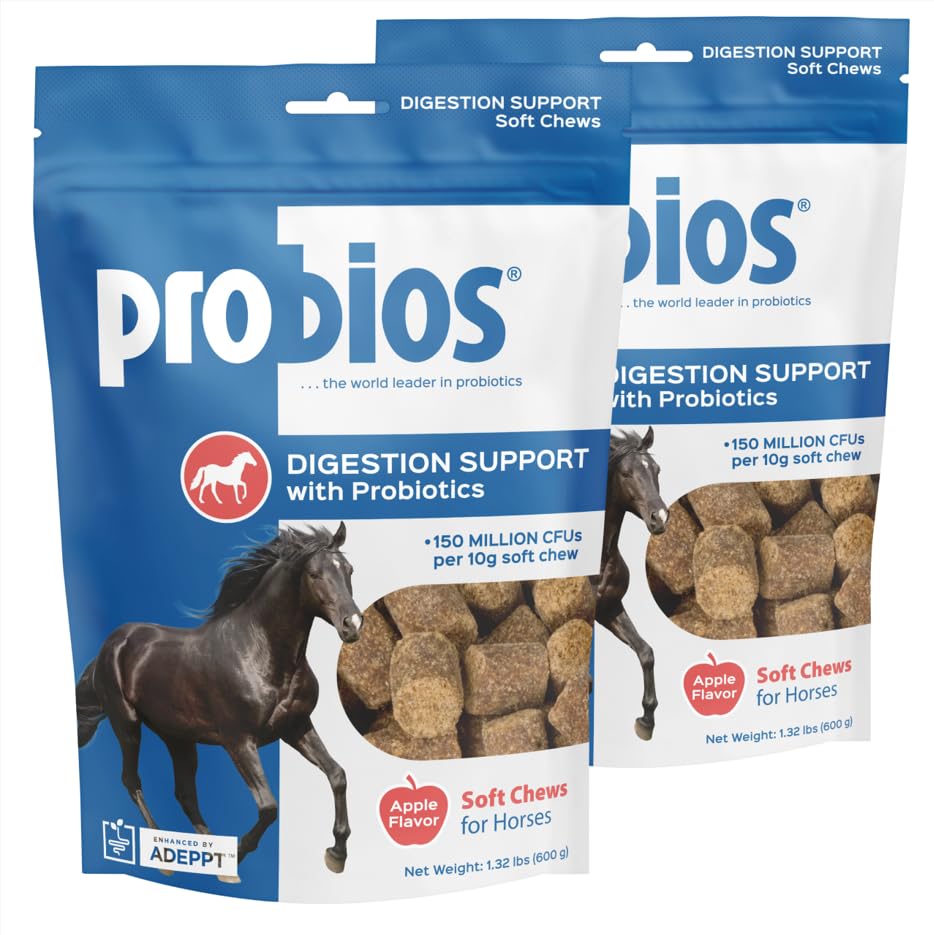
Probios Soft Chews solve the most common compliance problem in equine supplementation: horses that refuse anything mixed into their feed. The apple-flavored soft pellet format delivers 150 million CFU per chew of Bacillus subtilis and Bacillus licheniformis — both spore-forming strains that survive stomach acid to reach the hindgut. The proprietary ADEPPT technology enhances probiotic performance by maintaining microbial balance without disrupting beneficial gut bacteria, a feature that differentiates these chews from basic probiotic pellets.
Each 1.32 lb bag provides a generous supply for ongoing daily use, and the resealable packaging locks in freshness to maintain chew texture between servings. Owner reports are particularly compelling for senior horses with fecal water syndrome — one gelding showed significant improvement within days, with symptoms returning after a two-week break and resolving again upon resuming the chews. The dual bag pack (two bags per purchase) offers a practical supply for multi-horse households without requiring monthly reordering.
The trade-off for the convenience of a soft chew format is a lower total CFU load compared to concentrated powders. Horses requiring aggressive gut recolonization after severe dysbiosis may benefit more from a powder formulation with higher absolute CFU. Additionally, the chew format limits the ability to adjust dosing precisely — each chew delivers a fixed amount rather than allowing fractional scoop adjustments.
Why we love it
- Soft chew format ensures 100% consumption even with picky horses
- ADEPPT technology supports probiotic survival and performance
- High success rate with fecal water syndrome in seniors
Good to know
- Lower total CFU per serving than concentrated powders
- Fixed dosing limits adjustment for different body weights
4. Formula 707 Digestive Health 8lb Bag

The 8lb bag of Formula 707 Digestive Health is the same trusted formulation as the 4lb version but scaled for multi-horse operations or extended single-horse use. The microencapsulated probiotic technology protects live bacteria from stomach acid, ensuring higher survival rates compared to non-encapsulated powders. Prebiotics in the formula encourage native micro-flora growth, while digestive enzymes (amylase, protease, cellulase) help break down roughage for improved feed conversion — a critical function for horses on hay-heavy diets that tend to pass undigested fiber.
Customer reports consistently highlight two outcomes: resolution of chronic loose stool within days, and noticeable improvements in coat shine and overall condition within two to four weeks. One owner noted that a 32-year-old gelding regained appetite and resolved constipation after starting 707, while another reported that a horse with frequent colic episodes has remained colic-free since adding the supplement. The pellet format makes it easy to scoop directly onto grain with minimal waste, unlike powders that can stick to bucket sides.
The 8lb bag requires proper storage in a cool, dry location to prevent pellet softening or mold growth during extended use. While the formula is effective for most digestive issues, it does not contain the specialized ingredients (bentonite, magnesium) needed for gastric ulcer support or psyllium for sand clearance.
Why we love it
- 8lb bulk size offers best cost efficiency for multi-horse barns
- Microencapsulated probiotics survive stomach acid effectively
- Digestive enzymes improve feed conversion on hay-heavy diets
Good to know
- Not formulated for gastric ulcer or sand clearance support
- Bulk bag requires proper cool, dry storage to maintain freshness
5. Formula 707 Digestive Health 4lb Bag

Formula 707’s 4lb bag delivers the same microencapsulated probiotic, prebiotic, and digestive enzyme blend as the bulk 8lb version, making it an ideal entry point for owners with one or two horses who want to test the product before committing to a larger investment. The pellets are manufactured in the company’s own Colorado facility — a quality-control advantage over supplement brands that outsource production. The microencapsulation technology is the standout feature here, as it protects live bacteria from the acidic stomach environment far better than standard probiotic powders that release their contents prematurely.
Owner feedback mirrors the bulk version’s results: resolution of loose stool, reduced colic frequency, and improved coat condition. The 4lb bag is especially practical for barns with selective eaters, as the pellet texture is more readily accepted than powder top-dressings. One owner reported that a horse with chronic weight loss began gaining condition after two weeks on 707, with observable improvement in hip, rib, and back coverage after one bag.
The 4lb bag requires more frequent reordering than the 8lb version, which may be inconvenient for owners of multiple horses. Additionally, the formula does not address gastric ulcers directly — owners whose horses show signs of gastric irritation (girthiness, cribbing, poor appetite) may need a separate ulcer-specific supplement.
Why we love it
- Microencapsulation delivers superior bacterial survival through stomach acid
- Manufactured in-house in Colorado since 1946 — proven quality control
- Pellet format is accepted by selective eaters
Good to know
- 4lb bag requires more frequent reordering for multiple horses
- Not formulated for gastric ulcer or sand clearance
6. MagnaGard Plus Gastric Support Supplement

MagnaGard Plus is not a traditional probiotic — it is a gastric ulcer support powder that uses bentonite clay and activated carbon to buffer stomach acid, combined with magnesium, calcium, and omega-3 fatty acids to support the gastric lining. The 6lb bag (45-day supply) provides 50% more product than the previous 4lb version, reflecting the manufacturer’s response to owner demand for longer-lasting supply. The targeted use case is horses that show signs of gastric discomfort: sensitivity around the girth, ulcer-like behavior when cinched, or a tendency toward high-strung anxious demeanor that owners suspect is linked to stomach pain.
Customer reports are striking for speed of action — one owner saw resolution of diarrhea and a sensitive underbelly within 24 hours, while another reported a hot-headed 12-year-old quarter horse mare became noticeably calmer and stopped colicing within days. Multiple owners noted that the horse’s demeanor reverts when the supplement is withdrawn, confirming that the active ingredients are providing real symptom relief rather than a placebo effect. The apple flavor helps acceptance, though the powder format requires mixing with wet feed for best consumption.
The supplement does not contain live probiotic cultures, so it cannot recolonize the hindgut after antibiotic use or transport stress. Owners looking for both gastric support and probiotic recolonization will need to layer MagnaGard with a separate probiotic product. Additionally, the bentonite content can interfere with medication absorption if fed too close to oral medications.
Why we love it
- Bentonite and activated carbon provide rapid gastric pH buffering
- Owners report noticeable calming effect within 24 hours
- Omega-3s and vitamin E support coat and hoof health
Good to know
- Contains no live probiotic cultures — not a gut recolonization product
- Bentonite may interfere with oral medication absorption
7. Farnam Equi Aid Natural Horse Psyllium Pellets

Farnam Equi Aid Psyllium Pellets serve a fundamentally different purpose than probiotic supplements — they physically bind sand and dirt particles in the ventral colon and facilitate their elimination through the digestive tract. The natural psyllium husk fiber absorbs water and forms a gel-like mass that traps debris, reducing the risk of sand colic in horses turned out on sandy soil or overgrazed pastures. The apple and molasses flavoring makes the pellets highly palatable even for picky eaters, and the pelleted format eliminates the mess associated with psyllium powders.
Owner reports confirm that Equi Aid works effectively as part of a two-week purge program or as a weekly maintenance dose for horses in high-sand environments. The small pellet size does not require soaking before feeding, unlike some psyllium powders that can swell and cause choke if fed dry. Multiple owners with mini horses report successful use when mixed with a small amount of grain as a treat. The 10lb bag provides a practical supply for monthly sand-clearance protocols.
The key limitation is that psyllium is not a probiotic — it does not introduce beneficial bacteria or correct dysbiosis. Horses with loose stool caused by hindgut imbalance rather than sand accumulation need a true probiotic supplement. Additionally, psyllium should be used in cycles rather than fed continuously, as long-term daily use can reduce nutrient absorption by binding minerals in the gut.
Why we love it
- Psyllium gel binds sand particles for safe colon elimination
- Palatable apple-molasses flavor accepted by picky eaters and minis
- Pellet format avoids choke risk of dry psyllium powder
Good to know
- Not a probiotic — does not correct hindgut bacterial imbalance
- Should be used in cycles, not continuously, to avoid mineral binding
FAQ
Can I feed a probiotic and a psyllium sand-clearance product at the same time?
How long does it take for a horse probiotic to show visible results?
Why do some probiotics say “shelf-stable” and others require refrigeration?
Can I use a human probiotic for my horse in an emergency?
Do probiotics help with horses that crib or windsuck?
Final Thoughts: The Verdict
For most horse owners seeking a daily probiotic that delivers measurable improvements in stool quality, coat condition, and immunity, the HealthyGut Probiotics is the winner because its 20-strain diversity and inulin prebiotic provide the broadest recolonization support per serving. If you need a format that guarantees consumption from a picky horse, the Probios Soft Chews offer 150 million CFU per chew with ADEPPT technology for enhanced bacterial survival. And for owners managing sand-heavy paddocks where colic risk is driven by physical debris rather than bacterial imbalance, nothing beats the Farnam Equi Aid Psyllium Pellets for safe, palatable colon cleansing.