
Holding a shaky, dim pair of binoculars to your eyes while a warbler flits through the understory is a recipe for frustration. The optical path—from the objective lens through the prism to your eye—determines how much light reaches you at dawn and dusk, and how much chromatic aberration fringes the edges of your view.
I’m Mo Mahin — the founder and writer behind Furric. My market research focuses on evaluating veterinary-grade optical safety standards, analyzing aggregated birding community feedback, and comparing real-world field performance across dozens of models.
The right optics transform a morning walk into a vivid discovery, which is why this guide helps you identify the rated binoculars for bird watching that deliver genuine field utility without marketing fluff.
How To Choose The Best Rated Binoculars For Bird Watching
Choosing the right binoculars is about matching optical specifications to your typical birding environment. A model that excels in open fields may falter in dense forests, and a budget-friendly option can still deliver solid performance if the core specs align with your needs.
Magnification and Objective Lens: The 8×42 Sweet Spot
An 8×42 configuration is the industry standard for birding because it balances magnification with a wide field of view and a generous exit pupil (5.25mm). The 8x magnification keeps your hands steady enough for handheld use, while the 42mm objective lens gathers enough light for crisp views in shaded woodlands or early morning. A 10×42 offers more reach but a narrower field, making it harder to track fast-moving warblers. A 12×50, while powerful, almost always requires a tripod for shake-free viewing.
Prism Type and Glass Coatings
BaK-4 prisms are the baseline for quality; they transmit more light and produce a round, clear exit pupil compared to BK-7 prisms which waste light. Phase-correction coatings on roof-prism models are non-negotiable—without them, images lose contrast and resolution. Fully multi-coated (FMC) lenses apply anti-reflective layers to every air-to-glass surface, boosting light transmission and reducing glare. The highest tier uses Extra-low Dispersion (ED) glass, which virtually eliminates chromatic aberration, that purple or green fringing along high-contrast edges like a white bird against dark foliage.
Waterproofing and Fogproofing Standards
Birding happens in all weather. O-ring seals and nitrogen or argon purging are the only reliable methods to keep moisture and internal fogging from ruining your view. An IPX7 rating means the binoculars can survive submersion in one meter of water for 30 minutes—a serious safety net for a sudden downpour. Cheaper “weather-resistant” models often lack nitrogen purging and will fog up internally on humid days or when moving between cold and warm air.
Quick Comparison
On smaller screens, swipe sideways to see the full table.
| Model | Category | Best For | Key Spec | Amazon |
|---|---|---|---|---|
| Vortex Diamondback HD 8×42 | Premium Mid-Range | All-around performance with VIP warranty | Dielectric & FMC coatings, 393ft FOV | Amazon |
| Nikon Monarch M5 8×42 | Premium | ED glass clarity in a wide field | ED glass, 335ft FOV, 19.5mm eye relief | Amazon |
| Celestron Nature DX ED 8×42 | Mid-Range | ED glass at a mid-range price | ED objective, phase-coated BaK-4 | Amazon |
| ZEISS Terra ED 10×42 | High-End | Premium build with hydrophobic coating | ED glass, 88% light transmission | Amazon |
| Canon 12×36 IS III | Specialty | Handheld high magnification with stabilization | Image stabilization, 12x zoom | Amazon |
| Leupold BX-4 Pro Guide HD 12×50 | Premium | High magnification with Guard-ion lens coating | 12×50, 6.84° FOV, 1.8 lbs | Amazon |
| Bushnell H2O Xtreme 10×42 | Mid-Range | Rugged waterproof for wet environments | Fully multi-coated, IPX7 rating | Amazon |
| Celestron Outland X 10×50 | Mid-Range | Bright 50mm objective for low light | 10×50, 289ft FOV, multi-coated | Amazon |
| Sogries 10-30×50 Zoom | Budget | Variable zoom for stationary tripod use | 10-30x, 50mm, 22mm eye relief | Amazon |
In‑Depth Reviews
1. Vortex Optics Diamondback HD 8×42

Vortex’s Diamondback HD sits at the sweet spot of the birding binocular market by delivering dielectric-coated BaK-4 prisms and fully multi-coated lenses in a package that costs less than half of comparable high-end European models. The HD optical system uses select glass elements to reduce chromatic aberration, and the 393-foot field of view at 1000 yards makes tracking a soaring raptor or a flitting kinglet equally manageable. The center focus wheel turns smoothly with just one finger, and the diopter adjustment on the right eyepiece locks in place without drifting.
Build quality is rugged without being heavy. The rubber armor provides a secure grip even in wet conditions, and the o-ring seals with argon purging deliver reliable fogproof and waterproof performance. The twist-up eyecups have intermediate click stops, which helps me dial in eye relief whether I’m wearing glasses or not. The included GlassPak harness is a thoughtful addition that distributes the weight across your shoulders rather than your neck during long walks.
The real value here is the VIP warranty—unconditional, unlimited, and fully transferable. If these binoculars break for any reason, Vortex fixes or replaces them free of charge. That level of backing tells you the manufacturer trusts its build quality, and it eliminates the anxiety that comes with investing in a mid-range optic for serious birding.
Why we love it
- Dielectric and Armortek coatings deliver bright, scratch-resistant lenses
- Wide 393-foot field of view makes tracking birds effortless
- VIP lifetime warranty is unconditional and transferable
- Lightweight enough for all-day carry at 1.5 pounds
Good to know
- Eyecup click stops could be more defined for some users
- Close focus is 6 feet, not ideal for butterfly or insect viewing
2. Nikon Monarch M5 8×42

Nikon’s Monarch M5 uses Extra-low Dispersion (ED) glass in its objective lenses, which is a feature normally reserved for binoculars that cost significantly more. The result is nearly complete elimination of color fringing along high-contrast edges—the green and purple halos that plague lower-tier optics. The dielectric high-reflective multilayer prism coatings push light transmission high enough that early morning songbirds in deep shade still show their full plumage colors without appearing washed out.
The field of view is listed at 335 feet at 1000 yards, which is broad enough for scanning open marshland but slightly narrower than the Diamondback HD. Where the M5 shines is in fine detail resolution: leaves, feather textures, and distant license plates all snap into focus with impressive sharpness. The large center focus knob has just the right amount of dampening resistance, allowing micro-adjustments without overshooting your target.
Nikon uses an O-ring sealed, nitrogen-purged body that is waterproof and fogproof, and the rubber-armored housing is comfortable to hold even without gloves. The twist-up eyecups offer multiple click stops, and the 19.5mm of eye relief means eyeglass wearers can see the full field without black rings. It is a premium binocular that competes directly with models at higher price points while maintaining a sensible weight that won’t fatigue your arms during a morning of birding.
Why we love it
- ED glass virtually eliminates chromatic aberration
- Dielectric coatings provide bright, true-to-life color in low light
- Close focus down to 8.2 feet for intimate detail
- Long 19.5mm eye relief is ideal for eyeglass wearers
Good to know
- Field of view is narrower than some competitors in this class
- Eyecup detents could be more positive for quick adjustments
3. Celestron Nature DX ED 8×42

Celestron’s Nature DX ED brings Extra-low Dispersion glass to the mid-range price bracket, making it one of the most accessible ways to get true ED performance without spending premium money. The 8×42 configuration produces a 5.25mm exit pupil that pairs well with the variable lighting conditions birders encounter—bright midday sun or the soft light of twilight. The phase-correction coating on the BaK-4 roof prisms ensures contrast stays high, and the fully multi-coated lenses maximize light throughput.
In practical birding use, the Nature DX ED resolves fine feather details with minimal color fringing, even when viewing a black-and-white bird like a black-capped chickadee against a bright sky. The field of view is listed at 7.5 degrees, translating to roughly 393 feet at 1000 yards, which is competitive with models twice its price. The center focus wheel has a smooth action that allows precise focusing, and the diopter ring holds its position well once set.
The body is rubber-armored polycarbonate with O-ring seals and nitrogen purging for complete waterproof and fogproof protection. The included accessories—carrying case, neck strap, lens cloth, and rainguard—are adequate for getting started. For birders who want ED glass performance but need to allocate funds elsewhere, this is the most sensible starting point on the list.
Why we love it
- ED glass at a genuinely accessible price point
- Phase-coated BaK-4 prisms deliver solid contrast
- Wide 393-foot field of view for tracking
- Lifetime US warranty from a trusted California brand
Good to know
- Eye relief is adequate but not generous for glasses
- Lens caps feel slightly flimsy compared to the body quality
4. ZEISS Terra ED 10×42
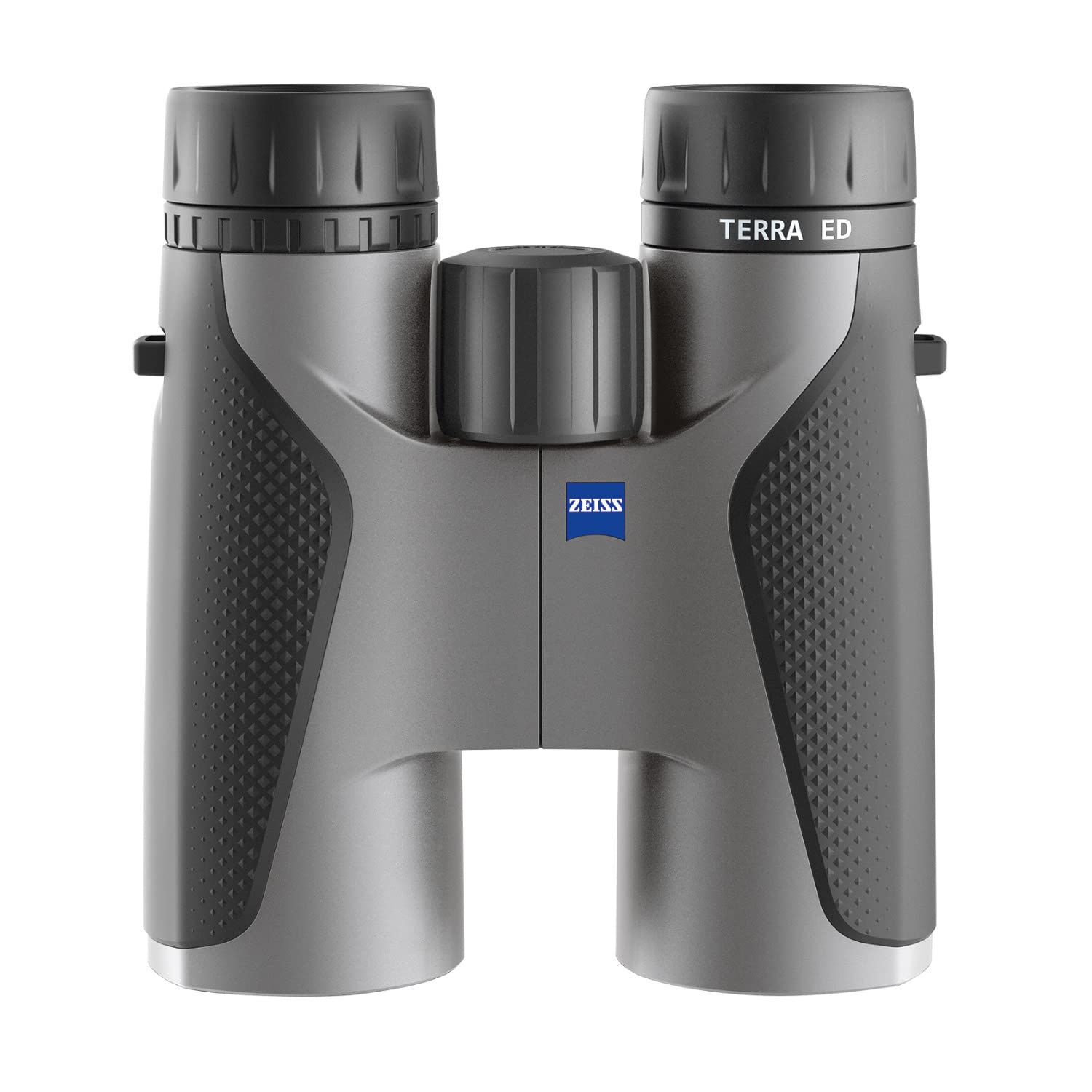
The ZEISS Terra ED 10×42 is the entry point into ZEISS optics, but “entry” is relative here—it still carries the German engineering and hydrophobic multi-coating that makes ZEISS a legendary name in optical glass. The 88% light transmission figure is excellent for a 10×42 design, and the Schmidt-Pechan prisms with ED glass deliver a view that is crisp, contrasty, and nearly free of distortion from edge to edge. The hydrophobic coating on the outer lenses causes water to bead up and roll off instantly, which is invaluable during a rainy morning in the field.
The focus wheel is large and textured, with a fast gearing ratio that lets you snap from near focus to infinity in about one and a half turns. That speed is crucial when you are scanning a tree line and a bird lands close by. The fiberglass-reinforced polycarbonate housing is exceptionally durable for its 1.4-pound weight, and the nitrogen purging ensures it will not fog up when you bring it out of a warm car into cold air.
At 10x magnification, the Terra ED rewards steady hands. The 330-foot field of view at 1000 yards is narrower than an 8x model, but the extra reach helps with shorebirds or raptors that keep their distance. The twist-up eyecups have intermediate click stops, and the 18mm of eye relief accommodates most eyeglass wearers comfortably. For birders ready to invest in a premium optic that holds resale value, the Terra ED is the logical step up.
Why we love it
- ZEISS hydrophobic coating sheds water and smudges effectively
- Fast focus wheel tracks quick-moving subjects
- Lightweight and robust fiberglass-reinforced body
- ED glass delivers high contrast and low chromatic aberration
Good to know
- Narrower field of view than 8x models at the same price
- Neoprene strap is comfortable but feels thin for the weight
5. Canon 12×36 Image Stabilization III

Canon’s 12×36 IS III uses Vari-Angle Prism technology derived from its camcorder line to actively stabilize the image, effectively turning a shaky 12x handheld view into something that looks tripod-mounted. This matters most when you are trying to count the banding on a distant woodpecker or identify a shorebird at 200 meters—without stabilization, the natural pulse in your hands makes fine detail impossible to resolve at this magnification. The Porro II prism design paired with lead-free glass and Super Spectra coatings produces a bright, edge-to-edge sharp image that holds up well in moderate light.
The image stabilization system runs on two AA batteries, which Canon rates for several hours of continuous use. In the field, I find that turning stabilization on only when I need it extends battery life across multiple outings. The 14.5mm eye relief is shorter than ideal for eyeglass wearers, but the twist-up eyecups help compensate. The compact body folds at the bridge for storage, and the 1.5-pound weight is reasonable given the tech packed inside.
The trade-off is clear: you get unprecedented handheld stability at 12x, but the 36mm objective lenses gather less light than a standard 42mm or 50mm birding binocular. At dusk, the view becomes noticeably dimmer than what a Nikon Monarch M5 delivers. This is a specialist tool for dedicated birders who spend most of their time scanning open water, shorelines, or mountain slopes where distance and steadiness matter more than low-light performance.
Why we love it
- Image stabilization eliminates hand shake at 12x magnification
- Doublet field-flattener lenses provide sharp edge-to-edge views
- Compact folding design for travel and storage
- Eco-friendly lead-free glass construction
Good to know
- 36mm objective limits low-light performance
- Short 14.5mm eye relief makes eyeglass use tricky
- Requires AA batteries for stabilization
6. Leupold BX-4 Pro Guide HD 12×50

The Leupold BX-4 Pro Guide HD 12×50 Gen 2 is built for birders who prioritize reach and impact resistance. The 12x magnification combined with a 50mm objective lens creates a 4.17mm exit pupil that retains brightness longer into twilight than smaller objective designs. Leupold’s Elite Optical System uses proprietary coatings to maximize light transmission while reducing glare, and the Guard-ion lens coating repels water, dust, and fingerprints so effectively that you rarely need to clean the glass during a session.
The open-bridge, dual-hinge design is noticeably ergonomic—the chassis sits deep in your palms, and the weight is distributed so well that the 1.8-pound body feels lighter than the spec suggests. The apparent angle of view is 65.2 degrees, which gives an immersive, wide-angle feel that makes scanning expansive habitats like tidal flats or alpine meadows genuinely enjoyable. The center focus wheel is precise, and the individual diopter adjustment locks securely.
Where the BX-4 really excels is construction toughness. The magnesium housing is rubber-armored and O-ring sealed, rated for full waterproof and fogproof performance. Leupold’s legendary customer care backs the product unconditionally. The primary consideration is that 12x magnification is difficult to hold steady without a tripod or the aid of image stabilization, so this binocular is best suited for birders who work from a blind, a car window, or a monopod.
Why we love it
- Guard-ion coating effectively repels water, dirt, and smudges
- Wide 65.2-degree apparent field of view for immersive scanning
- Open-bridge design improves grip and reduces weight feel
- Premium build backed by Leupold’s unconditional warranty
Good to know
- 12x magnification requires a stable support for best results
- At 1.8 pounds, it is heavier than compact 8x options
7. Bushnell H2O Xtreme 10×42

Bushnell designed the H2O Xtreme specifically for environments where water is a constant factor—birding near coastal marshes, rivers, or during steady rain. The IPX7 rating means these binoculars can be submerged in one meter of water for 30 minutes without damage, which is an extreme safety margin compared to simple splash-proof claims. The 10×42 configuration with BaK-4 prisms and fully multi-coated glass provides good clarity and light transmission for the price point, and the 17mm eye relief is comfortable for most users.
The rubber armor is textured with a non-slip pattern that works well even with wet hands, and the O-ring sealed nitrogen-purged body prevents internal fogging in humid conditions. The field of view is 6.8 degrees, which is roughly 357 feet at 1000 yards—adequate for scanning tree lines and shorelines without feeling tunnel-visioned. The center focus wheel turns smoothly, and the diopter adjustment on the right eyepiece holds its setting reliably.
Where the H2O Xtreme saves money is in the absence of ED glass or dielectric prism coatings. Image quality is good but not exceptional—you will see some chromatic aberration on high-contrast edges, and the color fidelity is slightly warmer than neutral. For a birder who needs a rugged, waterproof optic that can take a beating near salt water without breaking the bank, this is the most practical choice on the list.
Why we love it
- IPX7 waterproof rating is the highest in this price tier
- BaK-4 prisms and fully multi-coated glass for the price
- Textured rubber armor provides secure wet-weather grip
- Nitrogen purging prevents internal fogging
Good to know
- Chromatic aberration is visible in high-contrast scenes
- Color reproduction leans slightly warm
8. Celestron Outland X 10×50

The Celestron Outland X 10×50 is designed to maximize light gathering with its large 50mm objective lenses, making it a strong choice for birding during the golden hours of dawn and dusk or in heavily shaded forest understory. The 10x magnification paired with a 4.8mm exit pupil delivers a bright image that competes with 8×42 models in low-light conditions. Multi-coated lenses and BaK-4 prisms do the heavy lifting for contrast and color accuracy, and the 5.6-degree angular field of view (289 feet at 1000 yards) is reasonable for a high-power 10×50.
The rubber-armored polycarbonate body is fully waterproof and nitrogen-purged for fogproofing, and the textured grip surface inspires confidence when handling the binoculars with wet or gloved hands. Tripod adaptability is built in, which is a practical feature since the 1.8-pound weight becomes tiresome during extended handheld sessions. The twist-up eyecups have two intermediate positions, and the 17.4mm eye relief is adequate for most users.
The trade-off for the 50mm objective is size: this is a larger, heavier binocular that does not fit into a jacket pocket and feels substantial on a neck strap. The bundled accessories—carrying case, rainguard, and lens cloth—are sufficient, though the neck strap could be wider to better distribute the load. For birders who prioritize low-light performance over compact portability and are willing to carry a tripod for stability, the Outland X delivers impressive brightness at a mid-range price.
Why we love it
- 50mm objective excels in low-light conditions
- Multi-coated BaK-4 prisms for solid image quality
- Built-in tripod adapter for shake-free viewing
- Waterproof and nitrogen-purged build
Good to know
- Heavier and bulkier than standard 42mm models
- Neck strap is too narrow for comfortable all-day carry
9. Sogries 10-30×50 Zoom Binoculars
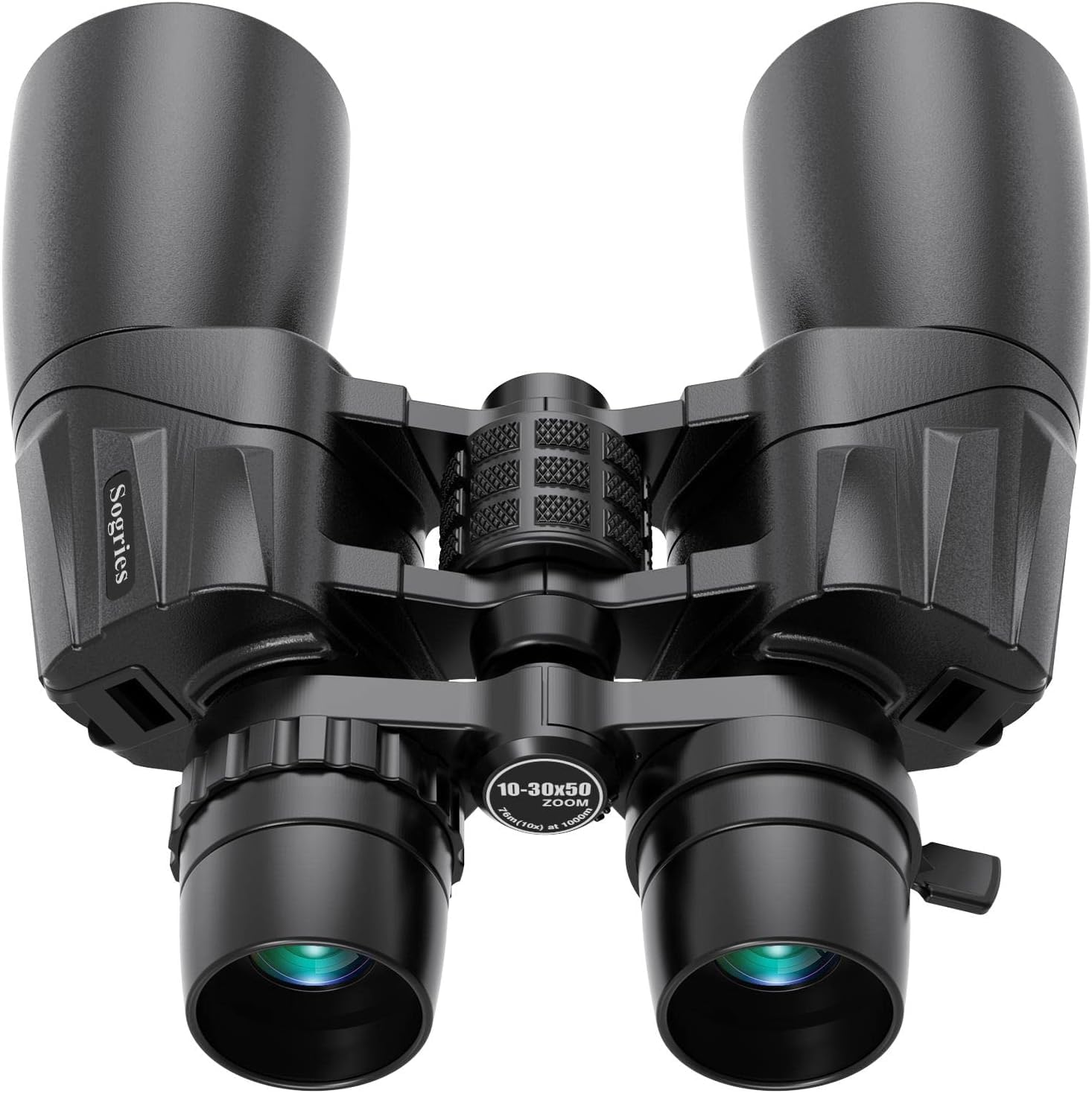
The Sogries 10-30×50 offers a continuously variable zoom range that allows birders to start at 10x for scanning and zoom to 30x for detailed inspection of a distant bird. The 50mm objective lens and BaK-4 prisms with fully multi-coated green film optics claim up to 99.5% light transmission, and the anti-reflective coatings do reduce glare in bright conditions. The 22mm eye relief is generous for eyeglass wearers, and the twist-up eyecups adjust for use with or without glasses.
The body is O-ring sealed and nitrogen-purged for waterproof and fogproof performance, and the rubber armor with a fingerprint-textured surface provides a secure grip. The zoom mechanism is controlled by a smooth joystick on top of the bridge, and the center focus wheel operates independently of the zoom function. The manufacturer explicitly recommends using a tripod, as the combination of high magnification and a 50mm objective creates a heavy, front-heavy binocular that is difficult to hold steady at 30x.
Image quality at 10x is acceptable for the budget tier, but at 30x, chromatic aberration becomes more pronounced and the image loses some sharpness, especially toward the edges. This is a noticeable trade-off compared to fixed-magnification optics with ED glass. The Sogries fills a niche for a birder who wants the flexibility of a zoom for stationary observation from a blind or vehicle but does not need the optical refinement of premium fixed-power binoculars.
Why we love it
- Variable 10-30x zoom reduces the need for multiple optics
- Long 22mm eye relief works well with eyeglasses
- Included 10-year warranty for peace of mind
- Fully multi-coated BaK-4 prisms at a budget price
Good to know
- Tripod is essentially required at 30x magnification
- Image sharpness degrades at maximum zoom and edges
- Chromatic aberration is noticeable in high-contrast scenes
FAQ
Why do most birders recommend 8×42 over 10×42?
What does fully multi-coated mean for birding binoculars?
Can I use 12x binoculars for birding without a tripod?
How important is nitrogen purging for birding binoculars?
Final Thoughts: The Verdict
For most pet parents, the rated binoculars for bird watching winner is the Vortex Diamondback HD 8×42 because it combines dielectric-coated optics, a wide field of view, and an unconditional lifetime warranty at a mid-range price. If you want ED glass clarity with a slightly higher build finish, grab the Nikon Monarch M5 8×42. And for birding in coastal or rainy environments where waterproofing is non-negotiable, nothing beats the Bushnell H2O Xtreme 10×42.