
The difference between a thriving reef and a slow-motion crash often comes down to what you cannot see in your tap water. Chlorine, chloramines, phosphates, silicates, and dissolved solids measured as TDS stress corals, burn fish gills, and fuel nuisance algae blooms. A dedicated filtration system built for aquarium use strips these contaminants down to a reading of zero parts per million, creating the blank slate aquatic life demands.
I’m Mo Mahin — the founder and writer behind Furric. I’ve spent thousands of hours comparing flow rate curves, membrane rejection percentages, DI resin capacities, and long-term owner feedback across the major players to understand which aquarium-specific RO/DI builds actually deliver on their spec sheets under real household water pressure.
This guide breaks down the top performers you can buy right now so you can match a reverse osmosis system for aquarium to your tank volume, tap water quality, and budget without guessing.
How To Choose The Best Reverse Osmosis System For Aquarium
Not all RO/DI systems are built for the consistent, zero-TDS output an aquarium demands. A drinking-water RO unit stops at the membrane, leaving behind enough dissolved solids to feed algae and stress sensitive livestock. You need a system with a dedicated deionization (DI) stage to polish the water to 0 PPM. Beyond that, the right choice depends on your tank volume, your home water pressure, and how much waste water you are willing to produce.
Stages Matter: RO vs. RO/DI
A standard RO-only system typically drops TDS from tap levels down to 5–15 PPM. That may be fine for drinking, but aquarium corals and invertebrates still suffer. An RO/DI system adds a mixed-bed DI resin cartridge that swaps remaining charged ions for hydrogen and hydroxide, forcing the output to 0 PPM. For any saltwater or planted freshwater tank with sensitive inhabitants, an RO/DI configuration—minimum 4 stages including DI—is non-negotiable.
Real-World Flow Rate vs. Rated GPD
The Gallons Per Day (GPD) rating printed on the box assumes ideal conditions: 77°F water and a steady 60 PSI pressure. In a typical home with 40–50 PSI, a 100 GPD membrane rarely produces more than 50–70 gallons per day, and a 50 GPD membrane may trickle at 1–2 gallons per hour. If you need 20+ gallons for a weekly water change, a 75 GPD or 100 GPD system saves hours of waiting. A booster pump can reclaim close to the rated flow if your pressure sits below 50 PSI.
DI Resin Capacity and Color Change
DI resin is a consumable: it exhausts faster when your feed water has high TDS (300+ PPM) or when the RO membrane ages and lets more solids through. Most quality systems pair color-changing resin that shifts from blue or purple to amber as it saturates. A 10-inch cartridge on a 100 GPD system treating 200 PPM tap water typically lasts 200–300 gallons before needing replacement. Systems with dual DI cartridges (or refillable cartridges) extend runtime between swaps, a useful feature for high-volume reef setups.
Build Quality and Fittings
Aquarium RO/DI systems live under sinks or in stands, often near moisture. Plastic brackets, push-to-connect fittings, and loose tubing can develop pinhole leaks over months of pressure cycles. Look for systems with a solid metal mounting bracket, 1/4-inch polyethylene tubing that seats fully into quick-connects, and a flush valve that lets you clean the membrane surface periodically. A built-in pressure gauge also helps you track when a booster pump or membrane replacement is needed without guesswork.
Quick Comparison
On smaller screens, swipe sideways to see the full table.
| Model | Category | Best For | Key Spec | Amazon |
|---|---|---|---|---|
| AquaFX Barracuda 100 GPD | Premium | High TDS well water | Solid aluminum bracket, pressure gauge | Amazon |
| Fountainhead RO/DI 150 GPD | Premium | Long-term reef investment | Dual DI cartridges, US-made | Amazon |
| Koolermax AR-122 150 GPD | Premium | Pure RO/DI, no drinking water | 6-stage, dual color-change DI | Amazon |
| LiquaGen 6-Stage Dual 75 GPD | Premium | Drinking + aquarium combo | Dual outlet, alkaline mineral filter | Amazon |
| Aquatic Life Classic 100 GPD | Mid-Range | Detailed monitoring | Built-in pressure gauge, ASO valve | Amazon |
| LiquaGen 5-Stage 75 GPD | Mid-Range | Standard saltwater/reef | Garden hose adapter, 2-year warranty | Amazon |
| Aquatic Life Twist-In 100 GPD | Mid-Range | Compact twist-in convenience | Triple-sealed twist-in cartridges | Amazon |
| Max Water 6-Stage 100 GPD | Mid-Range | 6-stage budget alternative | Color-coded quick-connect, clear housings | Amazon |
| LiquaGen 4-Stage 50 GPD | Budget | Small tanks, portable use | 4.2 lbs, garden hose adapter | Amazon |
In‑Depth Reviews
1. AquaFX Barracuda 100 GPD RO/DI System

The AquaFX Barracuda commands attention with its solid aluminum mounting bracket, a feature that eliminates the flimsy plastic frame flex common in budget systems. It ships with a Chlorine Guzzler carbon block that handles chloramines aggressively, and the liquid-filled pressure gauge lets you verify membrane performance at a glance. The TFC membrane is rated for 100 GPD and high rejection, meaning less work for the DI resin downstream.
Owners feeding hard well water with pH above 8.5 report that the Barracuda holds up without leaks, though sediment pre-filtration must be serviced every 10–14 days if the source is heavy with particulates. At typical household PSI (40–60), actual output landed around 50 GPD for most users, which aligns with realistic membrane performance. The DI resin depletion rate is noticeable—refillable cartridges are the smart play here to keep operating costs low over time.
The system comes partially pre-assembled, but the quick-connect fittings may require a gentle wiggling push to seat fully and avoid low-pressure stalls. A few owners resolved initial pressure drops by reseating tubing into the push-fit ports. Overall, the Barracuda is engineered for durability and consistent 0–2 TDS output, which explains its loyal following among reef keepers with demanding source water.
Why we love it
- Heavy-duty aluminum bracket eliminates frame flex
- Built-in pressure gauge for instant membrane health check
- High-rejection membrane extends DI resin lifespan
Good to know
- Sediment pre-filter clogs fast on high-sediment well water
- Quick-connect fittings occasionally need re-seating for full flow
- DI resin can deplete faster than expected on very high TDS feed
2. Fountainhead RO/DI 150 GPD Dual DI System

The Fountainhead Water System model FH32RODI150 stands out with dual DI canisters in a clear configuration, giving reef keepers the ability to run separate cation and anion resins or simply double the runtime between cartridge swaps. The 150 GPD rating is ambitious, but owners report consistent 0 TDS output even when fed from tap water measuring 800 PPM, which speaks to the membrane’s genuine rejection capability.
Long-term hobbyists who have cycled through various units over decades note that this system’s build consistency is among the best they have encountered, with no leaks or haze issues developing over multiple years of weekly use. A booster pump is a common add-on for low-pressure situations, and the system handled the extra backpressure without stress. The installation flow direction runs right-to-left, which is the reverse of some competitors, so reading the diagram carefully avoids a re-plumb.
At standard household pressure, production is slow—one owner measured 50 gallons over 32 hours—so pairing the Fountainhead with a pressure gauge and optional booster is practical for anyone needing 100+ gallons per week. Customer service has been responsive when non-essential components arrived missing. This is a system built for keepers who plan to stay in the hobby for the long haul.
Why we love it
- Dual DI canisters for extended resin life or custom media
- Proven performance on very high TDS feed water (800+ PPM)
- US-made, reliable build quality trusted by veteran reefers
Good to know
- Flow direction is reversed from many standard setups
- Very slow output at low household pressure without booster
- Booster pump purchase may be necessary for adequate GPD
3. Koolermax AR-122 150 GPD 6-Stage RO/DI System
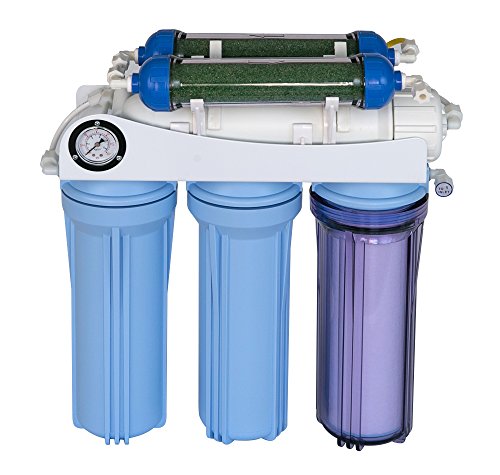
The Koolermax AR-122 packs six stages of filtration, including two color-changing DI cartridges, all assembled in Santa Ana, California, by a company with over two decades of RO system manufacturing. The extra DI stage means this system can handle larger water-change volumes before the resin exhausts, a crucial advantage for tanks exceeding 75 gallons that demand consistent 0 PPM water week after week.
Owners report that the system reduces feed TDS from 250–400 PPM down to zero reliably, and the flush valve prolongs membrane life by clearing accumulated debris. The push-to-connect fittings are standard 1/4-inch, but a few users noted the lines can pop loose at the valve connections if not inserted the full 3/4-inch depth. The included instructions are a PDF, which some found hard to reference, but the physical layout is straightforward enough for a confident DIY installer.
The AR-122 is not intended for drinking water—it is a pure RO/DI unit for aquarium, hydroponics, and lab use. At 17 pounds and a 16×5.5-inch footprint, it feels substantial. For the price point, you get dual DI capacity that normally costs significantly more. If your tap TDS is moderate and you want expanded runtime between resin changes, this unit delivers strong value.
Why we love it
- Dual color-changing DI cartridges for longer resin life
- Assembled in the USA by an established manufacturer
- Includes garden hose adapter for flexible setup
Good to know
- Push fittings require careful insertion to avoid pop-offs
- PDF-only instructions can be difficult to follow
- No inline TDS meter included for output monitoring
4. LiquaGen 6-Stage Dual-Use RO/DI 75 GPD

This LiquaGen is the rare system that serves two purposes from one frame: a drinking water outlet with an alkaline mineral cartridge that adds back calcium, magnesium, and potassium, and a separate RO/DI outlet that delivers 0 PPM water for your aquarium. The manual flush valve helps extend membrane life, and the pre-assembled design cuts installation time to roughly 10 minutes for most users.
Owner reports over an eight-year horizon confirm the system holds up without developing brittle plastic cracks or chronic leaks, which is exceptional for a unit in this tier. The RO/DI path reduced well water from 350 PPM to zero reliably, while the drinking water path outputs a pleasant tasting product similar to commercial RO. A few buyers noted that the DI cartridge came under-filled and required shaking to settle the resin, limiting initial output to roughly 40 gallons before exhaustion.
The waste-to-product ratio hovers around 3:1, which is typical for a 75 GPD membrane. If your goal is strictly aquarium use, you can simply remove the alkaline cartridge and run the DI output exclusively. The 75 GPD membrane delivers about 3–4 gallons per hour at 50 PSI, sufficient for a 50-gallon weekly change with a few hours of running time.
Why we love it
- Dual outlets for both drinking and 0 PPM aquarium water
- Alkaline mineral filter improves taste for consumption
- Manual flush valve prolongs membrane lifespan
Good to know
- DI cartridge may arrive under-filled; requires shaking to settle resin
- 3:1 waste-to-product ratio is on the higher side
- Some push-connect fittings needed re-taping to prevent minor leaks
5. Aquatic Life Classic 100 GPD 4-Stage RO/DI System

The Aquatic Life Classic 100 GPD builds on the brand’s reputation with a liquid-filled pressure gauge and an automatic shut-off solenoid (ASO) that stops production when a storage container is full. The Carbon Plus cartridge targets up to 98% chloramine removal, a critical spec for municipal water supplies that rely on chloramines rather than free chlorine. The refillable 10-inch DI cartridge lets you swap resin beads without replacing the entire housing.
Users with 50 PSI feed pressure report consistent 0 TDS output from 324 PPM tap water, with a production rate of about 5 gallons per film-length session. The unit uses standard 10-inch filter housings, which makes replacement filters widely available and inexpensive. A few owners encountered small rubber plugs lodged in the inlet ports—easily removed with needle-nose pliers but surprising on a system that is otherwise well-prepared.
Installation instructions are clear, and the Buddy-Fit press connectors (1/4-inch) seal without plumber’s tape when inserted fully. The 18.5x7x19-inch footprint is larger than some portable options, so check your under-sink clearance. This system is explicitly not intended for drinking water, so dedicate it solely to your aquarium needs. For a mid-range price, the ASO valve alone justifies the upgrade if you plan to automate water changes.
Why we love it
- Built-in liquid-filled pressure gauge for real-time monitoring
- Auto shut-off solenoid prevents overflow during unattended use
- Carbon Plus cartridge removes up to 98% of chloramines
Good to know
- Larger footprint requires adequate under-sink space
- Inlet ports may contain rubber plugs that need removal
- Not designed for drinking water; strictly for aquarium use
6. LiquaGen 5-Stage RO/DI 75 GPD
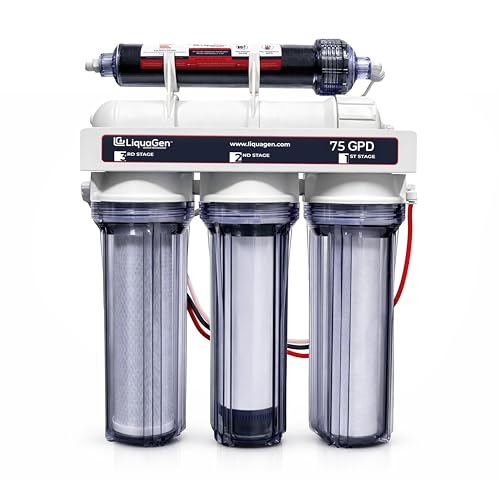
The LiquaGen 5-Stage is a pre-assembled workhorse that walks a tight line between affordability and genuine 0 PPM performance. The five stages roll sediment, activated carbon, coconut carbon, the RO membrane, and an inline DI canister into one frame. The membrane is a GE USA TFC sheet rated for 75 GPD, and the system ships with a garden hose adapter, making it easy to run from a laundry room or outdoor spigot.
Real-world output from a 75 GPD membrane at 50 PSI clocks in around 2.5–3 gallons per hour, which means a 20-gallon water change requires roughly 7 hours of run time. Owners feeding Detroit tap water at 300 TDS consistently report 0 PPM effluent, and the DI resin continues to output clean water for several hundred gallons before exhaustion. The unit measured roughly 8x the TDS in waste water (145 PPM reject vs. 89 PPM feed), confirming a reasonable recovery ratio.
A weak point is the garden hose adapter itself: some units arrive with a cracked fitting, and customer service has been inconsistent in responding to replacement requests. The system also tends to be top-heavy when placed on the floor, so wall-mounting or securing it to a board is recommended. With a 2-year warranty and lifetime support, this unit offers solid long-term value for the standard reef setup.
Why we love it
- GE USA TFC membrane for reliable contaminant rejection
- Pre-assembled with garden hose adapter for flexible installation
- Consistently achieves 0 TDS from high-TDS municipal tap water
Good to know
- Garden hose adapter quality is inconsistent; may need replacement
- Top-heavy design requires wall mounting or base securing
- 75 GPD output at 50 PSI is slow for large water changes
7. Aquatic Life Twist-In 100 GPD 4-Stage RO/DI

The Aquatic Life Twist-In distills the RO/DI process into a compact 12x4x13-inch frame where each filter cartridge screws in by hand—no wrenches, no housing bowls to wrestle. The triple-sealed cartridge design aims for leak-free operation, and the DI resin cartridge changes color as it exhausts, giving a visual cue for replacement. The 100 GPD membrane is paired with a sediment block and a carbon block rated for chlorine reduction.
Owner feedback consistently notes that actual GPD output runs about half the rated spec: a 100 GPD unit produced roughly 40–50 GPD at 55 PSI, and a 50 GPD unit produced about 25 GPD. That is typical for the category, but the gap feels wider here because the cartridges are proprietary and more expensive than standard 10-inch replacements. The DI canister also tends to exhaust faster than the sediment and carbon stages, leading some owners to replace the whole unit sooner than expected.
Portability is a genuine strength: the whole system weighs 7 pounds and fits inside a small carry bag, making it easy to store in a fridge or transport to a second location. The faucet adapter included in many packages has been reported missing or damaged, but customer support typically ships a replacement. For nano-reef keepers or those with limited under-sink space, the Twist-In’s convenience outweighs the higher per-cartridge cost.
Why we love it
- Ultra-compact footprint fits in tight spaces or a carry bag
- Tool-free twist-in cartridges simplify filter changes
- Color-changing DI resin provides clear replacement signal
Good to know
- Real-world output is roughly half the rated GPD
- Proprietary cartridges are more expensive than standard 10-inch
- Faucet adapter sometimes missing or damaged on arrival
8. Max Water 6-Stage 100 GPD RO/DI System

Max Water’s 6-stage system brings a 100 GPD membrane, a pair of carbon blocks, a sediment stage, and a color-changing DI cartridge to the table, all housed in clear canisters that let you inspect filter condition visually. The company touts 15+ years in water filtration and BPA-free components. Color-coded quick-connect fittings and labeled housings aim to simplify installation for first-time buyers.
The TDS after the DI stage is consistently zero, though the final inline carbon stage can leave a reading of around 24 PPM on some models due to harmless carbon fines—settling the carbon by running a few gallons to waste clears this up. The waste ratio tends toward 2:1, better than many competitors.
A few owners note that the supplied fittings require some plumbing experience—installing via a T in a copper line is straightforward for the handy, but novices may struggle. The instructions are adequate but assume familiarity with compression fittings. The system works well in the 45–70 PSI range; below 45 PSI, output slows noticeably. For the price, the 6-stage layout gives you redundant carbon filtration that helps if your municipal water has high organic load.
Why we love it
- 6-stage filtration with redundant carbon for organics removal
- Clear filter housings allow easy visual inspection
- Better waste ratio (~2:1) than many competitors
Good to know
- Final carbon stage may add minor TDS from carbon fines initially
- Requires moderate plumbing comfort for proper installation
- Output slows significantly below 45 PSI feed pressure
9. LiquaGen 4-Stage RO/DI 50 GPD Space Saver
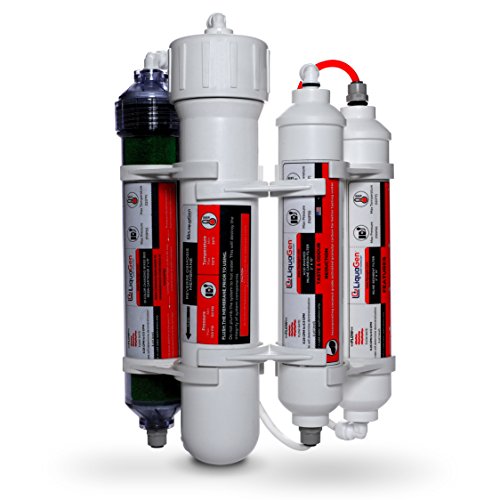
The LiquaGen 4-Stage Space Saver weighs just 4.2 pounds and requires no permanent installation—it connects directly to a garden hose or laundry faucet via the included adapter. The four stages (inline sediment, inline carbon, 50 GPD RO membrane, and inline DI resin) fit into a compact 8x6x13-inch frame. It is the lightest and most portable entry in this list, designed for the aquarist who wants 0 PPM water without drilling or under-sink work.
Owners confirm it reduces Dallas tap water from roughly 300 PPM to zero reliably, producing about 2 gallons per hour. A five-gallon bucket takes around 90–120 minutes to fill, a timeline that fits a small or nano-tank water change schedule. The manual flush valve allows periodic membrane cleaning, extending filter life. Several users reported very minor leaks at the quick-connect joints, easily resolved with a final tightening twist.
The 50 GPD membrane is slow by modern standards—a 100-gallon tank would require over a day of continuous operation for a 20% water change. Customer service has been praised for upgrading a lost package to a 150 GPD unit and sending replacement canisters after a shipping delay. For the buyer on a tight budget with a tank under 40 gallons, this entry point delivers genuine 0 TDS output with a minimal upfront investment.
Why we love it
- Ultra-light and portable, no installation required
- Genuine 0 TDS output from standard municipal tap water
- Manual flush valve included to maintain membrane performance
Good to know
- 50 GPD membrane is slow; expect 1.5–2 hours per 5 gallons
- Minor initial leaks at some quick-connect joints possible
- Not suitable for large tanks needing fast, high-volume production
FAQ
Can I use a drinking-water RO system for my saltwater aquarium?
How often do I need to replace the DI resin in an aquarium RO/DI system?
Why is my RO/DI system producing water slower than the GPD rating?
Final Thoughts: The Verdict
For most reef and planted-tank keepers, the reverse osmosis system for aquarium winner is the AquaFX Barracuda 100 GPD because the solid aluminum frame, built-in pressure gauge, and high-rejection membrane give you the reliability and monitoring needed for years of consistent 0 TDS water. If you want a dual-purpose system that serves both drinking water and your aquarium, grab the LiquaGen 6-Stage Dual-Use 75 GPD. And for the tightest budget or a nano tank where portability matters, nothing beats the LiquaGen 4-Stage Space Saver 50 GPD for its no-install convenience and verified 0 TDS output.