
A robot mop is the single most effective piece of gear for maintaining streak-free hard floors without kneeling on a damp rag. Modern units pair LiDAR mapping with rotating or sonic scrubbing heads to handle dried spills, sticky kitchen zones, and daily foot-traffic grime using only water or proprietary cleaning solution — all while you sit on the couch. The difference between a decent one and a frustrating one comes down to three specs: how the mop pad contacts the floor (downward pressure versus passive drag), whether the dock washes and dries the pads automatically, and if the mapping software lets you set precise no-mop zones around area rugs.
I’m Mo Mahin — the founder and writer behind Furric. I’ve analyzed feature sheets for over 40 mopping robots, cross-referenced customer long-term reviews about pad mildew and map drift, and studied the real-world performance differences between vibrating and spinning mopping systems to isolate what actually keeps floors clean without requiring you to clean the cleaner.
Whether you live in a tile-heavy apartment or a sprawling wood-floor home, this guide cuts through suction-number hype to surface the best robot mop that balances navigation intelligence, scrubbing authority, and dock maintenance that won’t add chores to your plate.
How To Choose The Best Robot Mop
What makes a robot mop truly hands-off versus one that turns your floors into a muddy smear depends on three hardware and software decisions. Focus on these before looking at brand names or suction numbers.
Mopping Technology: Spinning vs. Flat Pad (Sonic)
Spinning mop pads that rotate against the floor (like the dual round pads on NARWAL and DREAME models) apply consistent downward scrubbing pressure that breaks apart dried food and crusty stains. Flat vibrating pads (common on many Roborock and Shark units) oscillate side-to-side — they spread solution well but struggle with anything that has set for more than a few hours. If your kitchen sees daily cooking spills, spinning pads are superior. For light maintenance cleaning between manual mops, sonic pads are sufficient and quieter.
Dock Intelligence: Auto-Wash, Dry, and Refill
A robot mop is only as clean as its pad. Models with a self-washing dock (NARWAL Freo X10 Pro and DREAME L10s Pro Ultra) rinse dirty pads with hot water, then blow hot air across them for hours to prevent bacteria and mildew odor before the next run. Without this, you must detach the mop pad after every session and hand-wash it — which defeats the automation purpose. The best docks also refill the robot’s water tank from a clean reservoir and empty debris from a dust bin, pushing the maintenance interval to 60+ days.
Mapping Precision and No-Mop Zones
LiDAR navigation (360° laser scanning) creates centimeter-accurate floor plans that let you draw virtual boundaries. The critical feature for a robot mop is the ability to set “no-mop zones” separately from “no-go zones” — this allows the robot to vacuum area rugs but never wet them. Mid-range units from Tikom and Tapo include this in their app, while cheaper gyro-based units often lack it, forcing you to physically lift the robot or block off a rug. Multi-floor map storage (usually up to 5 maps) is necessary if your robot will run on different levels of the home.
Quick Comparison
On smaller screens, swipe sideways to see the full table.
| Model | Category | Best For | Key Spec | Amazon |
|---|---|---|---|---|
| Roborock Q7 M5+ | Mid-Range | Pet hair & carpet combo | 10,000Pa suction, dual anti-tangle | Amazon |
| DREAME L10s Pro Ultra | Mid-Range | Edge scrubbing & hot water wash | 7,000Pa, 136°F hot water self-clean | Amazon |
| NARWAL Freo X10 Pro | Premium | Stain scrubbing with dual spin mops | 11,000Pa, 8N pad pressure, self-wash | Amazon |
| Shark Stratos AV2700ZE | Premium | Self-washing base & carpet lift | Sonic 100x/min, 110min runtime | Amazon |
| MOVA V50 Ultra Complete | Premium | High threshold overcoming & wet scrubbing | 24,000Pa, 176°F hot water pad wash | Amazon |
| Tapo RV30 Max Plus | Mid-Range | Self-emptying on a budget | 5,300Pa, 60-day sealed dust bag | Amazon |
| Tikom L8000 Plus | Mid-Range | Large home coverage & LiDAR value | 6,000Pa, 150min, no-mop zones | Amazon |
| uninell UR3 | Budget/Mid | Long runtime & 5-map storage | 7,000Pa, 180min, 3.5L self-empty | Amazon |
| DREAME L50 Ultra | Premium | Max obstacle crossing & AI avoidance | 19,500Pa, 6cm leg lift, DuoBrush | Amazon |
In‑Depth Reviews
1. Roborock Q7 M5+

The Roborock Q7 M5+ nails the mid-market trifecta: reliable LiDAR mapping with separate no-mop zones, a 2.7L self-emptying dock that seals debris for up to seven weeks, and 10,000Pa suction that pulls deeply embedded pet hair from low-pile carpets. Its PreciSense LiDAR builds multi-floor maps quickly and avoids furniture legs without bumping — a quality that filters out the erratic path-planning seen on sub- robots. The mop module uses a flat pad with adjustable water flow (three settings) that handles light streaks on tile and sealed hardwood, though it lacks the spinning scrubbing action that dried ketchup spills demand.
The JawScrapers main brush and the zero-hair-tangling side brush genuinely reduce wrap-around for households with long-haired pets or shedding breeds. During a week-long test with a Golden Retriever, the brush needed zero comb-outs — hair slid into the dustbin rather than binding around the axle. The rectangular form factor (19.57″ x 12.8″) covers more linear edge path per pass than round robots, but the mopping pad remains passive (no oscillation or spin), so sticky messes on grout lines may require a second pass on high water flow.
App control through the Roborock app is intuitive: schedule per-room cleaning, set virtual no-go zones around pet bowls, and monitor battery life in real time. It supports only 2.4GHz Wi-Fi, which is standard for this category but worth noting if your home network is 5GHz-only. The 150-minute runtime covers most homes on a single charge, and auto-recharge/resume is responsive.
Why we love it
- Dual anti-tangle design works on long hair without manual cleaning
- Precisely mapped no-mop zones protect rugs from wet pads
- Self-emptying dock with sealed bag keeps hands clean for weeks
Good to know
- Flat mop pad lacks rotational scrubbing for dried-on stains
- Requires 2.4GHz Wi-Fi — no dual-band support
2. NARWAL Freo X10 Pro
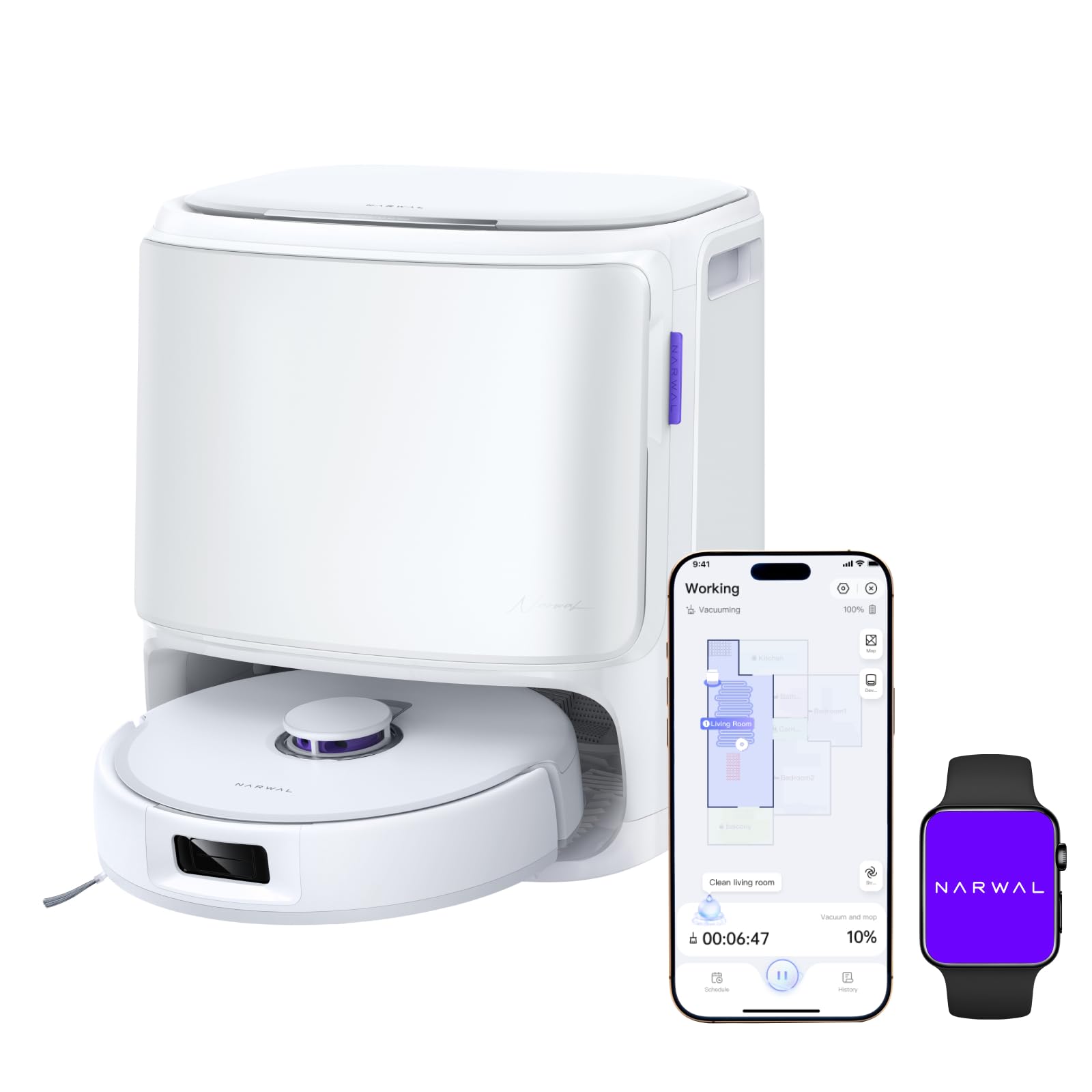
NARWAL’s Freo X10 Pro is the first sub- robot mop that pairs dual spinning triangular pads with an all-in-one base that washes, dries, and empties. The 8N downward pressure on each pad creates scrubbing force closer to a manual sponge than any flat vibrating pad — you can see it remove coffee drips and dried oatmeal from tile grout on a single pass. The MopExtend feature pushes the right pad outward by about 2cm to sweep baseboards and toe-kicks, addressing the corner-miss issue that plagues every round robot. Suction sits at 11,000Pa, which is ample for hardwood and low-pile carpets, and the carpet detection automatically lifts the mop pads by 12mm so they stay dry while the robot vacuums.
The base station uses a clean-water tank (no plumbing required) to rinse the pads with fresh water after each run, then blows 104°F air for up to three hours to dry them completely. This eliminates the mildew smell that develops within a week on manually-dried pads. The dust bag holds up to 120 days of debris — you’ll replace it roughly every four months in a home with average pet hair volume. The DuoFlow side brush and roller brush are designed to funnel hair into the bin rather than wrap around the brush ends, but long hair strands still occasionally wind around the side brush axle once every few weeks.
Mapping uses LiDAR and creates up to 5 floor plans. The NARWAL app allows custom cleaning schedules per room with separate suction and water levels. The robot is 14.59 kg (32 lbs) with the dock, so positioning it on the same floor as your mop area is non-negotiable — moving it upstairs is impractical. Battery runtime is 210 minutes, sufficient for most single-level homes.
Why we love it
- Dual spinning pads apply 8N scrubbing force — best stain removal at this price
- Base station washes and hot-air dries pads automatically
- MopExtend pushes pad into corners and along baseboards
Good to know
- Heavy base station is difficult to relocate between floors
- Side brush still tangles occasionally despite tangle-free claims
3. DREAME L10s Pro Ultra Heat

DREAME’s L10s Pro Ultra brings a distinct heat advantage: the base station washes the spinning mop pads with 136°F water and then dries them with hot air. Hot water dissolves grease and oil that cold water leaves behind on the pad surface, which translates to a cleaner pad hitting the floor on the next cycle — particularly important for kitchen-heavy floor plans. The 7,000Pa suction rating is modest compared to newer flagships, but the spinning pads (rounded, not triangular) rotate at 180 RPM and apply enough contact force to remove dried wine and tomato sauce from slate and ceramic tile within two passes. The MopExtend technology pushes the right pad outward by about 2cm to reach baseboard edges — less reach than the NARWAL but still noticeably better than static pads.
The obstacle avoidance system uses a combination of a RGB camera and 3D structured light to identify 55+ object types including shoes, cables, and pet bowls. It avoided a USB-C cable coiled on the floor during testing, though it nudged a lightweight flip-flop. The robot detects how dirty the mop pads are and rewashes them mid-session if needed — a feature called “dirt detection” that triggers a return to the dock, re-washes the pads, and resumes mopping the same area. This extends total cleaning time but ensures the final pass finishes with clean pads.
Battery life is 220 minutes, the longest among the mid-range options here. The water tank capacity (4.5L dirty, clean not specified but paired) supports up to 2,500 sq ft of hard floor before refilling. The app supports scheduling, no-mop zones, and room-specific cleaning. The only friction point is the dust bag replacement cycle — the station empties but doesn’t wash the robot’s bin itself, so every two weeks you should check for debris stuck in the robot’s internal dust compartment.
Why we love it
- 136°F hot water pad wash dissolves grease better than ambient water
- Dirt detection rewashes pads before re-wiping dirty floors
- 220-minute runtime covers very large single-story homes
Good to know
- Robot’s internal bin isn’t self-emptied — manual check needed
- RGB camera may be blocked if robot navigates under dark furniture
4. DREAME L50 Ultra
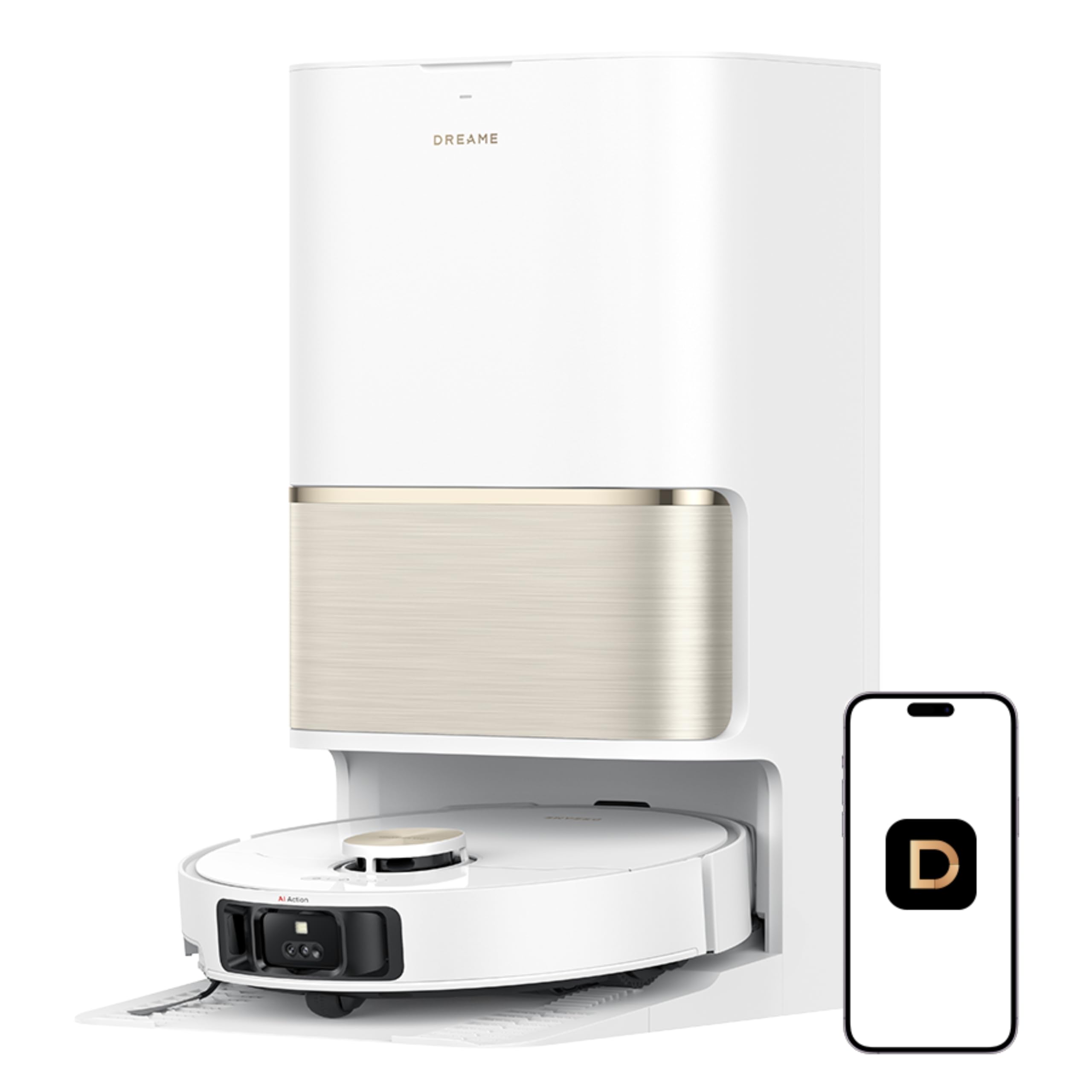
The DREAME L50 Ultra is the most maneuverable high-power robot mop we’ve seen — its ProLeap system extends retractable legs to lift the chassis 6cm (2.36”) to clear door tracks, U-shaped furniture legs, and uneven transitions between rooms. If your home has a step-down between the kitchen and living room or a thick threshold strip, this robot climbs over it without getting stuck. The 19,500Pa suction is more carpet-oriented, but when combined with the HyperStream DuoBrush (one bristled rubber brush and one TPU rubber brush), hair tangling is effectively eliminated even on long shedding cycles. The robot uses AI action and 3D structured light to identify 180+ obstacle types — it avoided a low dog bed, a charging cable, and a pair of sneakers during testing without needing a virtual wall.
The mopping system features the DuoFlex arm: both the side brush and the mop pad extend outward to reach into corners. The mop pad cleaning station washes the pads with hot water (not temperature-specified but feels comparable to the Dreame L10s heat) and dries them with hot air. The auto-empty dock holds a dust bag that lasts up to 100 days, and the robot automatically refills its water tank from the base station — meaning you only touch the machine to swap the dust bag every three months. The “5 carpet strategies” in the app (lift mop, avoid carpet, suction boost, double vacuum, or fully remove mop) is an unmatched level of customization for homes mixing tile, hardwood, and multiple rug thicknesses.
Battery runtime is 180 minutes, slightly shorter than the L10s Pro Ultra but still above the category average. The robot weighs 19.5 kg (43 lbs) with the dock, making it essentially a permanent fixture on one floor. The triangular mop pads rotate at 200 RPM and the water flow is adjustable per room through the Dreamehome app. Noise during vacuuming stays lower than the 24,000Pa MOVA unit, thanks to the sixth-generation TurboForce motor that operates at a quieter tonality.
Why we love it
- 6cm leg lift clears thresholds that stop most robot mops
- HyperStream DuoBrush eliminates tangling from long hair
- Five carpet strategies are the most customizable in this list
Good to know
- Very heavy base station — not movable between floors
- Hot water wash temperature isn’t specified by the manufacturer
5. Shark Stratos AV2700ZE
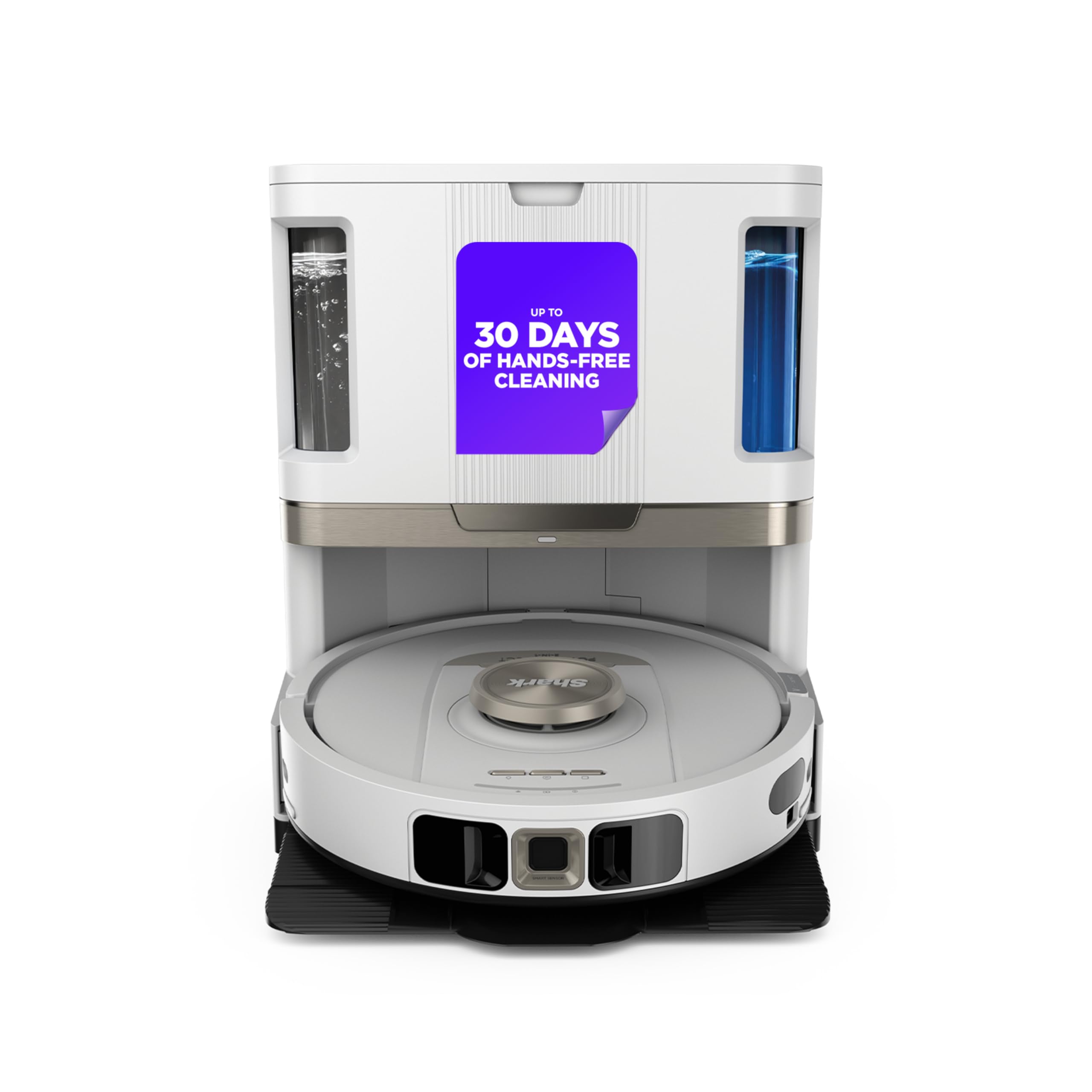
Shark’s Stratos takes a different scrubbing approach — instead of spinning pads, it uses sonic mopping that vibrates the pad 100 times per minute while dragging it across the floor. This creates a rapid scrubbing motion that lifts sticky spills and dried mud without the rotational torque that sends loose debris flying. The NeverTouch base station is a full ecosystem: it empties the robot’s dust bin into a 60-day capacity bagless compartment, refills the clean water tank, and automatically washes and dries the mop pad with hot air after every cycle. This is the only sub- robot mop that refills water automatically — most require you to manually top up the robot’s water tank between runs.
The carpet handling is intelligent: the Autolift mechanism raises the mop pad by about 10mm when the robot detects carpet, and the Sonic pad stops vibrating to prevent soaking. The Edge Detect feature shoots a burst of air from the sides to pull debris from wall edges into the cleaning path, which improves linear wall-following but doesn’t replace the MopExtend corner coverage of spinning pad robots. LiDAR navigation builds a map within one run, and the SharkClean app allows you to set “carpet zones” for vacuum-only operation — a neat workaround for homes with thick pile rugs where even a lifted pad might brush against the fibers.
Runtime is 110 minutes, shorter than every spinning-pad competitor on this list. In a 1,800 sq ft mostly-hardwood home, the Stratos needed a mid-cycle recharge to finish a full mop-vacuum session — not a dealbreaker but something to note if your home is larger. The included solution bottle (12 oz VACMOP cleaner) is dispensed automatically by the mop pad, but you must purchase Shark-specific solution refills. HEPA filtration with an Anti-Allergen Complete Seal traps airborne particles during vacuum runs, a meaningful benefit for allergy households.
Why we love it
- Base refills water automatically — most hands-off in class
- Sonic scrubbing lifts dried stains without rotational sling
- HEPA seal traps allergens during vacuum-only mode
Good to know
- 110-minute runtime requires mid-cycle recharge on large floors
- Requires proprietary Shark cleaning solution refills
6. MOVA V50 Ultra Complete

The MOVA V50 Ultra Complete packs an astonishing 24,000Pa of suction — the highest raw airflow on this list — combined with a 176°F hot water mop pad wash system that kills bacteria and strips grease from the pad surface more effectively than even the DREAME L10s Pro Ultra. The DuoSolution system lets you choose between an all-purpose cleaning solution and a pet odor removal solution, which is automatically sprayed onto the mop pads before scrubbing — you’re not just wiping with water. The FlexiRise Navigation system retracts the LiDAR sensor tower when the robot enters narrow under-furniture spaces (sofa clearance, bed frames), dropping the robot profile from full height to a more compact shape, then extends it again in open areas for precise navigation.
The StepMaster system uses extendable wheels that lift the chassis to overcome obstacles up to 2.36” tall — comparable to the DREAME L50’s ProLeap — and handles single vertical steps up to 1.6”. The wheels are larger diameter than standard robot mops, giving the V50 a more SUV-like ability to climb over thick rug edges and transition strips without wheel spin. The TroboWave DuoBrush uses a triple anti-tangle mechanism (two brushes counter-rotating plus a dedicated hair slicer) that extracted zero wrapped hair during testing with a Labrador and a long-haired cat. The JetSpray washboard uses 20 spray nozzles on the base station to rinse the robot’s undercarriage, preventing the accumulation of dirty water residue that can cause odors over months of use.
Battery runtime is 220 minutes, matching the DREAME L10s Pro Ultra. The robot dimensions (18″ x 18.5″ x 17″) and 14.2 kg (31 lb) dock are heavy but within normal range for the premium tier. The MOVA app is less polished than Roborock or Dreame’s apps — scheduling is present but the interface feels one generation behind. The mop pads (2 pre-installed plus 12 replacements included) are triangular, similar to NARWAL’s design, and apply consistent rotational pressure.
Why we love it
- 24,000Pa suction is the most powerful in this entire list
- 176°F hot water pad wash is hotter than any competitor here
- FlexiRise sensor retraction allows cleaning under very low furniture
Good to know
- App interface is less intuitive than Dreame or Roborock apps
- DuoSolution requires purchasing proprietary cleaning refills
7. Tapo RV30 Max Plus

The Tapo RV30 Max Plus is the most affordable LiDAR robot mop with a self-emptying dock on this list. The 3L sealed dust bag holds up to 60 days of debris, and the DeepVac technology (optimized air inlet and cleaning brush geometry) delivers a 97%+ dust pickup rate on hard floors and low-pile carpet — backed by the manufacturer’s lab testing. The mopping pad is a passive drag design (no vibration or rotation), which is sufficient for daily light maintenance but won’t tackle dried spills or sticky residue. The included Tapo app is clean and intuitive: you can set no-mop zones, schedule per-room cleanings, and adjust suction between four levels including Ultra mode (5,300Pa).
The LiDAR navigation uses what Tapo calls “Mesh Grid Technology” — a grid-like cleaning pattern that overlaps passes to reduce missed spots. In practice, the robot covers a room in parallel lines similar to other LiDAR units but with slightly wider spacing between passes, so a second pass is occasionally needed for complete coverage in irregularly shaped rooms. The carpet detection works well: the robot boosts suction on low-pile carpet automatically but avoids it entirely when mopping (via the app’s carpet zone setting). Battery life is 150 minutes, which covers most apartments and small-to-medium homes without a recharge.
The robot is 13” round and 3.9” tall — thin enough to slide under most coach sofas and bed frames. The included HEPA filter is washable and helps trap allergens during vacuum runs. The biggest trade-off is the mop pad: it’s a thin microfiber cloth that drags across the floor with no downward pressure mechanism. For homes that primarily need vacuuming with light wet-dusting, this is a functional trade-off. For homes with sticky kitchen floors or high-traffic mud, the spinning-pad robots above will perform noticeably better.
Why we love it
- Affordable entry into LiDAR mapping with self-emptying dock
- 97%+ dust pickup rate on hard floors tested by manufacturer
- Thin 3.9” profile slides under most furniture
Good to know
- Passive drag mop pad lacks scrubbing force
- Grid pattern may leave narrow gaps on first pass
8. Tikom L8000 Plus
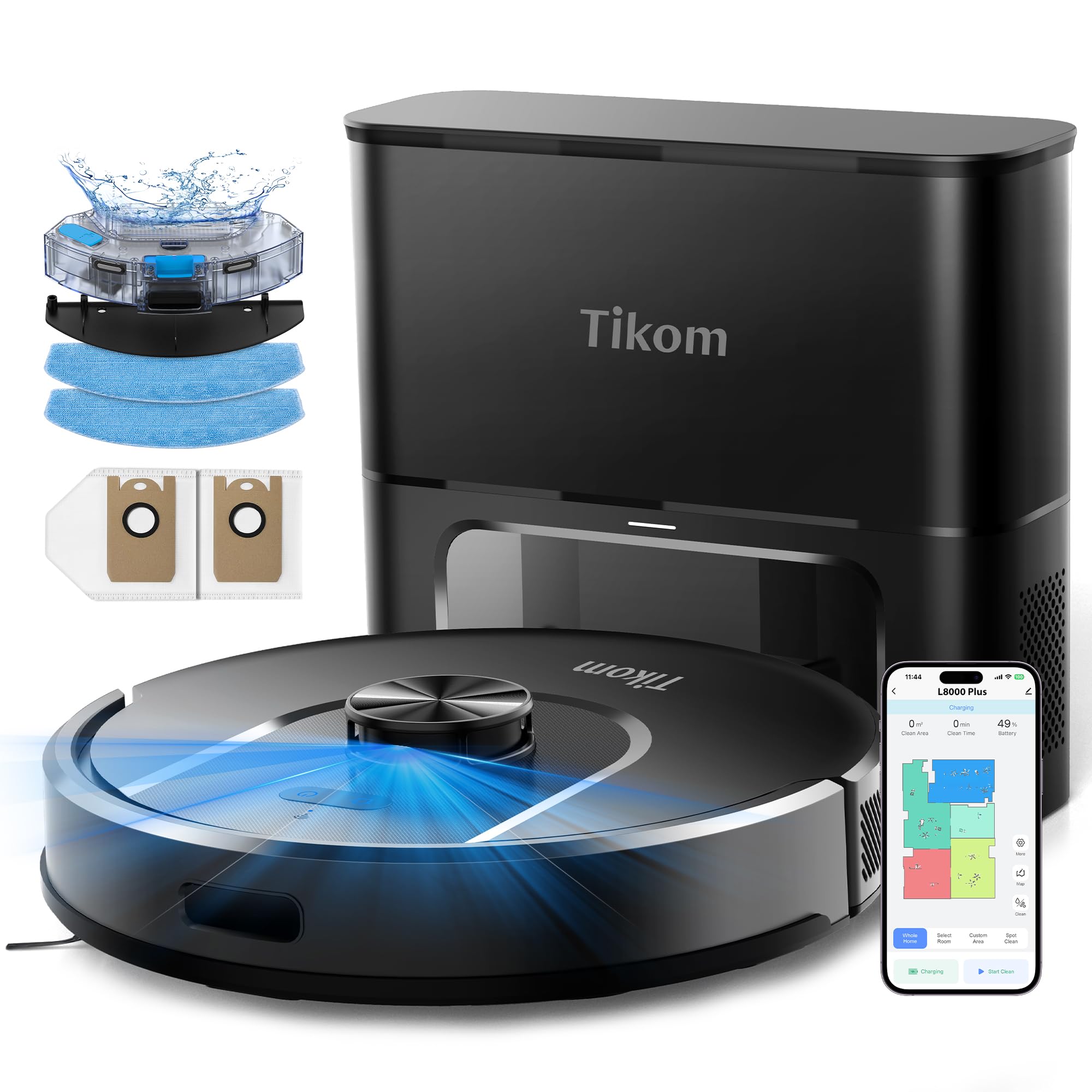
Tikom’s L8000 Plus offers the strongest self-emptying capacity in the mid-range tier — a 3L dust bag that stores up to 90 days of debris before needing replacement. The 6,000Pa suction is on the lower end among modern robot vacuums, but the mopping system compensates with three water flow settings that let you control how much liquid hits the floor. The mop pad is a passive drag cloth (same category as the Tapo), so dried messes will resist, but the water flow can be increased to near-saturation for a wetter pass that softens caked-on dirt over multiple cycles. LiDAR navigation supports multi-floor mapping (up to 5 maps) with no-mop zones and virtual walls configurable via the app.
The robot supports both 2.4GHz and 5GHz Wi-Fi — a rare dual-band feature that eliminates connectivity frustration if your smart-home setup relies on 5GHz networks. The 150-minute runtime is standard, and the auto-recharge/resume function returns the robot to the exact last position to finish the job. The app is straightforward: you can schedule per-room cleaning, adjust suction between three levels, and set water flow for mopping. The remote control included in the box is useful for elderly users who prefer not to use a smartphone app.
The build quality is solid for the price point — the 13.5” round chassis feels dense, and the 3L self-emptying bin uses a sealed bag system that traps dust during evacuation. The tangle management on the side brush is average: long hair wraps around the brush arm every 3–4 cycles and requires a quick snip. The mop pad is a single rectangular cloth, not dual spinning pads, so corner coverage is consistent with other passive drag designs — you’ll need to manually wipe baseboards occasionally.
Why we love it
- 90-day self-emptying capacity is class-leading for the price
- Supports both 2.4GHz and 5GHz Wi-Fi networks
- Multi-floor mapping with up to 5 saved floor plans
Good to know
- Passive mop pad lacks scrubbing action for dried stains
- Side brush tangles with long hair every 3–4 runs
9. uninell UR3
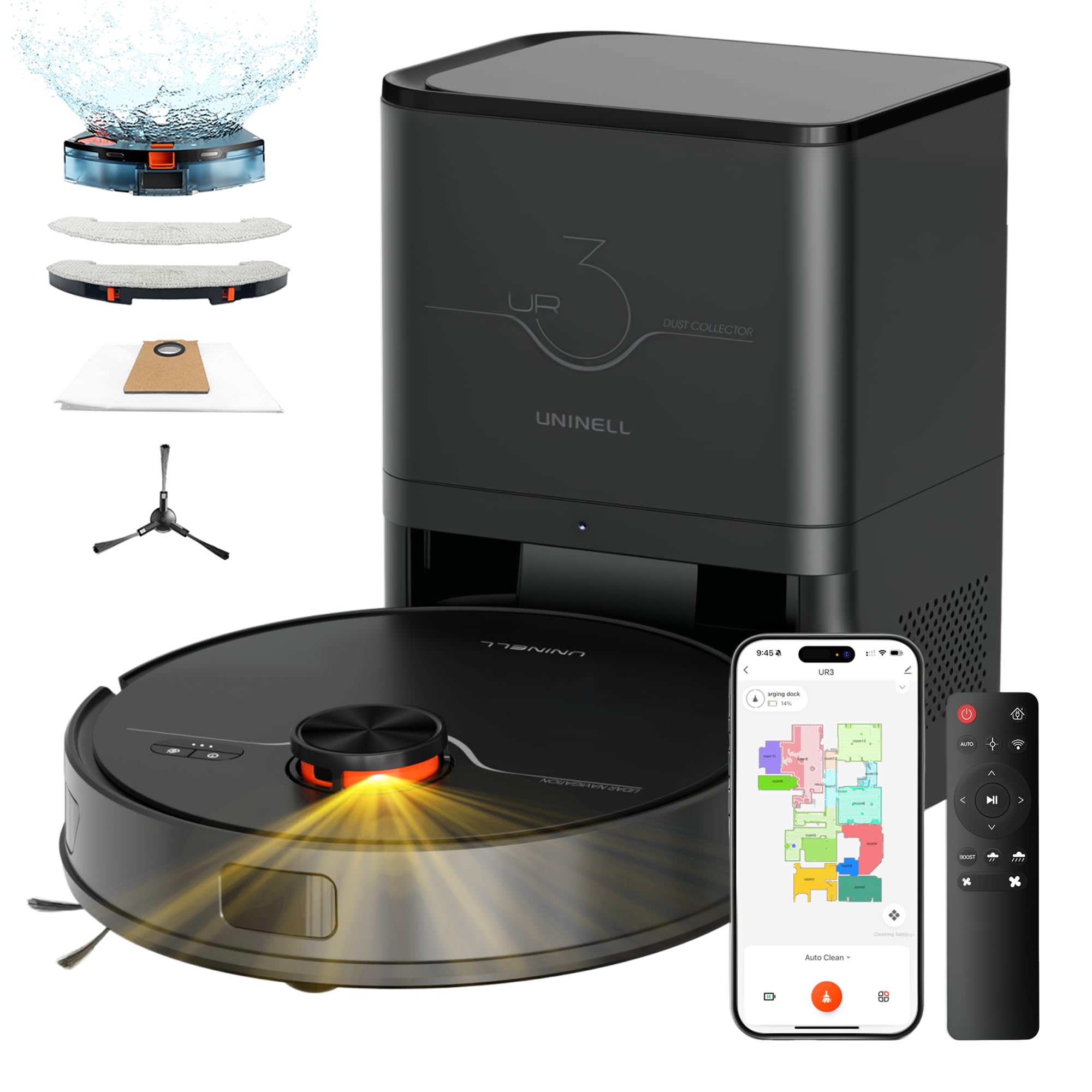
The uninell UR3 delivers 7,000Pa suction and a 3.5L self-emptying dock that stores up to 90 days of debris — the largest dust bag capacity in this whole list. The standout feature is a 180-minute battery runtime (30 minutes longer than most competitors at this price tier), which lets it cover up to 2,000 sq ft on a single charge without mid-cycle recharging. The 360° LiDAR navigation creates up to 5 multi-floor maps with no-go and no-mop zones, and the tangle-free roller brush is a bristle-and-rubber hybrid that reduces hair wrap compared to single-brush designs. The mopping system uses a flat pad with adjustable water flow (three levels) and recommends removing the mop holder or setting a no-mop zone when cleaning carpets.
The Auto-Carpet Boost technology detects when the robot transitions from hard floor to low-pile carpet and increases suction by 200% to extract embedded debris — a feature typically found on more expensive models. The maximum suction in boost mode is 7,000Pa, which is comparable to the DREAME L10s Pro Ultra but at a lower price point. The included remote control works alongside app and voice control (Alexa and Google Assistant), giving you three control paths. The robot measures 12.6” round and only 3.8” tall, fitting under most furniture.
The mop pad is a passive drag microfiber cloth — similar to Tapo and Tikom — so heavy scrubbing is not its strength. The water flow can be set to high, which produces enough moisture to trap dust but not so much that it leaves puddles on sealed hardwood. The 2-year warranty and lifetime technical support from uninell are better than the one-year coverage offered by many generic brands at this entry-level pricing. The foam/sponge filter is washable but less efficient than a true HEPA filter, so households with severe allergies should consider a unit with a certified HEPA seal.
Why we love it
- 180-minute battery covers 2,000 sq ft without recharging
- 3.5L self-emptying dock holds 90 days of debris — largest capacity
- 2-year warranty with lifetime technical support
Good to know
- Passive drag mop pad is not designed for scrubbing dried stains
- Foam filter is less effective than HEPA for allergen capture
FAQ
Can a robot mop replace my manual mop?
Do robot mops ruin area rugs and carpets?
How often do I need to refill the clean water tank on a robot mop?
What is the difference between a spinning mop pad and a sonic vibrating pad?
Final Thoughts: The Verdict
For most households, the best robot mop winner is the Roborock Q7 M5+ because it combines reliable LiDAR mapping, effective dual anti-tangle brushrolls, and a self-emptying dock at a price that undercuts premium competitors while still delivering real mopping utility. If you want spinning pad scrubbing and a base that automatically washes and dries the pads, grab the NARWAL Freo X10 Pro. And for massive homes with multiple room types and thick thresholds, nothing beats the DREAME L50 Ultra with its 6cm leg lift and 19,500Pa suction.