
The difference between a robot pet that becomes a child’s daily companion and one that sits abandoned in a corner after three days comes down to a single design choice: does it simulate genuine nurturing or just repeat canned movements? Most parents discover this distinction only after the disappointment has already set in.
I’m Mo Mahin — the founder and writer behind Furric. I’ve spent months cross-referencing product specifications, studying behavioral responses from thousands of verified owner testimonials, and mapping the technical gaps that define this specific pet-alternative category.
This guide isolates the three core performance vectors—responsive touch mechanics, battery stamina, and programmable action depth—that separate a fleeting toy from a genuine interactive companion. Use these criteria to confidently select the robot pet that sustains engagement long past the first hour of play.
How To Choose The Best Robot Pet
A robot pet is half hardware, half behavioral psychology — the best models trick a child’s brain into believing they are caring for a real creature. Three specs determine whether that illusion holds or shatters.
Touch-Response Precision
The most advanced models use capacitive or pressure-based head-touch sensors that trigger context-appropriate reactions — a stroke on the head produces a happy bark; a tap produces a different response. Cheaper units ignore touch entirely or register only a single binary on-off signal. Check whether the product description mentions multi-zone sensing or simple motion activation.
Battery Architecture
Built-in rechargeable lithium-ion packs (400 mAh or higher) allow for 60-90 minutes of continuous play and eliminate the ongoing cost of alkaline replacements. Units that rely on AA or AAA batteries drain quickly during heavy use — expect weekly replacements if a child plays for more than 30 minutes daily. The rechargeable path is almost always cheaper within six months of ownership.
Programmable Action Depth
The ability to chain 8-12 individual actions (forward, bark, sit, dance, handstand) into a custom sequence teaches sequencing logic and dramatically extends replay value. If the robot pet only responds to live remote inputs without memory, the interaction stays shallow. Look for a dedicated “program” button on the controller that lets the child record and later execute a routine.
Quick Comparison
On smaller screens, swipe sideways to see the full table.
| Model | Category | Best For | Key Spec | Amazon |
|---|---|---|---|---|
| FUUY Robot Dog | Head Touch | Most realistic interaction | Head-touch sensor + 400 mAh battery | Amazon |
| Lterfear Robot Dog | Programmable | STEM logic development | 20-function programming + dual batteries | Amazon |
| Koonie Realistic Puppy | Plush Role-Play | Toddler nurturing play | 9.8″ plush + 8 medical accessories | Amazon |
| Dwi Dowellin Robot Dog | Pink Design | Preschool music & story | Storytelling + nursery rhymes | Amazon |
| GOBRILLFUN Walking Puppy | Grooming Set | Pretend pet care routines | Walking + 6-piece grooming tools | Amazon |
In‑Depth Reviews
1. FUUY Robot Dog, Blue

The FUUY Robot Dog earns its position at the top of this list through a head-touch sensor that actually changes behavior based on where and how you pet it — stroke the head gently and it responds with a soft bark and a waist twist; a firmer tap triggers a different reaction. This multi-zone tactile feedback loop is exactly what keeps a child’s brain engaged beyond the initial novelty because the pet appears to “remember” who is interacting with it.
The 400 mAh rechargeable battery delivers roughly 60 minutes of continuous operation before needing a USB charge, and the unit includes five adjustable volume settings so parents can dial down the barking during quiet hours. Its programmable function lets you chain up to 12 movements — walk forward, spin, bark, dance — into a single routine that the dog will repeat on command, reinforcing sequencing logic without feeling like a classroom exercise.
At approximately 10 inches tall and constructed from glossy ABS plastic with smooth edges, the dog holds up to the drops and bumps of children aged three to seven. The only requirement is 2 AAA batteries for the remote control, which is a minor trade-off given the onboard lithium-ion pack handles the dog’s own power needs entirely.
Why we love it
- Head-touch sensing creates genuine pet-like feedback without needing a remote
- Onboard rechargeable battery eliminates ongoing alkaline costs
- Programmable routine builder supports logic development during play
Good to know
- Remote control requires 2 AAA batteries (not included)
- Plastic body may feel lighter than plush alternatives for some children
2. Lterfear Robot Dog, Red

The Lterfear Robot Dog packs more autonomous stunt variety than any other unit in this roundup — twenty separate actions accessible via remote control including handstands, push-ups, prone positions, and programmed dance sequences. That breadth means the dog can perform a different set of tricks each day without repeating, which is essential for maintaining the attention of older children in the five-to-ten age bracket.
A standout logistical advantage is the inclusion of two 3.7V rechargeable batteries in the box. While one charges via USB, the other keeps the dog operational, effectively eliminating downtime. The auto-shutdown feature triggers after five minutes of inactivity — signaled by three beeps — which preserves battery charge when play is interrupted. The remote control does require 2 AA batteries not included, but the robot itself runs entirely on the swappable packs.
From a STEM perspective, the programming function works as follows: press the program button, select up to 12 actions in sequence (say hello, dance, sit, handstand), then press program again. The dog executes the entire routine from memory. This teaches cause-and-effect sequencing more explicitly than toys that only respond to live remote inputs. The red finish and bulldog aesthetic give it a distinctly mechanical look that appeals to kids who prefer robots over plush animals.
Why we love it
- 20 distinct stunts including handstands and push-ups provide daily variety
- Dual rechargeable batteries mean zero wait time for charging
- Sequential programming function explicitly teaches action chaining logic
Good to know
- Remote control requires 2 AA batteries (not included)
- Smaller 4.7-inch body may feel less substantial to younger children
3. Koonie Realistic Robot Puppy

When the child’s primary need is a soft, huggable creature rather than a mechanical stunt machine, the Koonie Realistic Puppy fills that gap perfectly. Its 9.8-inch plush body is stuffed with soft fabric that invites cuddling, and the design revolves entirely around nurturing role-play — the set includes a feeding bottle, brush, stethoscope, food tray, syringe, thermometer, otoscope, and foot covers. This transforms play into a veterinary or grooming scenario that builds empathy and reduces fear of real doctor visits.
The interactive mechanics are triggered by props rather than buttons. Place the feeding bottle in the dog’s mouth and it barks and wags its tail. Stroke the brush across the back hair and it plays music. These cause-and-effect reactions are perfect for children aged two to five who may not yet grasp abstract remote control interfaces. The dog walks and barks on its own when turned on, but sustained interaction requires using the included accessories — this design forces active participation rather than passive observation.
Some owners report that after a few days the barking can become stuck on a loop until the main power switch is toggled off, which may require an adult to intervene. The unit operates on batteries (not rechargeable), so weekly replacement is typical with daily use. Despite these quirks, the plush construction and accessory-rich package make it the strongest choice for scenarios where softness and pretend caregiving matter more than programmable logic.
Why we love it
- Complete grooming and medical accessory set supports immersive role-play
- Prop-based triggers (bottle, brush) teach cause-and-effect naturally
- Soft plush body is safe for cuddling and gentle for toddlers
Good to know
- Barking can occasionally loop continuously until power is cycled
- Runs on disposable batteries; no rechargeable option included
4. Dwi Dowellin Robot Dog, Pink
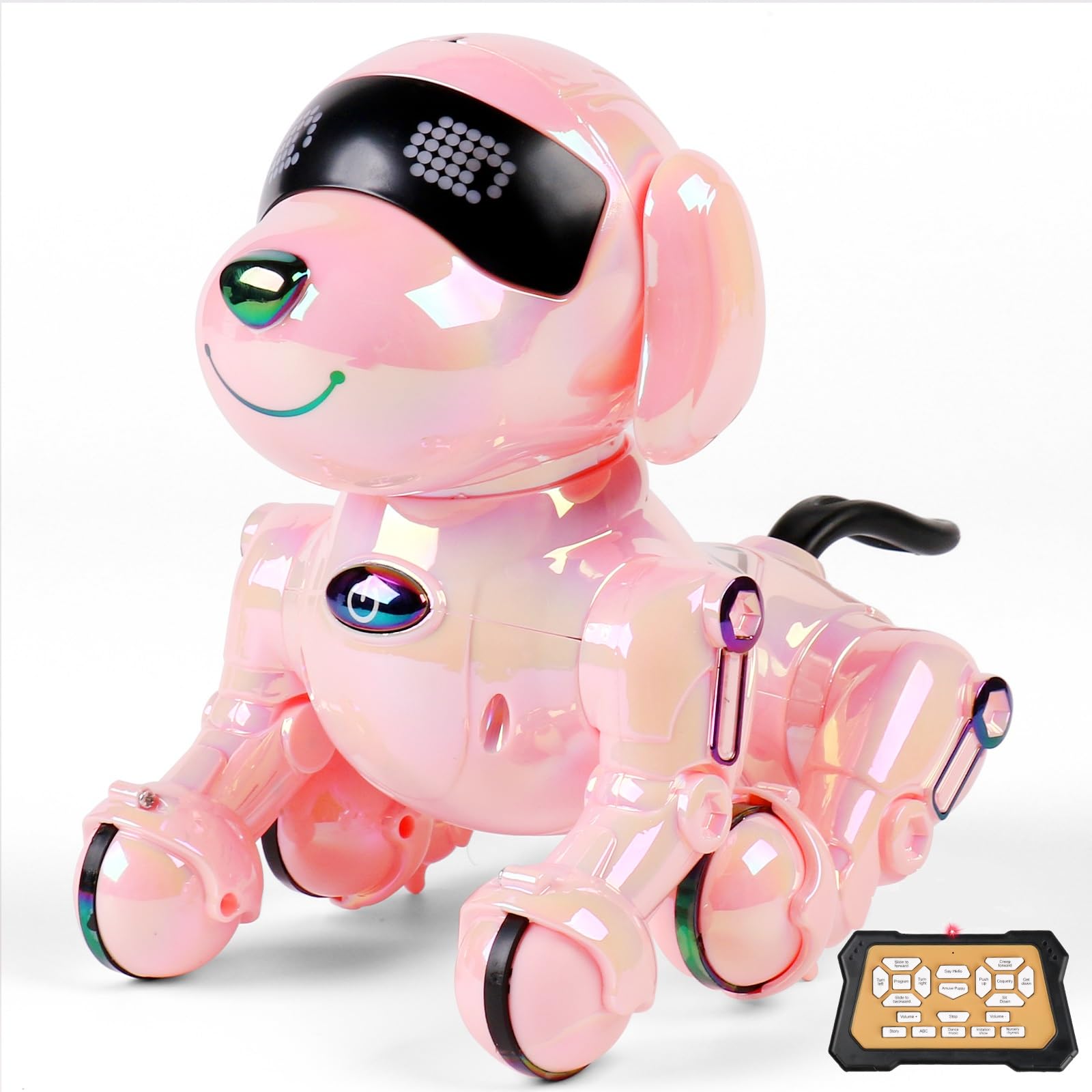
The Dwi Dowellin Robot Dog shifts the interactive focus from movement sequences to auditory engagement — it tells stories, sings nursery rhymes, and offers an English-teaching mode that makes it feel like a playful tutor rather than just a pet simulation. For parents who want the robot pet to double as early childhood educational support, this is the strongest candidate in the lineup.
Interaction centers on chin-touch triggers: stroke or tap the underside of the chin and the dog responds with a random mix of barks, wiggles, and sentences. This unpredictable response loop keeps younger children guessing, which delays the boredom curve compared to robots that produce the same sound every time. The remote control adds a programming key that lets children chain simple actions, though the library of pre-loaded stories and songs is the real draw here.
The 23.22-inch listed dimensions on the product sheet appear inflated — actual size is more compact — but the bright pink finish and smooth ABS surface appeal strongly to preschool-aged children. Battery operation requires fresh cells periodically, though multiple verified owners report the dog holds charge impressively across weeks of light daily use. The educational objective annotation states “early education and entertainment,” which accurately describes the dual-purpose positioning.
Why we love it
- Built-in story and nursery rhyme library supports early language exposure
- Chin-touch triggers produce unpredictable responses for sustained curiosity
- English-teaching mode adds educational value beyond pure entertainment
Good to know
- Listed dimensions may confuse buyers expecting a larger physical dog
- Requires batteries for operation; no rechargeable pack included
5. GOBRILLFUN Interactive Walking Plush Puppy

The GOBRILLFUN Walking Puppy is the most cost-conscious entry in this list, but it carves a clear niche with its grooming accessory set — shower gel bottle, comb, scissors, and soap — that lets children simulate bathing and brushing routines in a way no other robot pet here matches. The plush golden-furred dog measures 9.1 x 5.5 x 9.2 inches, making it large enough to feel like a real pet during walk-along play via the included leash.
Walking is triggered via a remote control, not autonomous movement — the child presses forward on the remote to make the legs shuffle forward in a slow, realistic gait. Barking and tail-wagging accompany the motion. The core educational objective is responsibility training: the child must remember to “feed” the dog, brush its coat, and take it on walks, which builds a sense of routine ownership. Verified owners consistently report that the battery life is surprisingly long — one household noted three months of intermittent play on a single set of cells.
Assembly is required out of the box (attaching the legs to the body), and the fabric surface can collect dust and lint more readily than plastic alternatives. The walking speed is deliberately slow, which adults may find underwhelming but toddlers perceive as appropriately paced. For families who want to test whether their child is ready for a real pet before committing, this unit provides the closest behavioral analogy at the lowest entry cost.
Why we love it
- Full grooming accessory set creates the most comprehensive pretend-care routine
- Long battery life reported across months of intermittent use
- Leash and walk feature simulates real dog-ownership behavior
Good to know
- Walking speed is intentionally slow, which may bore older children
- Fabric plush body collects dust and requires spot cleaning
FAQ
How long do robot pet batteries typically last per charge or set?
What age range is most appropriate for programmable robot pets?
Can robot pets help prepare a child for owning a real dog?
Final Thoughts: The Verdict
For most families, the best robot pet is the FUUY Robot Dog because its head-touch sensor creates the most lifelike feedback loop without requiring constant parent intervention. If you want programmable logic development for an older child, grab the Lterfear Robot Dog. And for a toddler who needs a soft, plush companion with a full grooming kit, nothing beats the Koonie Realistic Puppy.