
Tile floors reveal every speck, every crumb, and every dust bunny that dares drift across the grout lines. A robot vacuum built for this surface must navigate uneven transitions, avoid cliff-like rug edges, and deliver suction that pulls debris from the textured surface without scattering it. This guide cuts through the noise to find the units that actually respect tile.
I’m Mo Mahin — the founder and writer behind Furric. I’ve spent years studying market data, cross-referencing specification sheets, analyzing owner feedback across thousands of households, and tracking how suction power, navigation algorithms, and mopping systems perform specifically on hard, slick, and grouted flooring.
This analysis focuses exclusively on models engineered to handle the unique demands of ceramic, porcelain, and stone floors, presenting a curated selection of the best robot vacuum for tile floors across multiple value tiers and feature sets.
How To Choose The Best Robot Vacuum For Tile Floors
Tile presents a unique cleaning challenge: dirt sits in the rough texture of ceramic and in the recessed grout lines, debris scatters easily across the slick surface, and the cliff sensors that keep the robot from falling down stairs can mistake the reflection of polished tile for a drop-off. Knowing which specs compensate for these factors separates a machine that frustrates from one that delivers.
Suction Power and Grout Depth Cleaning
Tile floors look smooth, but the surface has micro-texture, and grout lines can be 2–5 mm deep. Suction below 4,000 Pa tends to skim dirt off the top rather than pull it out. Units with 6,000 Pa or more, especially those with a carpet boost that can be repurposed to high power on tile, ensure that fine dust hiding in grout gets extracted. The difference between a vacuum that leaves a faint trail of dirt behind a clean swath is almost always suction-related.
Navigation and Cliff Sensor Calibration
LiDAR-based mapping is the gold standard for tile homes. Those infrared or optical sensors on some budget models struggle with reflective tile surfaces — they can misinterpret a shiny floor as a cliff edge and stop abruptly, leaving half the room uncleaned. LiDAR lasers measure distance, not reflectivity, so the robot maps the entire tile layout without phantom cliffs. Look for models that also offer no-go zone setting in the app, so you can block areas with loose rugs or delicate tile borders.
Mopping System Design for Streak-Free Results
A stationary mopping pad dragged behind the vacuum can push debris across the tile and leave a wet smear. For tile, a system that uses a rotating roller mop constantly refreshed with clean water — or a vibrating pad with adjustable water flow — prevents the grime redistribution problem. The ability to set no-mop zones is crucial if you have porous unsealed tile, and hot water self-washing docks keep bacteria from building up on the pad during storage.
Self-Emptying Capacity for Multi-Room Runs
Tile homes often include the kitchen, hallway, and bathroom. Those rooms generate fine dust, hair, and food debris. A self-emptying base with a capacity of 2.5 liters or more means you can let the robot cover the whole living level for weeks without touching the bin. For households with pets that shed, look for a 3-liter or larger dust bag; it reduces maintenance frequency and prevents the small onboard bin from filling mid-run on a large tile area.
Quick Comparison
On smaller screens, swipe sideways to see the full table.
| Model | Category | Best For | Key Spec | Amazon |
|---|---|---|---|---|
| eufy E25 | Premium | Deep mopping on sealed tile | 20,000 Pa suction / Always-Clean roller mop | Amazon |
| roborock Qrevo Edge 2 | Premium | Ultra-low furniture clearance | 25,000 Pa suction / 3.14 in slim height | Amazon |
| DREAME L10s Pro Ultra Heat | Mid-Range | Hot water self-cleaning dock | 7,000 Pa suction / 136°F mop wash | Amazon |
| roborock Q7 M5+ | Mid-Range | Pet hair on tile and low-pile rugs | 10,000 Pa suction / Dual anti-tangle brushes | Amazon |
| DREAME D20 Plus | Mid-Range | Long auto-empty intervals | 13,000 Pa suction / 5L dust bag | Amazon |
| Shark Navigator AV2110S | Mid-Range | Bagless self-empty for pet dander | 120 min runtime / LiDAR row-by-row cleaning | Amazon |
| Tikom L8000 Plus | Budget | Affordable self-empty with mapping | 6,000 Pa suction / 3L dust bag | Amazon |
| uninell 7000Pa | Budget | Long runtime for large tile layouts | 7,000 Pa suction / 180 min battery | Amazon |
| Shark Navigator RV2120AE | Mid-Range | 60-day bagless self-emptying | Up to 50% more suction vs competitor / LiDAR | Amazon |
In‑Depth Reviews
1. eufy Robot Vacuum E25
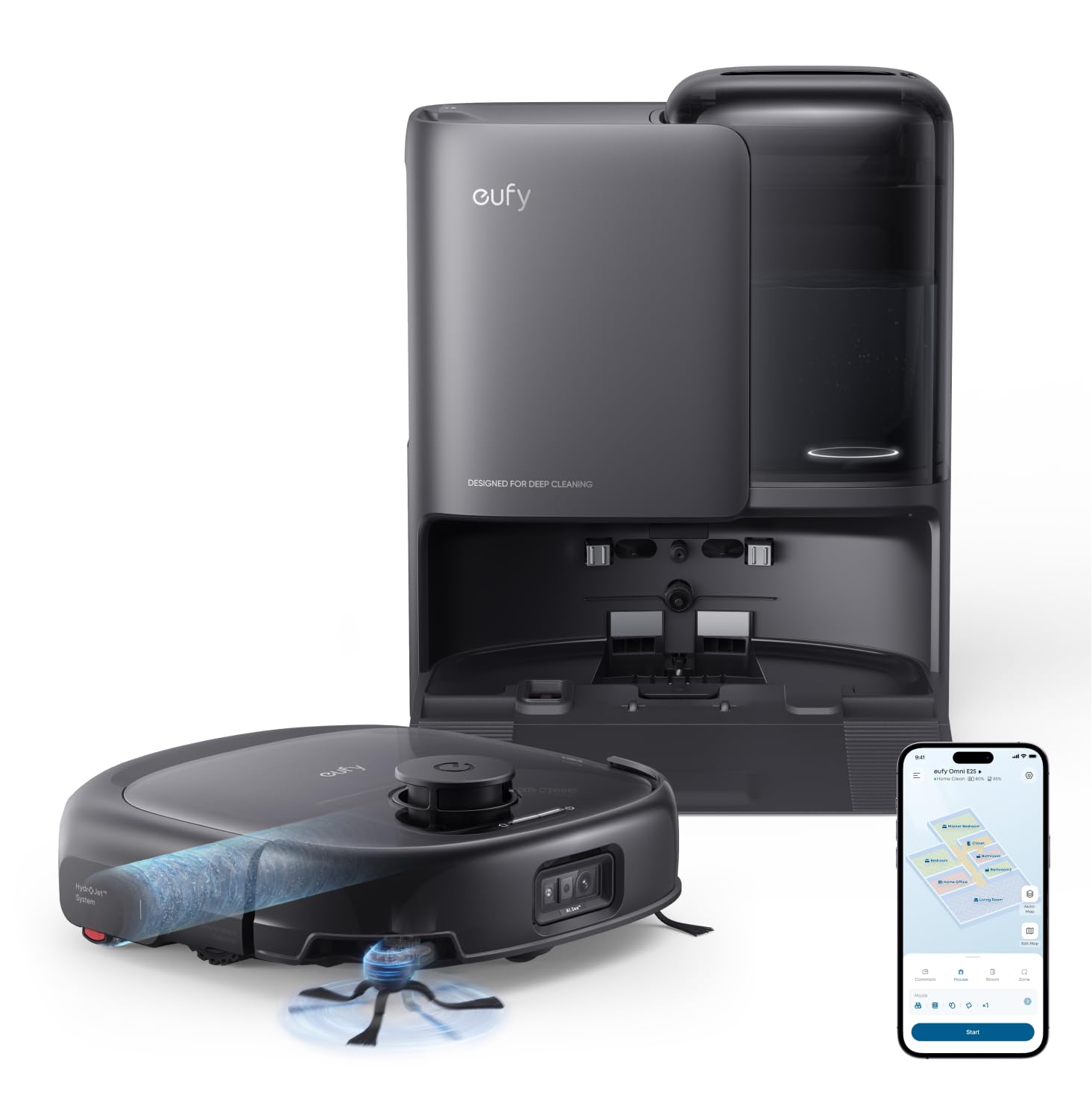
The eufy E25 is the only unit in this list that pairs 20,000 Pa suction with a HydroJet system that refreshes its roller mop twice per second with clean water. On tile, this prevents the common problem of dragging a dirty mop pad across the floor and leaving a film of grime. The mop roller scrubs grout lines and tile surfaces without the circular streaks that spinning pads produce.
Its CornerRover arm extends the roller into baseboard edges and furniture legs, a feature that matters on tile where dust collects along the wall line. The all-in-one station auto-empties the 3L dust bag, washes the mop with clean water, hot air dries it at 50°C, and refills the water tank. The 125-minute standard-mode runtime covers most single-level tile homes in a single session, and the ≤61 dB max-mode noise level means it runs during a video call without interrupting.
The AI obstacle recognition and LiDAR mapping produce accurate no-go zones for area rugs and pet feeding stations. Owners consistently rate it highly for dog hair pickup and quiet operation, though some note it occasionally tangles with rug tassels. For tile-heavy homes where mopping quality is as important as vacuuming, this model delivers the most complete hands-free process.
Why we love it
- Roller mop self-cleans with fresh water mid-run, avoiding cross-contamination on tile
- 20,000 Pa suction pulls dirt from grout channels and micro-texture
- CornerRover arm reaches the wall-tile edge where dust collects
Good to know
- All-in-one station is large; requires clear floor space for dock placement
- May snag low-hanging rug tassels on first passes
2. roborock Qrevo Edge 2
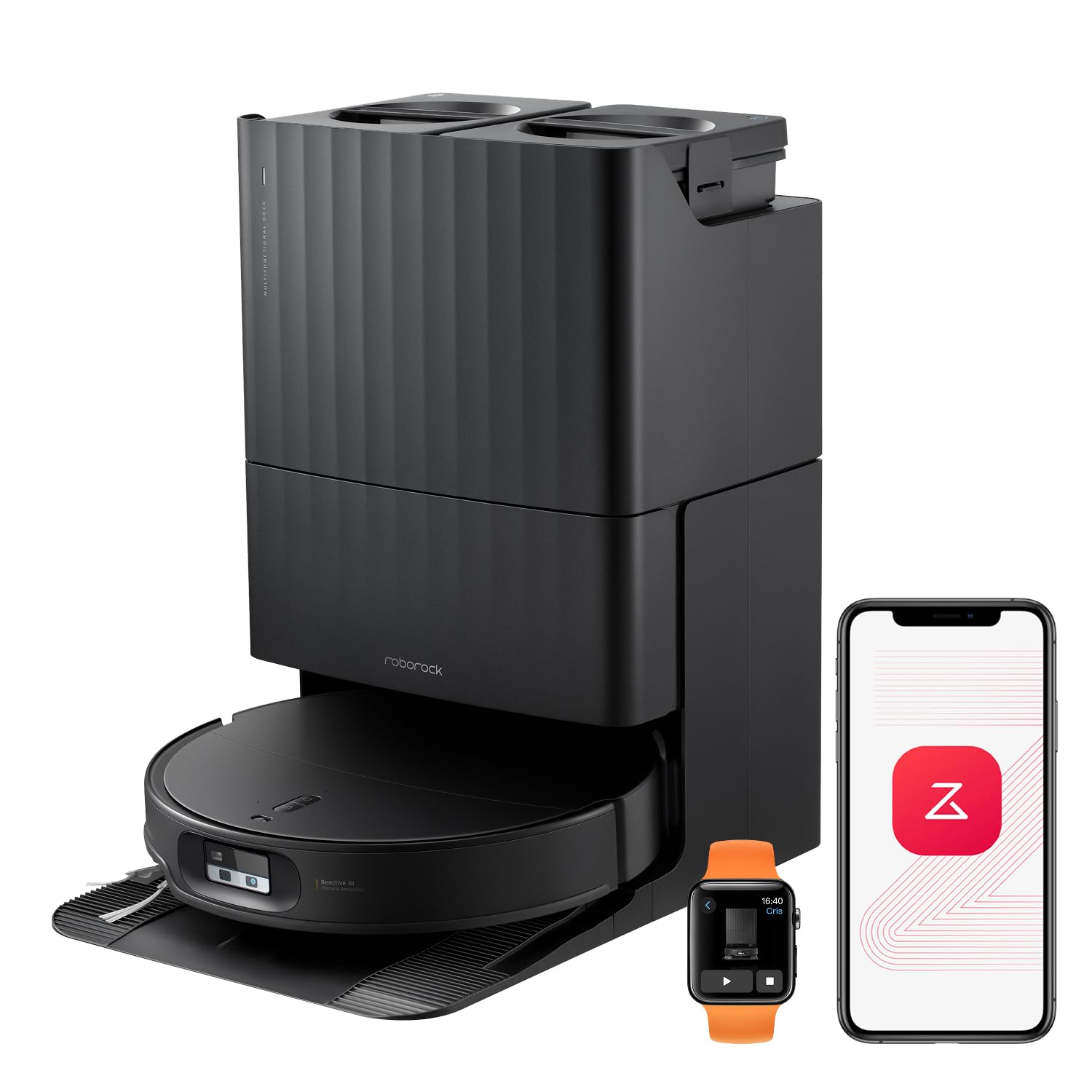
The Qrevo Edge 2 crams 25,000 Pa of suction into a 3.14-inch slim body, making it the only robot on this list that can slide under standard sofa bases and low-clearance bed frames on tile. Its RetractSense Navigation retracts the LDS tower when the robot detects a low overhead space, so it doesn’t get stuck mid-map under furniture that other LiDAR units would avoid entirely.
The FlexiArm side brush extends to scrub against baseboards and into corners — areas where tile dust accumulates and wand-style vacs cannot reach. The mopping system applies 8N of downward pressure to break up dried-on spills on tile, and the dock washes the mops with 176°F hot water, then dries them with 131°F air. The 65-day auto-empty capacity and 188-minute battery mean the robot can handle even large ground-level floors with tile throughout without depotting.
Reactive AI recognizes over 280 objection types, and the RGB-based dirt detection system triggers auto-remopping on tile zones that show heavy soiling. The dock features a detachable base for cleaning, which prevents hard-water mineral buildup from affecting performance on tile. Home Assistant integration is straightforward out of the box, a plus for tech-forward homeowners.
Why we love it
- Rare sub-4-inch profile fits under low furniture on tile floors
- Hot water mop wash and drying prevent odor and bacterial growth on pads
- FlexiArm side brush catches corner debris missed by other models
Good to know
- Premium pricing makes it an investment for multi-floor tile homes
- Larger than expected dock footprint requires dedicated wall space
3. DREAME L10s Pro Ultra Heat

The L10s Pro Ultra Heat differentiates itself with a 136°F hot water self-cleaning system for the mop pads, addressing a specific tile issue: after mopping a dirty kitchen or bathroom, the pad itself becomes a bacteria vector if not properly washed. The dock flushes it with heated water and then hot-air dries it, so the next mopping pass on clean tile starts with a fresh pad.
Its MopExtend technology pushes the mop pad out to reach edges and corners, filling the gap left by robots whose pad is fixed within the width of the chassis. The 7,000 Pa suction is moderate compared to premium peers, but the dirt detection algorithm compensates by automatically triggering a re-mopping pass on heavily soiled tile zones. The 220-minute battery is the longest in this roundup, covering expansive single-level tile layouts entirely on a single charge.
The 3D structured light obstacle avoidance skips cables and pet bowls on tile without collisions. Owners with cats and dogs report it handles litter and hair well on both tile and laminated surfaces. The dustbin lasts over two months between bag changes for typical households. One limitation: the dock’s cleaning bin cannot be removed for deep cleaning, so periodic manual wiping is required.
Why we love it
- Hot water mop self-cleaning keeps the pad hygienic for repeated tile mopping
- MopExtend reaches into corners and along baseboards
- 220-minute runtime cleans very large tile areas without recharging
Good to know
- Dock cleaning bin is fixed in place, requiring manual wiping inside the base
- Battery may not fully cover two-story homes on one charge
4. roborock Q7 M5+

The Q7 M5+ arrives with 10,000 Pa HyperForce suction, a step up from mid-range norms, and two anti-hair-wrap mechanisms: a JawScrapers main brush and a zero-hair-tangling side brush. On tile floors where pet hair collects along baseboards and under cabinet overhangs, these two features prevent the brush jam that stops many vacuums mid-run. The 2.7L sealed dust bag in the dock stores up to seven weeks of hair and debris without generating dust clouds during emptying.
The mopping system uses a vibration plate rather than a spinning pad or roller, and it offers three adjustable water flow levels. On sealed tile, this provides a consistent damp mop that doesn’t oversaturate the floor or leave puddles in grout lines. The PreciSense LiDAR mapping remembers up to five floor plans, making it useful for multi-level homes where tile is limited to the ground floor kitchen and entryway.
Battery life reaches 150 minutes in standard mode, and the robot returns to the dock, recharges, and resumes automatically if a large tile area requires multiple passes. Owners consistently praise the quiet motor and accurate mapping, though some note that the cliff sensors interpret dark-colored area rugs on tile as drop-offs, so setting no-go zones around them is essential.
Why we love it
- Dual anti-tangle brushes eliminate pet hair wrap on tile runs
- 10,000 Pa suction strong enough to lift hair from tile micro-texture
- Multi-floor map storage ideal for homes with tile only on certain levels
Good to know
- Cliff sensors can mistake dark rugs on tile for drop-offs
- Mop is a vibration plate — less aggressive on dried stains than roller systems
5. DREAME D20 Plus
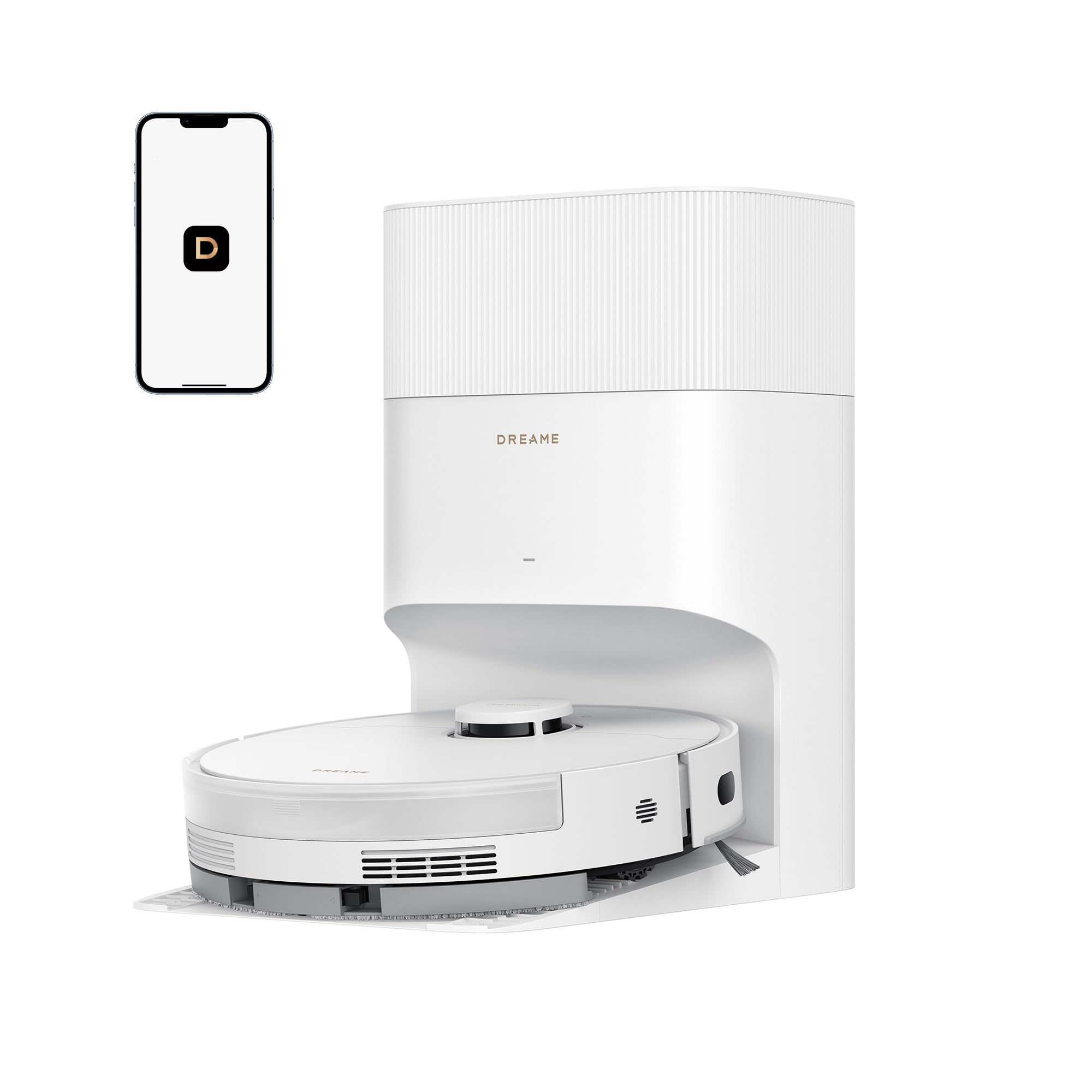
The D20 Plus stands out for its 5L dust bag — the largest in this comparison — which translates to roughly 150 days of hands-free emptying for a typical household. On tile where daily vacuuming is common due to visible dust, this means the bag needs changing roughly twice a year. The 13,000 Pa Vormax suction is more than sufficient to extract debris from grout, and the DuoBrush anti-tangle roller handles long hair without clogging.
The mopping system uses a 350ml water tank with 32 adjustable water levels, giving fine control over moisture output. On tile, selecting a lower water level prevents excess pooling while still picking up sticky spills. The Pathfinder mapping technology creates editable floor plans with no-go and no-mop zones, which is critical for rooms with porous, unsealed tile. The 180-minute battery covers large tile living zones in one session without needing a recharge pause.
App connectivity requires a 2.4GHz network — a common point of confusion for users who attempt setup on 5GHz. Some units have had charging dock alignment issues, but overall, owners report strong suction performance, quiet operation, and reliable daily cleaning on hardwood and tile that matches more expensive models.
Why we love it
- 5L dust bag reduces maintenance to twice per year for daily tile cleaning
- 13,000 Pa suction handles fine dust in grout without requiring max boost
- 32 water level adjustments let you dial in perfect mopping for tile
Good to know
- Setup requires 2.4GHz Wi-Fi; no 5GHz band support
- Some units have reported dock alignment issues during charging
6. Shark Navigator AV2110S
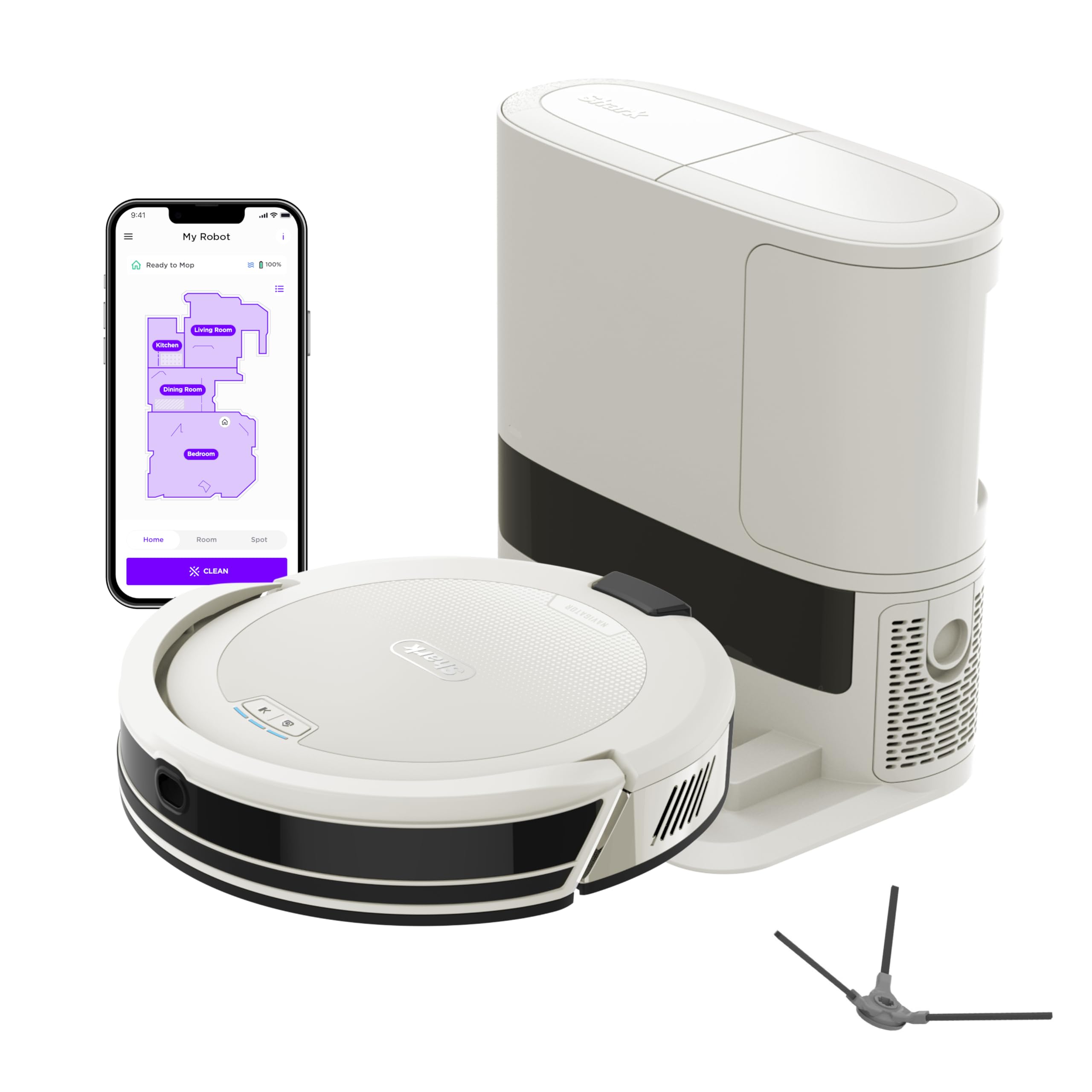
Shark’s Navigator AV2110S uses SmartPath LiDAR to clean tile in a methodical row-by-row pattern, and its bagless self-emptying base holds up to 30 days of debris without requiring proprietary disposal bags. The anti-hair wrap brushroll is designed to self-clean during operation, which prevents hair from accumulating on the roller during long tile hallway runs.
The suction power is strong enough for embedded dirt in tile, though Shark does not list a specific Pa rating — owner reports confirm it lifts pet hair and fine dust from hard floors effectively. The 120-minute battery covers modest tile layouts, and the recharge-and-resume function allows it to finish a large area in two segments. The robot detects and avoids objects on the floor, so you don’t need to pick up toys or shoes before a cleaning cycle on tile.
One recurring observation from owners: the unit excels on hard floors but struggles to transition onto any carpet type, from low-pile to shag. For homes where tile is the primary surface with few or no throw rugs, this is a non-issue. Replacement parts have been harder to locate than for Shark’s stick vac lineup.
Why we love it
- Bagless self-empty base eliminates ongoing cost of disposal bags
- Self-cleaning brushroll reduces maintenance on long hair households
- LiDAR navigation covers tiles methodically without random bouncing
Good to know
- Not designed for multi-surface homes with carpet rooms
- Replacement parts availability is inconsistent
7. Shark Navigator RV2120AE

The RV2120AE is the upgraded sibling of the AV2110S, delivering the same bagless self-empty design but with a 60-day capacity base and Shark’s claim of up to 50% more suction versus competitor robot vacuums. On tile, the increased suction ensures that fine dust trapped in the porous surface of unglazed ceramic and grout gets pulled out on the first pass.
It retains the same self-cleaning brushroll and SmartPath LiDAR navigation as the AV2110S, and the obstacle detection system adapts to daily changes — shoes left on tile, charging cables, and pet bowls — without requiring pre-cleaning. The 120-minute battery is identical to the base model, and the recharge-and-resume feature works seamlessly for larger tile layouts. The reusable dust bin in the base means zero recurring costs for disposable bags.
The strongest reports from owners highlight reliable performance on hard floors with no mapping errors, no clogging from pet hair, and a cleaning time of about one hour per 600 square feet. The major limitation is the same as the standard Navigator: poor carpet performance. If your tile floor is strictly tile without adjacent carpeted rooms, this model delivers excellent value and low ongoing maintenance.
Why we love it
- Bagless base with 60-day capacity means zero bag purchases
- Higher suction than many competitors, lifting deep grout dust
- Adaptive obstacle detection reduces pre-cleaning requirements
Good to know
- Struggles significantly on carpet — best for homes with almost all tile
- No mopping function, so tile spills may require manual attention
8. Tikom L8000 Plus
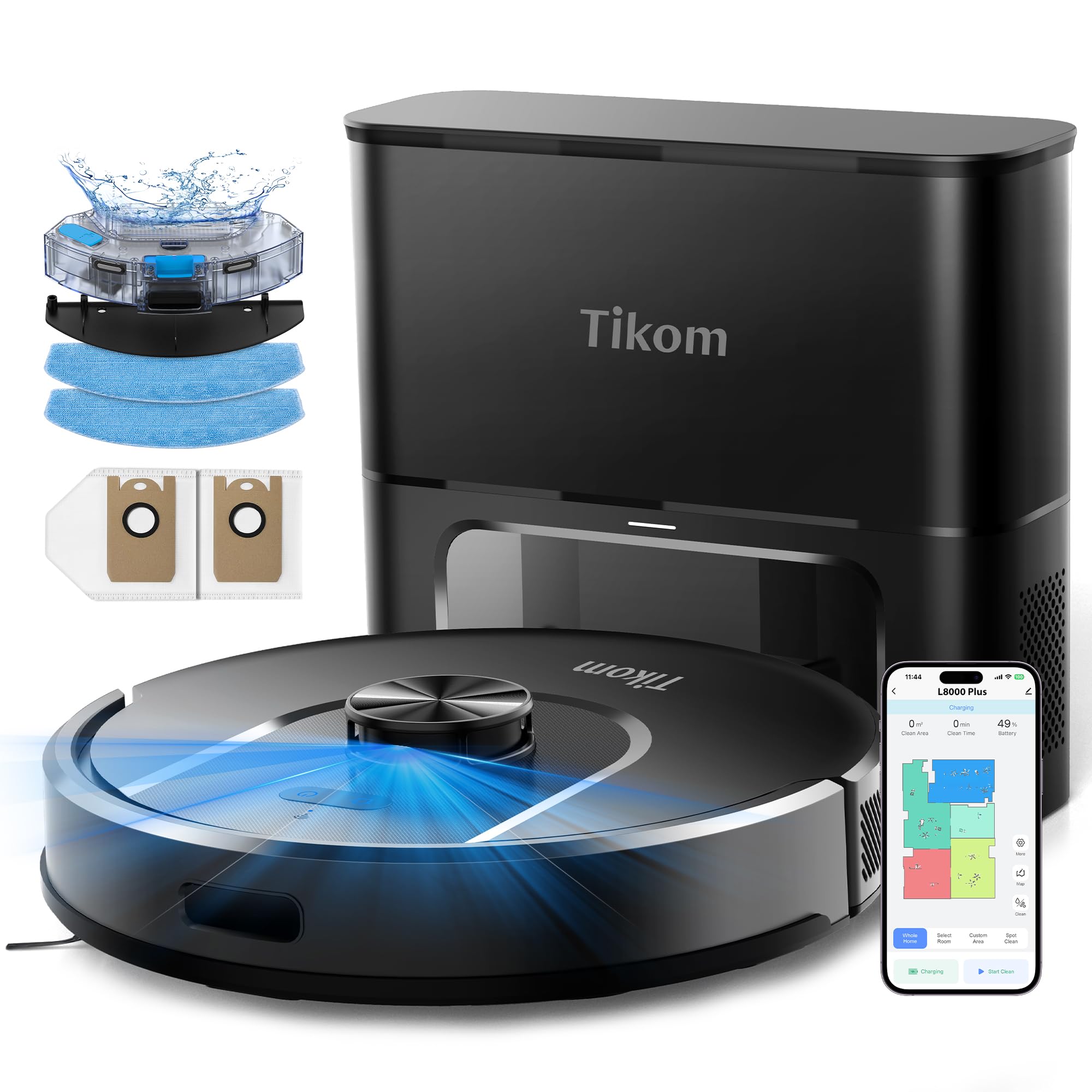
The Tikom L8000 Plus brings LiDAR mapping and a self-emptying base into a price tier where those two features rarely appear together. The 3L dust bag holds up to 90 days of debris, and the 6,000 Pa suction is adequate for tile floors, especially using the max mode that auto-engages on carpet areas. The 2-in-1 mopping system uses three water-level settings controlled through the app — essential for dialing in the right moisture for different tile finishes.
The 360° LiDAR navigation creates accurate maps with no-go and no-mop zones, up to five floor plans. The 150-minute battery in gentle mode covers most single-level homes, and the auto-recharge-resume ensures the robot completes the entire mapped area even on large tile layouts. The robot supports both 2.4GHz and 5GHz Wi-Fi, a rare convenience that eliminates setup frustration.
Owner feedback highlights the quiet operation, strong suction for dust and pet hair, and easy app scheduling. The mopping pad is a fixed damp cloth rather than a rotary system, so it’s best suited for light maintenance mopping between deep manual cleans. The cliff sensors work reliably on tile surfaces, and the obstacle avoidance handles furniture legs and baseboards well.
Why we love it
- LiDAR mapping and self-emptying base at low cost
- Dual-band Wi-Fi (2.4/5GHz) avoids setup issues
- 150-minute battery covers large tile areas without stopping
Good to know
- Fixed mop pad is light mopping only — not for scrubbing dried spills
- 6,000 Pa suction works fine on tile but won’t deep-extract embedded carpet dust
9. uninell 7000Pa Vacuum and Mop
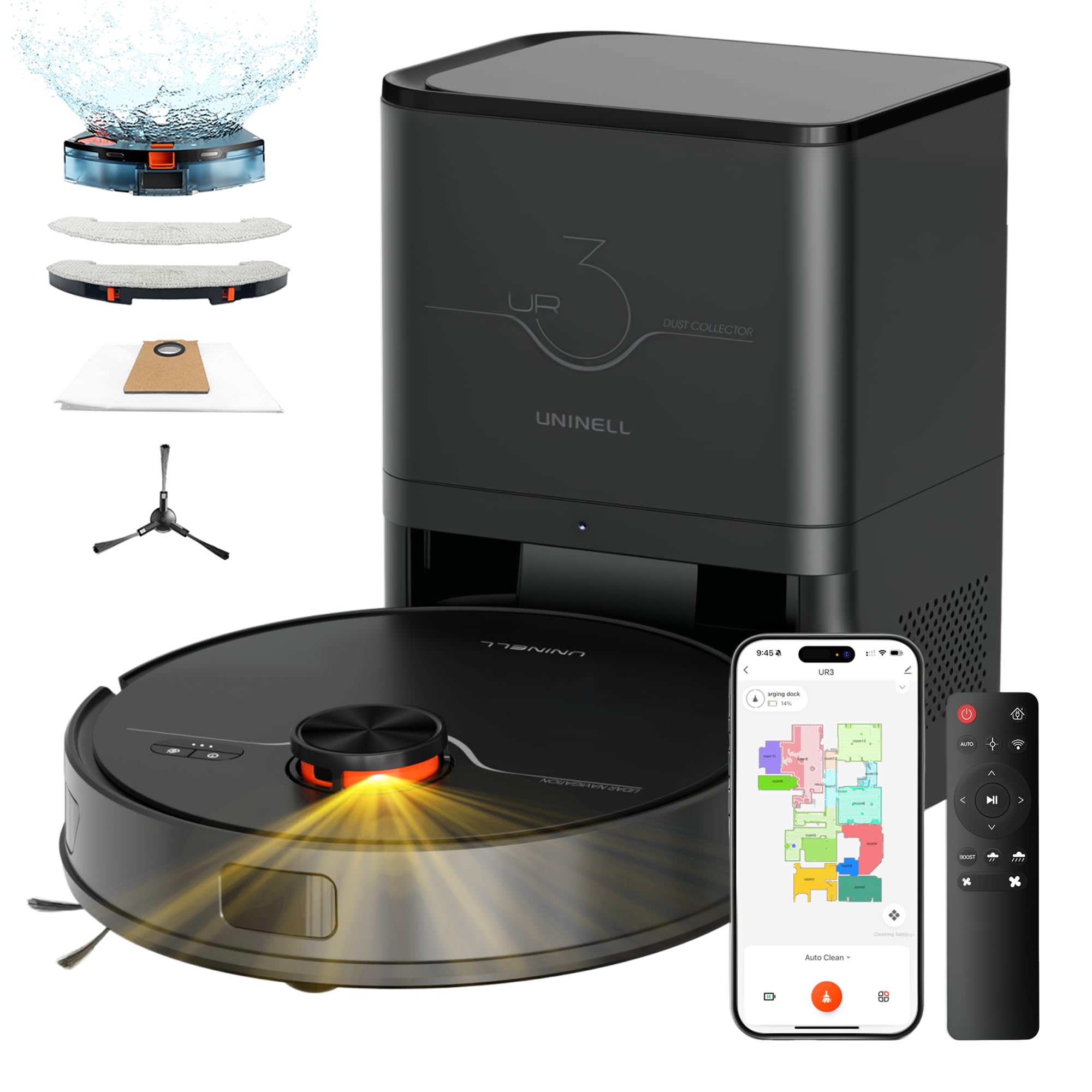
The uninell 7000Pa model offers the longest battery life in the budget tier at 180 minutes, enough to cover up to 2,000 square feet of tile on a single charge. The 3.5L self-emptying base stores up to 90 days of pet hair and debris, and the auto-carpet boost ramps suction when transitioning from tile to rug zones. The LiDAR laser mapping supports up to five floor maps and includes app-controlled no-go zones.
Its tangle-free brush design actively prevents hair wrap around the main roller, a common failure point on tile-run robots when pet hair accumulates. The dual control options — app and remote — make it accessible for users who prefer not to manage cleaning through a smartphone. The mopping system uses a stationary pad with water flow adjustment, which provides light damp wiping for daily tile maintenance rather than deep scrubbing.
Owners report that the unit handles dog and cat hair effectively on tile and carpet, and the self-emptying function is considered essential for low-touch daily use. Some note that the mop is merely a quick wipe — adequate for dust and light soil but not for sticky messes. The robot occasionally gets tangled in cords and low-hanging clothes, though obstacle detection avoids furniture and pet bowls reliably.
Why we love it
- 180-minute runtime covers very large tile homes on one charge
- Self-emptying 3.5L base requires emptying every 3 months
- Remote control included for users who skip app-based scheduling
Good to know
- Stationary mop pad is light wipe — not true scrubbing for dried stains
- May get tangled in cords and loose clothing on the floor
FAQ
Will a robot vacuum damage the glazed finish on my ceramic tile?
Why does my robot vacuum stop and refuse to move on light-colored tile?
Can a robot vacuum handle the transition from tile to a thick carpet in my living room?
Final Thoughts: The Verdict
For most tile-floor homes, the best robot vacuum for tile floors is the eufy E25 because it pairs the highest suction in its class with a self-refreshing roller mop that actually scrubs grout rather than pushing dirty water across the tile. If you need a robot that slides under low furniture on tile, grab the roborock Qrevo Edge 2 — its 3.14-inch height fits where others stop. For the best price-to-feature ratio with a giant dust bag, the DREAME D20 Plus offers 150 days of hands-free cleaning on tile with strong suction and precise flow control.