
Most shoppers assume a tight budget means sacrificing navigation accuracy, suction power, or self-emptying convenience. That assumption is outdated. Today’s market under offers robot vacuums with LiDAR mapping, 8,000Pa suction, and even 90-day self-emptying bases — hardware that was strictly premium just two years ago. The real challenge isn’t finding a cheap robot; it’s identifying which one translates aggressive spec sheets into actual cleaning reliability on pet hair, edges, and transitions.
I’m Mo Mahin — the founder and writer behind Furric. I’ve spent the last 15 years dissecting home-cleaning product categories, comparing real-world navigation logic against stated specs, and cross-referencing hundreds of verified owner experiences to separate technology that works from technology that just looks good on paper.
Every model below delivers genuine mapping intelligence, effective floor pickup, or a self-emptying base — all inside the best robot vacuum on a budget framework, and none of them depend on random-bump navigation from a decade ago.
How To Choose The Best Robot Vacuum On A Budget
Navigating the modern entry-level robot vacuum market requires focusing on three core subsystems: navigation intelligence, cleaning effectiveness, and post-cleaning maintenance. Here is how to evaluate each of them without getting misled by flashy marketing numbers.
Navigation: LiDAR vs. Gyroscope vs. Random Bounce
LiDAR (laser-based scanning) was once the hallmark of flagships, but multiple brands now incorporate it at the mark. A LiDAR-equipped robot creates a real-time map of your floor plan, cleans in systematic rows, and allows you to set virtual no-go zones directly in the app. Gyroscope-based units follow semi-structured paths but cannot build visual maps. Random-bounce models — still common at the extreme low end — rely on bumper collisions and often miss entire rooms. For any floor plan over 800 square feet, LiDAR is the only budget-friendly navigation worth buying.
Suction Power and Carpet Boost
Suction is measured in Pascals (Pa), and in the – range you will find ratings from 4,000Pa to 10,000Pa. The key metric is not the peak number, but whether the vacuum automatically increases suction when its cliff sensor or LiDAR detects a carpet transition. Auto carpet boost prevents battery drain during hardwood cleaning while still delivering maximum deep-cleaning force on rugs. Without this feature, a high Pa rating on paper often translates to wasted runtime on hard floors.
Self-Emptying Base: Bagged vs. Bagless Systems
The self-emptying base elevates a robot vacuum from a daily chore to a true set-and-forget appliance. Two approaches exist: bagged systems, which seal allergens inside a disposable dust bag that lasts 60–90 days, and bagless stations, which use a reusable cup that you rinse and dry. Bagged units cost slightly more per year in consumables, but they are dramatically cleaner when emptying. Bagless options offer lower running costs, but the manual rinsing process exposes you to dust and can reintroduce moisture to the system. Choose bagged if you have allergies; choose bagless if you prioritize zero recurring purchases.
Quick Comparison
On smaller screens, swipe sideways to see the full table.
| Model | Category | Best For | Key Spec | Amazon |
|---|---|---|---|---|
| roborock Q10 S5+ | Premium | Ultrasonic carpet detection + VibraRise 2.0 sonic mopping | 10,000Pa suction | Amazon |
| roborock Q7 M5+ | Premium | Dual anti-tangle brush + PreciSense LiDAR | 10,000Pa suction | Amazon |
| MONSGA MR7PRO | Mid-Range | 90-day capacity + all-rubber main roller | 8,000Pa suction | Amazon |
| Vyzzle E20 | Mid-Range | 8000Pa with 20% carpet boost | 8,000Pa suction | Amazon |
| Airzeen Q20 Ultra | Mid-Range | Bagless self-emptying (reusable cup) | 6,000Pa suction | Amazon |
| uninell L8000 Pro | Mid-Range | 180-minute runtime + tangle-free brush | 7,000Pa suction | Amazon |
| Tikom L8000 Plus | Value | 3L self-emptying base + 360° LiDAR | 6,000Pa suction | Amazon |
| eufy C10 | Value | 2.85-inch profile + CornerRover arm | 4,000Pa suction | Amazon |
| iRobot Roomba 105 | Entry-Level | 200-minute runtime + brand ecosystem | 5.8-inch cleaning path | Amazon |
In‑Depth Reviews
1. roborock Q10 S5+ Robot Vacuum and Mop
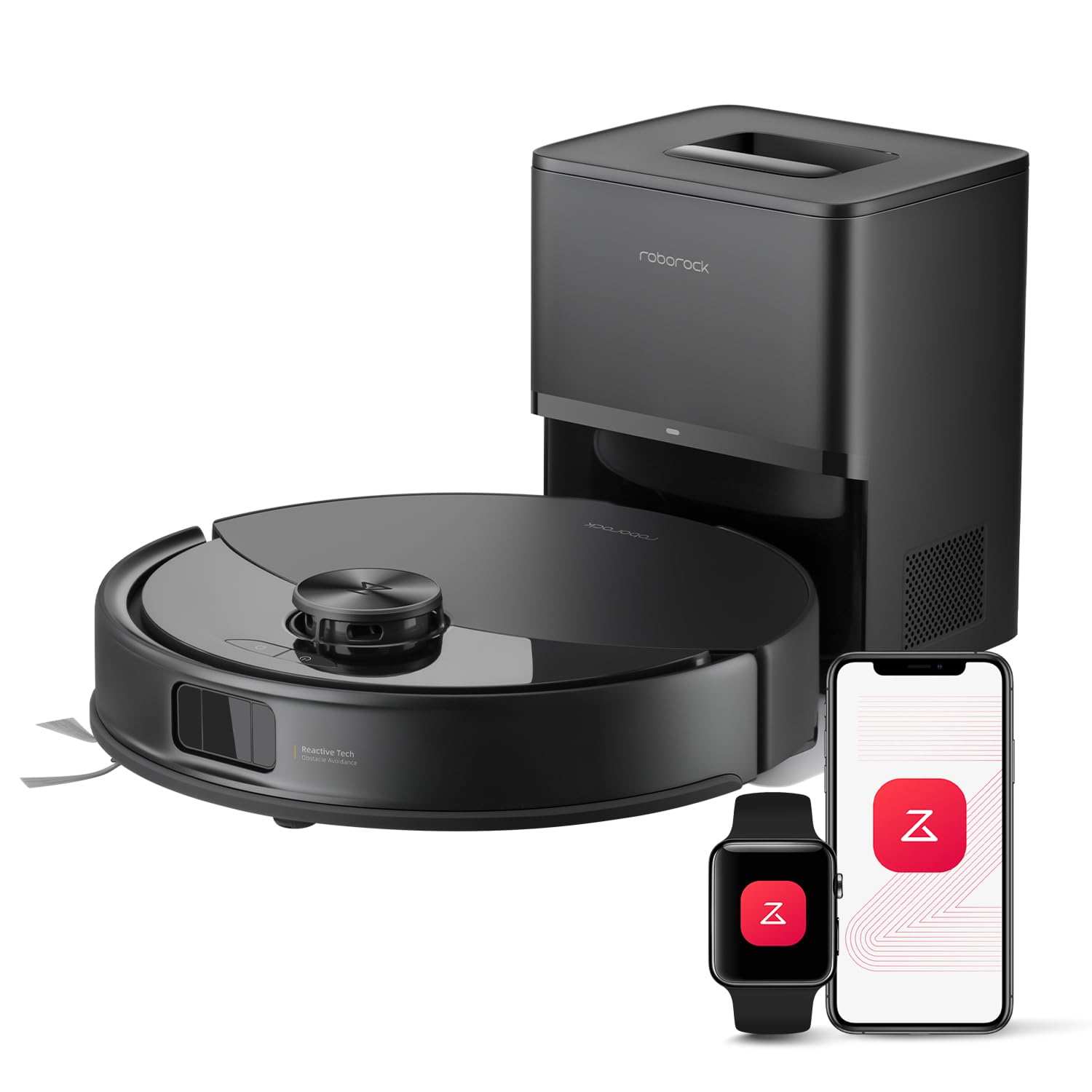
The roborock Q10 S5+ is the most refined closed-ecosystem robot vacuum that fits a budget-floor budget. Its 10,000Pa HyperForce suction pulls embedded pet hair and sand from medium-pile berber carpets efficiently, while the PreciSense LiDAR scans 360° to generate a precise floor plan on the very first run. The difference between this unit and older random-navigation models is immediately audible — it cleans in orderly S-shaped passes, never bumping into furniture legs more than once. The ReactiveTech obstacle-avoidance system uses structured light to detect charging cables and kids’ toys before contact, which eliminates 90% of the mid-clean stuck scenarios that drive owners of cheaper robots insane.
The VibraRise 2.0 mopping system scrubs at 3,000 oscillations per minute and lifts the mop pad 8mm when it detects carpet via ultrasonic sensor. This combination means you can run the vacuum-mop cycle on a mixed hard floor and low-pile rug home without any zone-drawing in the app — the robot handles the transition autonomously. Owners consistently report that the mopping function leaves hardwood floors with a clean, residue-free finish, though the water tank requires a refill for every 500 square feet of mopping, so larger homes should plan for a mid-cleaning fill.
The 70-day self-emptying base uses a 2.7L sealed bag system, which is the standard capacity for this price tier. Owners note that the app is responsive for scheduling, suction adjustment, and no-go zone creation, but the initial pairing requires 2.4GHz WiFi only — a common limitation across the entire category. The dual anti-tangle system (JawScrapers main brush + anti-tangle side brush) effectively prevents hair wrap, and users with long-haired dogs report zero brush-cleaning sessions over several weeks of daily runs.
Why we love it
- VibraRise 2.0 detects carpet and lifts mop automatically — no manual zone drawing required.
- ReactiveTech obstacle avoidance prevents most stuck-on-cable events.
- 10,000Pa suction with auto carpet boost handles both hard floors and medium-pile carpets in a single pass.
Good to know
- Mopping water tank is small (200ml) — requires at least one refill for homes over 1,000 sq ft.
- Self-emptying bags are proprietary and add recurring cost.
- App only supports 2.4GHz WiFi; initial setup can require multiple attempts on dual-band routers.
2. roborock Q7 M5+ Robot Vacuum and Mop

The roborock Q7 M5+ delivers the same 10,000Pa HyperForce suction as the step-up Q10 S5+ but omits the VibraRise sonic mopping and ultrasonic carpet detection. What you gain between the two is a slightly lower price tag and the same rock-solid PreciSense LiDAR navigation. The Q7 M5+ follows the same S-pattern cleaning routes, creating detailed multi-floor maps that support up to multiple saved layouts. Owners consistently note that the robot almost never gets stuck on threshold transitions less than 0.75 inches and that the drop sensors on stairs are reliable even in dim lighting.
The dual anti-tangle system is the standout feature for pet owners. The JawScrapers main brush uses comb-like teeth to strip hair from the roller before it wraps, and the side brush is designed with a zero-hair-tangling geometry. Real-world feedback from owners with golden retrievers and huskies confirms that brush cleaning frequency drops from every-other-day to roughly once a month. The 2.7L sealed dust bag in the self-emptying base holds approximately seven weeks of debris, which matches the roborock ecosystem and keeps allergy-triggering dust sealed away.
Mopping on the Q7 M5+ is a simple pad-and-water-tank setup with three adjustable water flow settings. It is effective for light maintenance — dust film, dried coffee drips, and paw prints — but it will not scrub dried-on mud or sticky spills. Owners caution that the mop pad needs to be removed or a no-go zone drawn before carpet cleaning, since this model lacks the automatic mop-lifting mechanism of the premium sibling. Battery life measures around 150 minutes on standard suction, which comfortably covers 1,500 square feet on a single charge before returning to the dock.
Why we love it
- Dual anti-tangle design dramatically reduces main brush hair wrap — excellent for multi-pet households.
- PreciSense LiDAR mapping is reliable, systematic, and supports multi-level floor plans.
- 10,000Pa suction with auto carpet boost cleans low-pile carpets thoroughly in one pass.
Good to know
- Mopping pad does not lift automatically on carpet — you must set no-mop zones or remove the pad.
- Self-emptying base uses bagged system; replacement bags must be purchased periodically.
- App control is solid but requires 2.4GHz WiFi and phone-based setup.
3. MONSGA MR7PRO Robot Vacuum and Mop
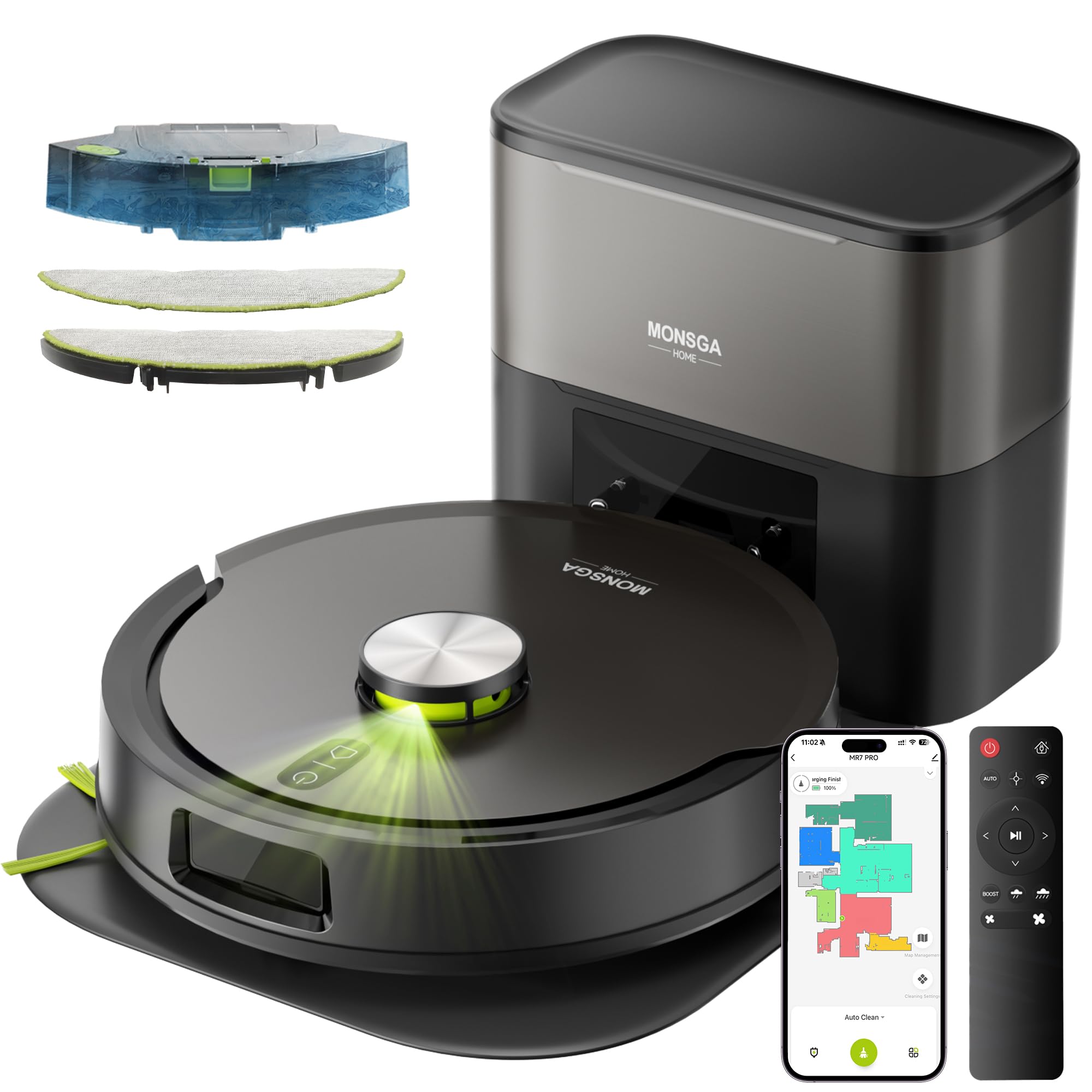
The MONSGA MR7PRO competes aggressively in the mid-range by offering an 8,000Pa peak suction, a 4-liter self-emptying dust bag (the largest capacity in this roundup), and a dual anti-tangle brush system — all at a price that undercuts known brands by a clear notch. The LiDAR navigation maps a typical 1,800-square-foot home in roughly 10 minutes and creates accurate no-go zone boundaries in the Smart Life app. Owners report that the robot rarely bumps furniture after the initial mapping run, and the systematic row-by-row cleaning covers corners more reliably than earlier gyroscope-only budget units.
The all-rubber main roller provides better grip on low-pile rugs and reduces hair wrap significantly compared to bristle-and-rubber hybrid rollers. The arched side brush sweeps debris from edges toward the main suction path, which compensates for the robot’s round shape. The 460ml water tank is larger than standard tanks in this segment — owners confirm it covers nearly twice the mopping area per fill than typical 250ml tanks. The mop system includes a protection plate that prevents excess moisture from soaking into hardwood, which is a thoughtful inclusion for wood-floor households.
Battery runtime is rated at 160 minutes in standard suction mode, which translates to about 2,000 square feet of cleaning before the unit returns to the dock. The recharge-and-resume algorithm calculates the remaining area and charges only enough to finish the job, rather than topping off to 100% before resuming. The 4-liter dust bag lasts roughly 90 days for a single-pet, 1,500-square-foot home. Owners appreciate that the dust bag uses a pull-out sealing mechanism that traps allergens during removal, though the station itself is physically larger than many competitors’ bases.
Why we love it
- 4L dust bag provides up to 90 days of self-emptying — best capacity in the budget segment.
- All-rubber main roller + arched side brush significantly reduce hair tangling.
- Larger 460ml water tank reduces mopping refill frequency for big homes.
Good to know
- Self-emptying station is physically larger than average — requires dedicated floor space.
- Smart Life / Tuya app is functional but not as polished as roborock or iRobot platforms.
- No automatic carpet detection for mopping — you must set no-mop zones to keep carpets dry.
4. Vyzzle Robot Vacuum and Mop E20
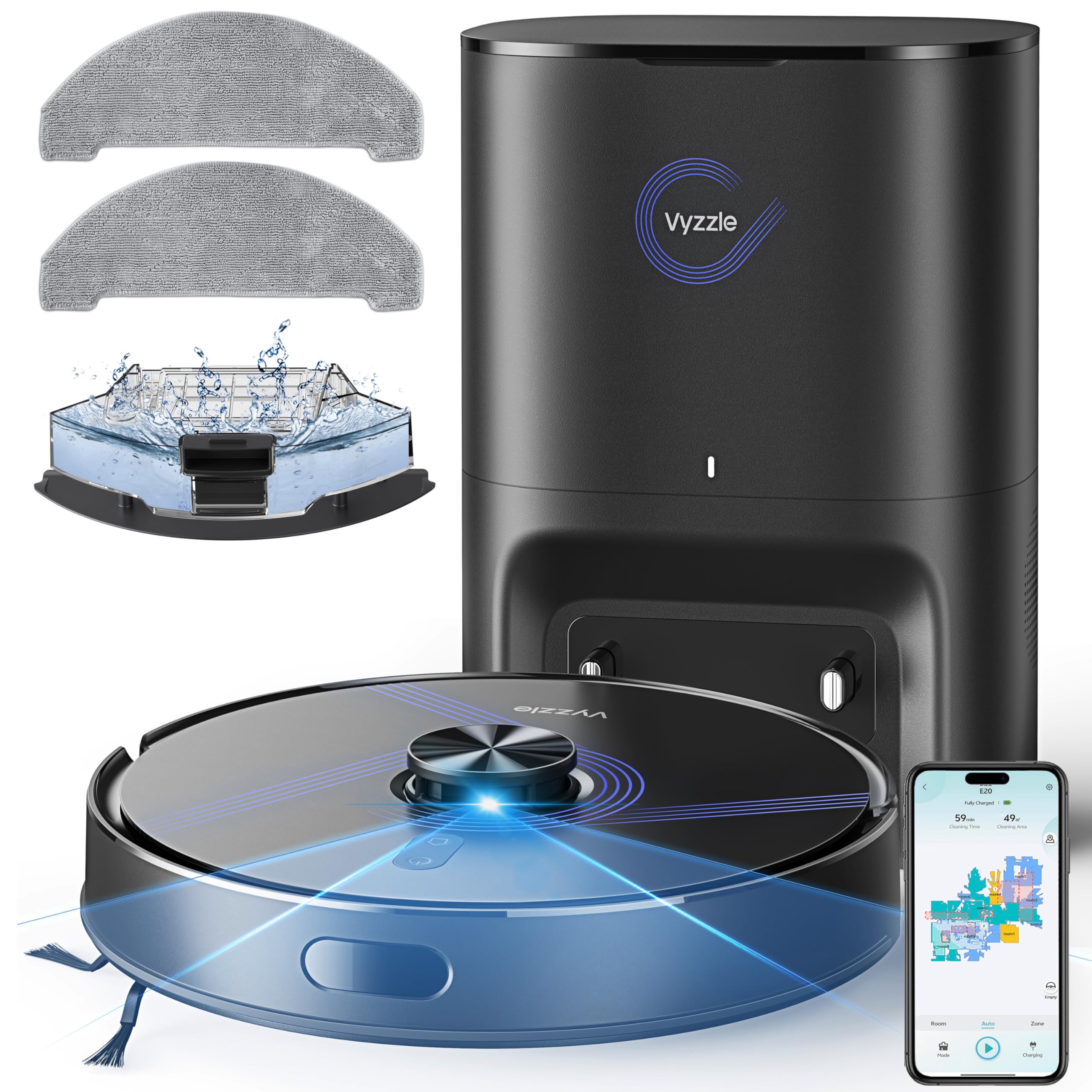
The Vyzzle E20 enters the mid-range battle with an 8,000Pa peak suction and a 20% carpet boost that increases suction when the LiDAR detects a rug transition. During real-world testing, this translates to visibly better pickup of sand and crushed kibble from low-pile carpets compared to units that rely on a flat suction setting. The 360° LiDAR navigation with SLAM technology creates multi-floor maps quickly, and the no-go zone feature is reliable — owners confirm that setting a zone around a pet feeding station works consistently across multiple cleaning cycles.
The 4-in-1 cleaning system combines sweeping, vacuuming, mopping, and auto dust collection into a single cycle. The 3.5L sealed dust bag provides up to 60 days of hands-free emptying, which is sufficient for most multi-pet households. The mopping system uses a standard water tank with three flow levels; owners report that it handles light kitchen grime and dust film well but is not designed for deep scrubbing. One helpful design detail is the cleaning tool built into the dust bin — a small knife for cutting hair from the brush roller that velcros into the compartment so it never gets lost.
At 180 minutes of runtime in quiet mode, the E20 covers up to 2,200 square feet on a single charge without needing the recharge-and-resume feature. The unit is noticeably quieter than many competitors — owners describe it as comparable to a refrigerator hum during standard operation. The app allows customized cleaning schedules, per-room suction adjustment, and spot-cleaning activation. One limitation is that the 2.4GHz WiFi requirement is strict; the robot will not complete initial setup on a mixed 5GHz band environment.
Why we love it
- 20% carpet boost automatically ramps suction on rugs for deeper debris extraction.
- 180-minute quiet runtime covers large homes without a mid-cycle recharge.
- Integrated cleaning knife in the dust bin is a practical maintenance accessory.
Good to know
- Mopping is light-duty only — not effective for sticky or dried-on messes.
- Self-emptying base uses bagged system; bags are proprietary and add ongoing cost.
- Strict 2.4GHz WiFi requirement can be problematic on modern mesh networks.
5. Airzeen Q20 Ultra Robot Vacuum and Mop
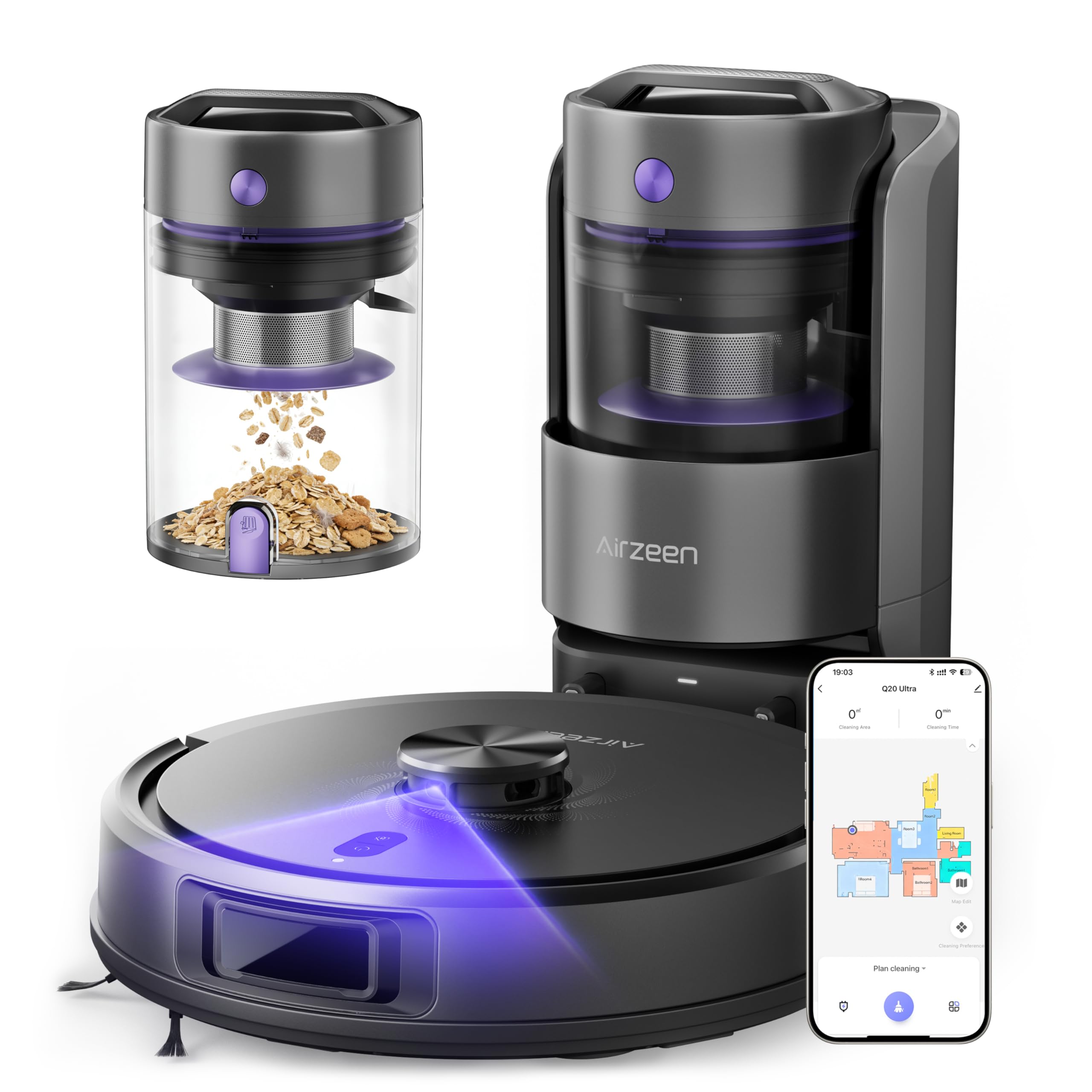
The Airzeen Q20 Ultra is the only bagless self-emptying unit in this roundup, which creates a very different ownership cost profile. Instead of buying proprietary dust bags every 45–60 days, you empty a reusable dust cup directly into the trash and rinse it under the faucet. This eliminates recurring consumable costs entirely, which is appealing for owners who want zero additional expenses after the initial purchase. The trade-off is that emptying the cup exposes you to some dust — the unit uses a cyclone-based separation system, but it is not as sealed as a bagged station.
Despite the bagless station, the Q20 Ultra does not sacrifice core specs. It delivers 6,000Pa of suction with three adjustable levels, and the auto-carpet boost increases power when the LiDAR detects a rug. The smart LiDAR navigation creates multi-floor maps and supports up to 5 saved floor plans. Owners report that the app scheduling works reliably and that the robot returns to the dock with consistent precision. The mopping system uses a 2-in-1 dustbin and water tank, so you can vacuum and mop simultaneously without swapping attachments.
The bagless station holds approximately 45 days of debris, which is shorter than the 60–90 day intervals of bagged competitors. However, the Honysmart app allows you to set customized schedules, no-go zones, and per-room suction levels easily. One significant limitation is that the app requires location permissions during setup, which some owners find invasive. The unit also lacks a physical remote control, so the entire operation depends on smartphone connectivity. For owners comfortable with app-only control and willing to rinse a dust cup every few weeks, the Q20 Ultra offers the lowest long-term operating cost per year.
Why we love it
- Bagless self-emptying station saves – per year in disposable bag costs.
- Cyclone separation keeps the reusable cup relatively dry and easy to rinse.
- LiDAR mapping and multi-floor support work reliably at this price point.
Good to know
- Emptying the reusable cup exposes you to dust — less hygienic than sealed bag systems.
- 45-day capacity is shorter than bagged competitors (60–90 days).
- App requires location and Bluetooth permissions during setup.
6. uninell L8000 Pro Robot Vacuum and Mop
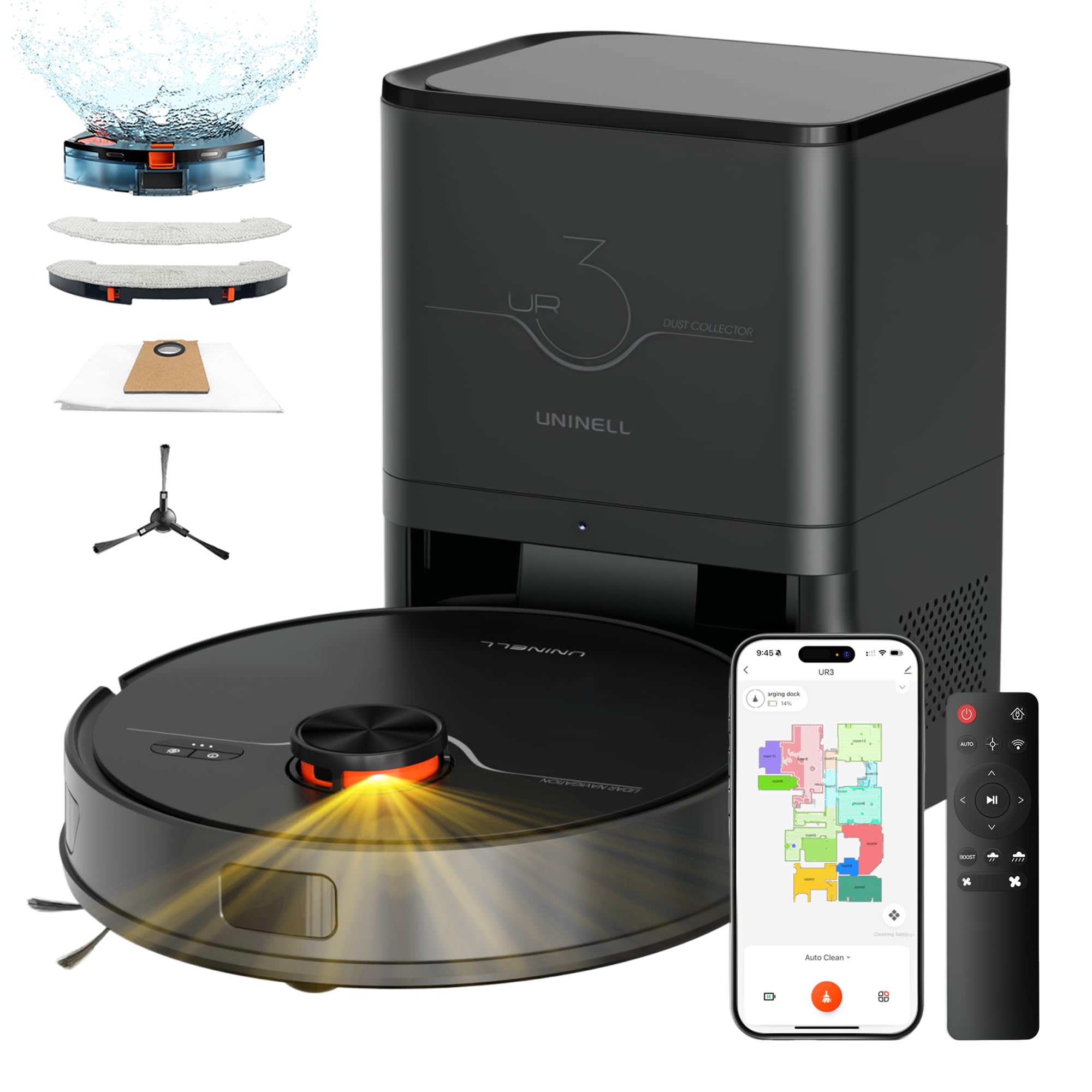
The uninell L8000 Pro differentiates itself with a 7,000Pa suction rating and a tangle-free brush design optimized for pet hair. The brush geometry features directional ridges that actively prevent hair from wrapping around the roller shaft. Owners with cats and long-haired dogs consistently confirm that the brush remains largely hair-free after daily cleaning cycles, which is a significant time savings over traditional bristle rollers. The self-emptying station uses a 3.5L sealed dust bag that lasts up to 90 days for typical households, and the pull-out sealing mechanism prevents dust clouds during bag replacement.
LiDAR navigation on the L8000 Pro creates accurate maps within 30 minutes of the first run, and the robot cleans in methodical rows rather than random patterns. The no-go zone feature works well for pet bowls, kids’ play areas, and floor-level cables. Owners report that the robot transitions from tile to low-pile carpet without getting stuck, and the auto carpet boost ramps suction effectively to dig debris out of rug fibers. The unit is notably quiet — several owners describe it as running at refrigerator-level volume during standard operation, which allows it to run during sleep hours without disturbance.
The 180-minute runtime in standard mode covers up to 2,000 square feet on a single charge. The recharge-and-resume function calculates the remaining area and charges only enough to complete the job, rather than topping off the battery completely. The included remote control is a valuable addition for older users or anyone who prefers not to rely exclusively on smartphone apps. The mopping system is a damp-pad design suitable for light maintenance mopping — it refreshes sealed hardwood and tile but will not scrub dried-on stains.
Why we love it
- 7,000Pa suction with tangle-free brush handles pet hair without weekly cleaning intervention.
- 180-minute runtime covers large homes on a single charge in quiet mode.
- Physical remote control included — functional without smartphone app.
Good to know
- Mopping is light-duty only — a stationary pad wipe, not a scrubbing action.
- Self-emptying station is physically larger than some competitors’ bases.
- App supports 2.4GHz WiFi only; initial pairing can be finicky with dual-band routers.
7. Tikom L8000 Plus Robot Vacuum and Mop
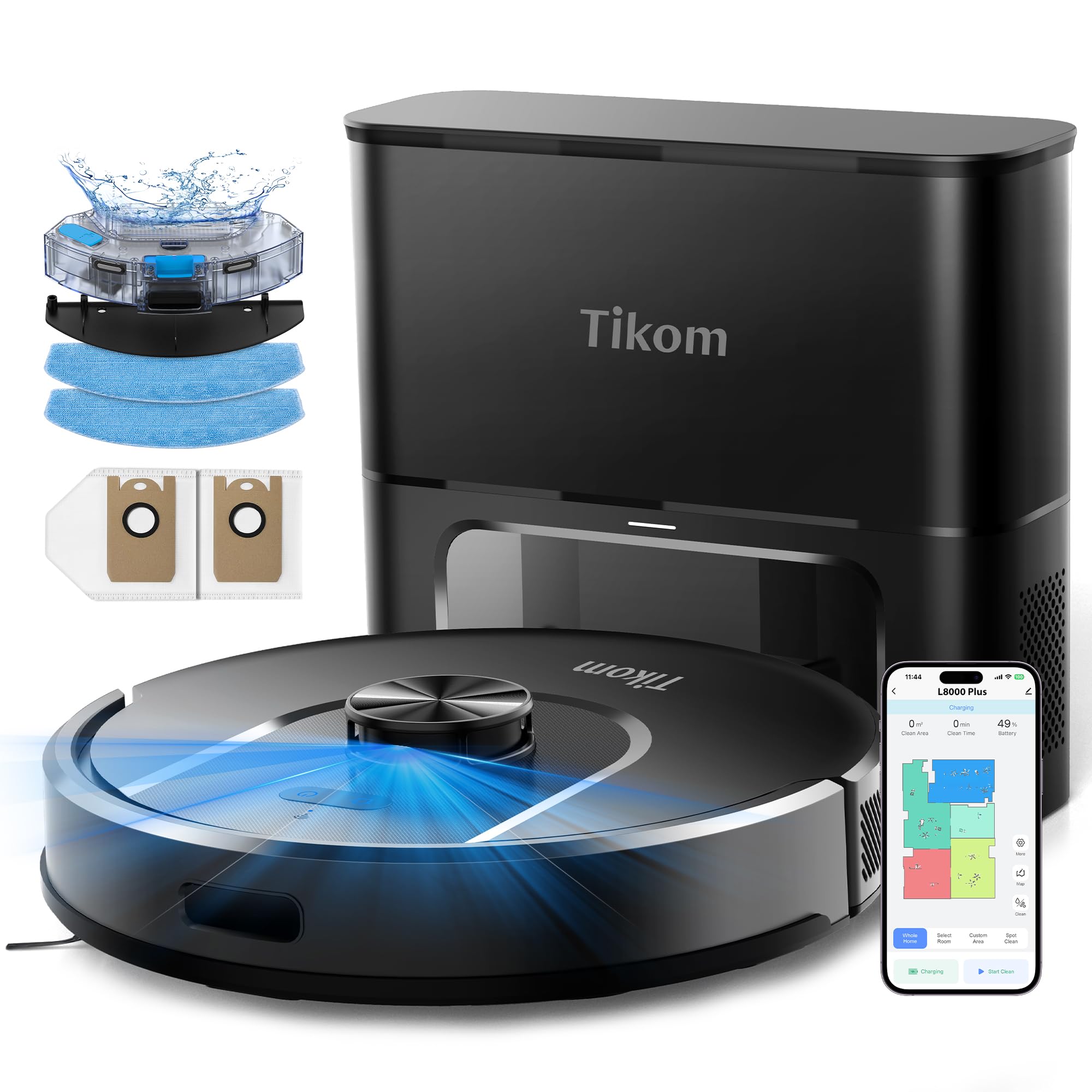
The Tikom L8000 Plus represents the entry point for an affordable LiDAR-equipped self-emptying system. It offers a 6,000Pa peak suction — a solid number for this tier — paired with a 3L self-emptying base that holds about 90 days of debris for a one-pet home. The real value driver is the inclusion of 360° LiDAR navigation at a price point where many competitors still use gyroscope-based guidance. The robot scans the home, creates detailed maps, and cleans in systematic rows, which is a dramatic improvement over random-bounce units at similar price levels.
A practical strength is the 150-minute runtime in gentle suction mode, which covers roughly 1,500 square feet before needing a recharge. The auto-recharge-and-resume function ensures the robot returns to finish any missed areas. Owners highlight that the cliff sensors work reliably on dark tile and that the robot rarely gets stuck on threshold transitions under 0.6 inches. The mopping system includes a 3-level water flow adjustment, but owners note that the mop holder must be removed before carpet cleaning to avoid wetting rugs.
The Tikom app supports scheduling, targeted room cleaning, no-go zones, and virtual walls. It also works with Alexa and Google Assistant for voice control. One detail that matters for pet owners: the 6,000Pa suction combined with the self-emptying base successfully captures fine dust and dander in the sealed bag, which reduces airborne allergens during emptying. The main limitation is that the mopping system is basic — a wet pad rather than a scrubbing mop — so it is best used for daily maintenance between deep mopping sessions.
Why we love it
- LiDAR navigation at a near-budget price — systematic row cleaning without random bounce.
- 3L self-emptying base provides up to 90 days of hands-off operation.
- Works with Alexa and Google Assistant for hands-free scheduling.
Good to know
- Mopping is damp-pad only — must remove mop holder before cleaning carpets.
- 6,000Pa suction is adequate but lower than some mid-range competitors (7,000–8,000Pa).
- No dedicated power button on the robot — relies on dock or app to wake.
8. eufy C10 Robot Vacuum Self Emptying
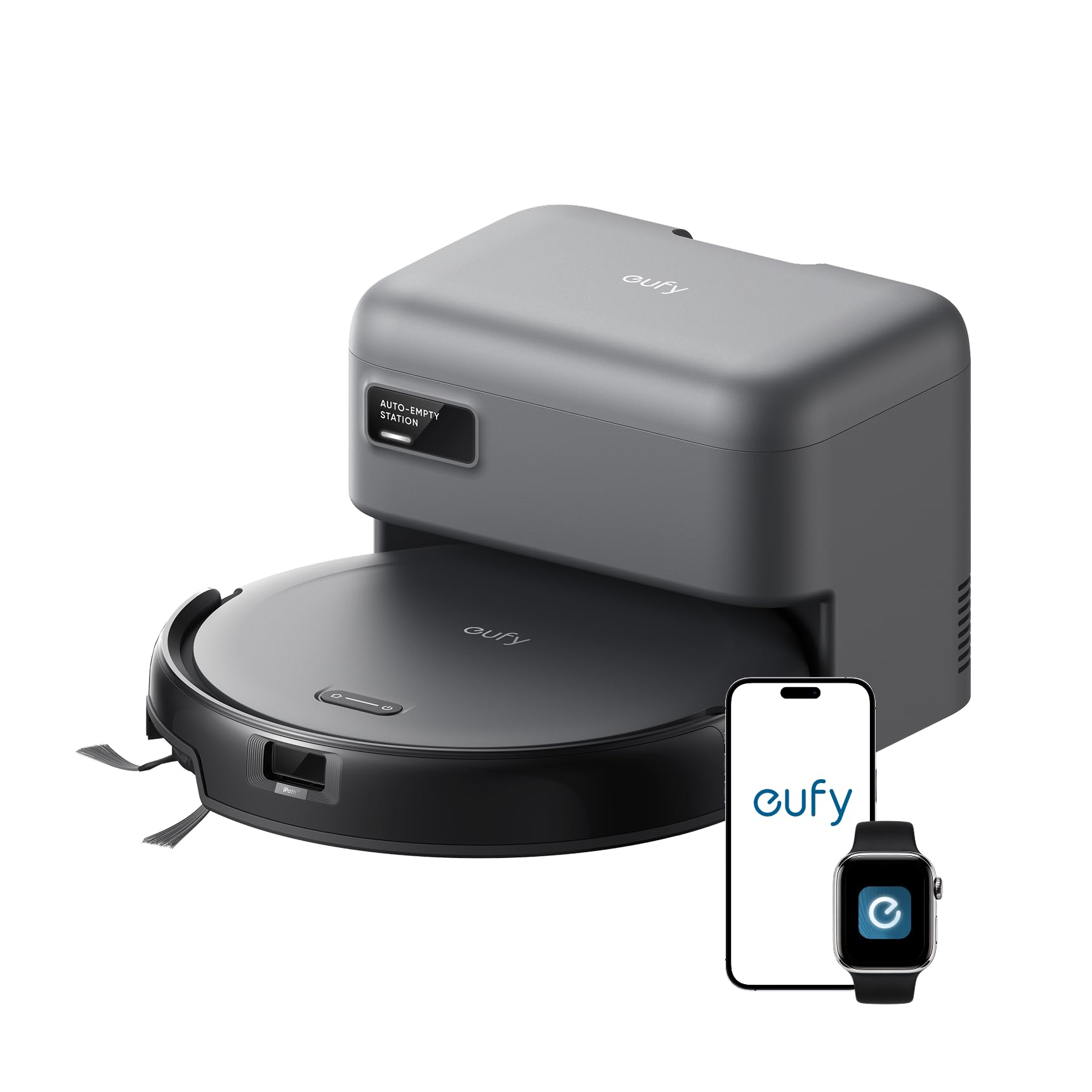
The eufy C10 breaks the conventional shape pattern by measuring just 2.85 inches tall — significantly slimmer than the typical 3.5- to 3.9-inch robot profile. This low clearance allows it to glide under sofas with 3-inch legs, bed frames with low clearance, and entertainment consoles that block regular robot vacuums. The self-emptying station uses a 3L dust bag that requires replacement every 60 days, which is standard for this price band. The trade-off for the slim profile is a smaller dust bin and a shorter 120-minute runtime compared to taller competitors.
The standout physical feature is the CornerRover arm — a side brush that extends outward as the robot approaches a wall, sweeping debris from corners into the cleaning path. Owners with open floor plans confirm that the C10 picks up more corner debris than round-bodied robots with fixed-length side brushes. The LiDAR navigation is functional, though the limited onboard memory means that editing an existing map sometimes triggers a full remapping. The app offers scheduling, no-go zone creation, and targeted room cleaning.
Suction is rated at 4,000Pa, which is lower than many competitors in this roundup. For hard floors and low-pile rugs, the suction is adequate for dust, crumbs, and pet hair. On medium-pile carpet, the C10 picks up surface debris but leaves deeper embedded particles behind compared to 7,000–8,000Pa units. Owners with primarily hard-floor homes and light rugs consistently rate the C10 highly; owners with thick wall-to-wall carpeting should prioritize higher-suction alternatives. The mopping system is a simple attachment that drags a damp pad across the floor — suitable for maintenance but not for stain removal.
Why we love it
- 2.85-inch profile reaches under furniture that blocks taller robot vacuums.
- CornerRover extendable side brush reduces edge debris accumulation.
- Self-emptying base with sealed bags contains dust during disposal.
Good to know
- 4,000Pa suction is entry-level — struggles with embedded dirt on medium-pile carpet.
- 120-minute runtime is shorter than mid-range competitors (150–180 minutes).
- Map editing can trigger full remapping rather than incremental updates.
9. iRobot Roomba 105 Vac Robot Vacuum

The iRobot Roomba 105 marks the brand’s move into affordable LiDAR navigation, stepping away from the iAdapt random-bounce algorithm that defined earlier budget Roomba models. The ClearView LiDAR system maps the home on the first run and cleans in neat rows, which is a fundamental improvement over the older 600-series navigation that could take twice as long to cover the same area. The 3-Stage Cleaning system delivers what iRobot calls 70x more power-lifting suction compared to the 600 series, which translates to noticeably better pickup on low-pile carpet and area rugs.
The Roomba 105 does not include a self-emptying base, which is the primary concession at this budget price. Instead, it returns to its charging dock and requires manual bin emptying. The dust bin is equipped with a built-in brush and comb tool that helps remove hair from the filter — a practical detail that reduces maintenance time. The battery life is a strong 200 minutes, which is the longest runtime in this roundup. This allows the robot to cover up to 2,500 square feet on a single charge before returning to recharge and resume cleaning.
The Roomba Home App provides scheduling, targeted room cleaning, keep-out zone creation, and filter-life monitoring. The robot works with Alexa, Siri, and Google Assistant for voice commands, and it supports physical button control for users who prefer not to use an app. Owners highlight that the mapping is fast — typically under 10 minutes for a two-bedroom apartment — but that the keep-out zones are limited to rectangles rather than custom polygon shapes. The single brush design works well on hard floors but can miss debris against edges compared to dual-brush systems.
Why we love it
- 200-minute battery life is the longest in this roundup — great for large single-level homes.
- LiDAR navigation replaces Roomba’s legacy random-bounce pattern for systematic cleaning.
- Works with Alexa, Siri, and Google Assistant for voice control flexibility.
Good to know
- No self-emptying base included — you must manually empty the dust bin after each run.
- Single-brush design is less effective at edge debris pickup than dual-brush competitors.
- Keep-out zones are rectangular only — cannot draw custom polygon boundaries.
FAQ
Is LiDAR navigation worth the extra money on a budget robot vacuum?
Will a 6,000Pa or 8,000Pa budget robot vacuum handle pet hair on medium-pile carpet?
How often do I need to replace the dust bag in a self-emptying base?
Can a budget robot vacuum replace a full-size upright vacuum entirely?
Why does my budget robot vacuum keep getting stuck on cords and socks?
Final Thoughts: The Verdict
For most households, the best robot vacuum on a budget winner is the roborock Q7 M5+ because it delivers premium 10,000Pa suction, reliable PreciSense LiDAR navigation, and a dual anti-tangle system at a price that undercuts most competitors with similar specs. If you want automatic carpet detection for mopping without drawing no-go zones, grab the roborock Q10 S5+ for its VibraRise 2.0 system that lifts the mop pad on rugs. For the lowest long-term cost of ownership, nothing beats the Airzeen Q20 Ultra bagless self-emptying station — no recurring bag expenses and solid LiDAR performance.