
Finding a robot vacuum that actually self-empties, navigates around pet bowls without bumping into furniture, and scrubs dried-on grime out of kitchen tiles is the real challenge—especially when you are trying to stay within a strict budget that excludes the flagship brands. Many buyers assume every model under certain tiers will just bounce around randomly or that “mopping” means a barely damp pad, but recent releases have closed that gap significantly.
I’m Mo Mahin — the founder and writer behind Furric. I spend my time comparing real-world suction wattages, LiDAR mapping update intervals, dust-bag capacities, and mopping pad oscillation rates across dozens of units to identify which robot vacuums actually deliver on their claims for the price.
Shoppers shopping for the best robot vacuum under $400 now have access to LiDAR navigation, anti-tangle brush systems, and self-emptying bases that were once reserved for models costing much more.
How To Choose The Best Robot Vacuum Under $400
With the wide range of features available at this price ceiling, choosing the right unit comes down to understanding how your home’s layout, floor types, and pet situation interact with the specific engineering trade-offs manufacturers make.
Suction Power vs. Brush Design
Suction is measured in Pascals (Pa), and you will see numbers ranging from 5,000Pa to 10,000Pa in this segment. High suction alone does not guarantee a clean floor if the brush design allows hair to wrap around the roller. Look for models with a rubber roller or an active hair-cutting mechanism like the eufy L60’s system; otherwise, you will spend more time cutting hair off the brush than the vacuum saves you.
Self-Emptying Bag vs. Bagless System
A self-emptying base is the single biggest convenience upgrade in this category. Some units use a sealed 2.5L to 4L dust bag that you toss every 45 to 90 days. Others, like the Airzeen Q20 Ultra, use a bagless reusable bin that saves recurring costs but requires rinsing. Bagless models are better for the environment and your wallet over time, but they expose you to dust during the emptying process. Bagged models seal allergens away completely.
Mapping, No-Go Zones, and Multi-Floor Storage
LiDAR navigation is the gold standard. It creates a precise map of your home and lets you set virtual walls or no-go zones to keep the robot away from pet bowls, cords, or delicate rug fringes. If you have a multi-level home, ensure the model stores at least 3 to 5 maps in memory so you can move the unit between floors without re-mapping each time.
Mopping Realism: Pad Lift and Oscillation
Many robot vac-mop combos simply drag a damp pad across the floor. At this price, you should demand at least a sonic mopping function that oscillates (like the Shark Stratos at 100x per minute) or an electronic water pump with adjustable flow. Even more important is automatic mopping pad lift: when the robot detects carpet, the pad must rise to avoid soaking your rugs, a feature not yet common in the mid-range of this segment.
Quick Comparison
On smaller screens, swipe sideways to see the full table.
| Model | Category | Best For | Key Spec | Amazon |
|---|---|---|---|---|
| MONSGA MR7 PRO | Mid-Range | Pet households with mixed flooring | 8,000Pa & 4L bag (90 days) | Amazon |
| eufy L60 | Mid-Range | Homes needing active hair cutting | 5,000Pa & active hair slicing | Amazon |
| roborock Q7 M5+ | Premium | High suction & deep carpet cleaning | 10,000Pa & 2.7L bag (7 weeks) | Amazon |
| Airzeen Q20 Ultra | Mid-Range | Zero-maintenance bagless users | 6,000Pa & bagless self-empty | Amazon |
| SHELIKI D60S MAX | Premium | Large homes over 2,500 sq.ft | 6,000Pa & 220 min runtime | Amazon |
| BOTLUXE E10+ | Premium | Pet owners wanting 75-day emptying | 8,000Pa & 3.5L bag (75 days) | Amazon |
| Shark Stratos AV2700ZE | Premium | Auto-wash mop pad convenience | 100x/min sonic mop & self-wash | Amazon |
In‑Depth Reviews
1. MONSGA MR7 PRO
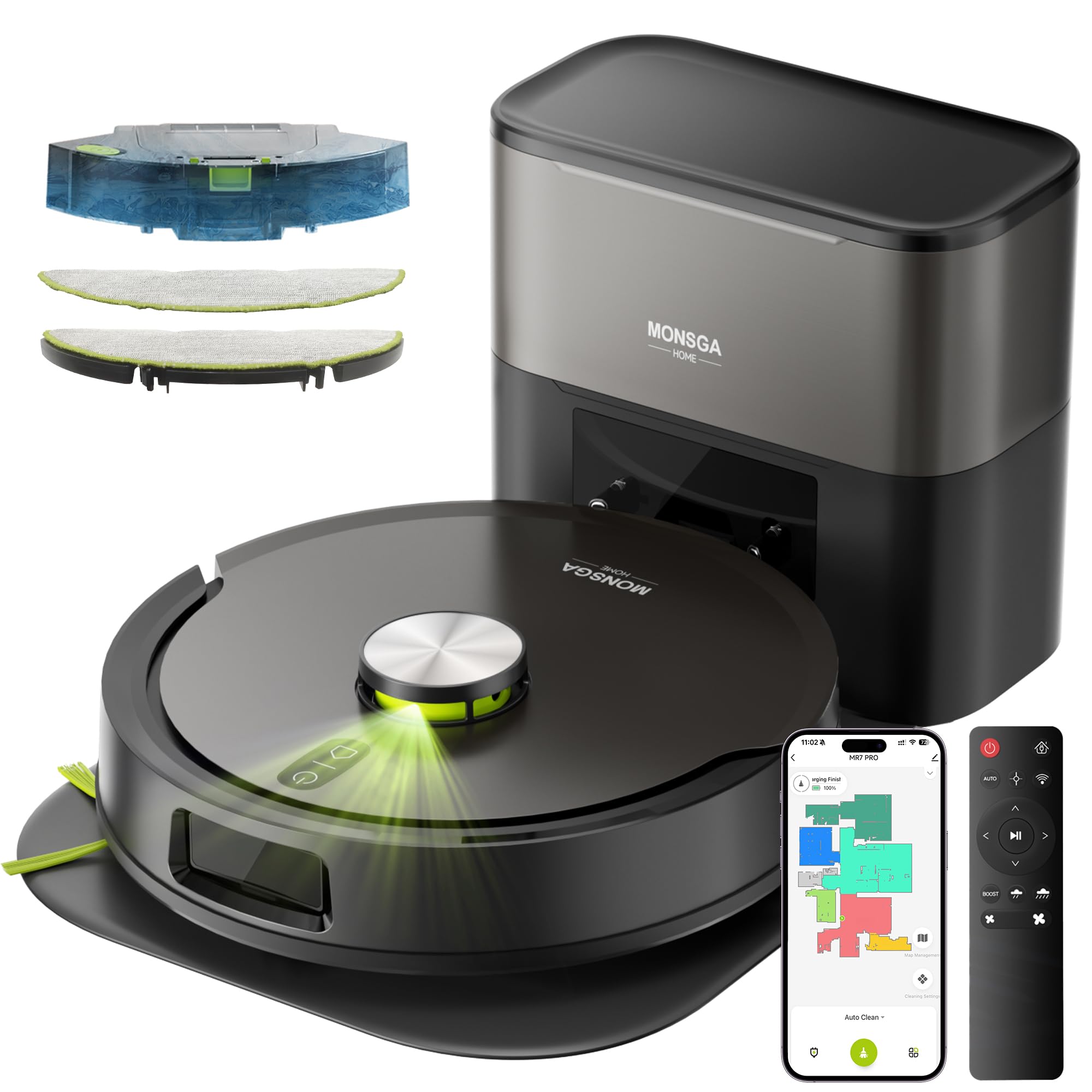
The MONSGA MR7 PRO hits a rare sweet spot: it offers an 8,000Pa suction rating that rivals more expensive units, paired with a 4-liter dust bag that stretches self-emptying intervals to roughly 90 days. The dual anti-tangle design features a zero-tangle arched side brush and an all-rubber main roller that handles pet hair without the constant wrap-ups that plague cloth-brush competitors.
Its LiDAR navigation scans and maps a home in about ten minutes on the first run, storing up to five different floor plans for multi-level households. The 460ml water tank covers nearly twice the area of standard tanks per fill, and the protection plate prevents moisture from warping real wood floors during mopping cycles. The 160-minute runtime with smart recharge-and-resume means it finishes the job even after a low-battery pause.
Real owners consistently highlight the accurate mapping under furniture, the significant reduction in visible cat litter and dog hair, and the fact that the self-emptying base keeps dust locked away for months. The Smart Life/Tuya app integration allows for virtual walls and no-go zones, though it only supports 2.4GHz Wi-Fi, which is standard for this tier.
Why we love it
- 8,000Pa suction at a mid-range price point
- 4L dust bag offers longest self-empty interval in class
- Dual anti-tangle roller stops hair wrap before it starts
Good to know
- App only works on 2.4GHz Wi-Fi networks
- No automatic mop pad lift for carpet detection
2. eufy L60
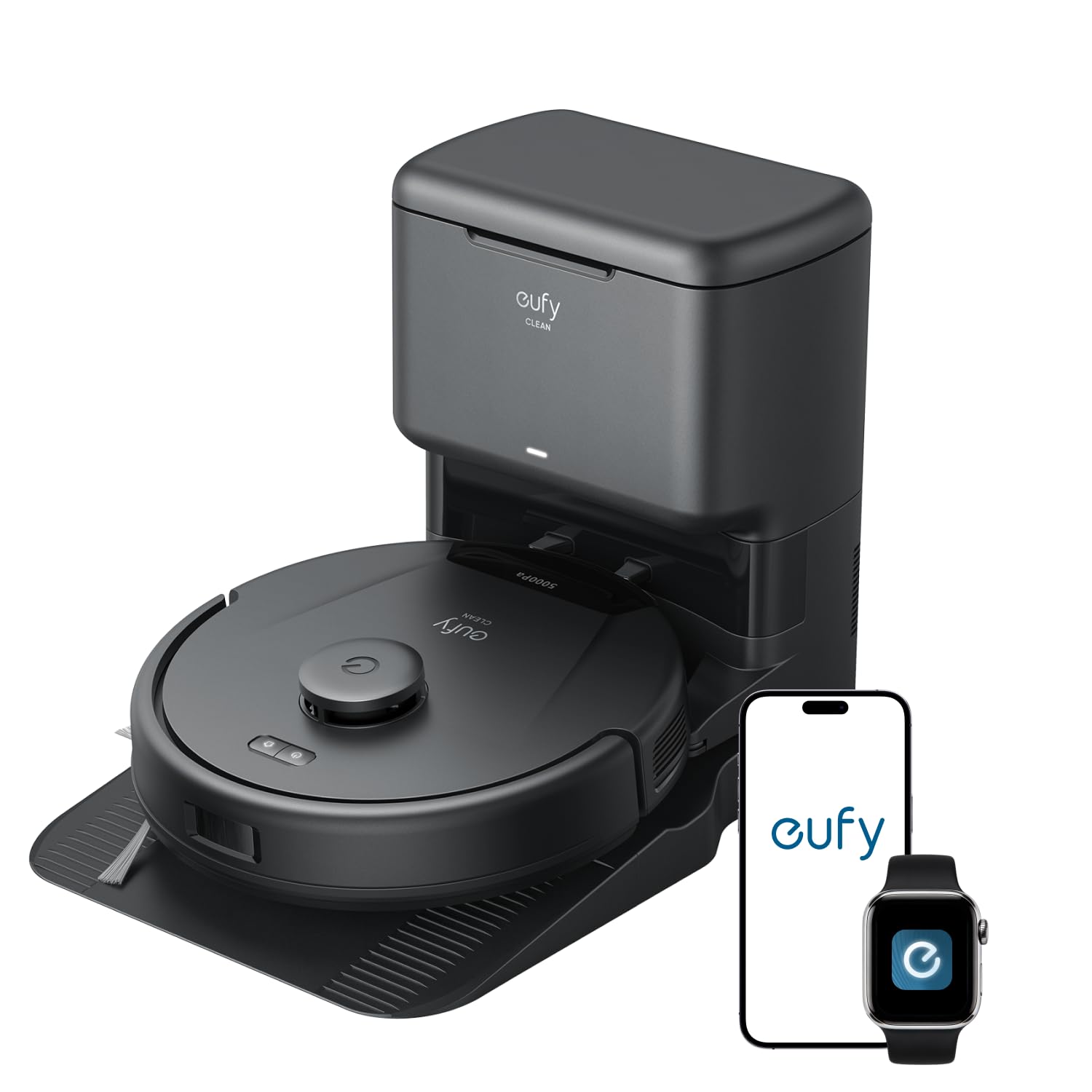
The eufy L60 differentiates itself with an active hair-cutting mechanism inside the self-emptying station. Every time the robot docks, a blade slices hair off the roller brush, which means you never have to manually cut or pull tangled strands — a significant advantage for long-haired households or homes with shedding dogs. The 5,000Pa suction is sufficient for hardwood, tile, and medium-pile carpets, picking up crumbs and pet hair in a single pass.
Its iPath LiDAR navigation produces accurate maps quickly and supports no-go zones, room selection, and multi-floor mapping across different levels. The 2.5-liter dust bag in the self-emptying base lasts about 60 days before needing replacement. Note that this model does not include a mopping function at all; it is strictly a dry vacuum robot, which keeps the price lower and the bin purely dedicated to debris.
Owners report excellent pet hair pickup on tile and low-pile carpets, and the self-empty bag fills reliably as indicated. Some users note the automatic haircutting feature’s blade is not user-replaceable — you must ship the entire dock for service if it dulls. The initial Wi-Fi pairing can require a few attempts, but once connected, the app scheduling is straightforward.
Why we love it
- Active hair-slicing blade stops manual cleanup entirely
- iPath LiDAR maps quickly and accurately
- Quiet operation on hardwood floors
Good to know
- No mopping function — dry vacuum only
- Auto-haircut blade is not user-serviceable
3. roborock Q7 M5+
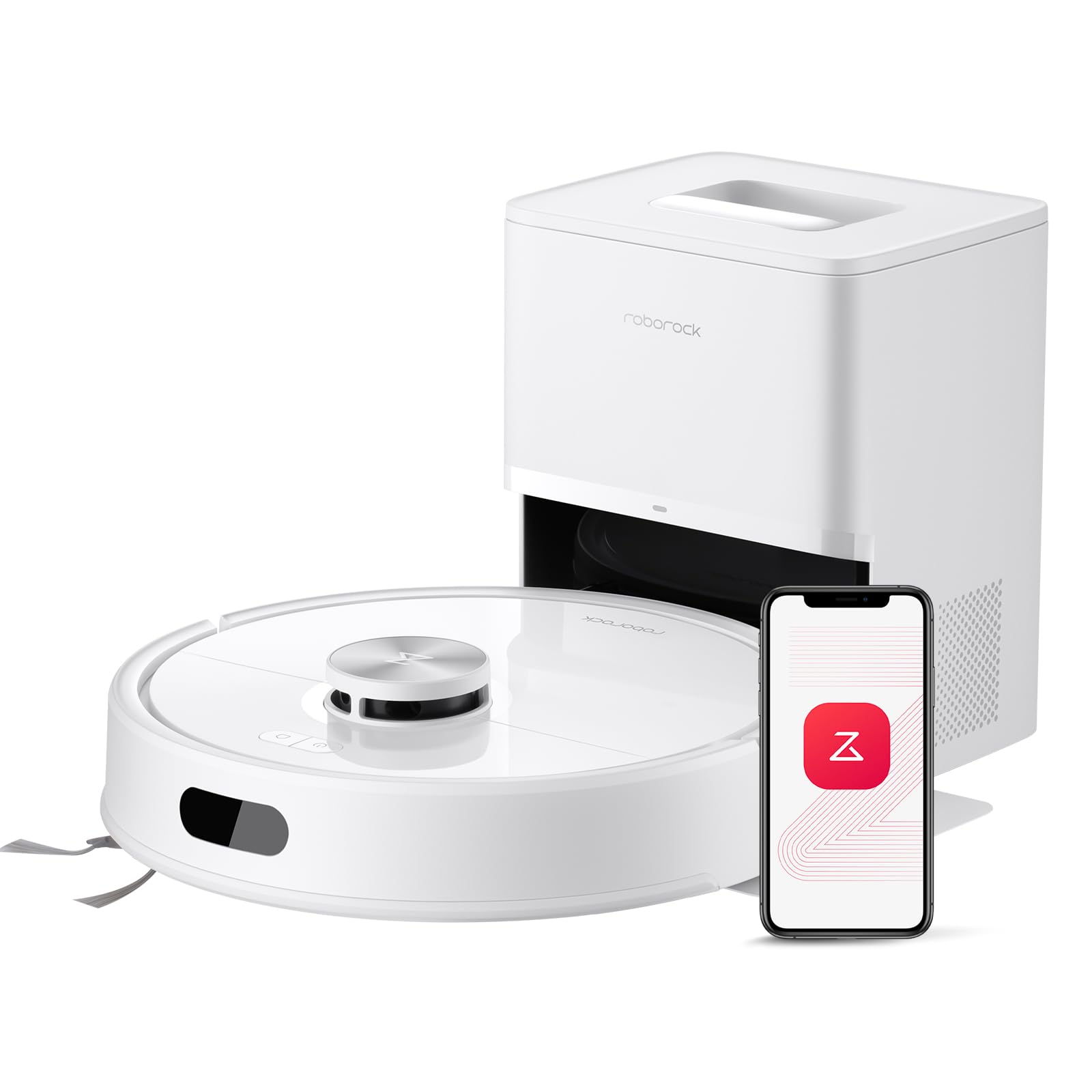
Roborock’s Q7 M5+ delivers the highest suction in this list at 10,000Pa, which translates to aggressive deep-cleaning on carpets and effortless lifting of embedded pet hair. The RockDock Plus auto-empty station uses a 2.7-liter sealed dust bag, lasting about seven weeks before a swap is needed. The dual anti-tangle system includes a JawScrapers main brush and a side brush that resists tangling even with long-haired breeds.
The PreciSense LiDAR navigation system maps a home in real-time and supports the storage of up to three floor maps, making it viable for multi-level homes. The mopping module uses three adjustable water flow settings and a 2-in-1 dustbin and water tank, letting you vacuum and mop simultaneously. The rectangular form factor helps with edge cleaning, though the device is larger than round competitors.
Real users praise the accurate no-go zones that protect rug fringes, the quiet operation compared to previous Roombas, and the large battery that covers about 85-90% of a 2,300 sq.ft home per charge. The app requires 2.4GHz Wi-Fi and a WPA2 password without special characters, which some Comcast users found tricky during setup. The mopping function handles light cleaning well but does not remove tough dried spills.
Why we love it
- 10,000Pa suction power for deep carpet cleaning
- Multi-floor mapping supports up to 3 stored maps
- JawScrapers brush resists tangling effectively
Good to know
- Larger footprint may struggle in very tight spaces
- Mopping pad does not lift automatically for carpets
4. Airzeen Q20 Ultra
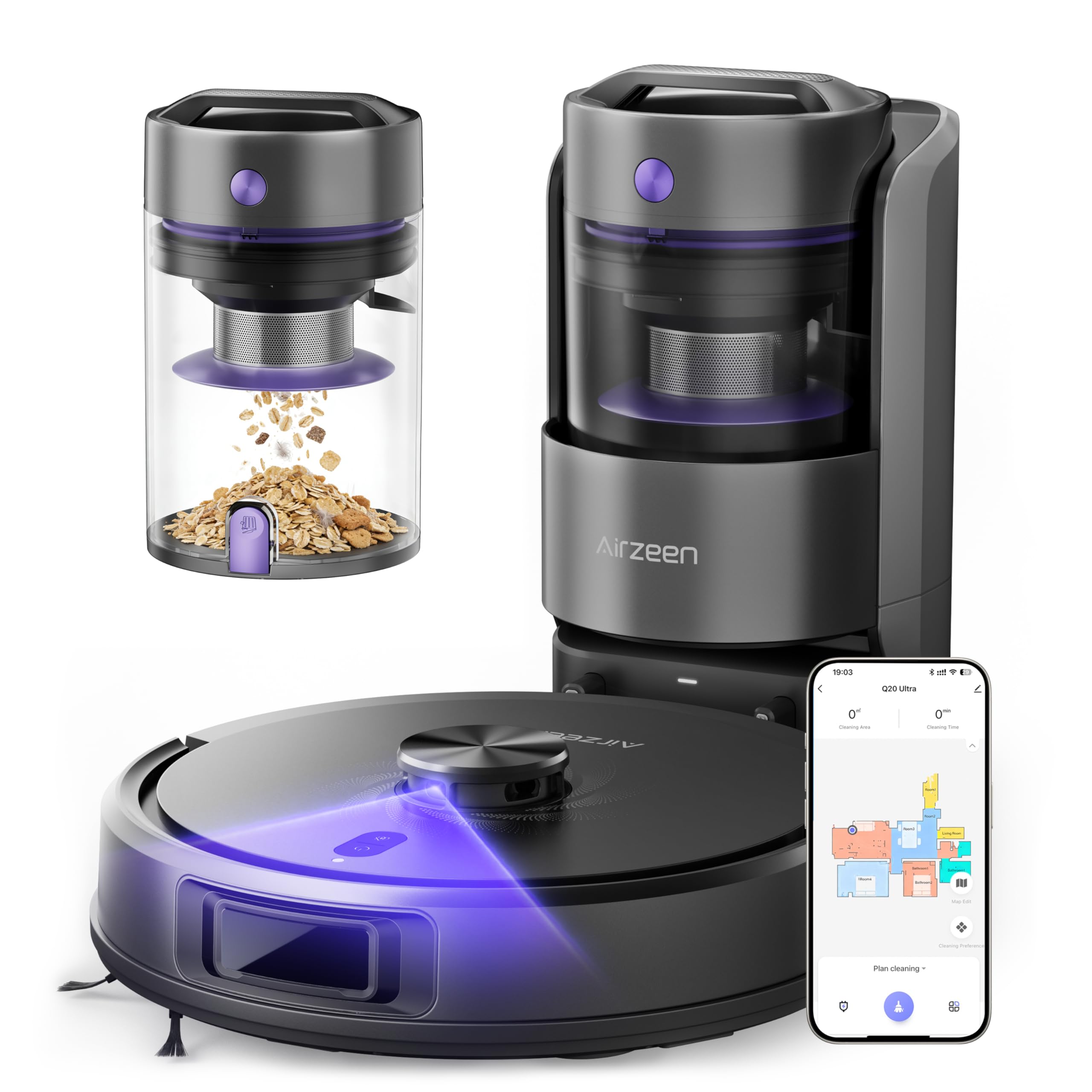
The Airzeen Q20 Ultra stands out for its bagless self-emptying system, which automatically transfers debris into a reusable dust cup that you simply rinse out — no recurring cost for disposable bags. The 6,000Pa hyperforce suction offers three adjustable levels, and the 4-in-1 system (vacuum, sweep, mop, self-empty) is built around a 2-in-1 dustbin and water tank for simultaneous wet and dry cleaning. The LiDAR navigation scans 360 degrees and stores up to 5 maps for multi-level homes.
Owners appreciate the quiet operation, the auto-adjusting suction that ramps up on carpet, and the ability to create no-go zones and virtual walls through the Honysmart app. The 150-minute runtime in ECO mode covers most single-floor homes, and the auto recharge-and-resume function ensures the entire area gets cleaned without gaps. The bagless bin design saves roughly per year in replacement bags compared to bagged competitors.
The main trade-off is that emptying the bagless bin requires removing and rinsing the reusable cup, which can stir up some dust — though the HEPA filter inside the bin does capture most particles. A handful of owners reported that the app requires location permissions, which may be a privacy concern for some users. The mopping function works well on tile and hardwood but does not feature automatic pad lift, so you must remove the mop holder before it cleans carpets.
Why we love it
- Bagless self-empty saves ongoing bag costs
- Stores up to 5 maps for multi-floor homes
- Adjustable suction auto-increases on carpet
Good to know
- App requires location permission to operate
- Mop holder must be removed before carpet cleaning
5. SHELIKI D60S MAX
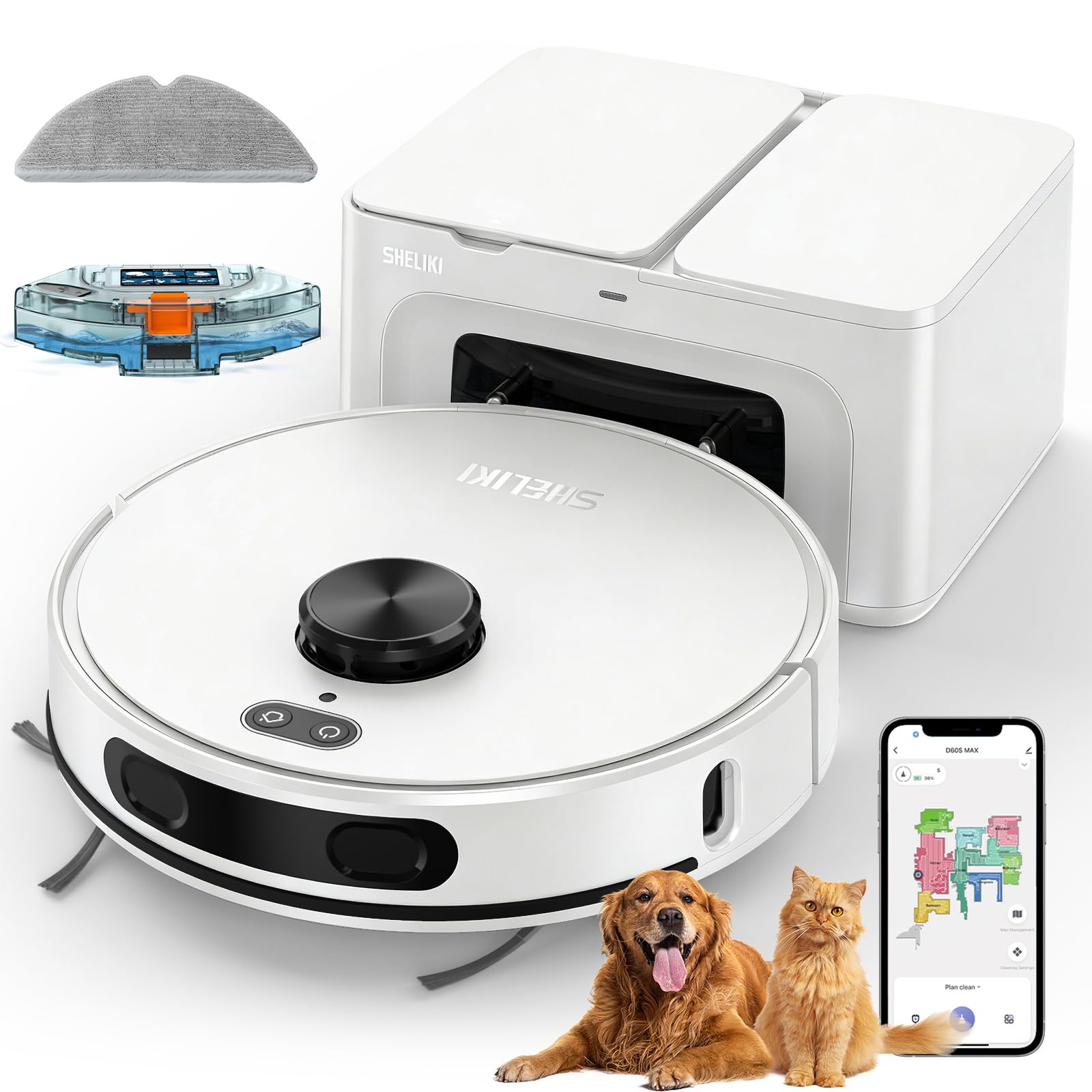
The SHELIKI D60S MAX focuses on endurance: with a 220-minute runtime, it can cover up to 2,500 square feet on a single charge, making it the best option for larger homes in this price bracket. When the battery drops below 15%, it intelligently returns to base, charges to 80%, and resumes cleaning exactly where it left off, ensuring total coverage without manual intervention. The 6,000Pa suction provides four modes — Quiet (800Pa), Standard (1,600Pa), Strong (2,700Pa), and Max (6,000Pa) — allowing you to tailor noise and power to the surface.
The 3-in-1 sweep, vacuum, and mop system uses a 2-in-1 dust and water bin, and the LiDAR navigation creates accurate smart maps that allow up to 14 no-go zones. The self-emptying base accepts a massive 2.5-liter dust bag, and the box includes five replacement bags, which the manufacturer claims lasts a full year. The 2.87-inch slim profile slides under most couches and low-profile furniture, a design point owners consistently praise.
Real owners note excellent stair detection via anti-drop sensors, ensuring the robot never tumbles down stairs. The 65dB noise level on standard mode allows it to run during phone calls or while watching TV. The mopping function is effective on entryway tiles, though it is a simple drag system rather than sonic oscillation, so dried-on stains may require a second pass. The app saves up to five maps, which is useful for multi-story homes.
Why we love it
- 220-minute runtime leads the category for large spaces
- 2.87-inch slim profile fits under low furniture
- Reliable stair detection and anti-drop sensors
Good to know
- Mopping is a drag system without oscillation
- Self-empty bag is not as large as MONSGA’s 4L
6. BOTLUXE E10+
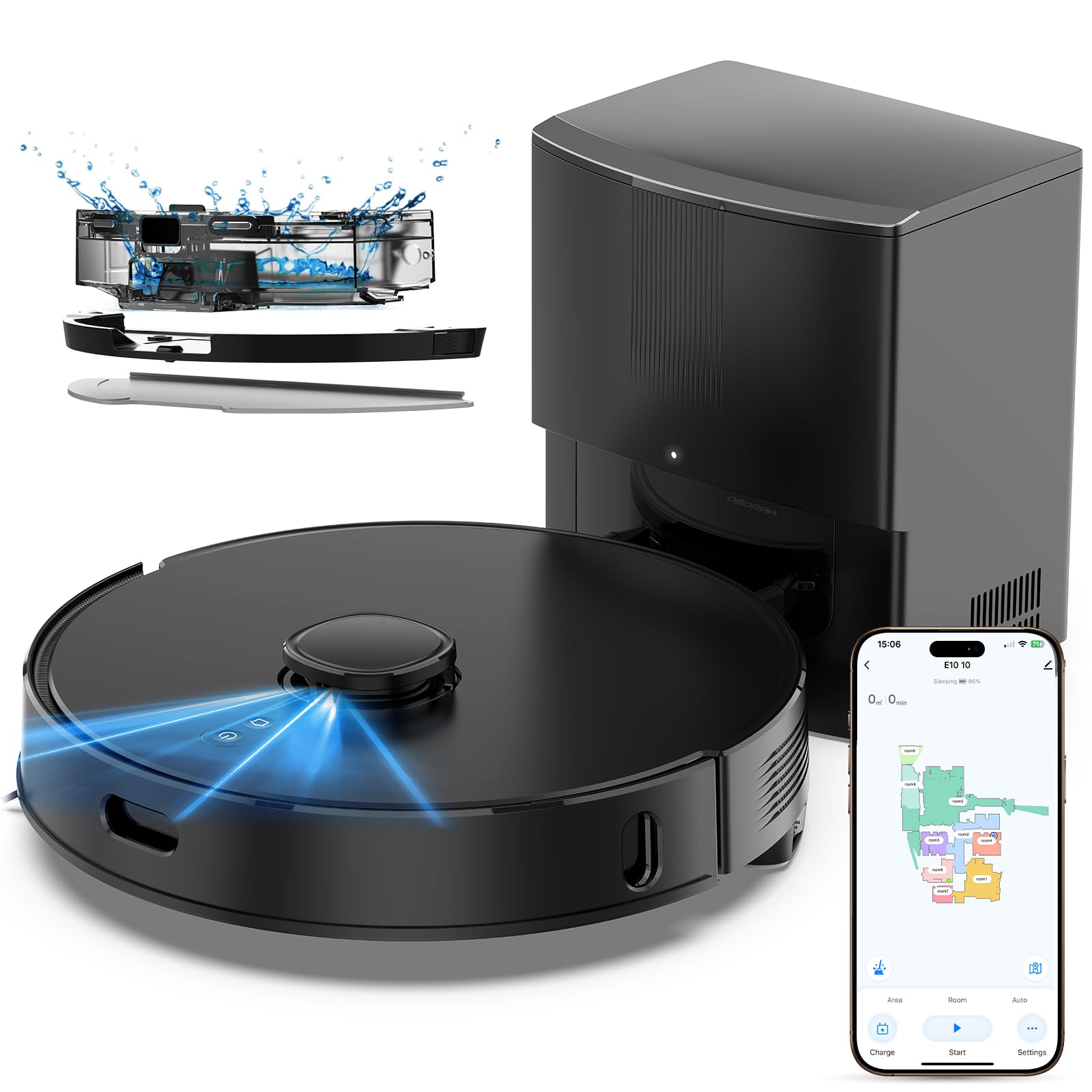
The BOTLUXE E10+ matches the MONSGA’s 8,000Pa suction but extends the self-emptying interval to 75 days thanks to a 3.5-liter dust bag. This makes it a compelling choice for homes with multiple shedding pets where the dustbin fills fast. The 2-in-1 vacuum and mop design uses a 330ml dustbin and a 280ml water tank, allowing simultaneous sweeping and mopping in a single pass. The LiDAR navigation system quickly scans and stores multi-floor maps via the app.
Owners repeatedly note the accurate mapping and organized cleaning pattern — the robot follows back-and-forth paths rather than random movement, ensuring thorough coverage of each room. The self-emptying station works reliably, and the 150-minute runtime (manufacturer states 180 minutes under ideal conditions) handles most single-floor homes before needing a recharge. The unit also supports remote control via a physical remote, which some users prefer over app-only operation.
Key feedback from pet owners: the E10+ picks up cat litter, dog hair, and tracked-in debris effortlessly on both hard floors and low-pile carpets. The mopping function is best for light cleaning rather than heavy stain removal, as it lacks sonic oscillation. The only downside is the 110-120V voltage requirement — users outside North America will need a step-down transformer. Setup is under ten minutes out of the box.
Why we love it
- 8,000Pa suction with 75-day self-empty interval
- Accurate LiDAR mapping with multi-floor storage
- Includes both app and physical remote control
Good to know
- Mop is a passive drag pad, no oscillation
- 110-120V only; needs a transformer abroad
7. Shark Stratos AV2700ZE
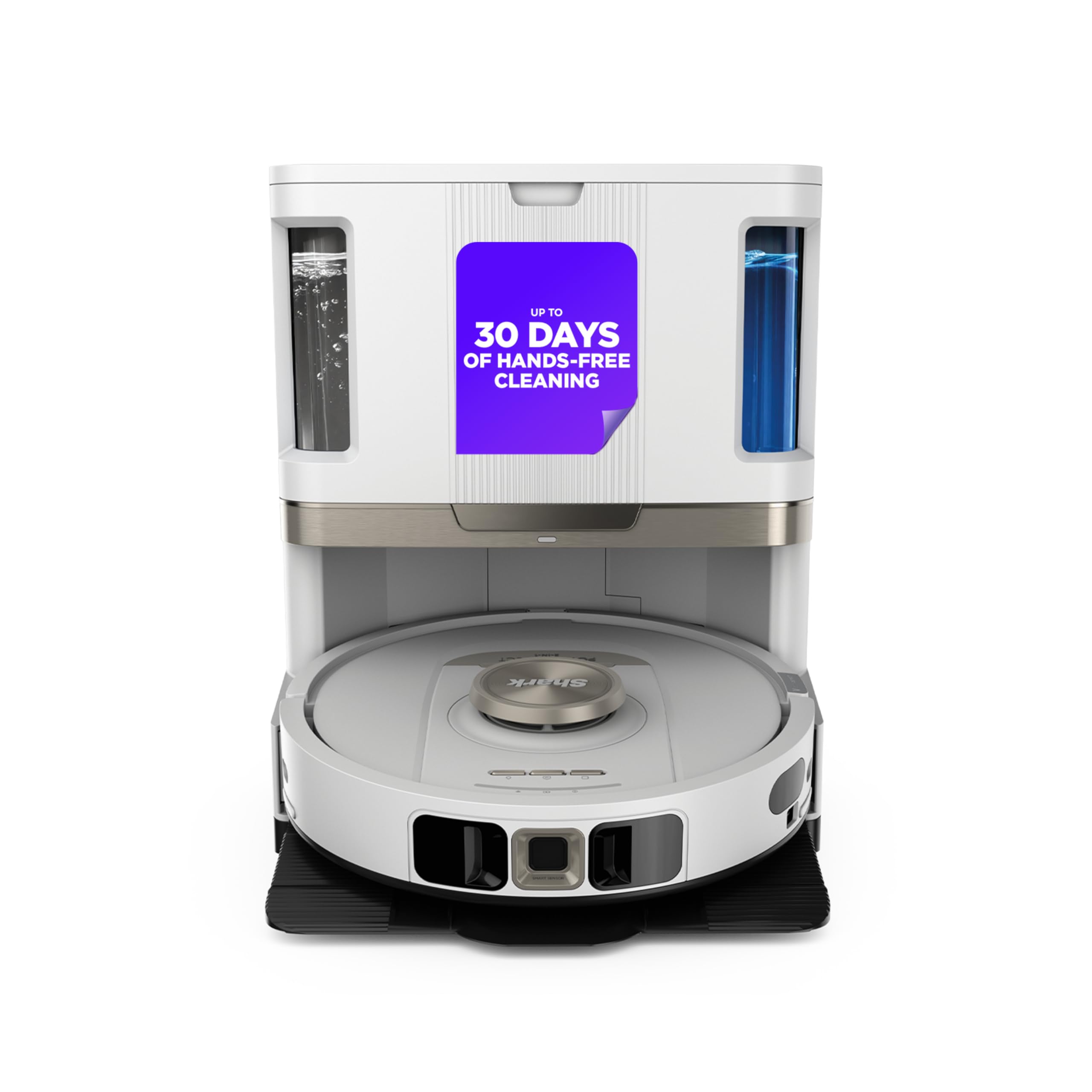
The Shark Stratos AV2700ZE sits at the higher end of this price guide and brings a feature that none of the other entries offer: a NeverTouch base that self-empties, refills water for up to 30 days, and automatically washes and dries the mopping pad after every cleaning cycle. The sonic mopping scrubs floors at 100 oscillations per minute, effectively lifting dried-on grime that passive drag pads leave behind. The high suction power pulls dirt, pet dander, and fine dust from both carpets and hard floors, supported by HEPA filtration with an Anti-Allergen Complete Seal.
The Precision LiDAR navigation builds an accurate home map in 360 degrees and avoids obstacles even in low-light conditions. AutoLift technology raises the mop over carpets so you never wet your rugs, and the self-cleaning brushroll with anti-hair wrap prevents tangles without manual intervention. Edge Detect uses air blasts to pull debris from corners and along walls into the cleaning path, addressing a common weak point in round robot vacuums.
Owners with multiple pets praise its ability to handle husky hair, clean corners effectively, and map new rooms without re-mapping. The 110-minute battery is shorter than some competitors, but the auto-empty and water refill base compensates by reducing the need to baby-sit. Some users found the initial setup instructions unclear and noted that the mopping performance, while better than passive systems, does not replace a thorough hand-mop for heavily soiled floors.
Why we love it
- Self-washing and drying mop pad eliminates dirty pad dragging
- Sonic mopping at 100x/min lifts tough stains
- AutoLift keeps mop off carpets automatically
Good to know
- 110-minute runtime is shorter than many competitors
- Requires Shark-brand floor cleaner for best results
FAQ
Can a robot vacuum under $400 handle pet hair without tangling the brush?
What does the self-emptying base actually do, and how often do I need to maintain it?
How many floor maps can these robot vacuums store, and does it matter for multi-level homes?
Is sonic mopping really better than a standard passive mopping pad for this price?
Final Thoughts: The Verdict
For most households, the best robot vacuum under $400 is the MONSGA MR7 PRO because it delivers 8,000Pa suction, a 90-day self-emptying 4L bag, and reliable LiDAR navigation at a price that undercuts many rivals while offering higher capacity. If you want active hair-cutting to eliminate manual brush cleanup entirely, grab the eufy L60. And for large homes where runtime matters most, nothing beats the SHELIKI D60S MAX with its 220-minute battery and 2,500 sq.ft coverage per charge.