
If your cat suffers from dandruff, excessive shedding, or a brittle coat, the protein source in their bowl is likely the culprit. Many felines develop sensitivities to chicken or poultry-based formulas, leaving owners chasing digestive upset and skin irritation with expensive vet visits and trial-and-error diets. A salmon-first recipe shifts the nutritional foundation toward a single, novel animal protein that is naturally rich in the Omega-3 fatty acids responsible for reducing inflammation and restoring coat luster from the inside out.
I’m Mo Mahin — the founder and writer behind Furric. I spend my workdays dissecting pet food manufacturing methods, cross-referencing ingredient sourcing claims against nutritional science, and cross-analyzing thousands of verified owner reports to isolate which salmon-based formulas actually deliver on their skin-and-coat promises without triggering poultry cross-contamination.
After evaluating dozens of formulations across kibble sizes, protein percentages, and digestive support additives, these five recipes stand apart for their commitment to salmon as the primary protein. Whether your cat needs a grain-free diet, probiotic digestive support, or a hydrating wet meal, this guide to the best salmon cat food will help you match the right formula to your cat’s specific health needs.
How To Choose The Best Salmon Cat Food
Not all salmon cat food is created equal. The term “salmon” on the front of the bag can mean deboned salmon, salmon meal, or salmon by-product — each with a drastically different protein concentration and biological value. These three factors will determine whether the bag you bring home actually improves your cat’s skin, digestion, and energy levels.
Ingredient Sourcing: Deboned Salmon vs. Salmon Meal
Deboned salmon is the whole, raw fish before any processing — it contains natural moisture, which means its protein content is diluted by water weight. Salmon meal, by contrast, is the rendered, dried fish product with moisture removed, making it a more concentrated protein source by volume. A formula listing deboned salmon as the #1 ingredient followed by salmon meal in the top five generally provides the best balance of fresh protein and sustained amino acid density. Avoid recipes that list “salmon” alongside unnamed “fish meal” or “poultry by-product meal,” as these dilute the novel protein advantage.
Omega-3 and Omega-6 Fatty Acid Profiles
Salmon’s primary advantage over chicken or turkey is its naturally high concentration of EPA and DHA — the long-chain Omega-3 fatty acids directly linked to reducing inflammatory skin conditions, improving coat gloss, and supporting cognitive function in senior cats. Look for a guaranteed analysis that lists a minimum of 0.3% Omega-3 on a dry matter basis. If the bag does not publish Omega-3 percentages, check the ingredient list for salmon oil or menhaden fish oil as a secondary fat source; these concentrated oils amplify the anti-inflammatory effect beyond what the whole fish alone provides.
Particle Size and Kibble Geometry
Salmon-based formulas often target cats with dental sensitivities or smaller jaw structures. The kibble diameter should be small enough for a cat to crush without excessive chewing — roughly the size of a pea or smaller. Extra-small kibble, often labeled “small kibble” or “bite-sized,” reduces the risk of gulping and regurgitation in cats that inhale their food. For senior cats or those with missing teeth, a raw-coated kibble that softens quickly with added moisture is gentler on the gums while still delivering the dental scraping action of traditional dry food.
Quick Comparison
On smaller screens, swipe sideways to see the full table.
| Model | Category | Best For | Key Spec | Amazon |
|---|---|---|---|---|
| Blue Buffalo True Solutions Skin & Coat Care | Dry Kibble | Poultry-sensitive adults with dry skin | 3.5 lb bag, 0.4% Omega-3 guaranteed | Amazon |
| Stella & Chewy’s Raw Coated Salmon | Raw-Coated Kibble | Picky eaters needing probiotic digestion support | 5 lb bag, 65-70% animal protein | Amazon |
| Lucy Pet Formulas for Life Salmon, Pumpkin & Quinoa | Dry Kibble | Cats with chronic digestive upset or IBD | 4 lb bag, prebiotic fiber blend | Amazon |
| Hill’s Science Diet Adult Salmon & Brown Rice | Dry Kibble | Veterinarian-backed daily nutrition for adult coats | 3.5 lb bag, Omega-6 & Vitamin E | Amazon |
| Sheba Perfect Portions Bistro Salmon in Creamy Sauce | Wet Food Trays | Hydration and portion control for multi-cat homes | 48 servings, 2.6 oz twin-pack trays | Amazon |
In‑Depth Reviews
1. Blue Buffalo True Solutions Skin & Coat Care Adult Dry Cat Food, Salmon

Blue Buffalo’s True Solutions line tackles the specific pain point of chronic skin irritation with a clinically formulated Omega-3 and Omega-6 fatty acid profile that directly targets dry, flaky skin and brittle fur. Deboned salmon sits as the #1 ingredient, and the recipe is completely free of chicken by-product meal, corn, wheat, and soy — eliminating the most common dietary triggers for environmental allergy–like symptoms in cats. The kibble size is notably small, roughly 6–7 mm in diameter, which makes it accessible for cats with dental sensitivity or those who struggle with larger, denser pellets.
Owner reports consistently highlight a visible reduction in scabbing around the neck and tail base within two to three weeks of switching, along with a softer, glossier coat texture. The guaranteed Omega-3 content sits at approximately 0.4% on a dry matter basis, which is competitive for a mid-range dry food and sufficient to produce observable anti-inflammatory benefits in most adult cats. The formula does not rely on synthetic fiber additives; instead, it uses natural sources like barley and oat fiber to maintain stool consistency without causing loose movements during the transition period.
The 3.5-pound bag size is ideal for households that prefer to cycle through fresh stock rather than store a 15-pound bag for months, though the larger 11-pound option offers better overall value per feeding. Cats with established poultry sensitivities respond especially well — multiple owners report that their cats transitioned from covering themselves in scabs to having clear, healthy skin after removing chicken from their diets entirely. This formula is a strong starting point for any owner looking to switch to a salmon-based diet without introducing exotic or hard-to-source ingredients.
Why we love it
- Deboned salmon is the sole #1 ingredient with no poultry by-product meal
- Clinically proven Omega-3 level visibly reduces coat shedding and dandruff
- Free of corn, wheat, and soy — reduces common allergy triggers
Good to know
- Small 3.5 lb bag is expensive per ounce compared to the 11 lb option
- Some cats may require a slow 7-day transition to avoid loose stool due to the fiber profile
2. Stella & Chewy’s Raw Coated Cat Food, Wild-Caught Salmon

Stella & Chewy’s takes a fundamentally different approach to dry food by freeze-drying a raw salmon coating onto each small kibble piece, effectively delivering the enzymatic benefits of a raw diet without the mess of handling frozen blocks. The protein content sits between 65% and 70% from animal sources, with wild-caught salmon as the #1 ingredient — a significant jump over conventional extruded kibble that often dilutes protein with plant starches. The kibble diameter is approximately 5 mm, making it one of the smallest in this category and well-suited for kittens, senior cats, and brachycephalic breeds that struggle with larger pellets.
Digestive support comes from natural probiotics and fiber sources that do not rely on synthetic prebiotics. Owner reports consistently note that even the most resistant picky eaters — cats that typically refuse kibble or leave half the bowl untouched — actively seek out this food. The resalable bag design preserves freshness effectively, and the raw coating does not crumble off during shipping as some cheaper raw-coated competitors suffer. Multiple owners of cats with inflammatory bowel disease or chronic vomiting report that this formula stopped regurgitation within the first week of feeding.
The 5-pound bag is priced competitively within the premium raw-coated segment, and the combination of high animal protein with probiotic fiber makes it viable as a complete diet rather than just a topper. Cats that eat this food tend to produce smaller, firmer stools due to the higher protein digestibility ratio, which is a practical indicator of better nutrient absorption. For owners seeking transition away from chicken-based diets, this recipe is poultry-free and relies entirely on salmon and salmon oil for its fat profile, removing any risk of chicken cross-contamination.
Why we love it
- Raw freeze-dried coating delivers enzyme-rich nutrition without raw handling
- 65-70% animal protein from wild-caught salmon surpasses standard kibble ratios
- Extremely small kibble size (5 mm) suits kittens and seniors with dental issues
Good to know
- Higher protein content may require a longer transition for cats with sensitive stomachs
- Resealable bag is sturdy but the raw coating can degrade if stored in humid environments
3. Lucy Pet Products Formulas for Life Sensitive Stomach & Skin Dry Cat Food, Salmon, Pumpkin & Quinoa
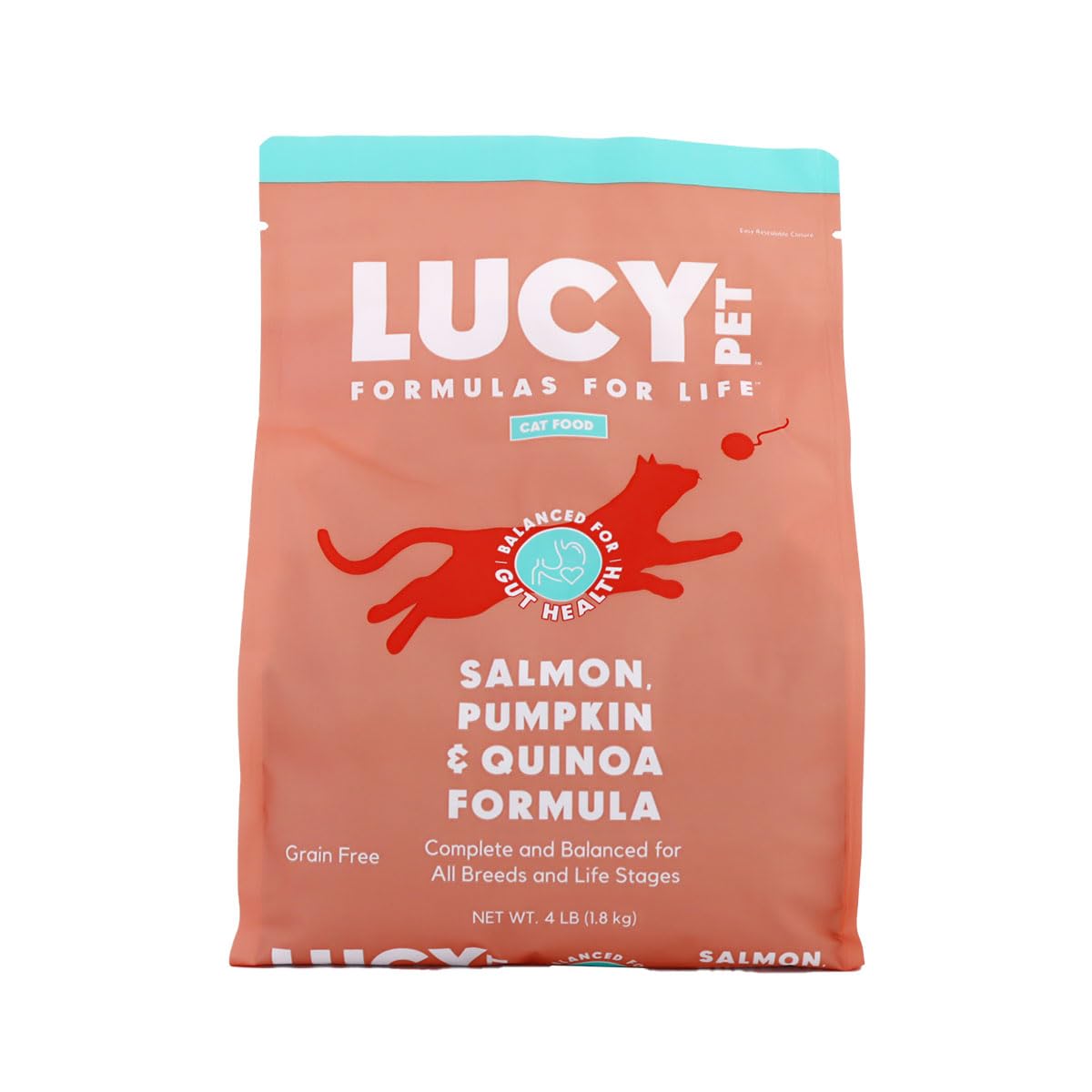
Lucy Pet Products addresses the intersection of skin health and digestive regularity by pairing deboned wild-caught Alaskan salmon with pumpkin and quinoa — two fiber sources that work as prebiotics to feed beneficial gut bacteria. The formula is the result of 40 years of research by Dr. George C. Fahey, a leading authority on gut health in companion animals, and the inclusion of balanced fiber is designed to regulate transit time in cats prone to loose stool or constipation. The kibble shape is a flat, rounded disk roughly 8 mm across, which encourages chewing without being too large for cats with smaller mouths.
Owner narratives emphasize this food’s effectiveness specifically for cats recovering from giardia, chronic diarrhea, or antibiotic-related gut dysbiosis. The salmon oil provides a direct Omega-3 boost for coat quality, while the absence of soy, wheat, and artificial additives ensures the formula remains hypoallergenic for cats with multiple sensitivities. The resealable bag is effective at preserving kibble freshness, though the 4-pound size is relatively small relative to the fiber density — owners of multiple cats may find themselves reordering more frequently than with larger bags.
The pumpkin inclusion is particularly useful for owners who have previously needed to supplement canned pumpkin separately to manage stool consistency. Every serving contains a measurable amount of soluble and insoluble fiber balanced to bind loose stool without causing constipation in cats prone to the opposite issue. Cats that have been on standard grocery-brand kibble often need a 7- to 10-day transition, but once adapted, the improvement in stool quality and coat gloss is among the most consistently reported outcomes across all salmon cat food reviews.
Why we love it
- Pumpkin and quinoa provide natural prebiotic fiber without synthetic additives
- Formulated by a leading gut-health researcher with 40 years of digestive science
- Deboned wild-caught Alaskan salmon ensures high Omega-3 content
Good to know
- 4 lb bag is relatively small for multi-cat households needing bulk
- Transition period may be longer (up to 10 days) due to the high fiber content
4. Hill’s Science Diet Adult 1-6 Dry Cat Food, Salmon & Brown Rice

Hill’s Science Diet occupies the veterinarian-recommended tier with a salmon and brown rice formula designed for adult cats between 1 and 6 years old. The protein comes from salmon as the primary animal source, supported by brown rice as a digestible carbohydrate that provides steady energy without spiking blood glucose. The Omega-6 fatty acid content, combined with Vitamin E, is targeted specifically at maintaining skin barrier integrity and reducing transepidermal water loss — the scientific mechanism behind a healthy, non-dandruff coat. The kibble shape is a rounded triangle roughly 8 mm across, designed to provide dental scraping action as the cat chews.
Owner feedback consistently highlights a rapid improvement in coat texture — multiple reports note visibly shinier and softer fur within just two to three days of switching. The formula is made with natural ingredients and manufactured in the USA, though it does source some ingredients globally. Cats that previously regurgitated after eating chicken-based formulas tend to hold down this salmon recipe without issue, likely due to the lower allergenic load of salmon combined with the gentle fiber profile of brown rice.
The 3.5-pound bag is the entry size, and while the price-per-pound is higher than bulk alternatives, the formulation consistency makes it a reliable choice for cats with sensitive systems that react poorly to formula changes. Hill’s does include chicken fat in its ingredient list, so cats with extreme poultry protein sensitivity may still react to the fat source — though in practice, most poultry-sensitive cats tolerate chicken fat without issue because the allergenic proteins are removed during rendering. For owners who prioritize veterinarian-backed clinical nutrition over boutique ingredient sourcing, this is the safest baseline choice.
Why we love it
- Veterinarian-recommended formula with clinically tested Omega-6 and Vitamin E levels
- Rapid coat improvement visible within days according to verified owner reports
- Natural ingredients made in the USA with consistent batch-to-batch formulation
Good to know
- Contains chicken fat — not suitable for cats with confirmed poultry protein allergies
- 3.5 lb bag is small; the larger sizes offer better per-serving value
5. Sheba Perfect Portions Bistro Adult Wet Cat Food, Salmon in Creamy Sauce

Sheba Perfect Portions delivers a wet food solution that solves two practical problems simultaneously: hydration and portion control. Each twin-pack tray contains two 1.3-ounce servings separated by a center divider, allowing owners to peel back exactly one portion and keep the second fresh without plastic wrap or storage containers. The salmon in creamy sauce recipe offers a higher moisture content than any dry food — approximately 82% moisture — which is critical for cats that do not drink standing water readily and are at risk of chronic dehydration or urinary tract issues. The creamy sauce texture coats the salmon shreds, making the meal highly palatable even for cats that typically reject pâté-style wet foods.
Owner feedback emphasizes the convenience of the tear-open trays, especially for multi-cat households where different cats have different dietary needs. The formula is grain-free and contains no corn, soy, or artificial flavors, though trace amounts of these may be present due to cross-contact during manufacturing. Cats that are picky about their gravy consistency tend to prefer this recipe because the sauce is thin enough to lap up independently but thick enough to coat the protein pieces evenly. The 24-count case provides 48 total servings, which translates to roughly a 24-day supply for a single cat eating two trays daily.
The protein content is lower than the dry food options on this list, as expected from a wet formula where moisture occupies the majority of the volume. However, the biological value of the protein is high because wet food undergoes less thermal degradation during the canning process compared to extrusion. For owners looking to incorporate a salmon-based wet meal into a rotation alongside dry kibble, this portion-controlled system eliminates the common problem of half-used cans drying out in the refrigerator. The trays stack efficiently in pantry storage, and the absence of a can opener requirement reduces daily friction in the feeding routine.
Why we love it
- Twin-pack trays eliminate messy leftovers and provide exact portion control
- High moisture content (approximately 82%) supports urinary tract and kidney health
- Grain-free with no corn or soy, formulated without artificial flavors
Good to know
- Trace cross-contact with grains and soy possible due to shared manufacturing lines
- Lower protein density than dry food — best used as part of a mixed feeding plan
FAQ
Can salmon cat food help with my cat’s chicken allergy symptoms?
Is salmon cat food too rich for senior cats or cats with kidney disease?
How much salmon cat food should I feed my 10-pound adult cat per day?
Final Thoughts: The Verdict
For most households, the best salmon cat food winner is the Blue Buffalo True Solutions Skin & Coat Care because it delivers a clinically proven Omega-3 level without chicken by-products, making it the most effective and accessible entry point for cats with poultry sensitivities. If your cat is a picky eater that refuses standard kibble, grab the Stella & Chewy’s Raw Coated Salmon — its freeze-dried raw coating consistently converts even the most stubborn feline resisters. And for cats recovering from digestive illness or chronic loose stool, nothing beats the Lucy Pet Formulas with Pumpkin and Quinoa, whose prebiotic fiber blend rebuilds gut health while the salmon oil restores coat shine.