
A reef tank is a closed-loop ecosystem where one wrong parameter shift can set you back months. The salt you mix defines your baseline calcium, alkalinity, and magnesium — the three pillars that determine whether your SPS colonies encrust or your LPS polyps extend. Choosing the wrong mix means constantly dosing to compensate, battling pH swings, or watching corals bleach for no obvious reason.
I’m Mo Mahin — the founder and writer behind Furric. My approach to reef salt comparison is rooted in cross-referencing chemical composition data against hundreds of verified owner experiences, isolating which mixes actually deliver on their labeled parameters batch after batch.
This guide breaks down the top commercially available mixes based on dissolution speed, elemental consistency, and real-world coral response so you can confidently select the right salt for a reef tank without relying on marketing claims.
How To Choose The Best Salt For A Reef Tank
Reef salts are not all the same. The primary difference lies in the target parameter range each manufacturer formulates for. Low-nutrient systems with heavy SPS dominance require elevated alkalinity and calcium, while soft coral or fish-only systems can run on balanced general-purpose mixes. Matching the salt to your bioload saves you from corrective dosing.
Calcium, Alkalinity, and Magnesium Balance
The three-way relationship between Ca (380-450 ppm), Alk (8-12 dKH), and Mg (1250-1450 ppm) dictates skeletal growth speed and pH stability. A salt mix that spikes alkalinity without proportional calcium forces you to dose calcium separately or risk precipitation. Every salt reviewed below lists its mixed parameters; use those as your primary filter.
Dissolution Speed and Clarity
Fine-grain salts dissolve in 30-60 minutes with a standard powerhead, while coarser granules may take hours and leave a cloudy haze. Anhydrous salts are highly concentrated and dissolve quickly but require precise measurement by weight, not volume, because the powder is denser. Cloudy water after 60 minutes indicates incomplete dissolution, which stresses livestock.
Phosphate and Nitrate Content
Most premium reef salts advertise phosphate-free and nitrate-free baselines. Low-quality mixes can introduce measurable phosphates (0.05 ppm or more), fueling undesirable algae blooms. If you run a ULN (ultra-low nutrient) system, only consider salts certified as phosphate-free with documented ICP results.
Quick Comparison
On smaller screens, swipe sideways to see the full table.
| Model | Category | Best For | Key Spec | Amazon |
|---|---|---|---|---|
| FritzPRO R.P.M. Redline High Alk | Premium | SPS dominant systems | Enhanced alkalinity, phosphate-free | Amazon |
| Red Sea Coral Pro Salt 175 Gal | Premium | Mixed reef & frag tanks | Ca 450+, Alk 12 dKH, Mg 1400 | Amazon |
| Red Sea Coral Pro Salt 200 Gal Bag | Premium | Bulk water changes | Ca 450+, Alk 12 dKH, Mg 1400 | Amazon |
| Instant Ocean Reef Crystals 160 Gal | Mid-Range | Soft coral & beginner reef | Extra Ca, added vitamins, detoxifies heavy metals | Amazon |
| Fritz Aquatics Reef Pro Mix 50 Gal | Mid-Range | Mixed reef & fish-only | Enhanced Ca, Mg, K, stable pH | Amazon |
| Seachem Vibrant Sea 60 Gal | Mid-Range | Budget-friendly reef | Anhydrous, enhanced potassium | Amazon |
| ARKA Premium Reef Salt 1 kg | Mid-Range | Small tanks & quarantine | Phosphate-free, fine grain, pH 8.3-8.5 | Amazon |
In‑Depth Reviews
1. FritzPRO R.P.M. Redline High Alk Salt Mix 55 lbs

FritzPRO built this mix specifically for SPS-heavy tanks where alkalinity consumption outstrips calcium. The enhanced alkalinity buffer means you can run a 10-12 dKH target straight from the bucket without adding separate sodium bicarbonate. Experienced reefers report that the fine powder dissolves almost instantly — some call it “baby powder texture” — and leaves zero residue when mixed with a powerhead for 20 minutes.
The 55-pound box yields 200 gallons, so the per-gallon cost sits well below competing high-alk options. Multiple users who switched from Instant Ocean Reef Crystals noted visibly better polyp extension and faster coralline algae spread within two weeks. The ammonium, nitrate, and phosphate-free baseline keeps ULN systems stable.
One frequent complaint: batch-to-batch salinity consistency can vary slightly. A handful of owners measured salinity hitting 1.028 instead of the targeted 1.025 when following the box instructions by volume, so measuring by weight with a refractometer is strongly advised. The bucket packaging is sturdy, but the outer cardboard box sometimes arrives crushed.
Why we love it
- Ultra-fine powder dissolves completely in under 30 minutes
- High alkalinity (10-12 dKH) ideal for SPS-dominated systems
- Phosphate and nitrate free — safe for ULN tanks
Good to know
- Salinity can run high if measured by volume rather than weight
- Cardboard outer packaging can be damaged in transit
2. Red Sea Coral Pro Salt Mix 175 Gallon Bucket

Red Sea Coral Pro is the default choice for reefers who prioritize accelerated coral growth, particularly for SPS frags that need to encrust quickly. The formula targets a calcium concentration above 450 ppm, alkalinity around 12 dKH, and magnesium at 1400 ppm — numbers that significantly reduce the need for supplemental dosing in most mixed-reef setups.
The bucket format includes a resealable inner plastic bag that keeps the salt dry between uses. Owners consistently report that the granules dissolve clear within 40 minutes of active mixing, and water clarity is exceptional.
Two drawbacks stand out. The bucket lid is a twist-off design that can crack if overtightened, and the bucket itself is heavy when full. A small number of owners received buckets with cracked sides, though the inner bag protected the salt. The mixing ratio is 18.1 grams per liter to reach 1.025 SG, so a kitchen scale is more reliable than cup measurements.
Why we love it
- High calcium and alkalinity ideal for fast SPS growth
- Dissolves clear with no cloudiness after 40 minutes
- Consistent batch chemistry backed by years of user data
Good to know
- Bucket can crack during shipping despite inner bag protection
- Twist-off lid is not very robust
3. Red Sea Coral Pro Marine Salt Mix 200 Gallon Bag

The 200-gallon bag version of Coral Pro delivers the exact same chemical formulation as the bucket but at a lower per-gallon cost, making it the most economical option for high-volume water changes. The bag eliminates plastic waste, which appeals to environmentally conscious reefers. The salt itself performs identically — fast dissolution, high calcium/alkalinity, and consistent trace elements.
Storage is the trade-off. The bag is not resealable, so you must transfer the salt into a dry, airtight container immediately after opening to prevent moisture absorption. Regular buyers pour the contents into a spare Coral Pro bucket or a food-grade plastic tote. In humid environments, the salt can clump within days if left in the open bag.
Shipping weight is lighter than the bucket, which sometimes translates to better delivery condition — fewer reports of torn bags compared to cracked buckets. Users running 140-300 gallon systems appreciate the bulk format for convenience, though some note that handling the large bag requires both hands and careful pouring.
Why we love it
- Lower per-gallon cost than the bucket format
- Same premium Red Sea Coral Pro chemistry
- Less plastic waste and lighter to ship
Good to know
- Requires an airtight storage container after opening
- Large bag can be awkward to pour
4. Instant Ocean Reef Crystals Reef Salt for 160 Gallons

Instant Ocean Reef Crystals has been a staple in the saltwater hobby for decades. The enriched formulation includes extra calcium to promote stony coral and coralline algae growth, plus added vitamins that benefit soft corals, anemones, and invertebrates. It also contains a heavy-metal detoxifier for those mixing with dechlorinated tap water rather than RO/DI.
This salt is less aggressive than high-alk options, making it a safer starting point for mixed reefs with a variety of soft and stony corals. The granules dissolve readily — most users report a clear mix within an hour with a heater and powerhead. The 160-gallon box offers excellent value, and many reefers who operate lower-demand tanks stick with Reef Crystals for years without needing any additives.
The biggest downside reported is packaging inconsistency. Some buyers receive the box format, which is less durable than a bucket, and a handful of boxes arrive with damaged corners or minor salt leakage. The bucket version is available separately and recommended if you have the option. A minority of advanced SPS keepers find the alkalinity too low for their needs.
Why we love it
- Extra calcium and vitamins support a wide range of corals
- Detoxifies heavy metals, useful for non-RO/DI mixes
- Affordable per-gallon cost for mixed reefs
Good to know
- Box packaging is less sturdy than buckets
- Alkalinity may be insufficient for demanding SPS tanks
5. Fritz Aquatics Reef Pro Mix Complete Marine Salt 4 Pack 50 Gallons

Fritz Reef Pro Mix comes in a convenient 4-pack of 50-gallon boxes, making it ideal for reefers who want to split the total volume across multiple water changes or share with fellow hobbyists. The formula contains enhanced calcium, magnesium, and potassium levels, plus buffer agents that bring the pH to a stable range shortly after mixing.
The salt dissolves cleanly and does not leave a white film on the mixing container. Owners with mixed systems containing soft corals, LPS, and SPS report balanced parameters without needing to dose additional elements. The nitrate, phosphate, and ammonia-free baseline ensures no unwanted nutrient introduction. Many users describe this as a “no-fuss” salt that works well straight out of the box.
The main issue concerns packaging integrity on the individual boxes. A few buyers received the shipment with one broken inner bag, leading to salt dust in the outer carton. Since the 4-pack format means each box holds a smaller volume, the cost per gallon is slightly higher compared to buying a single larger container. Also, the formulation may not be aggressive enough for dedicated SPS-heavy systems.
Why we love it
- 4 smaller boxes are easy to store and portion
- Enhanced calcium, magnesium, and potassium
- Phosphate-free and nitrate-free for clean water
Good to know
- Individual boxes can arrive damaged
- Higher per-gallon cost than bulk containers
6. Seachem Vibrant Sea Highly Concentrated Synthetic Sea Salt 60 Gallons

Seachem Vibrant Sea is an anhydrous salt, meaning water molecules are removed during processing, resulting in a more concentrated powder. This allows you to produce 60 gallons of saltwater from a 13.8-pound container — significantly less weight per gallon than hydrous salts. The formula includes enhanced potassium levels, which benefit coral coloration, particularly in SPS species.
Users consistently praise the dissolution speed: the powder mixes clear in under an hour with minimal effort, often requiring just a powerhead and no heater. The chemical profile targets calcium around 420-450 ppm, alkalinity approximately 10-11 dKH, and magnesium above 1350 ppm. Hobbyists who switched from standard salts report that anemones and LPS corals visibly expanded within days.
The anhydrous nature means you must measure by weight rather than volume, because the powder is denser than granular alternatives. A few owners unfamiliar with this distinction initially mixed too strong, raising salinity above 1.025. The packaging is a simple plastic bag inside a cardboard box, which offers less protection than a bucket during shipping.
Why we love it
- Lightweight anhydrous formula reduces shipping weight
- Enhanced potassium improves coral coloration
- Dissolves very quickly with just a powerhead
Good to know
- Must be measured by weight, not by volume
- Cardboard box packaging offers limited protection
7. ARKA Premium Reef Salt 1 kg
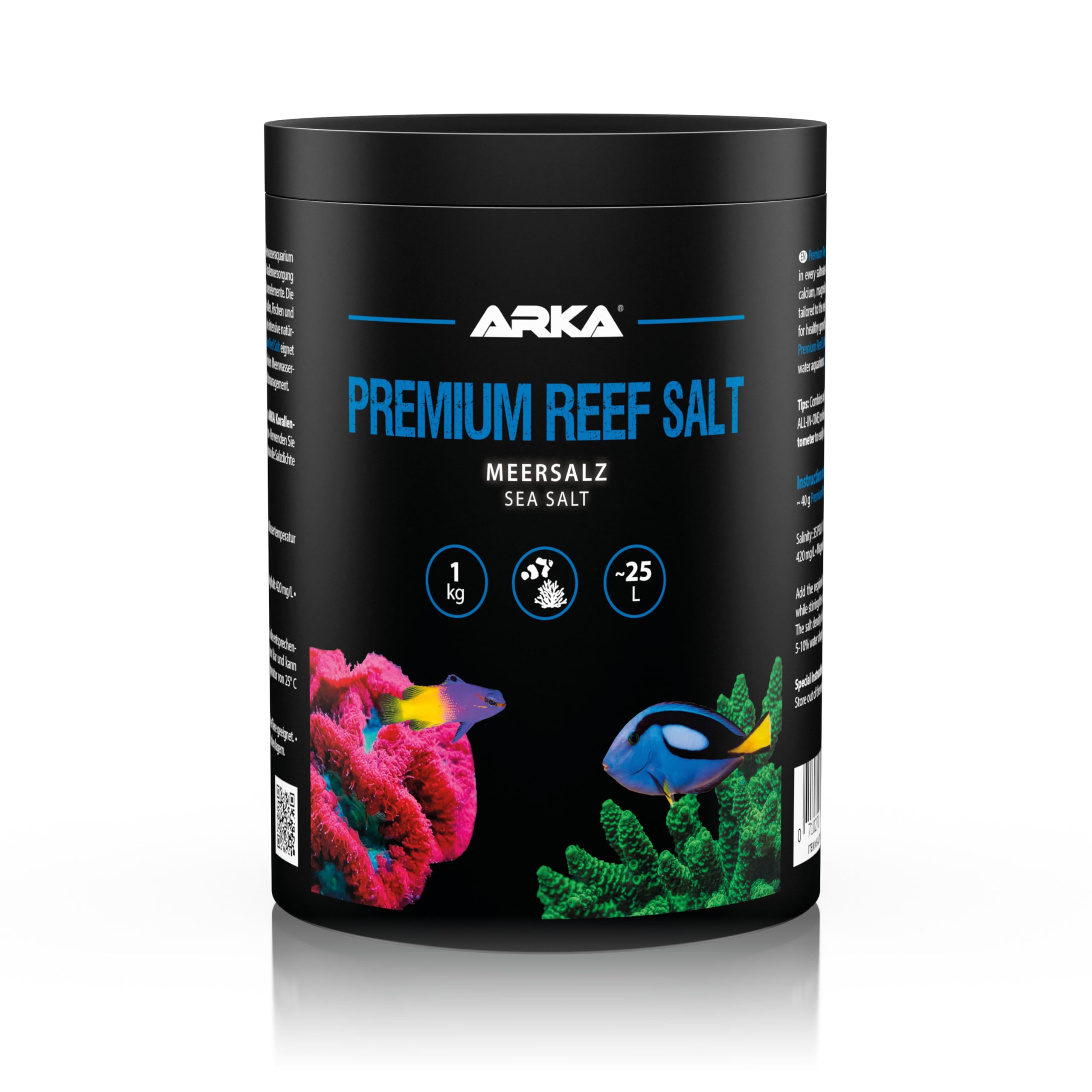
ARKA Premium Reef Salt is a European-formulated synthetic marine salt designed for small reef systems, quarantine tanks, and nano reefs. The 1-kilogram bag makes approximately 27 liters of saltwater, so it is best suited for tanks under 20 gallons or for emergency water mixes. The fine grain structure dissolves quickly with no visible residue, and the recommended dosing ratio is 37 grams per liter to reach a density of 1.022.
The chemical targets are calcium at 430 mg/L, magnesium at 1300 mg/L, alkalinity at 8-10 dKH, and pH between 8.3 and 8.5. These numbers are well-balanced for soft corals and LPS, though slightly conservative for demanding SPS. The salt is phosphate-free and nitrate-free, meeting the purity requirements of sensitive reef inhabitants.
The main limitation is the small total volume. For any reef tank above 20 gallons, the 1-kilogram bag requires frequent repurchasing, driving up the per-gallon cost significantly. The packaging is a simple resealable foil bag without a reinforcing box, so it can be punctured in transit. Despite these constraints, the salt itself earns praise for its consistent lab-tested quality and rapid dissolution.
Why we love it
- Lab-tested purity with consistent batch chemistry
- Very fine grain dissolves instantly with no residue
- Phosphate and nitrate free for clean water
Good to know
- Small 1 kg bag is expensive per gallon for larger tanks
- Foil bag packaging is vulnerable to punctures
FAQ
Can I mix reef salt with dechlorinated tap water instead of RO/DI water?
Why does my saltwater look cloudy after mixing for an hour?
How do I know if a salt mix has consistent batch chemistry?
Final Thoughts: The Verdict
For most reef keepers, the salt for a reef tank winner is the FritzPRO R.P.M. Redline High Alk because it combines SPS-grade alkalinity with rapid dissolution and a phosphate-free baseline at a competitive per-gallon cost. If you want a proven bucket that supports accelerated coral growth right out of the mix, grab the Red Sea Coral Pro 175 Gal Bucket. And for budget-friendly mixed reefs with simple dosing needs, nothing beats the value of the Instant Ocean Reef Crystals 160 Gal.