
Managing alkalinity, calcium, and magnesium swings in a closed-loop reef system is the single most stressful routine for any aquarist. The wrong salt mix sends corals into recession, fuels nuisance algae, or leaves your test kit reading numbers that make no sense. Finding a mix that dissolves completely and delivers consistent batch-to-batch parameters is non-negotiable for a thriving tank.
I’m Mo Mahin — the founder and writer behind Furric. I spend my time comparing manufacturer ICP reports, studying dissolution curves, and analyzing thousands of forum posts and verified owner reviews to separate marketing claims from measurable reef performance.
This guide breaks down the top contenders based on dissolution speed, elemental consistency, and value per gallon so you can pick the best salt for reef tank performance without wasting money on trial-and-error buckets.
How To Choose The Best Salt For Reef Tank
The right mix depends on your coral type, water change frequency, and tolerance for manual dosing. Here are the four specs that separate a premium blend from a base mix.
Alkalinity and Calcium Baseline
LPS and soft corals thrive in the 8–10 dKH range with calcium around 400–430 ppm. SPS-dominated tanks often benefit from elevated alkalinity target mixes like Red Sea Coral Pro or Fritz RPM, which mix closer to 11–12 dKH. If you maintain a low-nutrient system, a standard alkalinity mix (7.5–8.5 dKH) paired with supplemental dosing gives you finer control.
Dissolution Speed and Clarity
Fine-grain salts dissolve fully in 5–15 minutes with vigorous circulation. Coarse or caked blends leave a white residue, fall out of solution, or require hours of mixing. A clean, clear mixture indicates complete dissolution of calcium carbonate and prevents precipitation onto heater surfaces.
Trace Element Profile
Quality reef salts add strontium, iodine, potassium, and boron at levels matching or exceeding natural seawater. Some budget blends only guarantee calcium, magnesium, and alkalinity — corals may strip trace elements over time, forcing you to dose separately or risk pale coloration.
Packaging and Moisture Protection
Salt absorbs humidity from the air, forming hard clumps that throw off measurements. Buckets and mylar bags with resealable spouts preserve granule flowability. If you buy bags, plan to transfer the mix into an airtight container immediately upon opening.
Quick Comparison
On smaller screens, swipe sideways to see the full table.
| Model | Category | Best For | Key Spec | Amazon |
|---|---|---|---|---|
| Red Sea Coral Pro 200G Bag | Premium | SPS dominant tanks | 11–12 dKH mix target | Amazon |
| Fritz Reef Pro Mix 200G | Premium | Mixed reef systems | Enhanced Ca & Mg levels | Amazon |
| Instant Ocean Reef Crystals 160G | Mid-Range | Entry-level reef keepers | Extra Ca & trace elements | Amazon |
| Brightwell NeoMarine 50G | Mid-Range | Consistent high-purity mixing | ~1.025 sg at 134 g/gal | Amazon |
| Seachem Reef Kalkwasser 1 kg | Specialty | Top-off / dosing supplement | Pure Ca(OH)2 powder | Amazon |
| ARKA Premium Reef Salt 1 kg | Budget-Friendly | Small tank / quarantine | Phosphate & nitrate free | Amazon |
| Red Sea Coral Pro 175G Bucket | Premium | SPS growth acceleration | Elevated carbonate ratio | Amazon |
In‑Depth Reviews
1. Red Sea Coral Pro Marine Salt Mix 200 Gallon Bag

Red Sea Coral Pro is the gold standard for aquarists pushing SPS growth. The elevated calcium (450–460 ppm) and alkalinity (11–12 dKH) let stony corals build skeleton aggressively without requiring immediate supplemental dosing. Veteran users report consistent batch-to-batch parameters, with the salt dissolving in under 15 minutes with a powerhead and heater.
The 200-gallon bag offers substantial savings over the bucket format, but you must store it in a dry, sealed container. The mylar bag is not moisture-proof after opening, and clumping ruins measurement accuracy. Plan to transfer into a 5-gallon bucket with a gamma seal lid.
Long-term users running mixed LPS/SPS systems note that weekly 10% water changes maintain stable elevated parameters with minimal swing. If your tank is soft-coral-only or you dose heavily for ULNS (ultra-low nutrient systems), the high alkalinity baseline may overshoot your target, requiring you to blend with a lower-alk salt.
Why we love it
- Fast dissolution with no visible precipitate
- Elevated Ca/Mg/alk ideal for SPS growth
- Excellent value per gallon in bag format
- Consistent batch chemistry
Good to know
- Bag lacks moisture-proof seal — transfer immediately
- High alkalinity may require blending for soft corals
- Larger upfront purchase volume
- Requires strong circulation to mix fully
2. Fritz Aquatics 80243 Reef Pro Mix Complete Marine Salt, 200 Gallon

Fritz RPM (Reef Pro Mix) gives you the elevated calcium and magnesium profile of a premium salt with notably enhanced buffer levels that stabilize pH faster than most blends. Within 30–60 minutes of mixing, the pH settles to a stable range, reducing the risk of shocking sensitive corals during water changes.
It contains all major, minor, and trace elements — including enhanced potassium — and is certified nitrate, phosphate, and ammonia free. This makes Fritz a strong pick for mixed reefs where you want consistent trace element replenishment without testing and dosing weekly.
The 200-gallon bucket is heavy (55 lbs) but resealable, preserving granule flowability far better than bags. Some early reviewers noted higher than expected alkalinity (around 9–10 dKH), so test your first batch to confirm target levels. For LPS-heavy systems, this is a strengths.
Why we love it
- pH stabilizes quickly after mixing
- Enhanced potassium levels for coral coloration
- Good quality bucket with resealable lid
- Consistent major and minor element ratios
Good to know
- Bucket is heavy for handling
- High alkalinity may not suit low-nutrient SPS systems
- Spendy compared to basic reef blends
- Not widely stocked in local fish stores
3. Instant Ocean Reef Crystals Reef Salt For 160 Gallons

Instant Ocean Reef Crystals has been a starter reef staple for decades. The enriched formulation adds extra calcium, trace elements, and vitamins compared to standard Instant Ocean, making it a solid upgrade path for reef keepers graduating from fish-only salt. The added calcium encourages coralline algae growth and stony coral calcification.
It includes a proprietary metal-detoxifying agent that neutralizes trace heavy metals commonly found in tap water — a safety net for aquarists without RODI systems, though RODI is still recommended. Users consistently report quick dissolution with minimal residue when mixed with a pump at 78°F.
The bucket format is durable and resealable. A few customers noted occasional chipped buckets in shipping, but the inner liner contained the salt without contamination. It mixes to a clear solution within 10–15 minutes. The calcium and alkalinity can vary slightly between batches, so test parameters after mixing for exact calibration.
Why we love it
- Extra Ca accelerates coral encrusting
- Detoxifier protects against tap water metals
- Cost effective for larger tanks
- Widely available and well-documented parameters
Good to know
- Slight batch alkalinity variation
- Lower trace element levels vs premium salts
- Some buckets arrive damaged in shipping
- Not as clean dissolving as ultra-premium brands
4. Brightwell Aquatics NeoMarine Marine Salt Blend, 50 Gallons
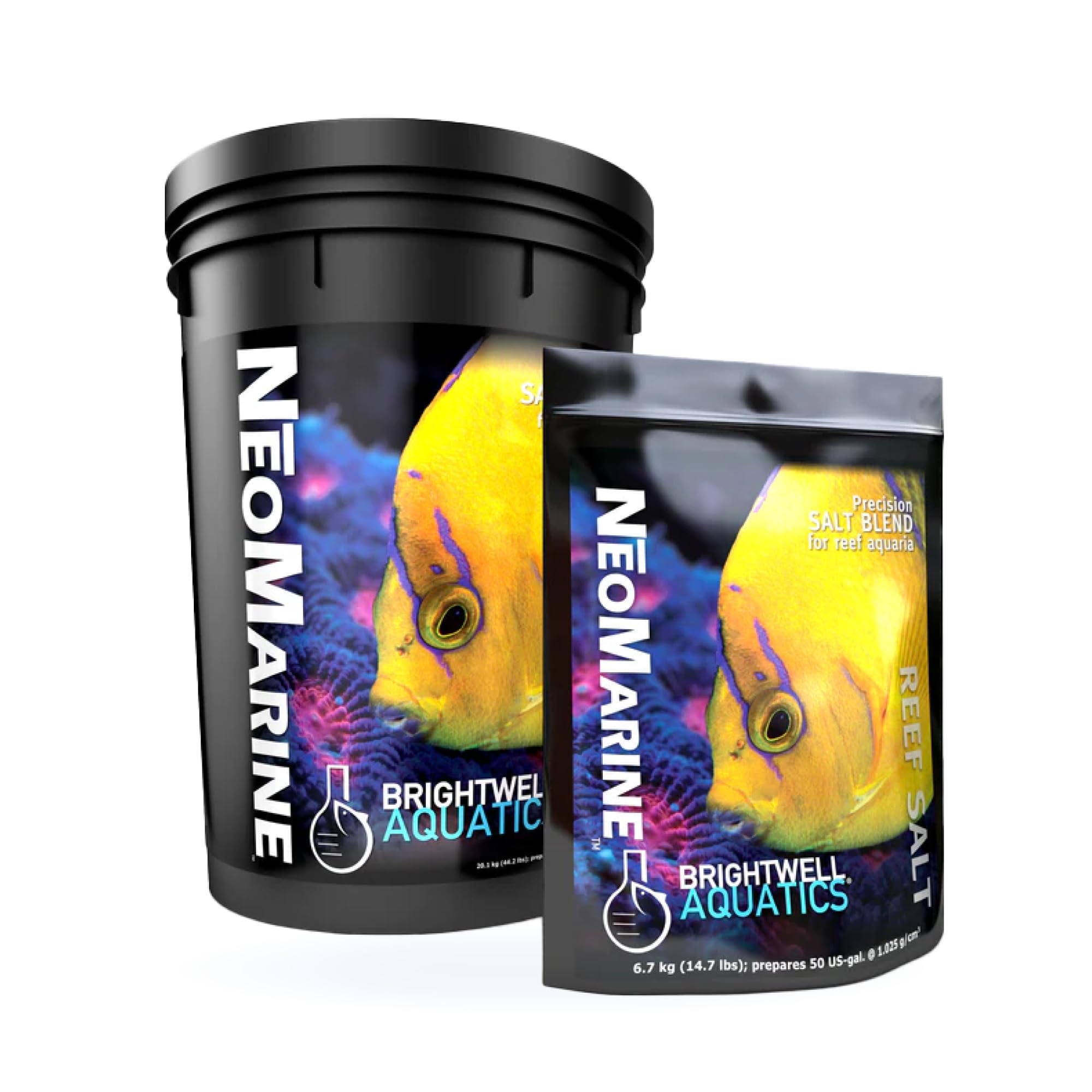
Brightwell NeoMarine stands out for its purity commitment: USP, ACS Reagent-grade, and FCC food-grade ingredients, with a production process that ensures uniform particle size. The salt mixes clear with minimal residue, and the recommended dose of 134.5 g per gallon delivers a specific gravity of about 1.025 and alkalinity of ~7.5 dKH.
Users switching from Instant Ocean brands often note that NeoMarine leaves less white film on mixing containers. The lower alkalinity (7.5 dKH) makes this an excellent baseline salt for aquarists who prefer to dial in alkalinity through targeted dosing rather than relying on the water change mix to do all the heavy lifting.
The 50-gallon bucket is compact and perfect for small-to-mid-sized tanks or nano reefs. A slight chemical odor when opening a fresh bucket is normal—it fades after a few minutes. Several reviewers with 90% SPS tanks switched to NeoMarine and reported improved coral polyp extension after moving away from higher-alk salts.
Why we love it
- Ultra-pure, reagent-grade ingredients
- Dissolves completely — no residue
- Predictable, stable alkalinity baseline
- Ideal base salt for customizable dosing
Good to know
- Lower alkalinity requires dosing for SPS
- Strong initial odor on opening
- Plain bucket — no inner bag for extra protection
- Premium price per gallon
5. Seachem Reef Kalkwasser 1 Kilo

Seachem Reef Kalkwasser is not a full-spectrum reef salt — it is high-purity calcium hydroxide (Ca(OH)2) used to prepare kalkwasser drips for maintaining calcium and alkalinity via top-off water. Saturated solution (2 tsp per gallon) supplies ~800 ppm calcium and raises pH, making it invaluable for tanks with high evaporation that need daily calcium delivery without manual dosing.
It works best when your evaporation rate draws enough saturated solution to meet demand. If your tank has low evaporation or extreme calcium/alkalinity consumption, you will still need supplemental dosing with Seachem’s Reef Advantage Calcium or Reef Builder. This is a supporting additive, not a water change salt.
The powder is fine and white — wear a dust mask if mixing dry to avoid inhaling particulates. Drip slowly: over-dosing kalkwasser can spike pH above 8.5 and cause calcium precipitation. Always drip with a peristaltic pump or a slow-drip valve, never pour directly into the tank.
Why we love it
- Supplies calcium and alkalinity simultaneously
- Boosts pH naturally without chemicals
- Requires minimal dosing equipment
- Economical way to maintain parameters
Good to know
- Not a complete salt for water changes
- Overdose risk — must drip slowly
- Dependent on evaporation rate
- Does not supply trace elements
6. ARKA Premium Reef Salt 1 Kilogram
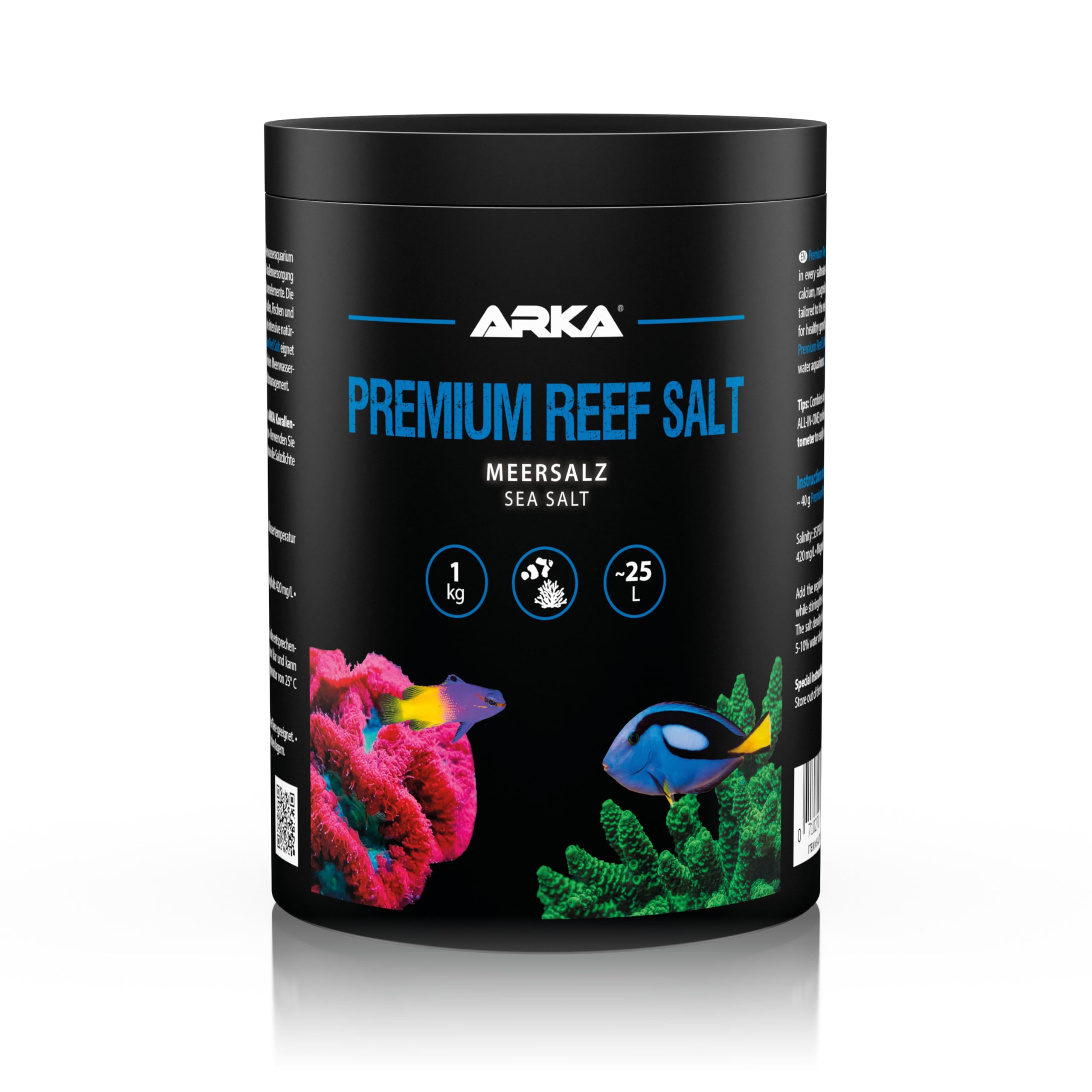
ARKA Premium Reef Salt delivers a phosphate- and nitrate-free formula tailored for small tanks, quarantine systems, or emergency top-offs. The fine granules dissolve rapidly in RODI water — most users report fully clear water within 5–10 minutes of mixing. The recommended dosage of 37 g per liter yields a density of 1.022, with parameters at pH 8.3–8.5, KH 8–10, Ca 430 mg/l, and Mg 1300 mg/l.
The 1 kg package makes it practical for nano reefs, species tanks, or as a backup salt when you run out mid-water-change. It does not include the enriched trace element load of premium brands, but for soft coral or fish-only tanks, it provides a stable baseline without driving up operating costs.
A few international reviewers noted that the package labeling is in German (ARKA is a German brand), but the mixing instructions are clear. The container is a plastic tub with a screw-top lid that seals well against moisture. For long-term LPS/SPS systems, you will likely want a larger volume salt, but for small-scale use this is a solid value.
Why we love it
- Phosphate and nitrate free
- Very fast dissolution — 5 min clear
- Compact package for nano tanks
- Consistent Ca/Mg ratio
Good to know
- Only 1 kg — not for large systems
- Labeling in German
- Lower trace element enrichment
- Density target is 1.022 vs typical 1.025
7. Red Sea Coral Pro Reef Salt Mix Large Bucket – Makes 175 Gallons

This is the same Coral Pro formula as the 200-gallon bag but supplied in a sturdy bucket with a resealable lid — the format that moisture-sensitive aquarists prefer. At 175 gallons per bucket, it offers the same elevated calcium, magnesium, and carbonate ratios that accelerate SPS skeleton deposition and enhance coral vitality.
The bucket is easier to store, scoop from, and seal than the bag variant. If you live in a humid climate or don’t have an airtight container for bulk salt, the premium for the bucket is worth the convenience. The salt dissolves quickly with a powerhead at 78°F, producing clear water with minimal foam.
Advanced SPS keepers running frag tanks often use Coral Pro as their exclusively reef salt, relying on its high alkalinity baseline (11–12 dKH) to support rapid growth without needing a calcium reactor. For mixed systems, test your first batch and adjust water change volume or frequency to avoid overshooting target alkalinity.
Why we love it
- Moisture-resistant bucket with secure lid
- Same high-alk formula as the bag version
- Supports accelerated SPS growth
- Easy to scoop and measure
Good to know
- More costly per gallon than bag
- High alkalinity may not suit all systems
- Heavy bucket — 55+ lbs shipping weight
- Not suitable for fish-only or low-demand tanks
FAQ
Can I mix different salt brands together?
Why does my salt leave a white residue in the mixing bin?
How long can I store mixed saltwater before using it?
Is high-alkalinity salt safe for soft corals?
Final Thoughts: The Verdict
For most reef keepers, the best salt for reef tank winner is the Red Sea Coral Pro 200G Bag because it delivers elevated calcium and alkalinity that fuel SPS growth while dissolving fast and clear. If you prioritize purity and prefer to control your own dosing schedule, grab the Brightwell NeoMarine 50G. And for budget-friendly entry-level performance, nothing beats the Instant Ocean Reef Crystals 160G.