
That mysterious bump on your dog’s skin can send any owner into a spiral of worry. Differentiating a harmless skin tag from a growing wart or a potential infection is the first hurdle, but finding a safe, effective treatment that won’t get licked off or irritate your pup’s sensitive skin is the real challenge. The wrong approach can lead to raw, inflamed patches and a miserable pet.
I’m Mo Mahin — the founder and writer behind Furric. I’ve spent years cross-referencing veterinary dermatology protocols against thousands of verified buyer experiences to identify which topical treatments genuinely resolve canine skin growths without causing secondary issues or requiring a costly vet visit for minor masses.
To cut through the internet noise, I’ve compiled the most effective options for addressing benign lumps and bumps at home. This guide breaks down the best skin tag remover for dogs based on real user outcomes, formulation safety, and practical application ease.
How To Choose The Best Skin Tag Remover For Dogs
Not all dog skin growths are the same, and neither are the treatments. Using a human-grade wart remover with salicylic acid on a dog can cause chemical burns, while a gentle antiseptic wipe will do nothing against a thick, keratinized tag. You need to match the tool to the growth type and your dog’s behavior.
Understand the Growth Type Before You Treat
The majority of canine skin tags are benign fibroblastic masses. Viral papillomas (often cauliflower-like) in young dogs usually resolve on their own. Histiocytomas in younger dogs are also self-limiting. If the bump bleeds, grows rapidly, or changes color, a vet needs to rule out mast cell tumors before any at-home removal attempt. For firm, fleshy tags that have remained unchanged for months, a topical drying agent or a gentle antiseptic that encourages sloughing is ideal.
Prioritize Non-Toxic, Lick-Safe Formulations
Dogs have an instinct to lick wounds and bumps. A treatment that is irritating or poisonous if ingested will cause more harm than the skin growth itself. Hypochlorous acid sprays and chlorhexidine-based wipes are safe if licked in small amounts, making them a first-line choice. Thick ointments or gels that form a protective film can also deter licking by creating a physical barrier, which keeps the active ingredient working longer.
Evaluate Your Dog’s Tolerance for Application
A squirmy, anxious dog will not tolerate a spray bottle directed at its face or a 10-minute wet-wrap application. In these cases, pre-moistened wipes or a quick-drying gel that requires only a dab are far more practical. For calm, senior dogs, a more intensive ointment regimen (twice daily) or even a sterile curette (used under professional guidance) might be feasible.
Quick Comparison
On smaller screens, swipe sideways to see the full table.
| Model | Category | Best For | Key Spec | Amazon |
|---|---|---|---|---|
| Vetericyn Plus Wound Spray | Spray | Open wounds & general skin repair | Hypochlorous acid, 8 oz | Amazon |
| Veterinus Derma Gel | Gel | Deep wounds & unbandageable areas | Protective film, 3.4 fl oz | Amazon |
| Creative Science WartsOff Ointment | Ointment | Hard warts on paws & legs | Thick cream, 4 oz jar | Amazon |
| Mal-A-Ket Wipes | Wipes | Fungal/bacterial issues & face folds | Chlorhexidine/ketoconazole, 50ct | Amazon |
| Surgical Design Curettes | Tool | Physical removal of dead layers | 3.00 mm sterile, 10-pack | Amazon |
In‑Depth Reviews
1. Vetericyn Plus Dog Wound Care Spray

This spray uses hypochlorous acid — a non-toxic compound that the body’s own white blood cells produce to fight bacteria. It is pH-balanced to match canine tissue, meaning it will not sting or burn when applied to raw, irritated skin around a healing tag site. Unlike caustic acids that burn off tissue, this solution supports the body’s natural healing cascade by keeping the wound bed clean and moist, which is critical when a skin tag has been scratched open or is oozing.
Owners report success using it 2-3 times daily on hot spots, small cuts, and those troublesome “chewed-off” tag sites. It dries quickly and leaves no sticky residue, which reduces the dog’s desire to lick the area. The 8-ounce bottle lasts through multiple treatment cycles, making it a cost-effective staple for any pet first aid kit.
The main trade-off is its limited physical drying power — this will not desiccate a thick, dry, horny wart the way a concentrated ointment might. It excels at preventing infection and speeding recovery after a tag has already been broken or removed, rather than actively dissolving a solid mass.
Why we love it
- Veterinarian-recommended and safe if licked
- Non-stinging formula works on sensitive areas like paw pads and face folds
- Versatile for cuts, hotspots, and post-removal site care
Good to know
- Not designed for drying out large, hard warts — better for healing wounds
- Spray nozzle can be difficult to aim on a moving dog; spray onto a cotton ball first
2. Veterinus Derma Gel

This is a unique “wound gel” that dries to form a transparent, flexible protective film over the affected area. It is designed for hard-to-bandage spots — between toes, around the tail, or on the flank — where a traditional wrap won’t stay put. For a skin tag that has been partially torn or a post-biopsy site, this gel seals the area from dirt and bacteria while keeping the tissue moist enough to heal without scabbing over too thickly.
The active mode here is physical protection, not chemical cauterization. Owners of dogs with stubborn flank ulcers or tail-tip wounds report that this gel stopped infection within 48 hours, even when oral antibiotics had failed. The 100ml tube provides roughly 20-30 applications, and the round-the-clock film effect means fewer re-applications compared to ointments that rub off.
Be aware that it is tacky during the initial drying phase, and dogs may try to lick it off in the first 5 minutes. Distracting your dog with a treat or a walk while it sets is essential. Once dry, the film is remarkably durable and stays on through normal movement and light activity.
Why we love it
- Creates a waterproof barrier without messy bandages
- Highly effective on unbandageable wounds and moist skin tag sites
- Fewer applications needed — lasts 12-24 hours per dose
Good to know
- Tacky during the 5-minute drying period; may need a distraction toy
- Not a standalone treatment for healthy, intact skin tags — best for post-removal care
3. Creative Science WartsOff Ointment

This 4-ounce ointment is a classic “drying” treatment designed for the thick, hard warts common on dogs’ paws and horses’ legs. The cream base stays put on application, which is critical for warts in high-movement areas. Multiple owners report that after 2-3 weeks of consistent twice-daily application, the wart softens, lightens in color, bleeds slightly, and eventually drops off.
The formula is breathable, meaning it allows air exchange even while creating a moist environment that softens the keratinized layer of the wart. This is a slower process than surgical removal, but it avoids the stress and cost of anesthesia for benign growths. Some reviewers mention that the ointment smells mild and is palatable to dogs, so you may need to use an Elizabethan collar or an anti-lick spray to keep the treatment in place.
The most frequent complaint is the time commitment — this is not a quick fix. Inconsistent application or missing a day can stall progress significantly. It also leaves a greasy residue on the fur around the wart, which can attract dirt if not wiped clean after each application.
Why we love it
- Effectively dries out and removes hard, established warts over 2-4 weeks
- Generous 4 oz jar provides many treatment cycles for multi-pet households
- Breathable formula reduces the risk of trapping moisture against the skin
Good to know
- Requires strict twice-daily application for results; skipping days resets progress
- Dogs may lick it off — plan for a collar or distraction during drying time
4. Mal-A-Ket Wipes

These medicated wipes combine chlorhexidine (antibacterial) and ketoconazole (antifungal) in a convenient pre-moistened format. They shine in cases where a skin tag or bump is accompanied by secondary yeast or bacterial infection — the red, itchy, moist dermatitis that often surrounds a chronically licked growth. The 2.25-inch round wipes are compact, making them perfect for cleaning face folds on flat-faced breeds like French Bulldogs and for wiping between toes where tags often develop.
Veterinarians frequently recommend these for managing “interdigital cysts” and facial fold pyoderma. Owners report that daily use stops paw biting within a day and significantly reduces redness and odor from yeast overgrowth within a week. The wipes are gentle enough for eyes and sensitive skin, though the medicinal vinegar-like scent is strong and some dogs object to the smell initially.
These are not a stand-alone tag remover — they lack the drying power to desiccate a solid fibrous tag. Their role is to clean the area, reduce inflammation, and prevent infection, setting the stage for a more targeted drying agent or allowing a minor tag to shrink on its own as the skin health improves.
Why we love it
- Vet-recommended dual-action formula for yeast and bacteria
- Non-stinging, gentle enough for facial folds and paw pads
- Easy, mess-free daily application — no spraying or dripping
Good to know
- Small size (2.25″) means you may need 2-3 wipes for a large area
- Not formulated to actively remove existing skin tags — a supportive product
5. Sterile Disposable Dermal Curettes (3.00 mm)
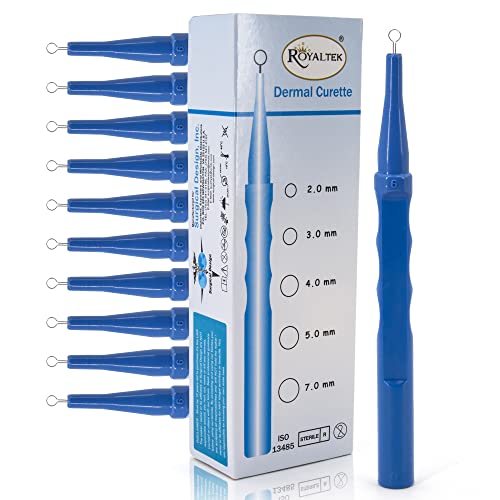
This is a stainless steel surgical tool designed for scraping away dead tissue or the surface layers of a wart. It is the most direct physical method in this list, and it requires a steady hand and a clear understanding of anatomy. Owners have used these 3 mm curettes on planter warts on themselves and on hard, callous-like skin tags on dogs — typically after soaking the area to soften the tissue.
The curette is extremely sharp, with a dynamic gripping handle that gives the user precise control. The sterile, individually packed format ensures you are not introducing bacteria into the site. Some reviewers warn that the first use can be aggressive and cause bleeding if you dig too deep, so the learning curve is real.
This tool is best reserved for thick, non-painful growths where a topical has failed or where a veterinarian has directed you to debride the area. It is not a first-line treatment for a sensitive, vascular tag. Used correctly, it can remove a wart in minutes rather than weeks, but the risk of infection, scarring, or pain if misused is higher than with any topical option.
Why we love it
- Extremely sharp edge for efficient debridement of dead tissue
- Individually sterile-packed to maintain clean technique
- Ergonomic handle provides comfortable grip during precise work
Good to know
- High skill required — risk of cutting too deep or causing infection
- Not ideal for vascular or sensitive skin tags; bleeding is common
FAQ
Can I use a human skin tag remover on my dog?
How do I know if a dog skin tag is cancerous?
Will the skin tag grow back after treatment?
Final Thoughts: The Verdict
For most dog owners looking for a safe, versatile, and vet-endorsed first-line option, the skin tag remover for dogs winner is the Vetericyn Plus Wound Spray because it works on healing any raw tag site while being completely non-toxic if licked. If you are dealing with a thick, stubborn wart on a paw and can commit to a twice-daily routine, grab the Creative Science WartsOff Ointment. And for managing itchy, infected areas around a tag or keeping French Bulldog face folds clean, nothing beats the Mal-A-Ket Wipes.