
The difference between a clean jump and a lost stirrup often comes down to the interface between your boot and the iron. Standard flat-bottom stirrups demand constant calf tension to keep your foot planted, creating micro-adjustments that break your position at the apex of a fence. The engineering problem is simple: you need a foothold that releases in an emergency but refuses to slip during take-off, landing, and the stride in between.
I’m Mo Mahin — the founder and writer behind Furric. I’ve spent thousands of hours cross-referencing tensile load tests, analyzing polymer versus aluminum fatigue ratings, and mapping owner feedback against real-world jumping conditions across every major equestrian equipment manufacturer to separate genuine safety innovations from cosmetic updates.
Whether you are recovering from a knee injury, schooling a green horse over crossrails, or competing at the 1.30m level, selecting the right stirrups for jumping means understanding how footbed width, joint articulation, and release mechanisms interact with your specific boot profile and riding discipline.
How To Choose The Best Stirrups For Jumping
Jumping stirrups must solve a contradiction: they need to provide an immovable platform under heavy load through take-off and landing phases, yet release instantly if your body separates from the saddle. The wrong choice can cause foot slippage at the wrong moment or, conversely, fail to release during a fall. Here are the three critical specifications to evaluate.
Release Mechanism Safety
There are three dominant safety architectures: side-opening arms that hinge outward under lateral pressure, 4-way pivot joints that allow the footbed to rotate and twist, and fixed breakaway bars that shear under extreme load. For jumping specifically, side-opening and 4-way pivot designs are most common because they retain structural rigidity during normal riding while still offering emergency release. Fixed breakaway designs can trigger prematurely on landing if your foot drives sideways.
Footbed Width and Tread Material
A narrow footbed forces your boot into a wedge position, concentrating pressure on the ball of your foot and reducing stability over fences. Look for a minimum internal width of 4.5 inches for adult riders. The tread material matters as much as the width — hand-laced leather with rubber pads offers the best grip-to-slip ratio because the rubber provides immediate bite while the leather base conforms slightly to your boot sole. Composite or rubberized inserts on aluminum or stainless steel frames clean faster but can lose grip when wet or dusty.
Joint Articulation for Joint Relief
Rigid stirrups transmit every landing shock directly through your ankle, knee, and hip. Jointed or swivel-tread stirrups reduce this force by allowing the footbed to tilt and rotate in response to your lower leg position. The Sprenger 4-jointed system, for example, pivots simultaneously in four directions, mimicking natural joint movement. However, too much articulation can create a feeling of instability under a rider with an unsteady leg. Riders rehabbing knee injuries should prioritize polymer jointed designs, while experienced jumpers with strong lower legs can benefit from metal jointed systems that offer more feedback.
Quick Comparison
On smaller screens, swipe sideways to see the full table.
| Model | Category | Best For | Key Spec | Amazon |
|---|---|---|---|---|
| AJ Tack Aluminum Angled Wide | Mid-Range | Knee relief & wide foot stability | 5″ wide bottom, angled 3° | Amazon |
| Compositi Reflex 3D Wide Track | Mid-Range | Lightweight shock absorption | 3D swivel tread, 4.75″ wide | Amazon |
| Tough 1 EZ Out Safety | Mid-Range | Emergency release for all levels | Spring-loaded side release | Amazon |
| ACAVALLO Arena Alupro | Premium | Certified safety with rigid stability | TUV Rheinland tested, 12cm width | Amazon |
| Sprenger 4 Jointed Security | Premium | 4-direction pivot & joint relief | 120mm, 4-way pivot system | Amazon |
| Herm Sprenger Bow Balance 4-F | Premium | Knee pain reduction & leg position | Bow Balance, 4-way pivot, 4.75″ | Amazon |
| Bow Balance Stirrup Stainless Steel | Premium | Shock absorption & foot security | 120mm stainless steel, 4-way pivot | Amazon |
In‑Depth Reviews
1. AJ Tack Aluminum Angled Wide Stirrups

The AJ Tack Aluminum Angled Wide Stirrups hit the sweet spot between affordability and targeted joint relief. Built from heavy-duty aluminum with a 3-inch neck and a 5-inch wide footbed measured from the inside, these stirrups provide the broadest landing surface in this review. The angled shape positions your foot into a natural alignment, which directly reduces torque on the knee joint — a feature riders with replaced or damaged knees consistently highlight in their feedback.
The hand-laced leather tread with stitched-on rubber pads delivers immediate grip without requiring you to clamp down with your calf. At 2.9 pounds per pair, they are noticeably heavier than composite options, but that weight contributes to a planted feel under foot during the landing phase of a jump. The rubber pads hold traction even when the arena footing is dusty or the leather has picked up moisture.
One limitation to note: the generous 5-inch wide bottom may not fit narrow stirrup leathers or smaller boot profiles comfortably. Riders with boots narrower than a standard men’s size 8 may find the platform overshoots their sole width, creating unnecessary bulk. The silver aluminum finish also shows scuffs readily, though this is purely cosmetic.
Why we love it
- Angled design significantly reduces knee and ankle pressure during and after long jumping sessions.
- The 5-inch wide platform offers exceptional stability for riders with larger feet or previous leg injuries.
- Hand-laced leather plus rubber tread provides superior grip across different moisture and dust conditions.
Good to know
- At 2.9 pounds, these are heavier than composite jointed stirrups, which may tire some riders over long courses.
- The wide footbed does not suit narrow boot profiles; best for men’s size 8 or larger.
- No emergency side-release mechanism — the angle and width provide stability, not breakaway safety.
2. Compositi Reflex 3D Wide Track Stirrups
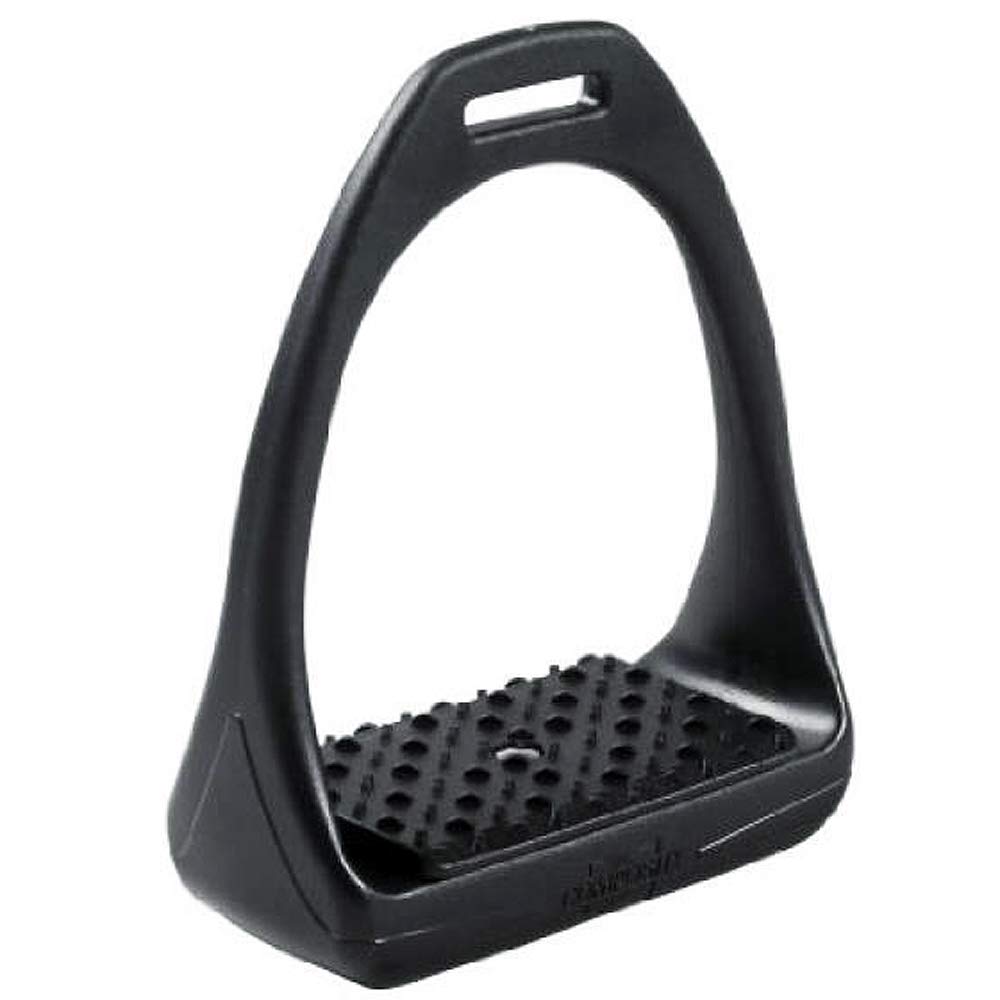
The Compositi Reflex 3D stirrups weigh roughly half of what the aluminum AJ Tack pair does, thanks to their hi-tech polymer construction sourced from DuPont. The 3D swivel-action tread rotates independently from the main stirrup body, allowing your foot to maintain full contact with the tread as your ankle rolls through the jump stride. Riders note this swivel reduces ball-of-foot pressure and keeps the leg longer and quieter over fences compared to fixed treads.
The non-slip sole pattern is aggressive enough to prevent forward foot slippage during take-off, but one rider flagged that the grippy texture makes it harder to intentionally adjust foot position mid-course. The quick foot release on the side is a standout safety feature — the polymer flexes under lateral pressure to free your boot in a fall, then snaps back into shape without any tools or complicated reset procedures.
The main drawback reported by multiple owners is the narrow internal width. Despite the “Wide Track” branding, the 4.75-inch measurement runs small, and a significant number of adult reviewers found these better suited for youth or narrow adult feet. At 0.48 kilograms per pair, they are exceptionally easy to pack and carry, but riders with wide boots should treat the sizing with caution.
Why we love it
- The 3D swivel tread independently moves with your ankle, reducing joint fatigue and improving lower leg position.
- Extremely lightweight polymer construction is easy on the saddle and convenient for travel.
- Safety release mechanism resets automatically without tools after emergency deployment.
Good to know
- Narrow footbed, despite marketing — not suitable for riders with wide feet or bulky boots.
- The aggressive grip tread resists mid-course foot adjustments, which may bother riders who shift foot position frequently.
- Durability of the hi-tech polymer under repeated heavy landing impacts is not as proven as aluminum or stainless steel alternatives.
3. Tough 1 EZ Out Safety Stirrups

The Tough 1 EZ Out stirrups prioritize one job above all else: making sure a rider never gets dragged. The spring-loaded outside release mechanism opens the entire side of the stirrup when lateral pressure exceeds a threshold — exactly the kind of force applied when a rider’s body separates from the saddle in a fall. This is the only stirrup in this review where the release feature is mechanically dedicated rather than relying on polymer flex or joint collapse.
At 2 pounds per pair, the aluminum construction feels solid without being burdensome. The rubber grip tread provides enough traction for jumping work, and the 3-inch neck fits standard stirrup leathers — though several reviewers noted the actual opening measures closer to 2.75 inches, so it will not accommodate thick or padded leathers. The reset is straightforward: simply push the side arm back into the locked position after release.
Where these fall short for jumping-specific use is the weight distribution. Riders who transition from composite stirrups comment that the EZ Out feels heavier and less responsive under foot during quick transitions. The rubber tread also shows wear faster than leather alternatives, especially if you school regularly in an indoor arena with deep footing. Additionally, the release mechanism can be accidentally triggered if your horse brushes a jump standard or a wall.
Why we love it
- Dedicated spring-loaded side release provides the most reliable emergency exit of any stirrup in this review.
- Resets quickly by hand with no tools — parents find this especially reassuring for young riders.
- Aluminum body offers solid durability without the premium price tag of European-engineered options.
Good to know
- The 3-inch neck measurement is inaccurate; actual opening is approximately 2.75 inches, limiting leather compatibility.
- Heavier than composite stirrups and less responsive for riders who prioritize feel and feedback.
- The spring release can open accidentally if the stirrup contacts jump wings or arena walls.
4. ACAVALLO Arena Alupro Stirrup

The ACAVALLO Arena Alupro is the only stirrup in this review that carries a comprehensive safety certification from TUV Rheinland in Germany, meaning its side-opening HiFLex mechanism has been tested under lab conditions to deploy reliably under specific load scenarios. The mechanism uses a stress-activated locking and release system — unlike a simple spring or polymer flex, it locks securely during normal riding and only opens when the force vector indicates a genuine fall.
The continuous integrated metal construction from the inner arm through the footplate gives this stirrup a rigid, unyielding feel that jumping riders with a strong lower leg appreciate. The footbed measures 12cm (approximately 4.75 inches) wide and the metal tread provides excellent feedback — you feel exactly where your boot is positioned relative to the iron without needing to look down. Riders report zero foot movement even through awkward jumping refusals or deep landings.
The trade-off for that rigid stability is a loss of shock absorption. Unlike jointed polymer stirrups, the Alupro transmits landing impact directly into your joints. Riders with existing knee or ankle sensitivity should approach with caution. The metal base also collects sand and dust from the arena more aggressively than rubber or composite treads, though a hoof pick or stiff brush cleans it quickly.
Why we love it
- Patented HiFLex safety release is TUV-certified — the most rigorously tested release mechanism in this comparison.
- Continuous metal construction from arm to footplate provides exceptional rigidity for confident jumping.
- Riders report zero foot movement even through refusals, rough landings, and tight turns.
Good to know
- Rigid construction transmits landing shock directly to joints — not ideal for riders with pre-existing knee or ankle issues.
- Metal tread collects arena grit and dust, requiring frequent cleaning between sessions.
- At a premium price point, this is a significant investment for a single pair of stirrups.
5. Sprenger 4 Jointed Security Stirrup Irons

The Herm Sprenger System-4 stirrup is the most mechanically sophisticated option here. Its patented design uses four independent joints that allow the stirrup to pivot simultaneously in all four directions, mimicking the natural range of motion of the ankle, knee, and hip. This multi-planar articulation softens the impact load on cartilage and ligaments — riders with chronic knee pain consistently describe these as a transformative addition to their tack.
Stainless steel construction gives the 4 Jointed stirrup premium heft without being excessively heavy. The black non-slip rubber inserts keep your foot locked in place, and the 120mm (4.75-inch) size works well for adult riders with standard-width boots. An important dimensional note: the shock-absorbing side rubber covers reduce the actual available space for the boot by 10mm, meaning a 120mm stirrup functions closer to 110mm internally.
The biggest real-world limitation for jumpers is the jointed sensation itself. Some riders find the independent movement of the four joints creates a feeling of instability under foot, especially during the landing phase when the stirrup needs to provide a solid base to push against. These are also not suitable for USEF-rated hunter competitions that require traditional stirrup designs. And at 2 pounds, they are heavy enough that the rubber covers can add noticeable mass on the saddle for smaller riders.
Why we love it
- Four-directional pivot system is unmatched for joint relief — repeatedly cited for eliminating knee and ankle pain during and after riding.
- Stainless steel frame with rubber inserts provides exceptional durability and solid grip across temperature ranges.
- German engineering with a 2-year manufacturer guarantee speaks to build quality.
Good to know
- Rubber side covers reduce internal width by 10mm; you must order up from your normal stirrup size.
- The jointed feel can feel unstable for riders, especially during landing; not for beginners.
- Prohibited in many USEF hunter show rings; best suited for schooling and lower-level competition.
6. Herm Sprenger Bow Balance Safety Stirrups 4-F

The Bow Balance 4-F from Herm Sprenger takes the 4-way pivot concept and refines it into a slightly more compact package. The anthracite stainless steel finish resists scratches better than polished silver, and the Bow Balance geometry is engineered to reduce the risk of the foot becoming trapped — the stirrup shape naturally guides the boot out during a fall rather than holding it in place.
Rider feedback consistently highlights two benefits: knee pain reduction and leg position improvement. The Bow Balance promotes a deeper heel and a longer leg line, which directly translates to a more secure base over fences. Multiple reviewers with over 40 years of riding experience describe these as providing immediate relief from chronic knee and hip discomfort that conventional stirrups had been exacerbating for decades.
The 4-F size (4.75 inches) fits adult boots well, but the same 10mm reduction from the rubber side covers applies here. A smaller concern is that the Bow Balance shape, while effective at preventing trapping, can make it more difficult to find the stirrup quickly if you lose it mid-course — the angled arms require a slightly different pick-up motion than traditional irons. The weight of 2.3 pounds per pair is comparable to other premium stainless steel models.
Why we love it
- Bow Balance geometry significantly reduces foot trapping risk while maintaining structural integrity for jumping.
- Veteran riders with long-standing knee and hip pain report immediate, noticeable relief in the first ride.
- The anthracite finish hides scuffs and wear better than standard silver stainless steel.
Good to know
- Rubber side covers reduce the internal width by 10mm — verify boot clearance before purchasing.
- The Bow Balance shape can be harder to find with your foot when you lose a stirrup mid-course.
- Premium price point places this in the same investment bracket as high-end saddlery hardware.
7. Bow Balance Stirrup Stainless Steel

The standard Bow Balance Stainless Steel stirrup shares the same 4-way pivot and safety-release design philosophy as the 4-F model but comes with a black/blue color scheme and slightly different rubber cover geometry. Owners describe these as lighter than the rubber-jointed competition stirrups they replaced, despite being made of stainless steel, and the 12cm (approximately 4.75-inch) footbed provides stable real estate for jumping.
The key benefit that distinguishes this model is the clarity of feedback. The Bow Balance pivot communicates every shift in your lower leg position directly to your seat, making it easier to self-correct during a course. Riders note that their horses respond more consistently to leg aids because there is no unwanted stirrup movement masking the signal. The improved stability also helps riders keep their heels down without conscious effort — a direct result of the footbed staying parallel to the ground through the jump arc.
Potential complications include the need to lift your foot deliberately when dismounting — the Bow Balance geometry that prevents trapping also requires a conscious upward motion rather than just sliding forward. The stainless steel construction, while durable, adds enough mass that smaller riders or those using lightweight saddles may notice the additional weight. Long-term owners report the rubber covers eventually lose elasticity after two to three years of heavy use.
Why we love it
- Excellent feedback transmission — riders feel exactly where their foot is positioned and can correct mid-stride.
- Promotes a natural deep heel position that improves jumping form without conscious effort.
- Durable stainless steel construction withstands years of weekly schooling and competition use.
Good to know
- Requires a deliberate upward foot motion to dismount — not a slide-out design.
- Rubber side covers may degrade after 2-3 years of regular use and need replacement.
- Weight is noticeable for smaller riders or when paired with lightweight jump saddles.
FAQ
What is the ideal footbed width for jumping stirrups?
Are jointed stirrups safe for beginner jumpers?
How do I measure my boot size for stirrup width?
Can I use dressage stirrups for jumping?
What causes stirrup rub and how do I prevent it?
Final Thoughts: The Verdict
For most jumping riders, the stirrups for jumping winner is the AJ Tack Aluminum Angled Wide Stirrups because they combine a 5-inch wide angled footbed with hand-laced leather grip at a price point that makes knee-friendly jumping accessible without requiring premium stainless steel investment. If your primary concern is joint relief and you are comfortable with the pivot sensation under foot, grab the Sprenger 4 Jointed Security Stirrup Irons. And for riders who prioritize emergency release above all else — especially those schooling young horses or jumping cross-country cross rails — nothing beats the Tough 1 EZ Out Safety Stirrups for its dedicated spring-loaded side-opening mechanism that resets by hand in seconds.