
When your dog feels warm, lethargic, or off, waiting and wondering wastes critical hours. A rectal thermometer is the only accurate way to check a canine fever, but wrestling a squirming 70-pound lab while balancing a glass mercury stick is a recipe for frustration. The digital tools in this guide are designed to change that equation entirely.
I’m Mo Mahin — the founder and writer behind Furric. Over the past 15 years, I’ve analyzed thousands of pet product specifications, compared veterinary-grade sensor accuracy claims, and cross-referenced owner-reported temperature consistency data to separate the reliable thermometers from the gimmicks.
A fast, accurate reading keeps you from overreacting or under-reacting to your dog’s illness. That is exactly why the best thermometer for dogs is a purchase every responsible pet owner should consider before an emergency strikes.
How To Choose The Best Thermometer For Dogs
Picking the right thermometer goes beyond grabbing the cheapest option. The accuracy, speed, and invasiveness of the reading depend entirely on the type of sensor and probe design you choose.
Probe Material and Length
Stainless steel probes are standard for veterinary use because they are non-porous, easy to disinfect, and conduct heat fast. A 5-inch probe lets you reach the correct depth for large dogs without your hand getting in the way; shorter 3-inch probes are better for puppies and cats but may not seat deeply enough for a 100-pound retriever. Plastic probes are cheaper but hold onto residue and clean less effectively.
Rectal vs. Infrared vs. Ear
Rectal thermometers are the gold standard for accuracy, with most digital units hitting ±0.2°F or better. Ear and non-contact infrared (belly scan) thermometers are faster and less stressful for the animal, but they are typically ±0.5°F off and can vary wildly based on fur thickness, ear canal debris, or ambient temperature. If you need a definitive fever diagnosis, rectal is the only route that veterinarians trust without a second reading.
Readout Speed and Battery Longevity
Look for units that stabilize within 8 to 15 seconds — faster models use better thermistors. Battery life matters too: coin-cell LR44 batteries tend to die faster than AAA-powered models, and losing power mid-reading is frustrating. A low-battery indicator is a small feature that saves big headaches.
Quick Comparison
On smaller screens, swipe sideways to see the full table.
| Model | Category | Best For | Key Spec | Amazon |
|---|---|---|---|---|
| Sharptemp-V | Rectal | Large dogs & livestock | 5-inch stainless steel probe | Amazon |
| PetMedics by iHome | Infrared | Stress-free fast scans | Non-contact belly/ear scan | Amazon |
| Aurynnns Pet Digital | Rectal | Horses & large animals | 9-inch probe length | Amazon |
| Hurinan Rectal | Rectal | Medium dogs & puppies | 3-inch probe diameter | Amazon |
| MEETI Ear Monitor | Infrared Ear | Quick cat & dog ear temp | 2-second reading time | Amazon |
In‑Depth Reviews
1. Sharptemp-V Veterinary Livestock Thermometer

The Sharptemp-V is the closest thing to a veterinary clinic standard packed into a home-use tool. Its 5-inch surgical-grade stainless steel probe is 3/16-inch in diameter with a blunt, rounded tip that reduces discomfort during insertion. The unit delivers a stable reading in 8 to 10 seconds with an audible beep, and the large 3/8-inch LCD digits are legible even in dim barn lighting. The accuracy spec of ±0.1°F is tighter than most consumer pet thermometers, which typically settle for ±0.2°F.
Durability is clearly a design priority here. The body is a tough plastic shell with a woven nylon lanyard for wrist security, and the friction-fit probe cover snaps on to protect the tip between uses. It comes with a hard polyethylene storage case and a single user-replaceable LR44 coin battery. The only real friction point is the power button — you have to hold it down to turn the unit on and off, which feels slightly dated compared to a simple press mechanism.
For owners of large dogs, horses, or livestock, this is the most reliable rectal thermometer on the list. The 5-inch length ensures you get deep enough for an accurate core reading without your hand getting in the way, and the 100-hour battery life means it stays ready through a full season of sick checks. The CE approval and one-year warranty add confidence, though a few buyers reported receiving units without a battery — worth double-checking when the box arrives.
Why we love it
- ±0.1°F veterinary-grade accuracy
- 5-inch stainless steel probe for deep insertion
- Beeps when stable, no timing guesswork
Good to know
- LR44 battery may not be included in every batch
- Button must be held to power on/off
2. PetMedics by iHome Non-Contact Infrared Thermometer
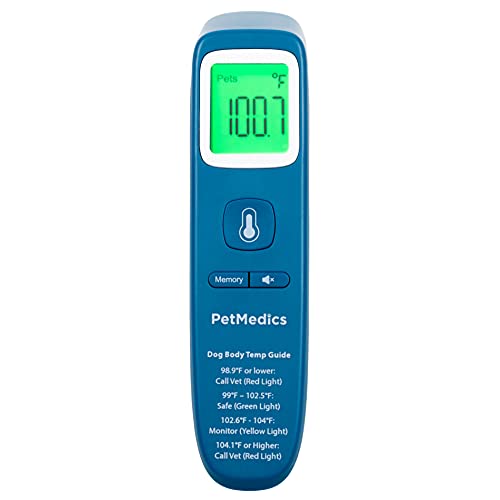
The PetMedics by iHome aims to eliminate the struggle entirely. Point the infrared sensor at your dog’s belly or inner ear, press the button, and the temperature appears on a large LCD display in about two seconds. It comes with a reference card showing normal, elevated, and high temperature ranges, which is a thoughtful addition for first-time owners who don’t know a dog’s baseline (typically 101–102.5°F). The unit is powered by two AAA batteries that are included, and a soft carry pouch keeps it clean between uses.
The non-contact approach is genuinely less invasive — no wrestling, no restraint needed for most calm dogs. However, accuracy consistency is this unit’s Achilles’ heel. Multiple verified buyers reported readings that swung as much as 5°F between scans on the same spot, and the sensor seems to struggle with cats and small dogs whose body surface area is small. For dogs with thick double coats, moving from the ear to the belly often improved consistency, but it added another variable to the process.
This thermometer is best used as a screening tool rather than a diagnostic device. If it reads high, follow up with a rectal thermometer to confirm before making any medical decisions. The PetMedics is perfect for daily spot-checks on a healthy dog but should not be your sole tool during a suspected fever. The backlit display and fast scan make it ideal for checking a sleeping dog without waking them.
Why we love it
- Two-second non-contact scan reduces stress
- Backlit display readable in low light
- Includes reference card for temperature ranges
Good to know
- Inconsistent readings with some dogs
- Not reliable for cats or very small pets
3. Aurynnns Pet Digital Anus Thermometer
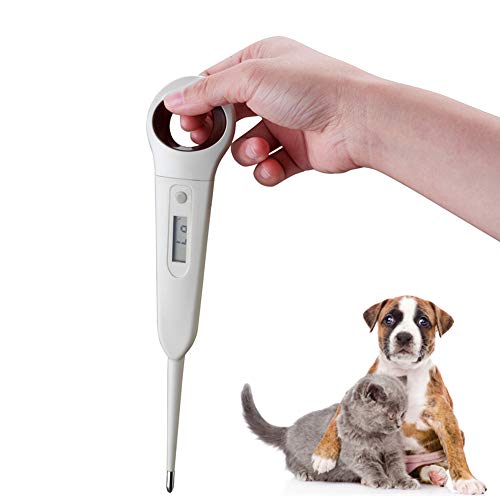
With a 9-inch probe, the Aurynnns thermometer is built for horses and cattle first, but it works well for the largest dog breeds too — think Great Danes, Mastiffs, or Saint Bernards where a standard 5-inch probe comes up short. The LCD screen is large and clear, and the loop at the end of the unit is big enough to thread a tether through, which is critical when you’re behind a horse that might kick. The ABS plastic body is lightweight but feels solid in the hand.
Speed is slightly slower than the Sharptemp — owners report readings taking closer to 15 to 20 seconds to stabilize. The unit tends to read about 1°F cooler than a mercury thermometer, so you may need to mentally adjust, though most digital users will never cross-check against glass. The temperature range spans 58°F to a high enough ceiling for any mammal fever, and the 9-inch immersion depth makes it impossible to insert too shallowly on any dog.
For most dog owners, a 9-inch probe is overkill and potentially uncomfortable for a medium-sized pet. But if you own horses or giant breeds, this thermometer is purpose-built for the job. The tether eyelet alone is a feature you won’t find on any other canine-specific thermometer, and the rugged build suggests it will survive years in a barn environment. Buyers should note it comes with only one LR44 battery — keep a spare on hand.
Why we love it
- 9-inch probe reaches deep for large animals
- Built-in eyelet for tethering during use
- Very clear digital readout
Good to know
- Reads ~1°F cooler than mercury
- Oversized for puppies and small dogs
4. Hurinan Rectal Thermometer for Pets
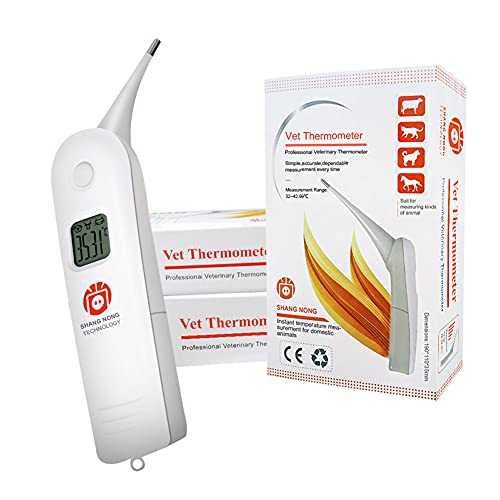
The Hurinan positions itself as a budget-friendly entry point without sacrificing the core specs that matter. Its 3-inch probe has a smaller diameter than most, making it a better fit for puppies, cats, and rabbits where a full-size thermometer would be uncomfortable. The large 4-digit LCD is easy to read, and the accuracy spec of ±0.2°F is in line with what most vet clinics expect. It operates on two AAA batteries, which are much easier to find than coin cells when you run out at 2 AM.
Build quality is the trade-off. Several verified reviews note that the plastic latches holding the battery cover in place snapped on the second use — the unit still works, but the cover has to be taped on afterward. The probe surface is smooth plastic rather than stainless steel, which means it can retain odors and is slightly harder to fully disinfect. Reading time falls in the 10 to 20-second range, which is on par with other thermometers at this price tier.
For a home with a medium-sized dog and no livestock, the Hurinan offers a perfectly usable experience at a cost that won’t make you wince. The smaller probe is genuinely easier for nervous first-time users to handle, and the consistent accuracy reported by most buyers means you can trust the number on the screen. Just handle the battery cover with care — it is the single point of failure on an otherwise solid device.
Why we love it
- Compact 3-inch probe suits puppies and cats
- Uses standard AAA batteries
- Consistent ±0.2°F accuracy
Good to know
- Battery cover latches are fragile
- Plastic probe harder to fully disinfect
5. MEETI Cat and Dog Ear Temperature Monitor

The MEETI Ear Monitor takes the non-contact concept and focuses it specifically on the ear canal, which should theoretically give a more consistent reading than belly scanning. It claims a ±0.36°F accuracy and delivers results in about two seconds. The unit comes with four AAA batteries including one spare, and the ergonomic design fits comfortably in one hand. It is marketed for dogs, cats, horses, and rabbits, making it a versatile addition to a multi-pet household.
In practice, the MEETI struggles most with cats and small dogs whose ear canals are narrow or heavily furred. Multiple verified cat owners reported getting wildly different readings — sometimes 98°F, sometimes 103°F — on the same animal within minutes. For medium to large dogs with clean, open ear canals, the consistency improves significantly, but the margin of error is still wider than a rectal thermometer. The unit is lightweight and drops easily; one buyer noted it broke after a single fall onto a hard floor.
This is a reasonable option if you have a cooperative, large-breed dog and want a quick, low-stress temperature check for routine monitoring. It is not suitable for diagnostic accuracy when you suspect a fever or illness. The inclusion of four AAA batteries is generous and suggests the manufacturer expects heavy usage, but the reliability gap between ear and rectal readings means this should be a secondary tool in your pet health kit.
Why we love it
- Two-second result with no restraint needed
- Comes with 4 AAA batteries
- Ergonomic grip for one-hand use
Good to know
- Inconsistent readings on cats and small dogs
- Fragile plastic if dropped
FAQ
What is the normal temperature range for a dog?
Can I use a human thermometer on my dog?
How long should I wait for the beep?
Are ear thermometers as accurate as rectal?
Final Thoughts: The Verdict
For most dog owners, the best thermometer for dogs winner is the Sharptemp-V because its 5-inch stainless steel probe delivers ±0.1°F clinical accuracy in 10 seconds with a rugged build that lasts. If you want zero-stress scanning without handling your dog, grab the PetMedics by iHome for quick belly or ear checks. And for owners of giant breeds or horses who need extra probe length, nothing beats the Aurynnns 9-inch with its unique tether eyelet.