
A foul, dark discharge seeping from the central cleft of your horse’s frog is the unmistakable signature of thrush — an anaerobic bacterial infection that thrives in moisture and debris trapped inside the hoof. Left unchecked, it migrates deep into sensitive structures, causing lameness that can sideline even the most stoic mount. The right treatment halts this process quickly, restores hoof integrity, and keeps your horse sound.
I’m Mo Mahin — the founder and writer behind Furric. I spend my time cross-referencing veterinary microbiology guidelines against real-world owner reports and farrier recommendations to isolate the formulas that deliver measurable, repeatable results against common equine hoof pathologies.
Whether you prefer a dry powder that wicks moisture or a deep-penetrating liquid that stains for visual tracking, this guide cuts through the noise to help you confidently choose the best thrush treatment for horses.
How To Choose The Best Thrush Treatment For Horses
The ideal thrush treatment depends on the severity of the infection, your horse’s environment, and how much time you can commit to daily hoof care. Three factors separate an effective product from a temporary cover-up.
Formula Type: Dry Powder vs. Liquid Solution
Dry powders — typically kaolin clay or medicated dusts — adhere to the moist environment in the frog cleft and absorb the exudate while delivering active ingredients directly. They excel in wet climates because they physically dry the area. Liquids, often containing copper iodine or other antiseptics, penetrate deeper into crevices and white-line separations. The trade-off is staining: many liquids leave a visible mark that fades as the hoof heals, providing a clear indicator of reapplication timing.
Active Ingredient & pH Profile
Effective thrush treatments rely on compounds that are hostile to anaerobic bacteria without cauterizing healthy tissue. Look for formulations that list non-caustic, non-staining properties alongside proven antibacterials like iodine complexes, copper sulfate, or natural clays with adsorptive capacity. Harsh chemicals that burn the frog delay regeneration and can create a chemical burn that mimics the original infection.
Application Frequency & Container Size
A treatment that requires daily application for two weeks will be used more consistently if the packaging fits your routine. Small 2-ounce bottles are fine for single-horse households treating an acute flare-up, while barns managing multiple horses or chronic cases benefit from 8-ounce or larger containers. Check the estimated number of applications per bottle to avoid running out mid-treatment.
Quick Comparison
On smaller screens, swipe sideways to see the full table.
| Model | Category | Best For | Key Spec | Amazon |
|---|---|---|---|---|
| Thrush Buster | Liquid | Daily maintenance in wet paddocks | Purple stain indicator 2 oz | Amazon |
| Vetericyn Equine Hoof Care | Liquid | Deep penetration into white line | 8 oz blue solution | Amazon |
| Four Oaks Farm No Thrush | Powder | Moisture absorption + wound care | Kaolin clay dry powder 2.5 oz | Amazon |
| Accuhoof Grooms Hand Thrush Solution | Liquid | Convenient 4-oz single-horse use | 4 oz plastic container | Amazon |
| Durvet Pierce’s Nu-Stock | Oil | Multi-species skin & hoof issues | 12 oz sulfur-based oil | Amazon |
In‑Depth Reviews
1. Thrush Buster Liquid Hoof Treatment
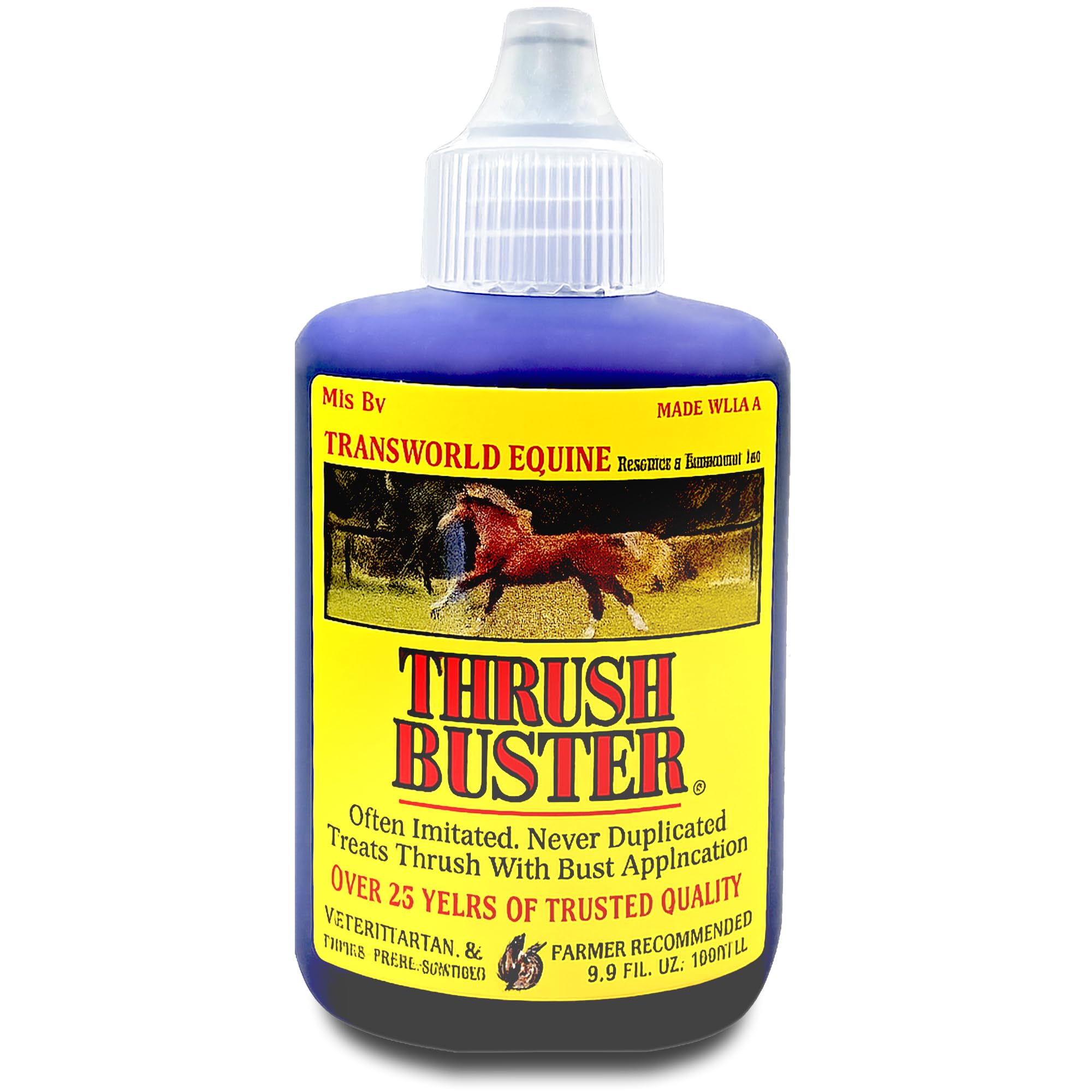
The Thrush Buster formula uses a thin liquid consistency that flows deep into the frog cleft and white-line separations, reaching areas a brush cannot. The purple stain remains visible until the hoof heals, giving you a precise visual cue — reapply only after the stain fades. This avoids the guessing game common with clear liquids that leave you wondering whether yesterday’s dose is still active.
Customers report noticeable improvement in three to four days on horses kept in muddy paddocks, with one Andalusian owner applying it almost daily through wet seasons to keep thrush at bay permanently. Farriers routinely recommend this for maintenance-level care because the weekly-to-daily frequency is sustainable without chemical overkill. The 2-ounce bottle is compact but surprisingly economical — a single bottle covers a two-week acute treatment cycle for one horse.
The absence of harsh chemicals means it does not burn the frog, even when applied to raw or sensitive tissue. This makes it a solid choice for owners transitioning from aggressive copper-based treatments that left the hoof dry and cracked.
Why we love it
- Stain indicator eliminates application guesswork
- Thin liquid penetrates deep crevices
- Non-caustic on sensitive frog tissue
Good to know
- Stain transfers easily to hands and clothing — wear gloves
- 2 oz size forces mid-treatment refill for barns
2. Vetericyn Equine Hoof Care

Vetericyn positions this as a proactive hoof-care solution rather than a reactive thrush-killer — meaning it works best when applied at the first sign of exudate or odor. The bright blue formula is engineered to draw out the bacteria-laden discharge while forming a protective barrier over the treated area. This two-step action (evacuation plus seal) is unique among the products in this lineup.
Farriers often recommend it for cases involving white-line separation and seedy toe because the liquid wicks into the narrow gap between the hoof wall and the underlying tissue. The 8-ounce container is the largest liquid option here, giving nearly four times the volume of the 2-ounce bottles. For a barn with two or three horses showing mild thrush simultaneously, this reduces restocking frequency considerably.
Some users note the blue color is less transparent than purple stains, making visual assessment slightly more challenging — you rely on fading rather than complete disappearance. But the farrier-recommended track record and generous bottle size make it a strong contender for prophylactic use in wet environments.
Why we love it
- Draws out exudate while sealing the hoof
- 8 oz volume suits multi-horse barns
- Farrier-recommended for white-line issues
Good to know
- Blue stain is less intuitive for tracking healing
- Solution dries if container is left unsealed
3. Four Oaks Farm No Thrush Dry Powder
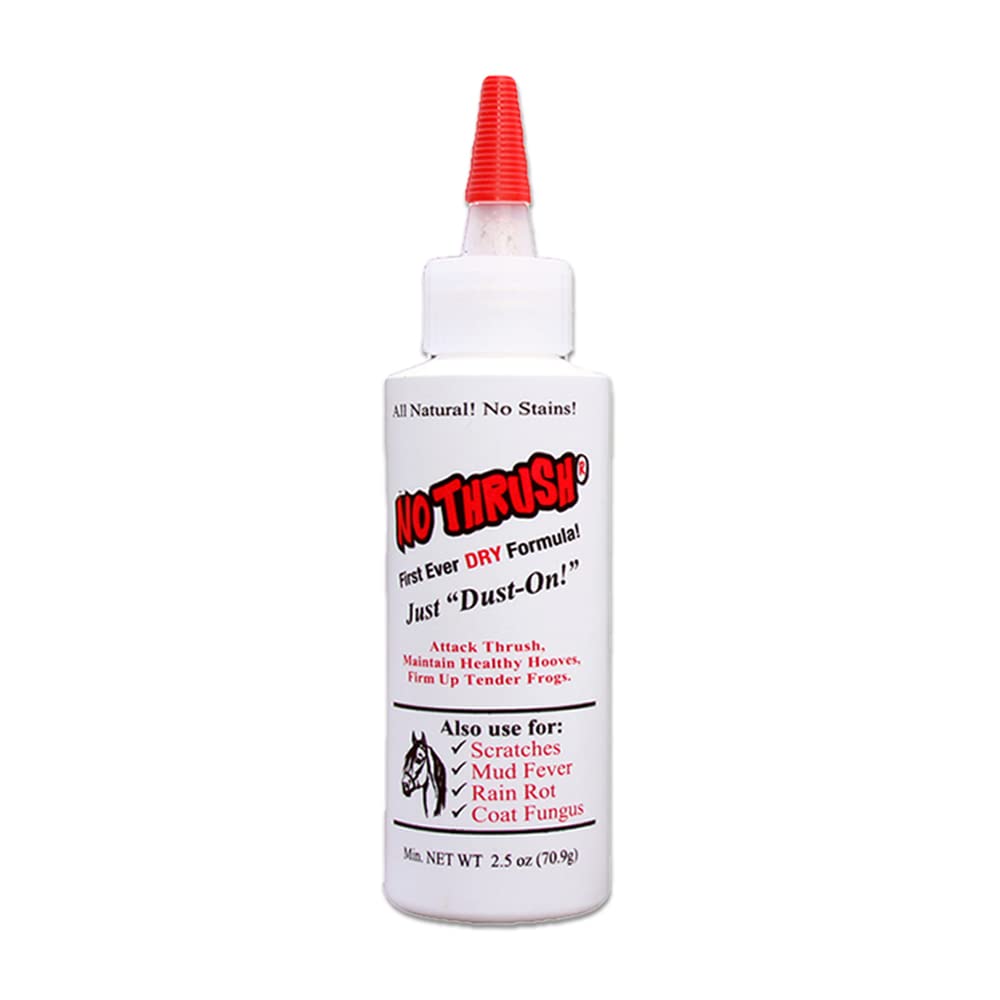
No Thrush reverses the moisture-retention dynamic by using fine dry kaolin clay particles that actively absorb the wet environment thrush bacteria require to survive. This is the only powder in the lineup, and its mode of action is fundamentally different from liquids — instead of trying to kill bacteria in a wet hole, it removes the water itself. The result is that the environment becomes inhospitable within three to four days.
Developed at the Four Oaks Farm rehabilitation center in California, this formula also addresses scratches, rain rot, and mud fever, which is useful if your horse deals with multiple skin and hoof conditions simultaneously. The application is simple: dust the frog and brush the powder into grooves. Because it is non-caustic and non-staining, there is zero risk of chemical burns on sensitive tissue, and it does not leave purple or blue marks on your hands or stall mats.
The 2.5-ounce bottle provides roughly 25 applications, which suits one acute case well. Barn owners should consider the 5.5-ounce or 10-ounce sizes to avoid frequent reordering. For owners who dislike messy liquids or need a treatment that works in deep, wet fissures without dripping, this powder is a standout alternative.
Why we love it
- Absorbs moisture rather than just treating bacteria
- Non-caustic and completely non-staining
- Effective on scratches, rain rot, and mud fever
Good to know
- Powder can clump if stored in humid environment
- Smallest size runs out fast for multi-horse barns
4. Accuhoof Grooms Hand Thrush Solution

Grooms Hand Thrush Solution comes in a straightforward 4-ounce plastic bottle with a silver cap, offering no-frills application for owners who want a reliable liquid without stain markers or specialty additives. The formula is designed for single-horse households managing acute thrush flare-ups, and the bottle geometry makes it easy to grip and tilt directly into the frog cleft without a brush or syringe.
Because the product is a thin, free-flowing solution, it seeps into tight separations between the frog and heel bulbs quickly. The absence of a stain indicator means you rely on visual inspection of the hoof — checking for discharge and odor regression — to gauge healing progress. Experienced farriers and owners who are comfortable reading hoof health without color cues will find this direct approach efficient.
The 4-ounce volume sits neatly between the small 2-ounce bottles and the larger 8-ounce bottles, giving it a practical Goldilocks position for someone treating one horse without committing to a giant container that might expire before use. Storage is simple, as the plastic bottle seals tightly and does not require refrigeration.
Why we love it
- Generous 4 oz volume for single-horse courses
- Thin liquid reaches deep into hoof separations
- Simple, reliable design with easy pour spout
Good to know
- No stain indicator — requires careful visual tracking
- Lacks multi-purpose wound care capability
5. Durvet Pierce’s Nu-Stock Oil

Durvet Pierce’s Nu-Stock is the outlier in this lineup — a thick, sulfur-based oil originally designed for skin issues in dogs but widely adopted by horse owners for thrush, abscesses, and hoof wounds. The sulfur smell is powerful and persistent, but the antimicrobial and tissue-repair properties are well-documented across species. Owners report using it on everything from equine hoof cracks to chicken bumblefoot, with rapid healing across the board.
The oil consistency is heavier than the other liquids here, meaning it stays in place once applied and does not drip out of the hoof. This is advantageous for deep, vertical cracks where thin solutions run out before they can work. The 12-ounce tube provides a massive number of applications per dollar, making it the most economical option per volume in the group — especially if you treat multiple animals or use it for skin lesions alongside hoof care.
Users consistently note that the sulfur odor lingers for hours and can transfer to bedding and clothing. The tube requires vigorous kneading before each use to reincorporate separated ingredients. For owners who can tolerate the smell and appreciate a multi-purpose wound dressing, this is a potent, old-school formula that delivers results across species.
Why we love it
- Thick oil stays in deep hoof cracks without dripping
- Huge 12 oz volume at budget-friendly per-use cost
- Proven on multiple species and wound types
Good to know
- Extremely strong sulfur smell that lingers
- Requires thorough shaking or kneading before use
FAQ
How do I know if my horse has thrush instead of a hoof abscess?
Can I use thrush treatment as a preventative on dry hooves?
What should I do if the thrush doesn’t clear after two weeks of treatment?
Final Thoughts: The Verdict
For most horse owners, the best thrush treatment for horses is the Thrush Buster Liquid because the purple stain indicator removes all guesswork about when to reapply, and the thin formula penetrates deep into the frog without causing chemical burns. If your horse lives in consistently wet conditions and you prefer a moisture-absorbing approach that also treats rain rot, the Four Oaks Farm No Thrush Dry Powder is a superior alternative. And for barns managing multiple animals or needing a multi-species wound and hoof dressing, nothing beats the value and versatility of Durvet Pierce’s Nu-Stock Oil.