
If you have a yard, you have ticks. These tiny arachnids don’t just crawl on your skin; they carry Lyme disease, Rocky Mountain spotted fever, and anaplasmosis. Spraying once and forgetting it has likely already failed you, because most homeowners under-dose or pick a chemical that breaks down in two days. This guide cuts through the label confusion so you can target the nymphs and adults before they latch onto your dog or child.
I’m Mo Mahin — the founder and writer behind Furric. I’ve spent years analyzing concentrated pyrethroid chemistry, studying residual half-lives under UV exposure, and mapping tick habitat preferences across different lawn types to deliver buying advice that actually reduces your bite risk.
Whether you need a quick granular broadcast for full-yard coverage or a precise concentrate for perimeter barrier spraying, the right best tick spray for yard balances potency, residual duration, and safety for your pets and pollinator plants.
How To Choose The Best Tick Spray For Yard
Choosing a tick spray isn’t like picking a general insecticide. Ticks live in the transition zone between your lawn and leaf litter, so the chemical must contact their resting surface and stay active long enough to kill after they climb onto it. There are three main decisions you have to lock in before you buy.
Granules vs. Concentrated Liquid
Granules are your set-and-forget option. You broadcast them with a spreader, then water in to release the active ingredient into the soil and thatch layer where nymphs hide. A product like the Ortho Lawn Insect Killer Granules covers up to 10,000 square feet and provides a 3-month residual window. Liquids, especially permethrin EC concentrates such as the Durvet or Martin’s offerings, require you to mix, pump, and spray every 4 to 6 weeks on targeted areas like fence lines, woodpiles, and shaded edges where ticks quest for a host.
Active Ingredient Strength and Residual Duration
Look for a minimum of 10% permethrin if you choose a concentrate, because weaker formulations degrade faster under sunlight and lose knockdown power after the first rain. Bifenthrin and lambda-cyhalothrin are alternative pyrethroids with similar half-lives but different target species lists. Always cross-reference the EPA registration number on the label against your state’s allowed uses, because some states restrict certain concentrations on residential turf.
Pet and Pollinator Safety
The same chemical that kills a lone star tick will also kill honeybees if applied to blooming weeds. Only apply granular products before rain so the active washes into the soil, not onto flowers. With liquid sprays, avoid drift onto pollinator-attracting plants and never treat areas where pets will walk while the spray is still wet. Most labels require the area to be dry before reentry — a waiting period of about 1 to 2 hours depending on temperature and humidity.
Quick Comparison
On smaller screens, swipe sideways to see the full table.
| Model | Category | Best For | Key Spec | Amazon |
|---|---|---|---|---|
| Sevin Lawn Insect Granules | Granules | Full-yard broadcast coverage | 20 lbs, carbaryl active | Amazon |
| Martin’s Permethrin 13.3% | Liquid Concentrate | Potent perimeter barrier spray | 13.3% permethrin, 32 oz | Amazon |
| Ortho Lawn Insect Killer Granules | Granules | Season-long all-insect control | 10 lbs, 100+ insect list | Amazon |
| Durvet Permethrin EC 10% | Liquid Concentrate | Budget-friendly high-concentrate mix | 10% permethrin, 8 oz | Amazon |
| Cutter Backyard Bug Control | Liquid Concentrate | Multi-pest mosquito & tick control | 32 fl oz, 3-pack bundle | Amazon |
In‑Depth Reviews
1. Sevin Lawn Insect Granules

The Sevin Lawn Insect Granules are the heaviest-duty granular option in this lineup, packing 20 pounds of carbaryl in a bag that treats well over 10,000 square feet when you follow the label rate. Carbaryl kills ticks through contact and ingestion, and once watered into the thatch layer, it remains active against black-legged and lone star ticks for several weeks. The 20-pound size means one bag can carry your entire property through spring and fall flushes without needing a second purchase.
Application requires a broadcast spreader set to the label’s suggested rate, followed by thorough watering — about half an inch of irrigation or rain. The granules break down slowly in moist soil, which provides a wider window of residual activity compared to liquid sprays that degrade faster on grass blades exposed to direct UV. Because carbaryl has a broad target list, you’ll also suppress fire ants, chinch bugs, and armyworms as a side effect.
The main trade-off is that carbaryl is toxic to aquatic invertebrates, so this product should never be used near ponds, streams, or drainage ditches. It also requires reentry after the treated area is completely dry, typically 2 to 4 hours post-application. For homeowners with large, dry lawns and no surface water runoff concerns, this is the most bang-for-your-bag broadcast tick control you can spread.
Why we love it
- Massive 20-lb bag covers large properties without repeat trips to the store
- Carbaryl provides long residual in thatch with proper watering
- Eliminates multiple lawn pests simultaneously
Good to know
- Carbaryl is highly toxic to fish and aquatic life — avoid waterway runoff
- Requires a spreader and at least 0.5 inches of post-application water
- Reapplication typically needed at 8- to 10-week intervals in heavy tick pressure
2. Martin’s Permethrin 13.3% Concentrate
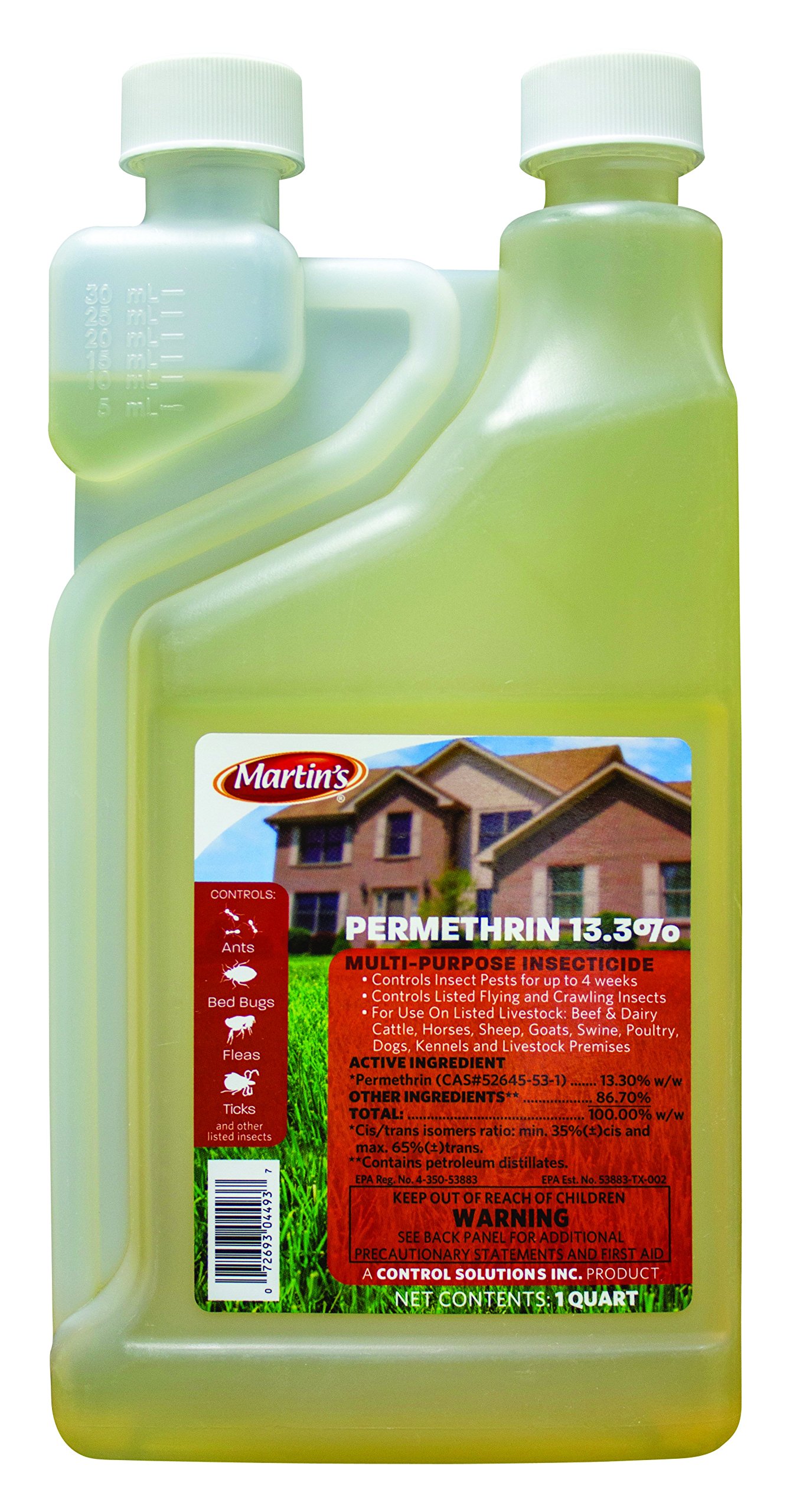
Martin’s Permethrin 13.3% is the highest-concentration permethrin concentrate on this list, and that matters for tick control because higher active percentages allow you to use less product per gallon of finished spray while achieving the same killer dose. A single 32-ounce bottle makes up to 64 gallons of ready-to-spray solution at the standard 0.5% tick-killing rate. That translates to roughly 16,000 square feet of coverage per bottle, assuming you use a 1-gallon sprayer at the label’s low-volume directive.
The residual photo-stability of permethrin at this concentration holds up well on shaded vegetation and under leaf canopies, which is exactly where ticks wait. You can treat fence lines, tall grass edges, woodpiles, and the perimeter of your property without oversaturating the open turf. Because it comes as a liquid, you have precise control over where the chemical lands, which dramatically reduces off-target drift to pollinator patches compared to a broadcast granule.
You must wear chemical-resistant gloves during mixing, and the concentrate itself is a strong irritant if splashed on skin. The real limitation is that permethrin breaks down faster in full sun, so you’ll need to reapply every 3 to 4 weeks during the high-risk spring and fall activity windows. For targeted barrier spraying with the highest concentration per dollar, Martin’s is the refined choice.
Why we love it
- 13.3% active is the strongest concentration available, needing less product per gallon
- Precise liquid application reduces drift and protects pollinators
- 32 oz yields massive coverage — ideal for perimeter-only treatment
Good to know
- UV degrades permethrin quickly — expect 3-4 week max residual in sunny yards
- Contact irritant requires full PPE during mixing and loading
- Not a broadcast solution — you’ll need a pump sprayer and walking time
3. Ortho Lawn Insect Killer Granules

Ortho Lawn Insect Killer Granules deliver a balanced mix of granular coverage and above-and-below-ground kill action in a 10-pound bag that treats up to 10,000 square feet. The formula kills ticks, ants, spiders, fleas, pillbugs, and scorpions by contact, and it provides a residual period that the brand claims lasts up to three months. Because the active ingredient is incorporated into a slow-release granule, you don’t need a sprayer — a Scotts spreader at the correct setting does the work.
Watering-in after application activates the chemical and drives it into the soil where tick nymphs and larvae dwell. Ortho designed this specifically for lawns, gardens, and landscape beds, with a label that includes vegetable gardens as a listed treatment zone, which few granular insecticides permit. That makes this an excellent choice if you want to treat a mixed-use yard where edible plants and play areas coexist.
The main catch is that at 10 pounds, a single bag covers a standard half-acre lot but may not be enough for a full acre. The three-month residual claim holds up best in dry conditions — heavy rain or frequent irrigation can shorten the window. It’s worth noting that the label instructs keeping people and pets off the treated area until the granules are watered in and the surface is dry, which typically takes 1 to 2 hours mid-day.
Why we love it
- Safe for vegetable gardens and landscape beds with label compliance
- Granular broadcast requires no liquid mixing or sprayer maintenance
- Long residual reduces reapplication frequency compared to many liquids
Good to know
- 10 lbs may only cover a half-acre — check your square footage before buying
- Extended rain events can shorten the 3-month residual window
- Need a spreader and watering source — not a ready-to-use product
4. Durvet Permethrin EC 10%

Durvet Permethrin EC 10% is the entry-level concentrated liquid choice for homeowners who want professional-grade chemistry without buying an industrial-sized jug. At 10% permethrin, this emulsifiable concentrate mixes with water at the rate of about 4 ounces per gallon to produce a 0.5% spray solution that kills ticks on contact and provides a residual barrier on grass, leaves, and wooden surfaces for roughly 2 to 4 weeks depending on sunlight exposure. The 8-ounce bottle yields 2 gallons of ready-to-spray mix, which is enough to treat the perimeter of a moderate suburban lot.
The EC formulation means the permethrin stays suspended in water rather than separating, which ensures consistent dosing through the entire spray session. Durvet markets this for livestock premises, so the label covers barns, kennels, and fence lines as well as ornamental gardens. That dual use makes it a versatile pick if you also need to treat dog runs or chicken coop perimeters where ticks often hitch a ride from field rodents.
Because the bottle is small, you’ll run out quickly if you plan to broadcast-spray your entire lawn. This concentrate works best for targeted, perimeter-only applications. You’ll also need a separate pump sprayer, and the concentrate has a strong chemical odor that can linger on skin if you don’t wear nitrile gloves. For the upfront investment, it’s a capable and concentrated barrier spray that punches above its size.
Why we love it
- 10% permethrin is the same concentration many professional services use
- EC formulation stays mixed without constant agitation
- Can be used on livestock-adjacent structures for added tick protection
Good to know
- 8 oz bottle treats only a limited area — not for full-acre broadcast
- Requires PPE and a pump sprayer, increasing upfront cost
- Strong odor during mixing — apply with good ventilation
5. Cutter Backyard Bug Control Spray Concentrate (3 Pack)

Cutter’s Backyard Bug Control Spray Concentrate comes in a convenient 3-pack, each bottle 32 fluid ounces, giving you 96 ounces of concentrate total — a massive volume that eliminates the need for repeat trips to the store during peak tick season. This concentrate targets mosquitoes, fleas, and listed ants in addition to ticks, making it a logical choice if your outdoor pest pressure includes flying insects as well as crawling arachnids. Each bottle mixes with water per the label to produce enough spray to cover the perimeter and vegetation of a typical quarter-acre lot.
Because Cutter is a market-leading repellent brand, this concentrate is formulated for residential use with adequate safety margins for lawns and ornamental plantings. The active ingredients are pyrethroids that break down relatively quickly in the environment, reducing long-term soil accumulation risk. The 3-pack format lets you keep one bottle in the garage and stash the others for dry, cool storage, which is critical because pyrethroid concentrates degrade in heat faster than people realize.
The main limitation is that this product’s primary label marketing leans toward mosquito control, so the tick-specific residual claims are less aggressive than the permethrin-only offerings. If your dominant concern is ticks, you may find yourself reapplying more often than with the Sevin granules or Martin’s liquid. It also requires a hose-end sprayer or pump sprayer, neither of which is included in the bundle. For the sheer volume and dual-threat capability, it’s a versatile utility player.
Why we love it
- 96 oz total concentrate provides season-long supply without repurchasing
- Covers mosquitoes, fleas, and ants alongside ticks — one-spray solution
- Pyrethroid formulations degrade quickly, reducing soil persistence
Good to know
- Mosquito-focused label — tick control may require more frequent reapplications
- No sprayer included in the bundle, adding to total cost
- Bulk bottles degrade in hot storage — keep out of direct sun and heat
FAQ
Can I use tick spray on my vegetable garden without contaminating produce?
How often should I reapply granular tick treatment during high tick season?
Does permethrin kill ticks on contact or only after they ingest it?
Why does my tick spray say not to use it near water?
Final Thoughts: The Verdict
For most homeowners, the best tick spray for yard winner is the Sevin Lawn Insect Granules because the 20-pound bag provides full-yard broadcast coverage with carbaryl’s long residual and no need for a sprayer or mixing. If you want precise perimeter targeting with the strongest permethrin concentration, grab the Martin’s Permethrin 13.3% Concentrate. And for a dual-threat mosquito and tick bundle that keeps your garage stocked for the entire season, nothing beats the Cutter Backyard Bug Control 3-Pack.