
Every owner of an escape artist knows the stomach-dropping panic when a dog slips the yard or bolts after a squirrel. A modern tracker is the only real insurance against that feeling — and choosing the wrong one means gaps in coverage, dead batteries at the worst moment, or unexpected subscription costs that drain your wallet.
I’m Mo Mahin — the founder and writer behind Furric. I spend my time tearing through the market, comparing GPS acquisition times, battery chemistries, radio direction-finding specs, and geofence algorithms across dozens of trackers to separate real-world performance from marketing claims.
After weeks of cross-referencing specs and analyzing hundreds of verified owner reports from rural property owners, urban walkers, and backcountry hikers, I’ve compiled what matters most in a tracking device for dogs so you can buy with confidence.
How To Choose The Best Tracking Device For Dogs
The tracker market splits cleanly into two camps — cell-based LTE trackers that rely on cellular towers for a data connection and radio-frequency (RF) direction-finding systems that operate completely off-grid. Your specific terrain, daily routine, and tolerance for monthly fees determine which camp fits.
Coverage Technology: LTE vs Radio Direction Finding
LTE trackers use onboard GPS chips to determine location and a cellular modem to transmit that location to your phone app. They are convenient everywhere cell towers exist, but fail in deep canyons, dense national forests, or remote rural properties with zero signal. Radio-based systems like the Marco Polo use a handheld receiver to hunt the dog’s collar tag via directional antenna — they require no cell service, no subscription, and work in the deepest wilderness, but require you to actively search rather than passively view a map.
Battery Life and Ping Intervals
Battery life is the spec that gets misquoted most often. A tracker advertising “14 days” achieves that at a low ping rate (once every five minutes) that’s useless during an active escape. Look for dynamic tracking modes that increase ping frequency when the dog is moving. Collar-side battery life on RF tags like the Marco Polo can reach six weeks because the tag only transmits a brief pulse — no GPS processing happens on the tag itself.
Subscription Costs and Lock-In
LTE trackers require an active data plan — typically to per month or to annually. Some include the first 6 or 12 months in the purchase price. RF-based systems have zero ongoing costs. Halo requires a membership for any GPS containment features. Garmin handhelds require a companion collar but no monthly fee for GPS tracking — only for advanced mapping features like BirdsEye imagery.
Physical Size and Attachment Security
Small dogs under 15 pounds need a tracker under 20 grams — the Fi Mini at 16 grams is a standout here. But lightweight trackers often use a rubber slip-on holder that can tear or allow the device to pop off during rough play or thick brush. Garmin and Dogtra collars bolt the receiver directly to a nylon strap with contact points, making loss nearly impossible. Review the attachment mechanism before buying.
Quick Comparison
On smaller screens, swipe sideways to see the full table.
| Model | Category | Best For | Key Spec | Amazon |
|---|---|---|---|---|
| Dogtra Pathfinder 2 | GPS + E-Collar | Hunting & off-grid tracking | 9-mile range, no subscription | Amazon |
| Garmin Alpha TT 25 | GPS + Training | Professional training & hunting | 136-hour expanded battery pack | Amazon |
| Marco Polo | RF Directional | No-cell-service wilderness | 1-mile range, 6-week collar battery | Amazon |
| Halo Collar 5 | GPS Fence + Tracker | Wireless containment + real-time alerts | 2-ft GPS accuracy, 20 updates/sec | Amazon |
| Fi Mini | LTE GPS Tracker | Urban/suburban escape alerts | 16 grams, 6-month battery life | Amazon |
| PETLOC8 GPS Tracker | LTE GPS Tracker | Budget travel companion | 14-day battery, 12-month sub included | Amazon |
| Dogtra Pathfinder 2 (Large) | GPS + E-Collar | Multi-dog hunting & e-fence | 21-dog capacity, 2-sec updates | Amazon |
In‑Depth Reviews
1. Dogtra Pathfinder 2 GPS Tracker & E-Collar

The Dogtra Pathfinder 2 solves the biggest pain point of dog tracking — ongoing fees — by operating with a free app and zero subscription costs. The system uses a handheld GPS connector paired with the collar receiver, giving you a 9-mile range with updates as frequent as every two seconds. Offline map support via Map Box means you can download terrain maps before heading into the backcountry and still track without cellular service.
Training features include Nick (momentary stimulation), Constant stimulation, Audible tone, Pager Vibration, and an LED Locate Light. The collar is waterproof and built for dogs 35 pounds and up. Owners consistently praise the rugged saltwater-safe construction, the accuracy of the E-Fence containment zone, and the ability to track up to 21 dogs from a single app. Smartwatch compatibility with Apple Watch Series 5 and Galaxy Watch4 adds convenience.
The main drawback is the reliance on your smartphone for the full mapping interface — you must keep your phone within Bluetooth range of the GPS connector. Some users also note that accessing quick stimulation mid-chase requires navigating the phone screen, which can feel slow compared to a dedicated remote dial. But for the blend of range, no fees, and training integration, this is the most balanced premium pick.
Why we love it
- No subscription fees over the lifetime of ownership
- 9-mile range with 2-second tracking updates
- Offline maps and smartwatch integration
- Rugged, waterproof, saltwater-safe construction
Good to know
- Smartphone app required for mapping interface
- Phone must stay within Bluetooth range of the GPS connector
- Quick stimulation adjustments require screen navigation
2. Garmin Alpha TT 25 GPS Dog Tracking and Training Collar

The Garmin Alpha TT 25 collar is built for the serious owner who demands GPS tracking alongside precise training corrections — but it requires a compatible Garmin handheld (like the Pro 550 Plus or Alpha series) sold separately. The TT 25 collar delivers tracking updates as fast as every 2.5 seconds at distances up to 9 miles, and the multicolor LED makes nighttime location checks effortless.
Training flexibility is exceptional: 18 levels of continuous or momentary stimulation plus audible tone and vibration, all adjustable via the companion handheld. The user-replaceable flex band and user-swappable battery packs are a major advantage for owners who keep dogs in the field for days at a time — the standard pack lasts 68 hours with dynamic tracking, and the expanded pack stretches to 136 hours. Wi-Fi connectivity provides automatic firmware updates when charging.
The collar itself is slim enough for large and small breeds despite the rugged build. Verified owners report sub-foot GPS accuracy in heavy rain and praise the easy pairing with Pro 550 Plus remotes. The downside is the ecosystem cost — you need the handheld unit, and the collar alone does not function as a standalone tracker. This is a choice for the owner already invested in Garmin’s training ecosystem.
Why we love it
- Expandable battery pack offers best-in-class run time
- 18-level stimulation plus tone and vibration
- User-replaceable collar strap and battery
- Sub-foot GPS accuracy verified in field use
Good to know
- Requires separate Garmin handheld for operation
- Higher total system cost with handheld purchase
- No standalone tracking via smartphone app
3. Marco Polo Advanced Pet Monitoring, Tracking and Locating System

The Marco Polo is the only system here that requires zero cellular service, zero GPS satellites, and zero monthly fees. It uses radio direction-finding technology — you carry a handheld receiver that points toward the collar tag, showing distance and direction. This is the tracker of choice for owners whose dogs roam heavily wooded properties, mountain ranges, or any location where LTE coverage simply doesn’t exist.
The collar tag is lightweight enough for cats and dogs 5 pounds and up, is fully submersible for prolonged swimming, and runs for up to six weeks on a single rechargeable battery while being continuously monitored. The handheld receiver battery lasts 4 to 6 weeks as well. Owners in dense Pacific Northwest forests report tracking cats reliably at 1/4 mile and dogs up to 1/2 mile in hilly terrain. The system can expand to cover up to three pets with additional tags.
This is not a passive “check your phone” tracker — you must actively walk with the receiver and follow the signal. The collar holder has drawn criticism for being somewhat flimsy with very rough activity, and the lack of a backlit screen makes night searches harder. But for total independence from networks, the Marco Polo is unmatched.
Why we love it
- Works completely off-grid with no cell or GPS needed
- Zero monthly subscription or data plan
- Collar battery lasts up to 6 weeks
- Proven 1/2-mile range in dense terrain
Good to know
- Requires active searching with handheld receiver
- Collar holder can detach during rough play
- No backlit screen on receiver for night use
4. Halo Collar 5 Wireless Dog Fence & GPS Tracker

The Halo Collar 5 redefines what a wireless fence can do by combining dual-frequency L1 and L5 satellite GPS with real-time ground-station correction data. The result is GPS accuracy within 2 feet of your dog’s actual location — a massive leap over traditional wireless fences that can drift by 20 feet or more. The collar updates location 20 times per second and works on properties as small as 900 square feet or as large as 1,200 square miles.
The built-in training program from Cesar Millan guides your dog through progressive sound, vibration, and static correction warnings as the boundary is approached. The collar fits dogs 10 pounds and up with an adjustable 8-to-30-inch strap. The app allows you to create multiple fences instantly, even at remote campsites or vacation rentals, without hauling any base station equipment.
There are two major considerations: a subscription is required to activate GPS and fence features (around per year), and the collar needs nightly charging. Some users note that the correction zone width can be too generous at 300 yards, potentially overlapping with other fences on smaller properties. For owners seeking a completely wire-free containment plus real-time tracking in a single collar, this is the most advanced option on the market.
Why we love it
- Sub-2-foot GPS accuracy thanks to dual-frequency satellites
- Fully portable — no base station required
- Built-in professional training guidance
- Works on rural properties with poor cell signal
Good to know
- Subscription required for all GPS features
- Requires nightly charging
- Correction zone width may be too broad for small yards
5. Fi Mini GPS Tracker for Dogs
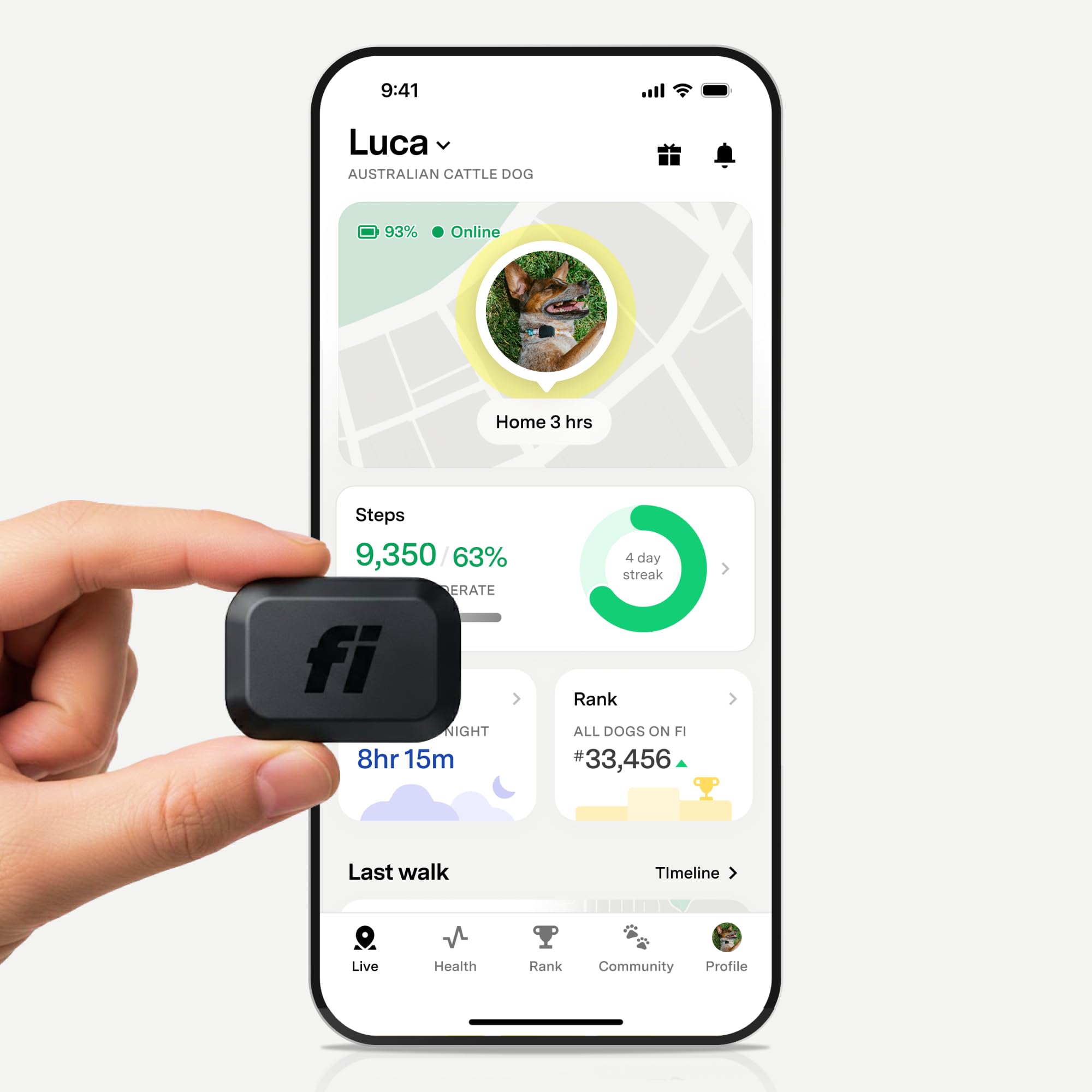
The Fi Mini is the lightweight champion of the LTE tracker category at just 16 grams — 80 percent lighter than the previous Fi Series 3+ — making it the go-to choice for small breeds like Chihuahuas and Miniature Schnauzers. It uses live GPS and LTE-M technology (a cellular standard designed for IoT devices with better building penetration than standard LTE) to track your dog in real time, even in more remote suburban fringe areas.
The collar attachment is a low-profile slip-on design that fits straps up to 1.25 inches wide. The IP68-rated waterproofing means it can survive submersion, rain, and mud. Battery life is a standout — the onboard 285 mAh cell delivers roughly three weeks between charges, and the app provides step-counting and health metrics in addition to location tracking. The included 6-month membership covers the LTE data connection.
The weak point is the rubber slip-on holder — several owners of active dogs report that it tears or damages within days, causing the tracker to go offline. Fi’s customer service is responsive, but the attachment remains a genuine durability concern for dogs that roll in brush, swim in rocky creeks, or roughhouse with other dogs. For calm indoor-outdoor dogs under 30 pounds, the Fi Mini is an elegant, lightweight solution.
Why we love it
- Ultra-light 16-gram design fits very small dogs
- Excellent battery life — charges roughly every three weeks
- Includes health and step tracking via the Fi app
- IP68 waterproof rating for submersion
Good to know
- Rubber collar holder can fail on active dogs
- Requires monthly subscription after first 6 months
- LTE coverage may be spotty in very rural areas
6. PETLOC8 Dog GPS Tracker
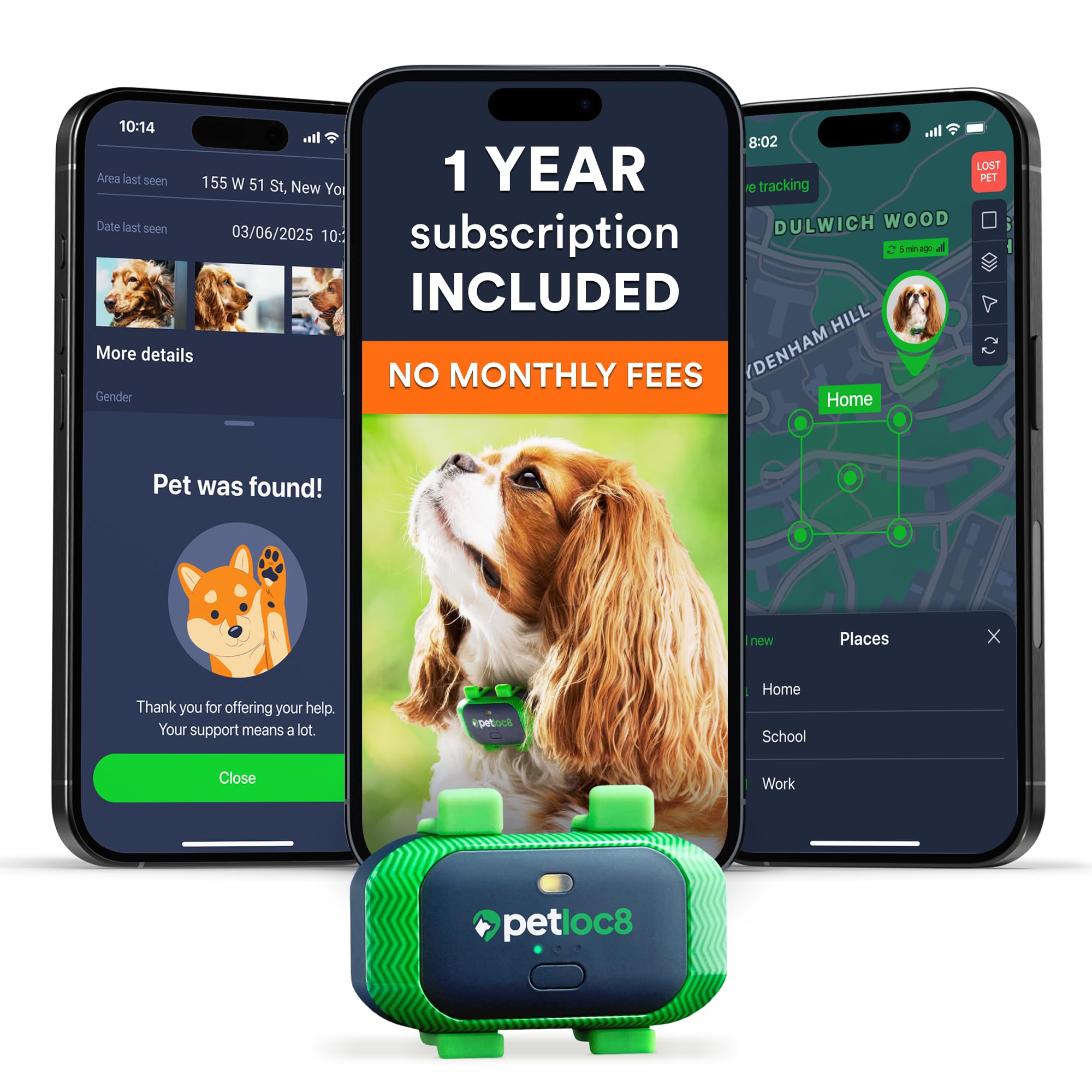
The PETLOC8 tracker punches above its price tier by bundling 12 months of LTE service with the device itself. The hardware uses 4G LTE CAT 1, Bluetooth, and Wi-Fi for location transmission and is certified IP67 waterproof. The 500 mAh battery delivers up to 14 days of real-world use between charges, and the compact 1.23-ounce design clips onto any collar up to a standard width without bulk.
The Petloc8 app provides real-time location, custom geofence zones with instant smartphone alerts, and a community feature that lets family and friends monitor your dog’s safety. The LED locator light adds visibility in low-light situations. Verified owners report reliable tracking during daily walks and hiking trips, along with responsive tech support that replaces defective units quickly.
Consistency is the concern here — a minority of users report the tracker losing GPS lock within 100 feet of the home, battery drain in under an hour on a single event, or a geofence minimum radius that’s too large to be practical on small properties. The 165-yard square geofence box means your dog could reach a road before you get an alert. For owners who need a low-cost entry point with a full year of service built in, it works well most of the time.
Why we love it
- 12-month LTE subscription included upfront
- Good battery life at 14 days average use
- Lightweight at 1.23 ounces
- App includes community sharing feature
Good to know
- Occasional GPS lock loss and quick battery drain reported
- Geofence minimum radius too large for small yards
- Unit powers off when connection is lost
7. Dogtra Pathfinder 2 — Hunting E-Collar GPS (Large Dog)

This version of the Dogtra Pathfinder 2 is tuned specifically for larger breeds (35 pounds and up, 12-to-22-inch neck size) and multi-dog hunting or containment scenarios. The system supports tracking up to 21 dogs from a single app, with 100 levels of Nick and Constant stimulation, plus Tone and Vibration modes. The 9-mile range with 2-second location updates matches the standard Pathfinder 2, but the e-fence functionality here is enhanced for farm and ranch use.
The E-Fence and Mobile-Fence features let you draw containment boundaries on the map within the app, with geofencing alerts sent directly to your phone. Offline maps from Map Box provide terrain, satellite, and general views without needing cellular data. The nylon collar strap is more durable than the standard Pathfinder 2’s biothane, and the contact points come with extension washers for thick-coated breeds.
Users on farms and acreages appreciate the long range and 24-hour battery life under continuous tracking. The main complaint is that the E-Fence must be manually turned on each time you use it, and the boundary accuracy can be 50 to 80 feet off — fine for a large property but problematic on smaller lots. The app also drains phone battery quickly over long tracking sessions. For the dedicated hunter or rural owner running multiple dogs, this is the most capable e-fence tracker available without a subscription.
Why we love it
- Supports up to 21 dogs from one app interface
- E-Fence with Mobile-Fence for property containment
- Offline maps for areas without cell service
- No subscription or monthly fees
Good to know
- E-Fence must be manually activated each use
- Boundary accuracy can drift by 50-80 feet
- App drains phone battery during extended tracking
FAQ
Can I use a GPS tracker on a dog under 10 pounds?
Do all GPS dog trackers require a monthly subscription?
How accurate is the geofence on a typical dog tracker?
What happens if my tracker loses cellular or GPS signal mid-hike?
Can I track my dog from a smartwatch?
Final Thoughts: The Verdict
For most owners, the tracking device for dogs winner is the Dogtra Pathfinder 2 because it delivers the perfect balance of 9-mile range, e-collar training, and zero ongoing subscription fees in a rugged, waterproof package backed by solid real-world reviews. If you need a collar that works deep in national forests where no cell tower reaches, grab the Marco Polo. And for comprehensive wireless containment with professional-grade GPS accuracy on large properties, nothing beats the Halo Collar 5.