
A tick bite isn’t just an itchy annoyance — it’s a direct line to Lyme disease, anaplasmosis, and a host of other pathogens that can chronically impact your health or your pet’s well-being. Choosing the wrong treatment means you’re not just wasting money; you’re leaving a gap in your defense that a vector-backed insect is happy to exploit.
I’m Mo Mahin — the founder and writer behind Furric. I analyze market data, compare formulation chemistry, study environmental fate of active ingredients, and aggregate thousands of owner reports to identify which tick treatments actually deliver measurable field efficacy beyond the marketing claims.
Whether you need something to treat your own hiking clothes or a monthly topical for your 80-pound Labrador, the best treatment for ticks depends entirely on the vector route — contact-kill barrier or full-body systemic repellency — and understanding that difference is the single most important decision you will make today.
How To Choose The Best Treatment For Ticks
Before you pick a treatment, you must decide your vector target — do you need to repel ticks from landing on your skin, kill them on contact when they crawl on treated fabric, or eliminate an existing infestation on a pet? Each chemistry works in a fundamentally different way, and choosing the wrong one leaves a defense gap big enough for a nymph-stage deer tick to exploit.
Active Ingredient Chemistry: Contact vs. Systemic vs. Repellent
Permethrin (used in Ben’s Clothing spray) bonds to fabric fibers — ticks must physically contact the treated surface to absorb a lethal dose. It is a contact-kill, not a vapor repellent. Picaridin (20% in Ben’s Tick Repellent) works on skin directly, confusing the tick’s chemoreceptors so it does not attempt to bite. Fipronil and etofenprox (the active bases in PetArmor and Hartz topicals) are absorbed into the pet’s sebaceous glands and released over weeks — ticks get a lethal dose when they attempt to feed. Match the mechanism to the application environment: gear spray for yourself, topical for your dog, skin repellent for exposed skin.
Duration And Re-Application Window
A tick treatment’s true cost is measured in how many unprotected hours you accumulate before you must reapply. Permethrin on clothing lasts up to six weeks and survives several washes — strong for camping expeditions. A 20% Picaridin spray gives roughly twelve hours of protection on skin, requiring daily reapplication during high-activity periods. Topical drops (fipronil, etofenprox) provide a full month of barrier release from the sebaceous glands, but waterproofing varies — a bath within 72 hours of application can strip efficacy prematurely.
Pet Size And Application Ease
Topical treatments have strict weight bands. Using a 45-88 lb formulation on a 20-pound dog can cause overexposure; using a small-dog dose on a 130-pound working breed will likely fail within two weeks. Collars (like the VICSOM 4-pack) offer set-and-forget convenience with 8 months per collar, but collar efficacy depends on direct skin contact — thick double coats can reduce transfer. If your dog swims frequently or lives outdoors, a waterproof topical or collar rated for wet exposure is non-negotiable.
Quick Comparison
On smaller screens, swipe sideways to see the full table.
| Model | Category | Best For | Key Spec | Amazon |
|---|---|---|---|---|
| Ben’s Clothing & Gear (24 oz) | Gear Spray | Preventing ticks on hiking gear | 0.5% permethrin / 6-week bond | Amazon |
| Ben’s Tick Repellent (6 oz 3-Pack) | Skin Spray | Direct skin protection while hiking | 20% Picaridin / 12-hour shield | Amazon |
| PetArmor Plus (45-88 lb, 6 mo) | Topical Drops | Large breed monthly flea/tick control | Fipronil + s-Methoprene / 24-hr kill | Amazon |
| Hartz UltraGuard Pro (61-150 lb) | Topical Drops | Large breed budget monthly defense | Etofenprox + dual IGR / 30-day barrier | Amazon |
| VICSOM Flea Collar (4-pack) | Collar | Long-term collar prevention for multi-dog homes | Natural formula / 8 months per collar | Amazon |
In‑Depth Reviews
1. Ben’s Clothing & Gear Insect Repellent (24 oz)

This is the right solution when you want to treat socks, pants cuffs, tent floors, and backpack straps — areas you cannot spray on skin. The 0.5% permethrin concentration is the EPA-approved level for clothing treatment, and the pump delivers a wet spray that saturates fabric without excessive pooling. Owners report consistent tick-free results after treating trousers for woodland hikes and even off-label use on chicken coop bedding to kill mites.
The key strength here is wash survivability: permethrin bonds to the fabric fibers at the molecular level rather than just coating them. Users confirm efficacy holds through at least two to three wash cycles, which effectively covers a two-week trip before needing reapplication. The 24-ounce bottle treats multiple full outfits, making the per-treatment cost lower than buying aerosol cans.
The main practical downside is the wetness control — the nozzle tends to produce several concentrated streams rather than a fine mist, so you have to spread the liquid manually to avoid dry streaks. Also, you must let treated items dry completely (2-4 hours) before wearing. But for anyone who wants a tick barrier on their gear without applying chemicals directly to skin, this is the proven formula.
Why we love it
- Bonds to fabric up to 6 weeks, surviving several washes
- 24 oz bottle treats multiple full outfits economically
- Tested tough in New Hampshire; strong user track record since 2017
Good to know
- Application requires spreading to avoid dry spots and pooling
- Must allow 2-4 hours drying time before wearing treated gear
2. Ben’s Tick Repellent 20% Picaridin (6 oz, 3-Pack)

For anyone who spends considerable time in tick-heavy woods — trail runners, dog walkers, gardeners — this is the insect repellent with the most consistent owner confidence for tick avoidance without the drawbacks of DEET. At 20% Picaridin, it matches the CDC-recommended concentration for ticks, and users in high-Lyme regions consistently report zero attached ticks after days of repeated exposure in dense underbrush.
The fine-mist nozzle delivers application that requires no rubbing — important for even coverage on arms and neck without missing small patches. The lack of odor is a real advantage: there is no chemical smell to warn you of its presence, and it does not damage synthetic clothing, watch bands, or gear coatings the way DEET formulations often do. Users report clear 12-hour windows of protection during multi-hour sweaty hikes.
One caution: a small minority of owners found it ineffective for their specific body chemistry or tick pressure level, suggesting that individual sweat pH may influence Picaridin adhesion. However, the majority consensus firmly ranks this above DEET formulations for tick-specific repellency. The 3-pack covers a full season of weekly applications for a single active person.
Why we love it
- 20% Picaridin matches CDC recommendation for tick repellency
- No odor, non-greasy, does not damage clothing or gear coatings
- Consistent 12-hour protection window in high-Lyme field environments
Good to know
- Not every user experiences full 12-hour efficacy — individual pH may affect adhesion
- Requires reapplication after swimming or heavy sweating
3. PetArmor Plus Flea and Tick Prevention for Large Dogs (45-88 lb, 6 mo)

PetArmor Plus matches the active ingredient profile used in Frontline Plus — fipronil as the adulticide and s-methoprene as the insect growth regulator that stops eggs and larvae from maturing — but at a per-dose price point that is consistently lower. For large breed dogs in the 45-88 lb range, a single 6-month supply effectively stops deer ticks and brown dog ticks from feeding long enough to transmit pathogens.
Owner reports highlight a fast onset: fleas begin dying within 24 hours of application, and ticks that attach post-treatment are killed before they engorge. The waterproof claim holds in practice — dogs that swim or get rained on still maintain full monthly coverage as long as the 72-hour pre-bath waiting period is observed. The formula spreads through the sebaceous glands across the skin surface from the application spot on the back of the neck.
The main consideration is that PetArmor works through ingestion or contact after the tick has already climbed onto the dog — it does not repel ticks before they land. Some owners note that during heavy tick pressure, they still find dead ticks in the dog’s coat, confirming the product is killing them but not preventing the initial climb. For homes where tick exposure is on-property daily, combine this with yard treatment for best results.
Why we love it
- Vet-quality fipronil + s-methoprene at a significantly lower per-dose cost
- Fast 24-hour kill onset with proven waterproof field performance
- Six-month supply means fewer trips to the vet or store
Good to know
- Does not repel ticks — kills them after they climb onto the dog
- Application site may show temporary irritation in sensitive dogs
4. Hartz UltraGuard Pro Flea & Tick Topical for Dogs (61-150 lb, 6 mo)

Hartz UltraGuard Pro is a valid entry-level option for owners of large dogs (61-150 lb) who want a monthly topical with dual insect growth regulators to break the flea cycle in the environment. The active ingredient is etofenprox, a fast-acting pyrethroid that provides rapid knockdown of fleas and ticks on contact. The dual IGRs target eggs and larvae, reducing the environmental reservoir over time.
Long-term Hartz users — some spanning decades — report consistent flea and tick control with zero breakthrough incidents when applied monthly. The angled Pro-Glide applicator is genuinely easier to part fur with than blunt-tip tubes, which helps you apply directly to skin rather than top of coat. The formula effectively kills brown dog ticks and deer ticks on the dog’s body within the 30-day interval.
The most frequent criticism is the greasy residue left along the dog’s back after application — owners of shorter-haired breeds notice an oily strip that requires a bath after 2-3 days to feel comfortable. Additionally, a subset of owners report that the initial dose provides only partial tick kill (ticks found smaller or not engorged, but still alive) and that full protection solidifies after the second monthly application.
Why we love it
- Affordable large-breed topical with dual IGR for environmental flea control
- Pro-Glide angled applicator simplifies parting thick fur
- Long user history shows consistent field efficacy over many years
Good to know
- Leaves a noticeably greasy residue strip; may require a post-application bath
- First dose may offer partial protection; full effect observed by second month
5. VICSOM Flea and Tick Collar for Dogs (4-pack)
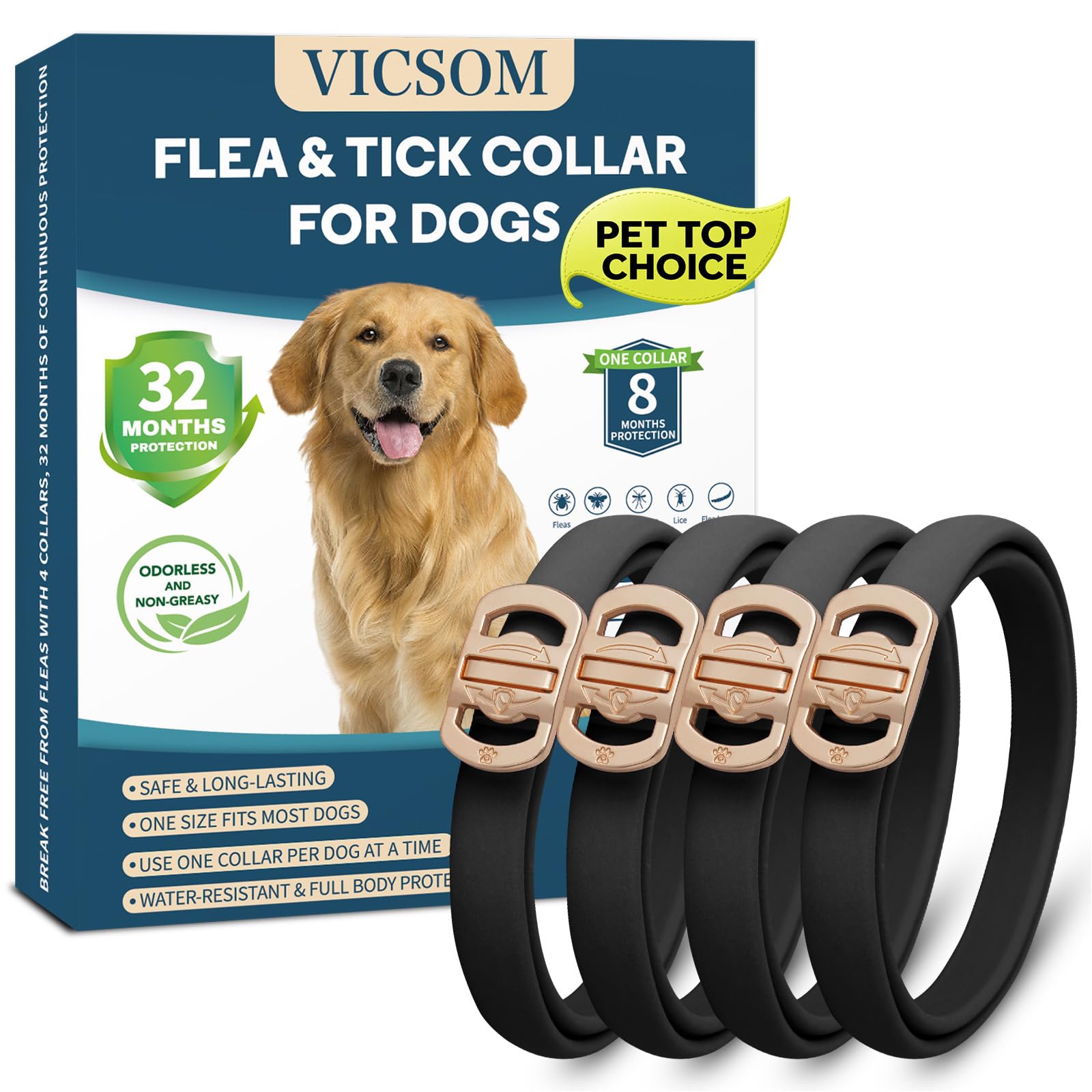
The VICSOM collar 4-pack is an attractive solution for multi-dog households or owners who dislike the greasy residue of topical drops. Each collar claims 8 months of continuous protection, giving a total 32-month supply. The formula uses natural active ingredients, and owners consistently note that the collars have no strong chemical odor and do not leave greasy marks on fur or furniture.
In practice, efficacy varies heavily with dog size. For small to medium dogs (17-26 lbs), owners report zero ticks found after weeks of outdoor exposure — on par with name-brand collars costing significantly more. The metal clasp feels secure, the adjustable length fits both small breeds and larger necks comfortably, and the collar can be worn alongside a regular collar without thickness issues. The non-greasy water-resistant finish holds up to rain and swimming reasonably well.
The reliability drops for very large dogs (130+ lb working breeds): one owner documented pulling roughly five ticks over several weeks, compared to zero with a prior premium brand collar. This suggests that the active ingredient distribution may not be sufficient for the surface area of giant breeds. Water exposure also appears to reduce collar efficacy — a bath immediately preceding a heavier tick period correlated with increased tick count in owner reports.
Why we love it
- Excellent value for multi-dog homes at a fraction of name-brand collar cost
- Non-greasy, odor-free design that dogs tolerate even with skin sensitivities
- Adjustable metal clasp fits small to large necks comfortably
Good to know
- Efficacy drops significantly for very large dogs (130+ lb)
- Water exposure may reduce protection; consider alternative for frequent swimmers
FAQ
What active ingredient works best for tick prevention on humans?
Does PetArmor Plus actually kill ticks or just repel them?
Why do some owners see partial tick protection in the first month of Hartz UltraGuard Pro?
How long does a flea and tick collar actually last on a large breed dog?
Final Thoughts: The Verdict
For most outdoor users, the best treatment for ticks winner is the Ben’s Tick Repellent 20% Picaridin 3-pack because it balances broad human application, long 12-hour protection without damaging gear, and the strongest owner confidence across high-Lyme regions. If you want treated gear protection that lasts weeks, grab the Ben’s Clothing & Gear Permethrin spray. And for monthly pet tick control at a reasonable per-dose rate, nothing beats the PetArmor Plus 6-month supply.