
The sour ammonia punch that radiates from turf, artificial grass, or a concrete dog run after repeated pet use is one of the most persistent odors in any home. Liquid sprays often just wet the surface, leaving the real source—caked urine salts buried deep in fibers, gravel, or soil—to re-release their stench the moment humidity rises. A true solution demands chemistry that breaks down the urea and ammonium compounds rather than covering them with perfume.
I’m Mo Mahin — the founder and writer behind Furric. I’ve spent thousands of hours cross-referencing microbiological formulations, mineral-based absorbents, and enzymatic cleaners against real-world owner feedback to isolate what actually neutralizes the toughest outdoor pet odors at a molecular level.
Whether you maintain a backyard lawn pad, a kennel run, or synthetic turf, selecting the right best turf odor eliminator hinges on understanding whether you need deep-penetrating granules, bacterial-enriched liquids, or concentrated sprays that work on contact and continue breaking down waste over time.
How To Choose The Best Turf Odor Eliminator
Not all odor removers function the same way. Some rely on live bacteria that digest organic waste, others use mineral absorption, and a few depend on oxidation to chemically alter ammonia molecules. Matching the formula to your surface type and usage intensity is the difference between a product that works for days and one that requires hourly reapplication.
Matching the formula to the surface
Synthetic turf with rubber infill traps urine in the base layer where most liquid sprays never reach. Granular products or bacterial concentrates that can be flushed deep into the pile perform far better here. On solid surfaces like concrete patios or brick, a spray that foams on contact and lifts salts before rinsing is sufficient. Natural grass lawns benefit from formulas that also feed the soil microbiome rather than disrupting it.
Active ingredient category: enzymes vs. bacteria vs. minerals
Enzymatic cleaners (common in spray concentrates) break specific urine proteins into smaller, non-smelly compounds on contact but lose potency once they dry. Bacteria-based formulas, like those containing Bacillus or Pseudomonas strains, establish a living colony that continuously degrades new urine deposits as long as moisture is present. Mineral-based granules absorb ammonia gas physically, making them ideal for dry areas or gravel where bacteria cannot survive without regular watering.
Coverage area and application frequency
A 32-ounce liquid concentrate that makes one gallon treats roughly 100–200 square feet per application. Granular options covering 400 square feet per two-pound container and lasting two to three weeks between reapplications offer more hands-off maintenance for large yards. For high-traffic areas like kennels or designated potty patches, a weekly top-up is normal regardless of product type.
Quick Comparison
On smaller screens, swipe sideways to see the full table.
| Model | Category | Best For | Key Spec | Amazon |
|---|---|---|---|---|
| Zep Urine Remover | Liquid Spray | Carpets, mattresses, sealed wood | 128 oz, hydrogen peroxide formula | Amazon |
| MICROBE-LIFT Outdoor Pet Odor Eliminator | Bacterial Spray | Artificial turf & patios | 32 oz, ready-to-use with deterrent | Amazon |
| ProVetLogic Kennel & Turf Care | Bacterial Concentrate | Kennels, synthetic turf, drains | 64 oz concentrate, vet-grade | Amazon |
| Angry Orange Pet Odor Eliminator | Concentrated Spray | Indoor & outdoor spot treatment | 8 oz makes 1 gallon, citrus oil | Amazon |
| SMELLEZE Outdoor Yard Odor Eliminator | Granular Mineral | Turf, gravel, soil, kennels | 2 lb, treats 400 sq ft, 2–3 weeks | Amazon |
In‑Depth Reviews
1. Angry Orange Pet Odor Eliminator
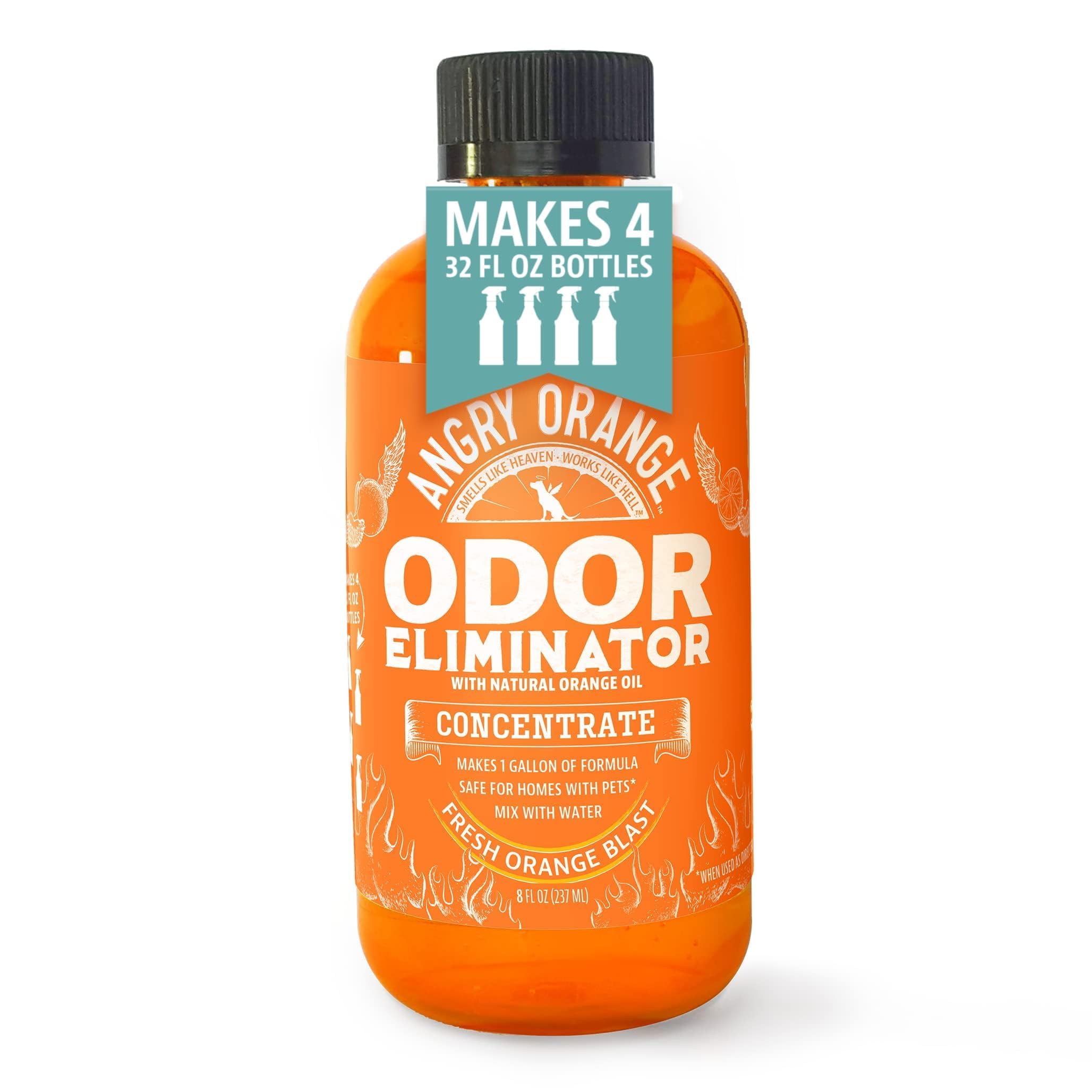
This concentrated formula relies on natural citrus oil as the active degreasing and oxidizing agent rather than enzymes or live bacteria. Owners report that a single 8-ounce bottle mixed with water produces a full gallon of ready-to-use spray, making the cost per treatment notably low despite the mid-range sticker price. The citrus scent fades completely within hours, leaving zero artificial fragrance residue behind.
Performance on porous surfaces like carpet padding and subflooring is where Angry Orange earned its cult reputation. Multiple verified reviews describe it eliminating years-old cat urine odors from hardwood floor seams and baseboards after other enzymatic cleaners failed. The concentrated nature allows users to adjust the dilution ratio for extra strength on severe cases, though the manufacturer’s recommended mix is four tablespoons per 32 ounces of water.
The main limitation is that the citrus oil does not establish a lasting colony the way bacterial products do, so repeated applications are necessary in high-traffic turf areas if pets continue to use the same spot daily. It also lacks a pheromone deterrent to prevent re-marking. Best suited for targeted spot treatment of deep-seated stains on indoor surfaces and around turf edges where liquid can soak into the backing.
Why we love it
- Extremely concentrated — one bottle treats multiple areas for months
- Natural citrus oil does not mask odors, it breaks down ammonia compounds
- Safe on sealed hardwoods, tile, and synthetic turf without bleaching
Good to know
- Strong initial citrus smell that dissipates; sensitive pets may avoid the area briefly
- No deterrent agent to stop dogs from re-marking treated zones
- Requires regular reapplication for ongoing turf use
2. ProVetLogic Kennel & Turf Care (Concentrated)
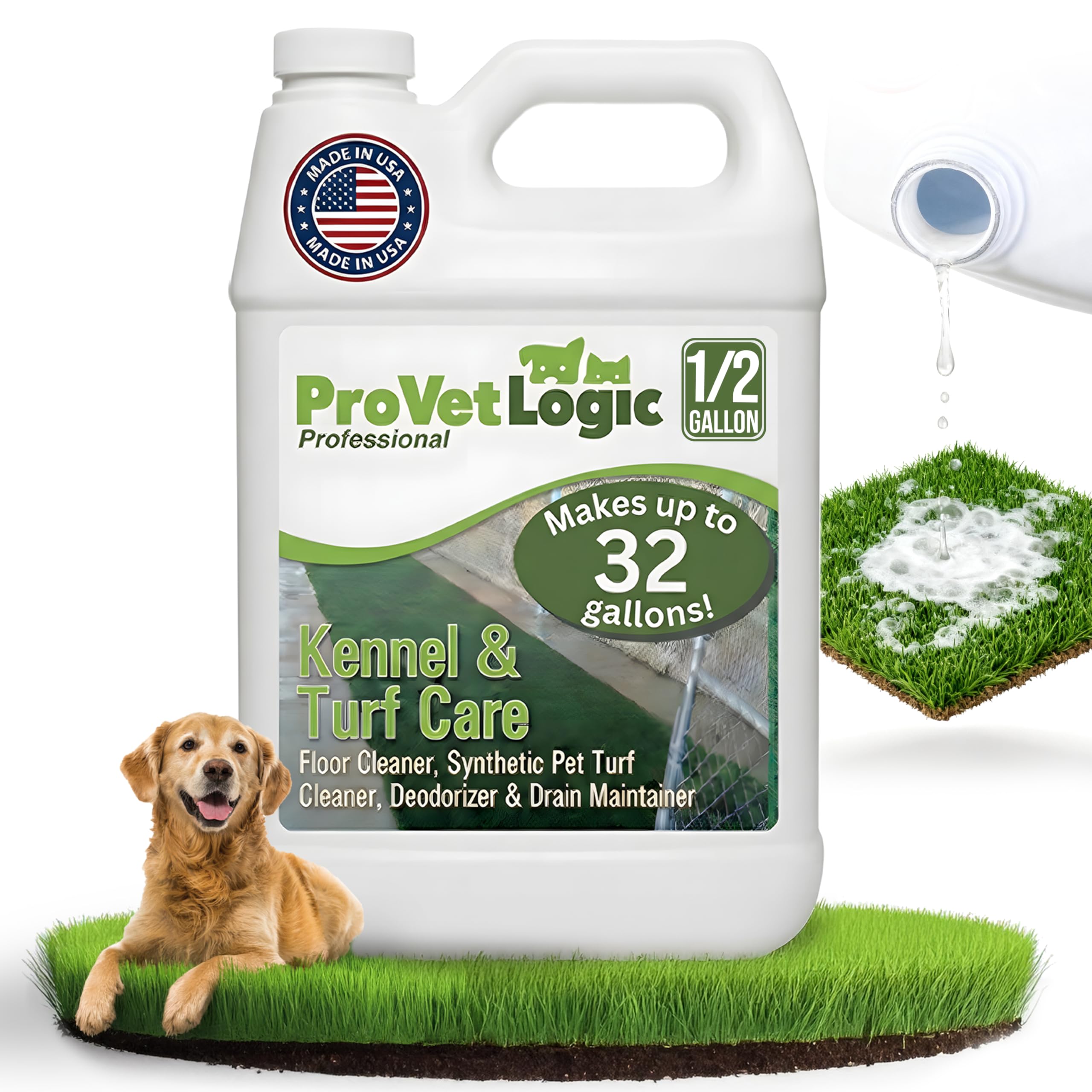
Developed for veterinary clinics and animal care facilities, ProVetLogic uses a bacterial-enriched formula that includes non-chlorine bleaching action to brighten synthetic turf fibers while digesting organic waste. The half-gallon concentrate dilutes significantly — users generally mix one to four ounces per gallon of water depending on the severity of the odor — making it one of the highest-value options for kennel operators or households with multiple large dogs.
The biological action continues to work between cleanings, which is critical for synthetic turf with rubber infill where urine salts migrate below the surface blades. Unlike straight enzymatic sprays that stop working once dry, the bacterial colony remains active as long as the area stays damp, which means a thorough watering after application extends the cleaning window. Multiple customer reviews highlight complete odor removal from artificial grass after a single application that was flushed through with a hose.
On the downside, this product works best when it can be mechanically agitated or flushed into the turf pile — simply spraying the surface and leaving it dry reduces effectiveness. It also requires a short dwell time (5 minutes minimum) before rinsing, which is harder to achieve on sloped or fast-draining surfaces. The brightening agent can lighten dark synthetic turf if over-applied in concentrated form.
Why we love it
- Professional-grade bacterial formula used in veterinary facilities
- Brightens synthetic turf fibers without harsh chlorine bleach
- High dilution ratio means the half-gallon lasts a long time
Good to know
- Requires proper flushing into the turf to activate bacteria
- Over-application on dark turf may cause lightening
- Not a ready-to-use spray — requires mixing
3. SMELLEZE Outdoor Yard Odor Eliminator (Granular)
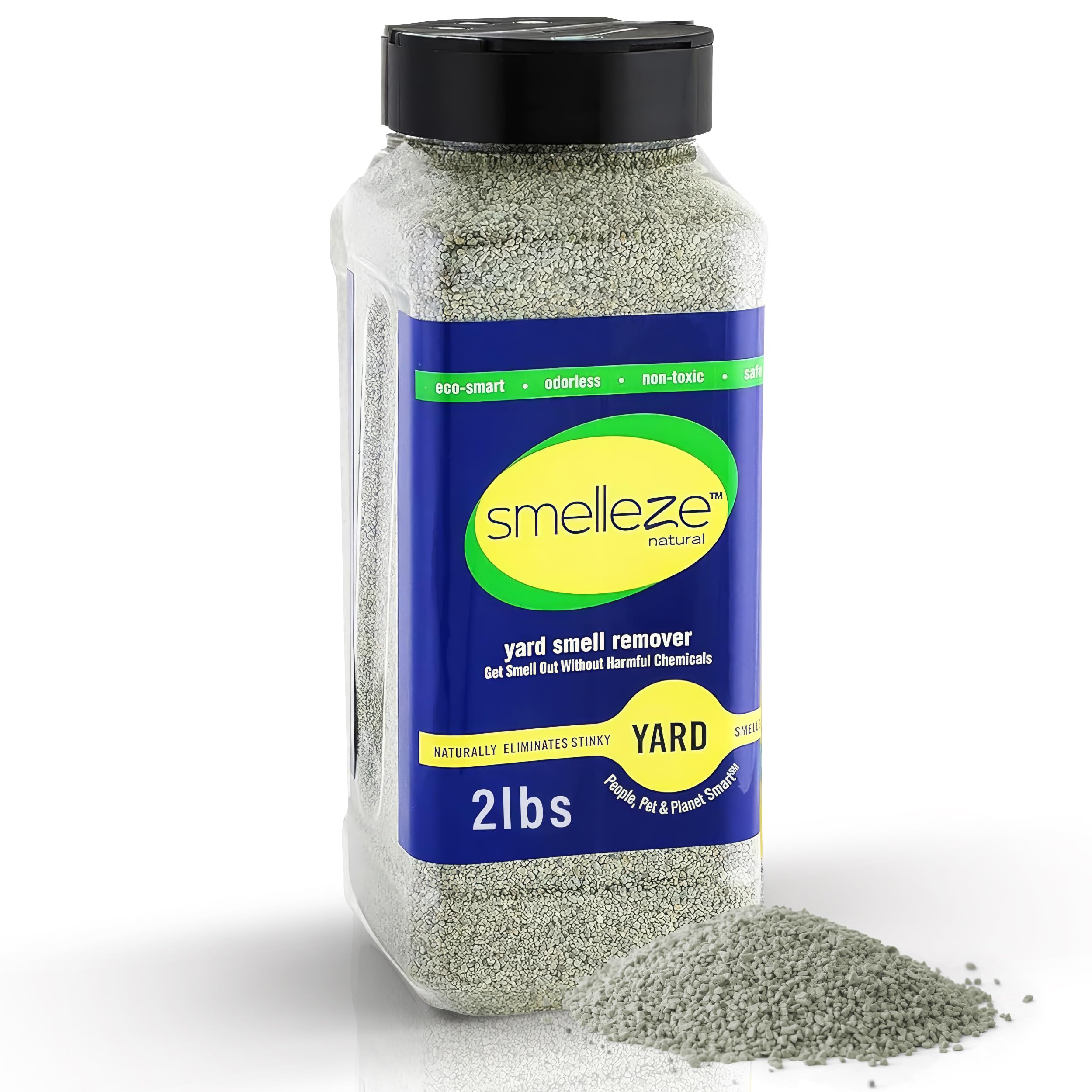
Where liquid sprays stop at the surface, SMELLEZE granules physically sink six inches or deeper into soil, gravel, and artificial turf infill to absorb ammonia gas at its source. The mineral-based formula contains no enzymes, bacteria, or synthetic fragrances, which makes it the safest choice for households with dogs that lick the ground or cats that roam treated areas. One two-pound container covers up to 400 square feet and lasts two to three weeks per application even after rain.
The application process is straightforward — sprinkle evenly, water lightly to activate, and walk away. Users report noticeable odor reduction within 24 hours and complete neutralization of even dead-animal and decomposition smells after 48 hours. The granular format is especially effective on gravel dog runs and concrete cracks where liquid cleaners simply run off without penetrating. Several verified reviews mention using it to treat large kennels and dirt yards where bacterial products failed to establish a colony due to lack of moisture.
The primary drawback is cost at scale. Maintaining a large yard with weekly applications can require multiple bags per month. Some users note that severe odors demand a heavier dose (two to three pounds per 200 square feet) initially, which depletes the container faster than the label suggests. The granular format is not suitable for indoor use or for spot-treating individual stains on upholstery.
Why we love it
- Penetrates six inches deep — reaches odors in gravel and soil below turf
- No enzymes, bacteria, or harsh chemicals — safe for pets and plants
- Survives rain and requires reapplication only every 2–3 weeks
Good to know
- Higher price per treatment for large yards needing weekly use
- Granules take 24–48 hours for full odor elimination
- Not designed for indoor fabrics, carpets, or upholstery
4. Zep Urine Remover

A professional-strength hydrogen peroxide formulation that chemically oxidizes urine compounds on contact, Zep Urine Remover comes ready-to-use in a full 128-ounce bottle with no mixing required. The hydrogen peroxide base creates a mild foaming action that lifts urine salts from carpet fibers, laminate flooring, and sealed concrete. Multiple owners confirm it removes stubborn cat urine smells from dark thick carpets without causing fading or discoloration.
The application method is simple — saturate the area, let it sit for 20 to 30 minutes, and blot dry. Where this product stands out is its versatility across surfaces: users successfully treated cotton clothing with a five-minute pre-soak before machine washing, laminate flooring after two 15-minute mop applications, and even sealed wood floors. The lack of added fragrance means there is no perfume residue, though some users detect a faint chemical smell (similar to Windex) that dissipates completely as the peroxide breaks down into water and oxygen.
The main limitation for turf use is that it does not establish any ongoing protection — once dry, the chemical reaction stops. For turf or lawn areas where pets urinate daily, this means reapplying every time a fresh deposit is discovered. The liquid also does not penetrate deep gravel or thick soil layers the way granules do, so it works best on smooth surfaces or carpeted potty pads rather than deep-pile artificial grass or heavily mulched areas.
Why we love it
- Large 128-ounce bottle is ready to use — no mixing or diluting
- Hydrogen peroxide safely lifts stains without chlorine bleaching
- Works on a wide range of surfaces from clothing to laminate to carpet
Good to know
- No residual protection — must reapply after each urination event
- Does not penetrate deep into gravel or soil
- Foaming action can be messy on vertical surfaces
5. MICROBE-LIFT Outdoor Pet Odor Eliminator

MICROBE-LIFT combines bacterial digestion of urine with a built-in pheromone deterrent that blocks the scent markers dogs use to find their favorite potty spots. The ready-to-use aerosol spray covers up to 6,000 square feet per 32-ounce bottle, which is roughly fifteen times the coverage of a typical liquid spray at the same volume. Users report that a single application on artificial turf and patios stops dogs from re-marking the same area while eliminating the underlying ammonia smell.
The bacterial action here is the standout feature — it converts urine compounds into carbon dioxide and water rather than masking them. Verified owners describe it as fast-acting, with noticeable odor reduction within minutes and complete neutralization after the five-minute dwell period followed by a water rinse. The fresh scent is mild and fades quickly, leaving no artificial fragrance behind. Several reviews confirm that it also works on stray cat spray on walls and plants without damaging vegetation.
Where this product faces criticism is inconsistency on heavily saturated artificial turf. Some owners reported that the smell returned after a day on deep-pile synthetic grass, suggesting that the bacteria could not reach urine trapped below the infill layer. The aerosol format also makes it harder to control application direction on windy days, and the 32-ounce container may deplete quickly for owners treating multiple large areas weekly.
Why we love it
- Pheromone deterrent reduces re-marking behavior effectively
- Bacteria convert odors into water and CO₂ rather than masking them
- Massive 6,000 sq ft coverage per bottle
Good to know
- Inconsistent results on deep-pile artificial turf with infill
- Aerosol can is difficult to control in windy conditions
- Bottle empties quickly when treating multiple large zones
FAQ
What is the difference between an enzymatic and a bacterial turf odor eliminator?
Can I use a granular turf odor eliminator on artificial grass with rubber infill?
How long does a typical turf odor treatment last before reapplication is needed?
Are citrus-based concentrated sprays safe for all types of artificial turf?
Final Thoughts: The Verdict
For most pet owners maintaining artificial turf or a backyard potty area, the best turf odor eliminator winner is the ProVetLogic Kennel & Turf Care because its bacterial-enriched formula both degrades existing waste and continues cleaning between applications, making it ideal for turf with infill where urine accumulates below the surface. If you need a granular option that handles gravel, soil, and deep-pile artificial grass with minimal effort, grab the SMELLEZE Outdoor Yard Odor Eliminator. And for deep-set indoor stains on carpets, upholstery, or sealed wood where nothing else has worked, nothing beats the Angry Orange Pet Odor Eliminator.