
A fly mask that doesn’t block UV rays is just a blindfold with netting. For horses with sensitive eyes, pink noses, or a history of uveitis, the difference between a standard fly mask and a true UV-rated mask is the line between irritation and real protection. The wrong choice leaves your horse squinting in the sun, rubbing at its eyes, or worse—developing a corneal issue that takes weeks to heal.
I’m Mo Mahin — the founder and writer behind Furric. I’ve spent years cross-referencing veterinary ophthalmology data with owner-reported field performance to separate the masks that merely claim UV protection from those that actually deliver it across a full turnout cycle.
Whether your horse has sun-bleached skin around the eyes or you simply want proactive shade in every paddock hour, finding the right uv protection fly mask for horses means understanding mesh density, wrap-around coverage, and how the mask stays clear of the cornea while blocking sunlight.
How To Choose The Best UV Protection Fly Mask For Horses
A UV fly mask is not a one-size-fits-all accessory. Three factors separate a mask that protects from one that merely frustrates your horse: the UV-block rating of the mesh, the fit geometry around the eyes, and the material’s durability under daily sun and sweat exposure.
UV Block Percentage and Mesh Design
Not all dark mesh blocks UV. Look for a manufacturer that specifies a UV-block percentage — 50%, 70%, or 99% — rather than vague “sun protection” claims. A standard fly mask’s open weave lets in significant light; denser weaves or a solid EVA visor lining block more rays but can trap heat. The best hybrid designs balance a dense top section for sun shade with a finer peripheral mesh for airflow.
Eye Clearance and Medical Fit
Horses with uveitis, corneal ulcers, or photosensitivity need a mask that holds the mesh off the cornea entirely. A mask that lays flat against the face can rub a healing eye or transfer debris into the tear film. Look for designs with a wraparound band or a rigid visor lip that maintains a consistent air gap between the mesh and the horse’s eye — this is the defining difference between a general-purpose mask and a medical-grade UV guard.
Nose and Forehead Coverage
A long nose panel prevents sunburn on a pink or white muzzle and keeps flies off the nostrils, but an over-long panel catches in feed buckets or drags on the ground. Measure from the poll to the mid-nostril point — that length determines whether a “long nose” model fits your horse’s face shape or becomes a dirt magnet.
Quick Comparison
On smaller screens, swipe sideways to see the full table.
| Model | Category | Best For | Key Spec | Amazon |
|---|---|---|---|---|
| EquiVizor Solar Vizor | Medical-Grade | Uveitis, ulcers, eye injury recovery | 99% UV block with solid EVA visor | Amazon |
| Cashel Quiet Ride Long Nose | Trail Riding | Riding over bridle, head-shaking prevention | Sheer mesh for clear vision at dusk | Amazon |
| Harrison Howard LumiVista | Mid-Range UV | Sunburn nose, daily turnout with UV need | Lab-tested UV protection, translucent fine mesh | Amazon |
| The Sunny Zebra Standard Nose | Mid-Range UV | Pasture turnout, 70% UV block requirement | Blocks 70% UV, breathable micro-mesh | Amazon |
| Harrison Howard CareMaster Fringe | Budget-Friendly | Extra nose fly protection, value buy | Spanish fringe + double velcro straps | Amazon |
In‑Depth Reviews
1. EquiVizor Solar Vizor Horse Fly Mask (Size Full)

This is the mask your veterinarian would recommend if your horse has uveitis, a corneal ulcer, or a photosensitivity diagnosis. The solid EVA lining across the top half creates complete shade — not filtered mesh, but a true light block — while the wraparound band design holds the mask an increased distance away from the eye surface, preventing the mesh from ever touching the cornea during head-shaking or rolling.
The quick-release breakaway buckle system lets you customize fit across the poll and jaw without buying a second size. Owners of blue-eyed horses with pink periocular skin report zero sunburn even after full-day summer turnout, and the durable 15-ounce construction has held up across multiple seasons for re-purchase customers. The three-measurement sizing system is not optional — measure forehead width, face length, and jaw circumference separately to avoid a loose fit.
At the top of the price range, this is not a budget impulse buy. But for a horse actively recovering from an eye injury or prone to recurrent uveitis, the Solar Vizor eliminates the single variable most fly masks get wrong — contact with the healing eye. The foam brow padding can rub slightly in humid summer heat; a thin layer of fleece tape under the visor fixes that issue if it arises.
Why we love it
- True solid EVA visor blocks 100% of direct sunlight, not just filtered mesh
- Wraparound design holds mesh off the cornea, ideal for ulcer recovery
- Breakaway buckle adds safety during field rolling
Good to know
- Requires three separate measurements for correct sizing — not a guess-and-go mask
- Foam visor can cause sweat-related rub on the forehead in summer
2. Cashel Quiet Ride Horse Fly Mask with Long Nose and Ears
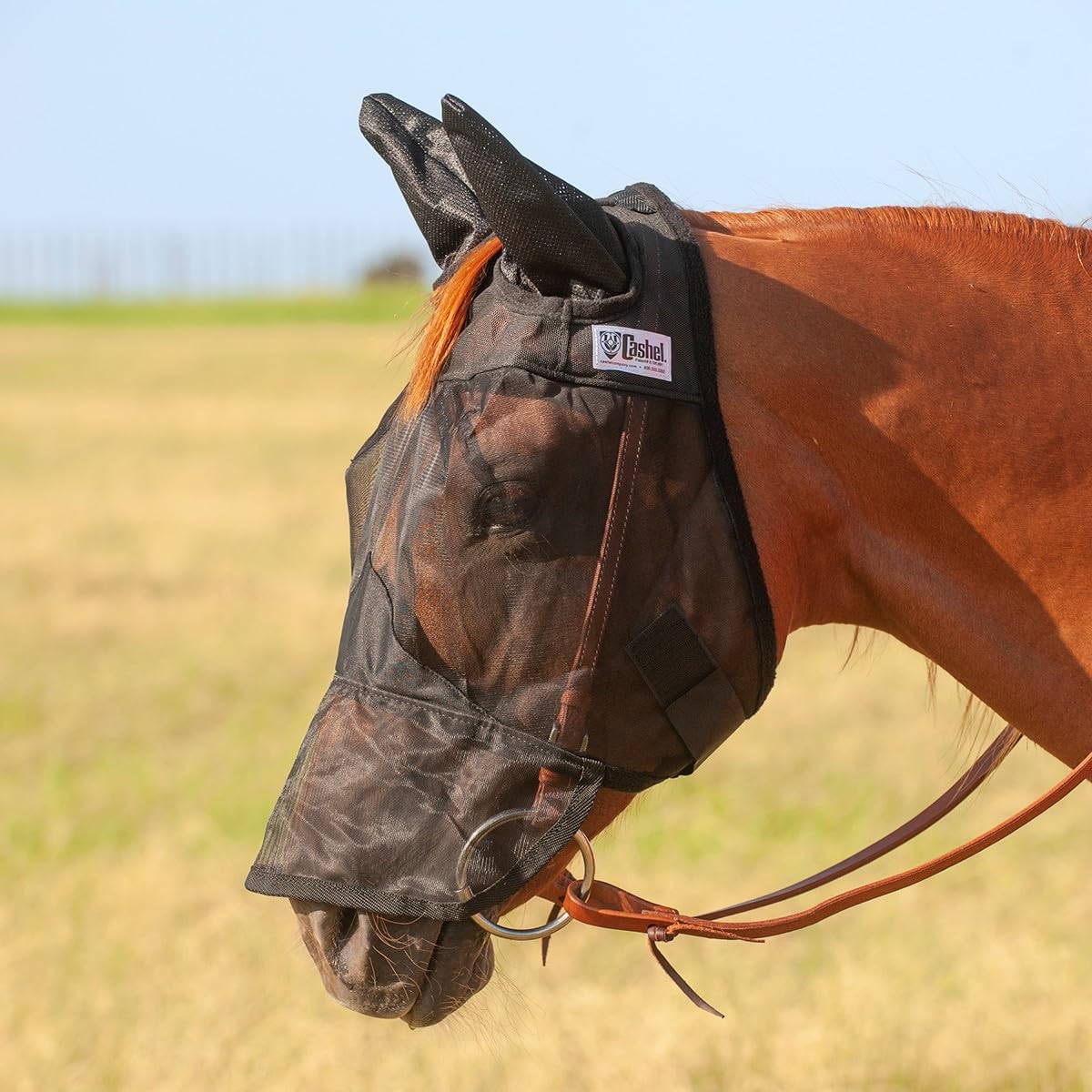
Designed specifically for riding — not turnout — the Quiet Ride attaches over the bridle in seconds with a single velcro strap and provides a sheer mesh that gives your horse a clear, undistorted line of vision on the trail. The long nose panel extends to just above the nostrils, which eliminates photic head-shaking from no-see-ums and sun glare without dragging on the ground.
Owners of head-shaking horses report immediate relief during rides, and the lightweight construction makes it tolerable even for sensitive mares who resist heavy masks. The Draft size fits a 17.2-hand Hanoverian without pressure points, while the Cob/Arab size fits 15-hand Quarter Horses snugly. Because the single velcro attachment is less secure than dual-strap designs, this mask is not recommended for field turnout — horses can rub it off on fences or trees.
The sheer mesh is inherently less UV-dense than a solid visor mask. For horses that need medical-grade shade, the Cashel is not your answer. But for trail riders who want bug protection and glare reduction during sunset rides without obstructing peripheral vision, the Quiet Ride is the most functional over-bridle mask on the market. The Draft sizing runs about an inch long on some horses, so check the bridge-of-nose measurement before ordering.
Why we love it
- Attaches over the bridle for instant on-trail protection without tack changes
- Sheer mesh preserves clear peripheral vision at dusk
- Cob/Arab size fits 15hh Quarter Horses and Morgans well
Good to know
- Single velcro strap is not secure enough for unsupervised turnout
- Draft size may run long on some horses; measure the bridge-to-nose distance
3. Harrison Howard LumiVista Horse Fly Mask Long Nose with Ears
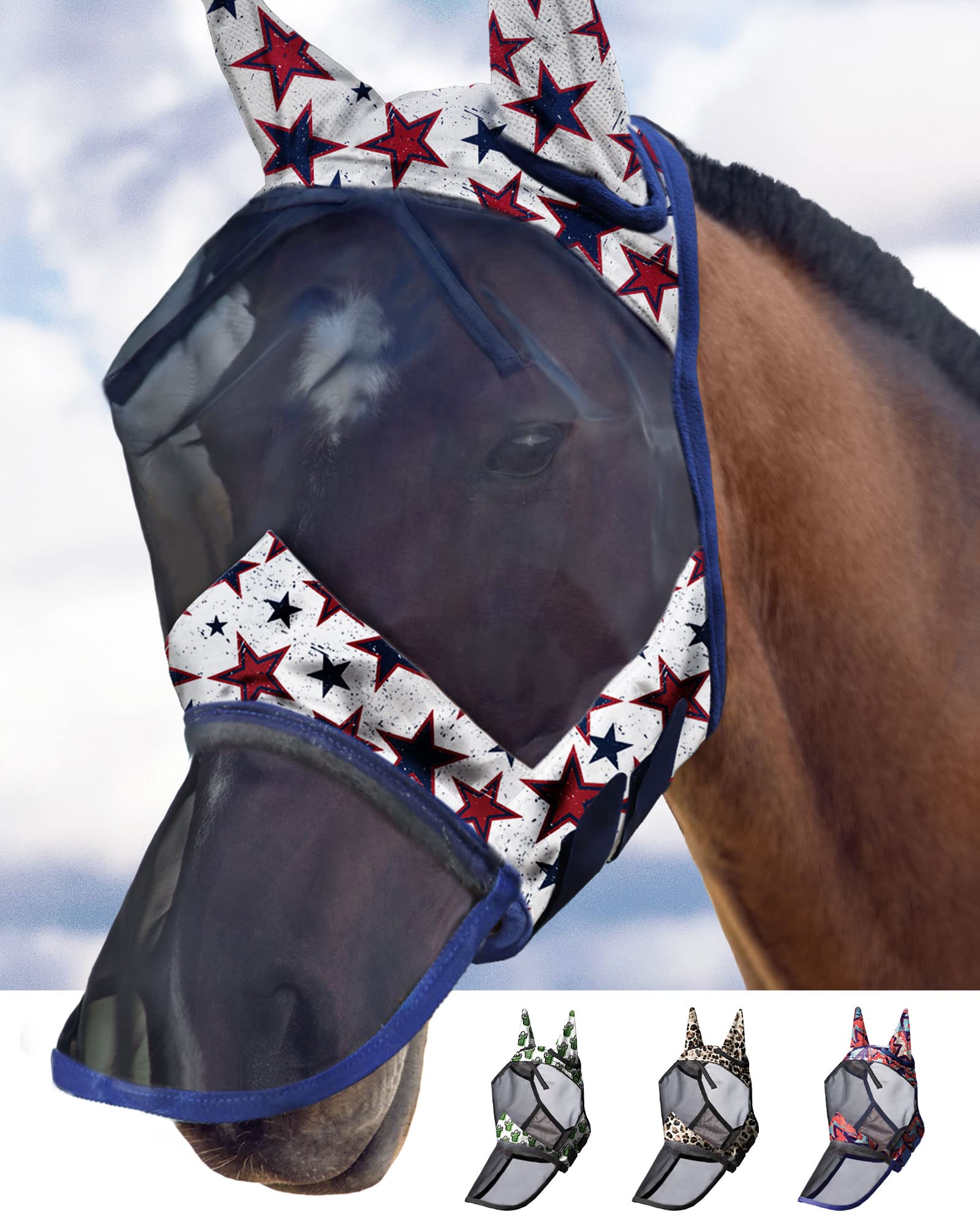
The LumiVista bridges the gap between a basic fly mask and a medical-grade sun block. Its translucent fine mesh is lab-tested for UV protection, and the anatomically shaped design with thick fleece padding along the forehead, nose, and throat prevents the pressure marks that plague cheaper masks. The long nose panel specifically addresses sunburn on white muzzles — owners of pink-nosed Quarter Horses report healing sun damage within two weeks of daily wear.
Secure touch closures and double velcro straps keep the mask on during pasture turnout, even on horses known to ditch standard fly masks. The Cob size runs large, fitting a 14.1-hand Quarter Horse better than a 15.2-hand Arabian, so measure your horse’s face length before selecting. The midge-proof material is breathable enough for all-day summer wear, and the mask holds its shape after repeated hose washes without the mesh sagging into the eye area.
Where the LumiVista falls short is the lack of a stated UV-block percentage — the manufacturer says “lab-tested UV protection” without publishing the exact number. For most turnout scenarios, the translucent mesh’s density provides meaningful shade, but if your veterinarian specifies a 99% block, you need the Solar Vizor instead. The color options are fun (Dream Star, mint, cobalt), and the mask stays out of the eyes reliably during rolling.
Why we love it
- Long nose panel heals sunburn on white muzzles effectively
- Fleece padding along three contact points prevents pressure rubs
- Double velcro straps keep the mask on during pasture turnout
Good to know
- Exact UV-block percentage is not published — estimate is high but unverified
- Cob size runs large; measure face length carefully before ordering
4. The Sunny Zebra Horse Fly Mask Standard With Nose Cover

The Sunny Zebra mask is one of the few budget-adjacent models that publishes an actual UV-block figure — 70% — which gives you a concrete spec to compare rather than marketing ambiguity. The breathable nylon micro-mesh is tear-resistant and soft, and the mask includes a laundry bag to protect it during machine washing, extending its lifespan significantly for a product in this tier.
Fleece padding runs along the forehead, nose, and throat to prevent rubbing, and the dual-locking touch tape combined with one adjustable chin strap creates a secure fit that stays on during full-day turnout. The Horse size fits a 14.2-hand Quarter Mare precisely, with the nose cover extending to the mid-nostril point without dragging into feed. The top mesh is softer and more prone to small tears than the face mesh — one owner reported a small hole forming in the ear area after a few weeks — but the face panel itself is durable enough for a full season.
At 70% block, this mask is not the right choice for a horse with active uveitis or a corneal ulcer that requires complete light elimination. But for a healthy horse with pink skin around the eyes who needs meaningful daytime shade without overheating, the Sunny Zebra delivers a usable UV spec at a very accessible price point. The plastic-free packaging is a thoughtful environmental detail that has no effect on mask performance but signals intentional manufacturing.
Why we love it
- Publishes a concrete 70% UV-block figure for informed decision-making
- Includes a laundry bag to protect mesh during machine washing
- Fleece padding on three contact points prevents rub during all-day wear
Good to know
- Top mesh is softer and can develop small tears faster than the face panel
- 70% block is insufficient for horses with medical eye conditions needing full shade
5. Harrison Howard CareMaster Horse Fly Mask with Ears and Nose Fringe
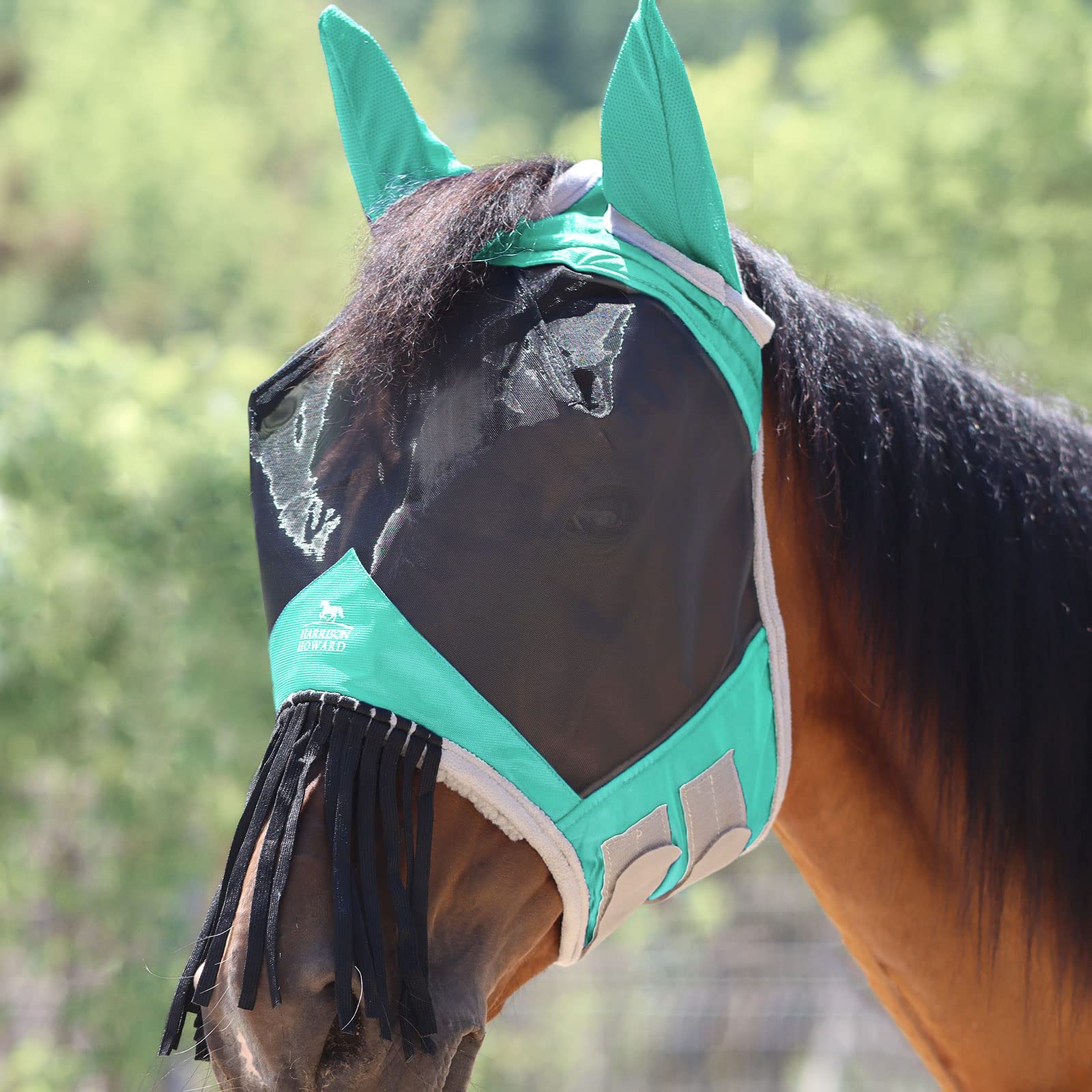
The CareMaster uses Spanish-style tassle fringe along the nose to add a physical fly deterrent that works independently of the mesh — the fringe moves with your horse’s head, sweeping flies off the muzzle before they land. This makes it uniquely effective for horses that dislike having their nose covered but need extra fly protection in that zone. The thick fleece padding around the eyes and throat prevents the gaps that let insects sneak through the seal.
The large Full size runs genuinely big — owners of standard Quarter Horses report that the Medium fits better than the Large, so measure your horse’s face length before assuming “Full” is correct. The double velcro straps are secure enough for field turnout, and the midge-proof material holds up to daily wear. A few owners noted the fringe is long enough to soak up wet feed, but trimming an inch off the tassles solves that issue without affecting fly-deterrence.
This mask does not publish a UV-block figure, and the mesh is standard fly density rather than a specialized UV weave. For a horse that primarily needs fly defense and lives in a region with moderate sun, the CareMaster’s fringe and fleece padding provide comfort that a basic mesh mask cannot match. But if UV-specific eye protection is your priority, the LumiVista or Solar Vizor are better fits. The CareMaster excels at what it claims to do — keeping flies off the nose through mechanical motion — not at blocking solar radiation.
Why we love it
- Fringe sweeps flies off the muzzle mechanically, effective even in high-insect environments
- Thick fleece padding prevents the gaps that let insects reach the eyes
- Double velcro straps keep the mask on during active pasture turnout
Good to know
- No UV-block specification — not a sun protection mask
- Sizing runs large; the Medium may fit a typical Quarter Horse better than the Full
FAQ
Can a standard fly mask block UV rays effectively?
How do I measure my horse for a UV fly mask with long nose coverage?
What UV-block percentage does a horse with uveitis need?
How often should a UV fly mask be replaced?
Final Thoughts: The Verdict
For most horse owners, the uv protection fly mask for horses winner is the Harrison Howard LumiVista because it combines a lab-tested UV weave with fleece padding and double velcro security at a price that works for daily turnout. If your horse has a medical eye diagnosis requiring complete shade, the EquiVizor Solar Vizor is the only choice — its solid EVA visor delivers the 99% block that partial meshes cannot match. And for trail riders who need fly protection over the bridle without blocking vision, nothing beats the Cashel Quiet Ride.