
No matter how clean your duck pen looks come morning, a standard feeder left on the ground guarantees a sludgy, trampled mess by midday. Wet grain rots fast, attracts rodents, and can make your flock sick. The right feeder solves this by lifting food off the mud, controlling spill rate, and letting air circulate through the feed.
I’m Mo Mahin — the founder and writer behind Furric. I’ve spent months comparing load capacities, corrosion resistance on galvanized metal versus carbonized wood, and gravity-feed vs. tray-style mechanics by cross-referencing dozens of owner reports across small-flock and backyard setups.
After reviewing the top options for keeping feed dry and reducing daily waste, this guide ranks the very best models to help you find the right duck feeder for your coop or yard setup.
How To Choose The Best Duck Feeder
Ducks eat differently than chickens — they scoop water with every bite and often mash their feed into a paste. A feeder built for chickens often fails for ducks because it doesn’t account for this wet feeding behavior. Here are the key factors to evaluate before buying.
Material and Weather Resistance
Galvanized steel and powder-coated stainless steel handle outdoor moisture best without rusting. Carbonized wood offers a natural look but needs varnish or treatment to survive repeated rain. Heavy-duty polypropylene is lightweight and won’t rust, but it can crack in freezing temperatures or after long sun exposure. Choose the material based on whether your feeder lives under a covered run or in an open yard.
Capacity and Refill Frequency
A small 5-pound feeder works for a pair of ducks for a day or two, but a 20-pound or larger gravity unit can stretch several days for a small flock. Consider how often you want to refill — a higher capacity means less daily work but also a larger, heavier unit to hang or mount. Gravity systems feed consistently as long as the container holds feed, while open trays run out faster and are more affected by rain.
Spill Reduction and Drainage
Ducks are messy eaters. A feeder with a mesh floor or raised tray drains moisture away so feed doesn’t sit in a puddle. Gravity feeders often include baffles or cone bottoms that release grain only when the tray empties, cutting waste significantly. Open-top platforms are cheaper but allow ducks to flick feed out easily. Look for a feeder that balances easy access for broad duck bills with some mechanism that slows spillage.
Quick Comparison
On smaller screens, swipe sideways to see the full table.
| Model | Category | Best For | Key Spec | Amazon |
|---|---|---|---|---|
| Little Giant Dome Feeder | Gravity | Large flocks, low refill effort | 60 lb capacity / 30.7″ height | Amazon |
| BUYYAH Galvanized Feeder | Gravity | Rain-prone climates, small flocks | 28 lb capacity / Galvanized metal | Amazon |
| Plexon Hanging Feeder | Hanging | Rodent deterrence, compact spaces | 6.6 lb capacity / Stainless steel | Amazon |
| Little Giant Fence Feeders | Clip-on | Pen mounting, small portions | 4.5 qt liquid / 4 qt dry capacity | Amazon |
| Kingsyard Ground Feeder | Platform | Ground-feeding birds, dry seed | 5 lb capacity / Mesh floor | Amazon |
| GIFANK Hanging Feeder | Gravity | Portable use, medium flocks | 26 lb capacity / 3 feeding ports | Amazon |
| CHTSJQW Picnic Table Feeder | Tray | Treat feeding, visual appeal | 15.6″ x 15.6″ / Carbonized wood | Amazon |
In‑Depth Reviews
1. Little Giant Dome Feeder (60 lb)

This is the clear capacity champion for anyone running a flock of a dozen ducks or more. The 60-pound gravity tank lets you dump an entire 50-pound bag of feed and walk away for a week or longer, depending on flock size. The heavy-duty translucent plastic lets you see the remaining level at a glance without opening it, and the three-leg base lifts the trough a few inches off the ground to keep feed from sitting in mud.
Owners of mixed chicken-and-duck flocks report that the wide base and gentle slope of the bottom ring work well for duck bills without jamming. The included Feed Saver ring reduces the amount of grain pushed out at once, which cuts spillage compared to open trays. Because the plastic is thick and weather-resistant, it holds up in direct sun without becoming brittle, and the bottom disassembles for cleaning without tools.
The main trade-off is its footprint — at 30.7 inches tall and 18.2 inches wide, it demands dedicated floor space in a covered run. Ducks that forage on top will perch and soil the lid, so a slightly domed lid would be a helpful design tweak. Still, for convenience and minimal daily effort, this feeder beats smaller options hands-down.
Why we love it
- Holds an entire feed bag, refill once a week
- Level window makes monitoring effortless
- Disassembles for deep cleaning
Good to know
- Large footprint needs covered run space
- Flat lid encourages duck perching and soiling
2. BUYYAH Galvanized Feeder (28 lb)

Galvanized metal is the gold standard for outdoor poultry gear, and this 28-pound gravity feeder uses it well. The metal body resists chewing from rodents and won’t degrade under UV in the way polypropylene can after a few seasons. The top-opening lid is designed to be operable with one hand, which matters when you’re carrying a heavy scoop of feed.
The rainproof top seals effectively, and ducks appreciate the broad, low trough that accommodates their wider bills without scraping. With a capacity of 28 pounds, it supports a small-to-medium flock for several days without refills. The base is sturdy enough that heavy ducks won’t tip it when feeding.
At 12.5 pounds empty, this feeder is not portable in the same way plastic units are, so pick a location and leave it. Some users note the feed opening at the bottom can occasionally bridge with crumbles, but whole grains and pellets flow smoothly. For those in high-rainfall areas who want a long-lasting metal unit, this is a standout choice.
Why we love it
- Galvanized steel resists rust and rodents
- One-hand lid makes refilling easy
- Rainproof top keeps feed dry
Good to know
- Heavy at 12.5 lbs, not portable
- Can clog with crumble feed at the base
3. Plexon Hanging Feeder (6.6 lb)
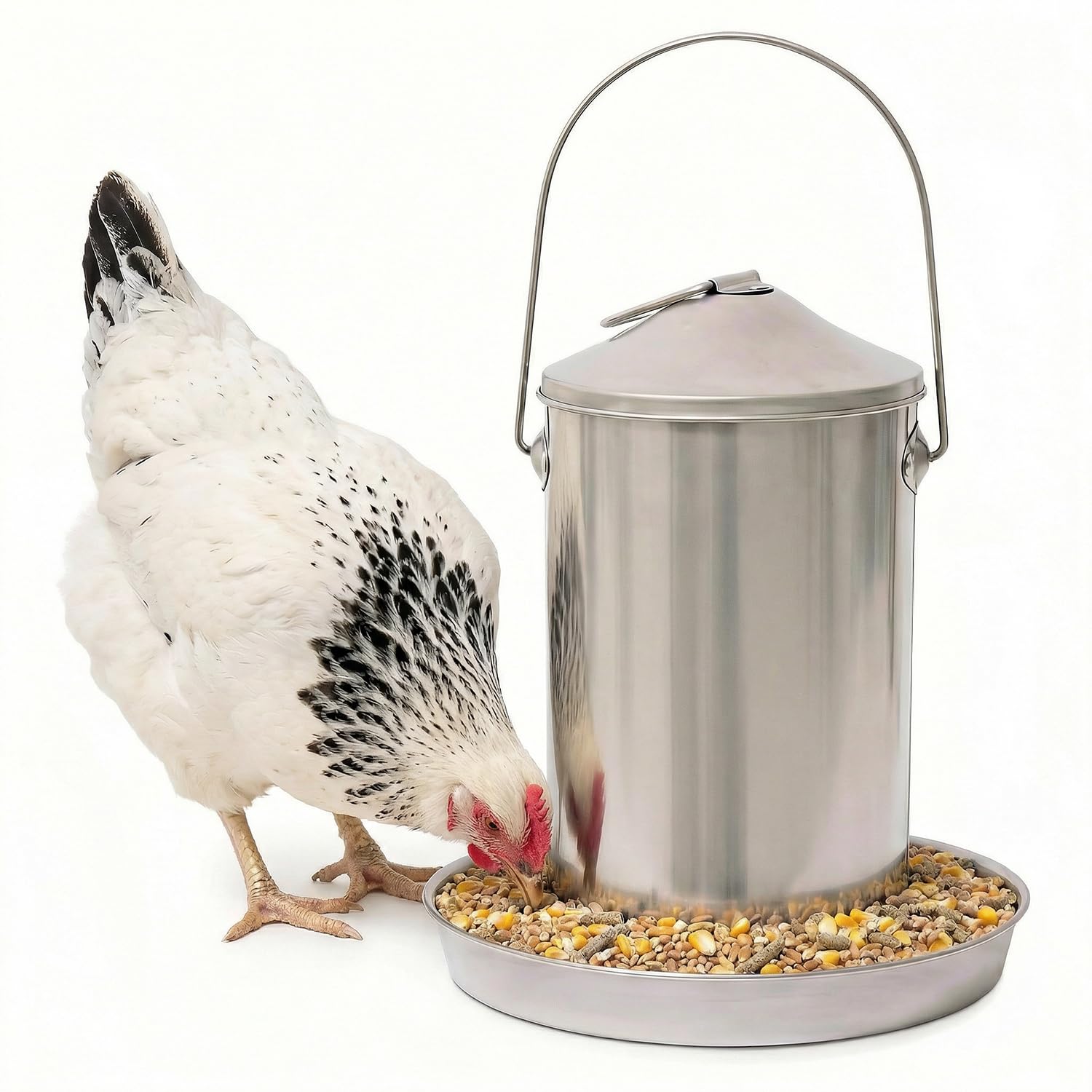
For small spaces or yards where ground-level scavengers are a problem, this stainless steel hanging feeder is a smart choice. The conical bottom funnels feed down into the tray, and the hanging design keeps the entire unit off the ground so rats, raccoons, and opossums can’t reach the feed. At 6.6 pounds capacity, it’s designed for daily refills with a pair of ducks or a small flock.
The stainless steel body is food-grade and won’t rust, dent, or corrode even if left out in the rain. Integrated handles make carrying and hanging simple, and the no-waste design reduces the amount of feed pushed out at once compared to open dome feeders. Ducks can access the tray without struggling, and the clean metal surface is easy to wipe down between fillings.
Because it’s hanging, you need a sturdy hook or beam to support it — hanging from a thin branch or light chain may cause swaying. The capacity is modest, so it’s best for owners who don’t mind daily refilling. For those fighting rodents in an uncovered run, the separation from the ground is a game-changer.
Why we love it
- Anti-rodent hanging design elevates feed
- Food-grade stainless steel won’t rust
- Conical bottom reduces waste
Good to know
- Small capacity requires daily refilling
- Needs strong hanging support
4. Little Giant Fence Feeders (2-Pack)

This two-pack from Little Giant offers a simple, low-cost solution for clamping feeders directly onto chain-link or wire fencing. Each feeder holds 4.5 quarts of liquid or 4 quarts of dry feed, making them suitable for supplementing a main feeder or offering treats in a separate pen area. The heavy-duty metal clips grip firmly and allow you to reposition without tools.
The high-impact polyethylene plastic is tough and won’t crack from sun exposure as quickly as cheaper thin plastics. Because the units mount vertically on a fence, they keep feed contained and off the floor, which reduces contact with droppings and mud. You can also install them permanently with staples or screws, but the clips work fine for temporary setups.
The narrow 11-inch length is good for small spaces but may be crowded if multiple ducks try to eat simultaneously. These work best as secondary feeding stations rather than the main daily source. The value lies in getting two durable feeders for the price of one, with flexible mounting that adapts to most pens.
Why we love it
- Two feeders included for a low cost
- Flexible fence-mounting clips included
- Tough plastic resists weather cracking
Good to know
- Narrow opening, one duck at a time
- Best as a secondary feeder
5. Kingsyard Ground Feeder (5 lb)

If your ducks free-range and you want a simple platform feeder for dry grains or mixed seeds, this Kingsyard unit delivers excellent build quality for its class. The tray is made from recycled plastic that feels dense and solid, and the metal mesh floor elevates the feed 6 inches above the ground for drainage. No assembly is required — just unfold the legs and fill.
The 5-pound capacity is suited for small, daily refills rather than bulk feeding. Ducks can easily reach the broad surface, and the mesh bottom prevents moisture from pooling under the grain. It also works well for mixed flocks that include ground-feeding birds, as the low profile is accessible to smaller birds without intimidation from larger ducks.
Because it’s an open tray with no roof, rain will wet the feed if left uncovered. Owners in covered runs will find this feeder perfect for portion-controlled feeding. The recycled plastic has a slight texture that grips well on dirt or grass, preventing sliding, and the feeder weighs enough that it won’t tip under normal duck activity.
Why we love it
- Mesh floor drains moisture away from feed
- No assembly required, unfolds and fills
- Stable on grass or dirt surfaces
Good to know
- Open top, rain will wet the feed
- 5 lb capacity needs daily refills
6. GIFANK Hanging Feeder (26 lb)

This hanging gravity feeder splits the difference between small daily units and huge bulk tanks. At 26 pounds capacity with three ports, it serves a medium flock efficiently without taking up floor space. The PP plastic body is BPA-free and the top is rainproof, while the wide opening makes filling from a scoop straightforward.
Owners report that the three ports reduce crowding because multiple ducks can eat simultaneously. The baffle system inside the ports slows the feed flow, cutting down on spillage compared to open trays. A stainless steel handle adds durability over plastic handles that can snap, and the included chain and S-hooks provide multiple mounting options for various run layouts.
The plastic construction is lighter than metal, which helps when hanging, but it may become brittle if left in extreme cold or direct sun for years. Some users noted the handle tabs can be tight to install, but once in place they hold securely. For anyone wanting a mid-capacity hanging feeder that doesn’t need daily refilling, this is a strong contender.
Why we love it
- Three ports allow multiple ducks to eat
- 26 lb capacity reduces refill frequency
- Rainproof top and stainless steel handle
Good to know
- Plastic may become brittle over time
- Handle tabs can be difficult to snap in
7. CHTSJQW Picnic Table Feeder

This carbonized wood picnic table feeder is as much a decorative piece as a functional feeding station. The wooden construction with a varnish finish gives it a rustic look that blends into a garden or coop setting, while the stainless steel mesh bottom promotes drainage and airflow to keep treats dry. It comes as a kit that assembles in two simple steps with included hardware.
At 15.6 inches square, the table is a good size for placing treats, chopped greens, or scratch grains. Ducks can eat from the top where the mesh sits, and the open sides let them access from any angle. The legs lift the table a few inches off the ground, which helps prevent feed from sitting directly on damp soil.
Because the wood is not pressure-treated, it performs best under a covered area rather than in open rain. Some owners added their own sealant for extra protection. This feeder is a supplementary treat station rather than a main feed source due to its limited capacity. For duck owners who want a charming, functional addition to their run, it delivers both form and basic utility.
Why we love it
- Attractive carbonized wood with varnish finish
- Mesh bottom drains moisture effectively
- Simple two-step assembly
Good to know
- Best for covered runs, not open rain
- Small capacity, suitable for treats only
FAQ
Can ducks use a chicken feeder without changes?
How do I stop my duck feeder from getting moldy?
Is a hanging or ground feeder better for ducks?
What capacity feeder do I need for 4 ducks?
Can I leave a duck feeder out in the rain?
Final Thoughts: The Verdict
For most gardeners, the duck feeder winner is the Little Giant Dome Feeder because its massive 60-pound capacity and gravity system let you feed a flock for a week without lifting a scoop. If you want metal durability and weatherproofing in rainy climates, grab the BUYYAH Galvanized Feeder. And for small runs where rodent control is critical, nothing beats the Plexon Hanging Feeder.