
Pouring a bag of aqua soil into your tank should feel like an upgrade, not a mudslide. Yet the first rinse — or worse, the first fill — often turns crystal-clear plans into a brownout that takes days to settle. The difference between a smooth cycle and a cloudy mess comes down to grain structure, ammonia management, and whether the soil is actually designed for your specific tank goals.
I’m Mo Mahin — the founder and writer behind Furric. I’ve spent years cross-referencing substrate composition data, analyzing pH buffering curves, and weighing thousands of owner reports to separate the soils that deliver stable water parameters from those that cause more problems than they solve.
Whether you are building a high-tech aquascape or a low-maintenance shrimp tank, finding the right base layer matters. This guide breaks down the top contenders for the title of best aqua soil, focusing on what each does well — and where it falls short — so you can make a choice your plants and livestock will thank you for.
How To Choose The Best Aqua Soil
Not all dark granules are created equal. The difference between a thriving planted tank and a frustrating cycle comes down to four key factors that define how aqua soil behaves once it hits the water.
Active vs. Inert Substrates
Active aqua soils buffer pH downward and soften water, which is ideal for Caridina shrimp, soft-water fish, and demanding plants like Eleocharis dwarf hairgrass. Inert substrates like clay gravel provide no chemical buffering — they rely entirely on liquid fertilizers or root tabs to supply nutrients. Active soils typically leach ammonia during the first few weeks, requiring careful water changes, while inert options let you add fish immediately.
Ammonia Management
Most active soils release a spike of ammonia as they establish the nitrogen cycle. Low-ammonia formulations (under 0.5 ppm per liter) allow faster stocking, while high-nutrient soils (common in ADA-style substrates) can produce readings above 2-3 ppm for weeks. Match the ammonia profile to your patience level: slow-cycling soils reward high-energy planted tanks; low-ammonia soils suit shrimp breeders and instant scapers.
Grain Size and Porosity
Fine grains (1-2 mm) pack tightly, which helps rooting but can inhibit water flow and trap debris. Medium grains (2-4 mm) offer the best balance for root penetration and mulm circulation. Coarse grains (4-6 mm) improve oxygenation in deep substrate beds but may let fine plant roots struggle. Porous granules host beneficial bacteria better than dense clay, directly affecting biological filtration efficiency.
pH and kH Buffering
Good aqua soil should maintain a stable pH in the 5.5-6.8 range and lower carbonate hardness (kH) to near zero. This softens water naturally, which many tropical plants and shrimp require. The buffering lifespan varies — higher-quality volcanic soils maintain pH suppression for 12-18 months before replacement is needed.
Quick Comparison
On smaller screens, swipe sideways to see the full table.
| Model | Category | Best For | Key Spec | Amazon |
|---|---|---|---|---|
| Seachem Flourite Black | Inert Clay | Long‑term root growth | 7.7 lb, 16oz weight | Amazon |
| UNS Controsoil Fine | Active Volcanic | Shrimp & Corydoras | 1L, pH 6.8 buffered | Amazon |
| LANDEN Aqua Soil | Active Natural | Mid‑range planted tanks | 5L (10 lbs), 3-5mm | Amazon |
| CrystalClear Thrive Tabs | Fertilizer Tab | Pond plants & lotus | 200 count, 10-14-8 | Amazon |
| Tropica Plant Care Soil | Active Premium | High‑tech aquascapes | 3L, 2.2 lb bag | Amazon |
In‑Depth Reviews
1. Seachem Flourite Black Clay Gravel, 7.7 lb

Seachem Flourite is not a true active soil — it is a fired clay gravel that holds its structure indefinitely without breaking down. Each 7.7-pound bag delivers consistent, darker-than-sand granules that weigh enough to anchor stem plants like Rotala rotundifolia without floating on initial fill. The dust you see during setup is unavoidable with any clay substrate, but experienced users report that a slow fill technique keeps cloudiness manageable and clears within two days.
Because Flourite is chemically inert, it provides zero pH buffering and no ammonia spike — a double-edged sword. You can stock fish immediately without cycling delays, but your plants will need root tabs or liquid fertilization to thrive. For tanks running under-gravel filters or for keepers who want absolute water parameter control, this clay base gives you a stable, long-lasting foundation that won’t exhaust or need replacement after a year.
Grain size consistency is a standout feature here. Most bags produce particles in the 1-4 mm range without excessive fines at the bottom, and the color stays naturally black even after months of direct light exposure. Satisfied owners note that snails and Corydoras catfish navigate the surface comfortably without damage to barbels, making this an excellent choice for community planted tanks that prioritize husbandry stability over pH manipulation.
Why we love it
- Zero ammonia leaching — safe for immediate stocking
- Heavy granules stay put during filling and siphoning
- Permanent structure; does not dissolve over time
Good to know
- Inert — requires root tabs or liquid ferts for plant growth
- Produces fine dust cloud that takes 1-2 days to settle
- Not ideal for shrimp that prefer acidic, buffered water
2. Ultum Nature Systems Controsoil – Freshwater Aqua Soil, 1 Liter

UNS Controsoil sits in a sweet spot between high-nutrient active soils and inert substrates. Made from fired volcanic ash, its low ammonia release profile (under 0.5 ppm per liter in most initial tests) means you can cycle a tank in two to three weeks with starter bacteria instead of enduring the month-long spikes common with richer soils. The granules are soft enough that bottom-dwellers like Corydoras catfish can dig without injury, yet firm enough to avoid turning into mud under heavy water flow.
The true strength of Controsoil is its pH buffering capability without extreme nutrient loading. It pulls the water down to a stable 6.8 pH and reduces kH, creating ideal conditions for Caridina shrimp and soft-water plants like Bucephalandra. Because it lacks the heavy nutrient content of dark Amazonia-style soils, you retain full control over fertilization through root tabs — beneficial for aquascapers who want to dial in specific NPK ratios without the soil releasing hidden compounds.
One practical disadvantage: the 1-liter package is small, and several owners report needing two or more bags to achieve the recommended 2-inch depth in a standard 10-gallon tank. The granules also release a fine tan dust upon first fill that requires multiple rinses or a Purigen-polished filter to clear. Buyers who skip rinsing often see brown water for several hours, though it settles overnight with adequate mechanical filtration.
Why we love it
- Low ammonia release enables fast cycling
- Buffers pH to 6.8 without drastic swings
- Soft granules safe for digging bottom-feeders
Good to know
- Low nutrient content — root tabs recommended
- Bag size (1L) insufficient for many tank setups alone
- Initial rinse produces significant tan dust cloud
3. LANDEN Aqua Soil Substrate 5L (10 lbs)

LANDEN’s 5-liter bag offers the most cost-effective way to fill a medium-sized planted tank with an active, pH-lowering substrate. The 3-5 mm grain size is noticeably more porous than clay-based alternatives, providing generous surface area for bacterial colonization while remaining heavy enough to avoid floating on initial fill. When properly installed without rinsing — LANDEN specifically advises against rinsing — the soil settles within hours and produces water stable enough for shrimp and most soft-water fish after a week.
The natural material composition buffers pH reliably down to the 6.0-6.5 range and eliminates carbonate hardness, matching the requirements of Caridina cantonensis shrimp and sensitive plants like Hemianthus callitrichoides (dwarf baby tears). Owners note that the soil includes occasional organic debris — dried grass fragments or leaf pieces — which requires manual removal during setup but does not affect overall water chemistry. The ammonia release is moderate, requiring partial water changes for the first week to keep levels below 1 ppm.
Where LANDEN pulls ahead of generics is its mechanical stability. After several months, the granules retain their shape without turning into sludge, unlike some budget soils that disintegrate under gentle siphoning. The dark black color also holds up better than expected under intense LED lighting, with no noticeable fading or tint leaching after six months of continuous operation in a 55-gallon community tank.
Why we love it
- Generous 5L bag for large setups at a fair cost
- Reliable pH buffering to 6.0-6.5
- Porous granules maintain structure over months
Good to know
- Contains organic debris that needs hand-picking
- Moderate ammonia release — water changes required first week
- Not suitable for tanks requiring immediate fish stocking
4. CrystalClear Thrive Aquatic Pond Plant Food, 200 Tablets
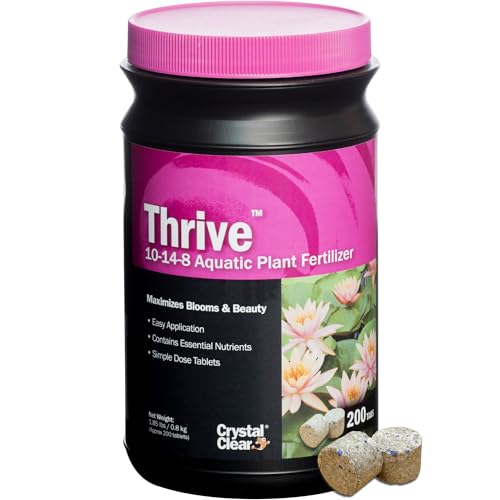
CrystalClear Thrive is not a substrate itself but a targeted root-feeding system for pond plants, large water lilies, and lotus grown in submerged pots. Each tablet delivers a 10-14-8 NPK ratio with a phosphate boost designed to push flower development and structural root growth in plants that are often shaded by deeper water columns. Owners of lotus tubers and tropical lilies report dramatic visual changes — pale, nitrogen-deficient leaves turning deep green within days, followed by multiple emergent shoots in the weeks after a single application.
Application is straightforward: push one to two tablets into the soil near the root zone every four weeks when water temperatures exceed 75°F. The tablets are safe for fish, koi, goldfish, frogs, and snails, with no reports of ammonia spikes or oxygen depletion when used according to directions. Some buyers note that a portion of the tablets arrive crushed into powder — the powder remains effective for broadcasting over soil, but the intact tablets allow precise placement near individual root masses.
The value proposition here is longevity: a 200-count bottle covers multiple growing seasons for a modest pond setup. While the product is unsuitable for aquarium use (the high phosphate load can trigger algae blooms in enclosed tanks), pond keepers benefit from its slow-release behavior in open water systems where dilution keeps algae in check. For anyone growing water lilies, lotus, or marginal pond plants in containers, these tablets provide a reliable, measurable boost that liquid fertilizers cannot match.
Why we love it
- High phosphate ratio (14%) triggers vigorous blooms
- 200 tablets provide multi-season supply
- Safe for all pond livestock including koi and frogs
Good to know
- Not for aquarium use — may promote algae
- Some tablets arrive crushed into powder
- Requires water temperature above 75°F for best results
5. Tropica Plant Care Freshwater Planted Aquarium Soil, 3 Liter Bag

Tropica’s 3-liter bag is a high-performance active soil built for demanding planted aquariums where water clarity and plant response matter most. The granules are naturally dark and porous, supporting rapid root establishment for species like Staurogyne repens and Micranthemum umbrosum. When placed correctly — with a gentle water addition using a bowl or diffuser — the soil produces minimal clouding and settles to a clean, natural-looking bed within a few hours.
Where Tropica draws sharp feedback is its ammonia profile and pH behavior. Several experienced users report that this soil leaches ammonia heavily during the first two weeks, consuming kH rapidly and causing pH swings as low as 5.0 in re-mineralized RO water setups. This makes it a poor choice for beginners or anyone trying to stock fish quickly. However, for hobbyists already running a mature filter or using a dark-start cycling method, the ammonia release accelerates the nitrogen cycle and builds a robust bacterial colony that supports heavy plant loads long-term.
Pricing is the most debated aspect here. At its current retail level, Tropica Soil sits above many comparable products, including Fluval Stratum and ADA Amazonia Light. Some owners consider it a direct equivalent to those options without offering a measurable improvement in plant growth or buffering longevity. If budget is not a primary concern and you are willing to manage a longer cycle, the soil performs reliably for high-energy aquascapes — but cost-conscious buyers will find equivalent results from mid-range alternatives for significantly less.
Why we love it
- Fast root development for demanding foreground plants
- Minimal clouding when installed correctly
- Strong biological cycle acceleration for experienced keepers
Good to know
- High ammonia leach — not for quick-stocking setups
- Premium price doesn’t always outperform cheaper alternatives
- Unstable pH swings reported with RO water
FAQ
How long does aqua soil buffer pH before needing replacement?
Can I mix active soil with inert gravel or sand?
Why does my aqua soil smell like sulfur after a few weeks?
Final Thoughts: The Verdict
For most hobbyists, the best aqua soil winner is the Seachem Flourite Black Clay Gravel because it eliminates ammonia risk entirely and provides a permanent base that never needs replacement. If you want active pH buffering with minimal spike risk, grab the UNS Controsoil Fine. And for budget-conscious aquascapers building a medium-to-large planted tank, nothing beats the value of the LANDEN Aqua Soil 5L bag.