
A jumping spider enclosure needs to balance three things that often war against each other: enough vertical height for your spider to stalk and leap, ventilation that keeps humidity stable without turning the habitat into a wind tunnel, and a door system that doesn’t spook your pet every time you drop a cricket in. Get that mix wrong and your jumper may refuse to build a hammock or, worse, find the one gap you missed.
I’m Mo Mahin — the founder and writer behind Furric. I’ve spent thousands of hours cross-referencing acrylic thicknesses, vent diameters, magnetic pull strengths, and latch mechanisms across the most popular enclosures on the market, then layered in owner feedback from long-term keepers to identify which designs actually hold up to daily feeding routines.
Whether you’re housing a regal jumper or a bold audax, the best jumping spider enclosure for your setup depends on how much you value escape-proofing versus visibility versus access speed for maintenance.
How To Choose The Best Jumping Spider Enclosure
Jumping spiders are visual hunters that need vertical space, stable humidity gradients, and zero escape routes. A generic reptile tub won’t cut it because it won’t offer the height-to-floor ratio or the ventilation pattern these active arachnids require. Here’s what to check before you add to cart.
Height and Vertical Space
A jumping spider spends most of its time on the upper third of its enclosure — building hammocks, hunting, and exploring upward. Enclosures under 8 inches of internal height force the spider to crowd its own ceiling loft, which can reduce natural web-building behavior. Look for at least 9 inches of height for adult regals and audaxes, while smaller species may do fine in an 8-inch tall setup.
Ventilation Configuration
Cross ventilation — vents on opposite sides plus the top — prevents stagnant air that can harbor mold in the substrate while maintaining a humidity gradient from the moist base to the drier top. The vent hole diameter matters: holes larger than 1mm can allow fruit flies and pinhead crickets to escape, while holes smaller than 0.5mm may restrict airflow too much for tropical species that need higher humidity around the lower third of the enclosure.
Door Mechanism and Security
Jumping spiders are escape artists. A poorly aligned magnetic door can leave a hairline gap that a bold jumper will exploit during the night. Traditional latches offer a mechanical seal that won’t weaken over time, but they can cause vibration when opened. Magnets offer silent, one-handed access but require a snug fit. Test the door seal by sliding a piece of paper around the edges — if it passes through, so can a sling.
Material and Clarity
Optical-grade acrylic with 90% or higher light transmittance lets you observe every detail of your spider’s hunting and molting behavior without distortion. Standard acrylic often has a slight haze that reduces visibility at angles. Glass offers superior scratch resistance but is heavier and more prone to shattering during cleaning. For most keepers, a mid-thickness acrylic (3mm to 4mm) provides the best balance of clarity, weight, and impact resistance.
Quick Comparison
On smaller screens, swipe sideways to see the full table.
| Model | Category | Best For | Key Spec | Amazon |
|---|---|---|---|---|
| ZENWUKONG Dual Magnetic | Premium Acrylic | Escape-proof daily use | 264 vents at 0.8mm | Amazon |
| EctoTherm Jumping Spider | Premium Kit | Dual-door access kit | 6x6x9 inches, pre-assembled | Amazon |
| NCYP Glass House | Glass Display | Decorative dry display | 7.5×4.9×9 inches, glass | Amazon |
| NANEEZOO Tall Barrel | Acrylic Cylinder | No-assembly height | 6x6x12 inches, magnetic door | Amazon |
| AZV Clouds Kit | Complete Kit | First-time keeper kit | 5.2×5.2×7.8 inches, magnetic door | Amazon |
| MYGIIKAKA Large Square | Mid-Size Acrylic | Wide floor area | 13.78×7.48×7.87 inches | Amazon |
| smartang Tall Cylinder | Budget Tall | Entry-level vertical | 6x6x12 inches, latch door | Amazon |
In‑Depth Reviews
1. ZENWUKONG Dual Magnetic Jumping Spider Enclosure
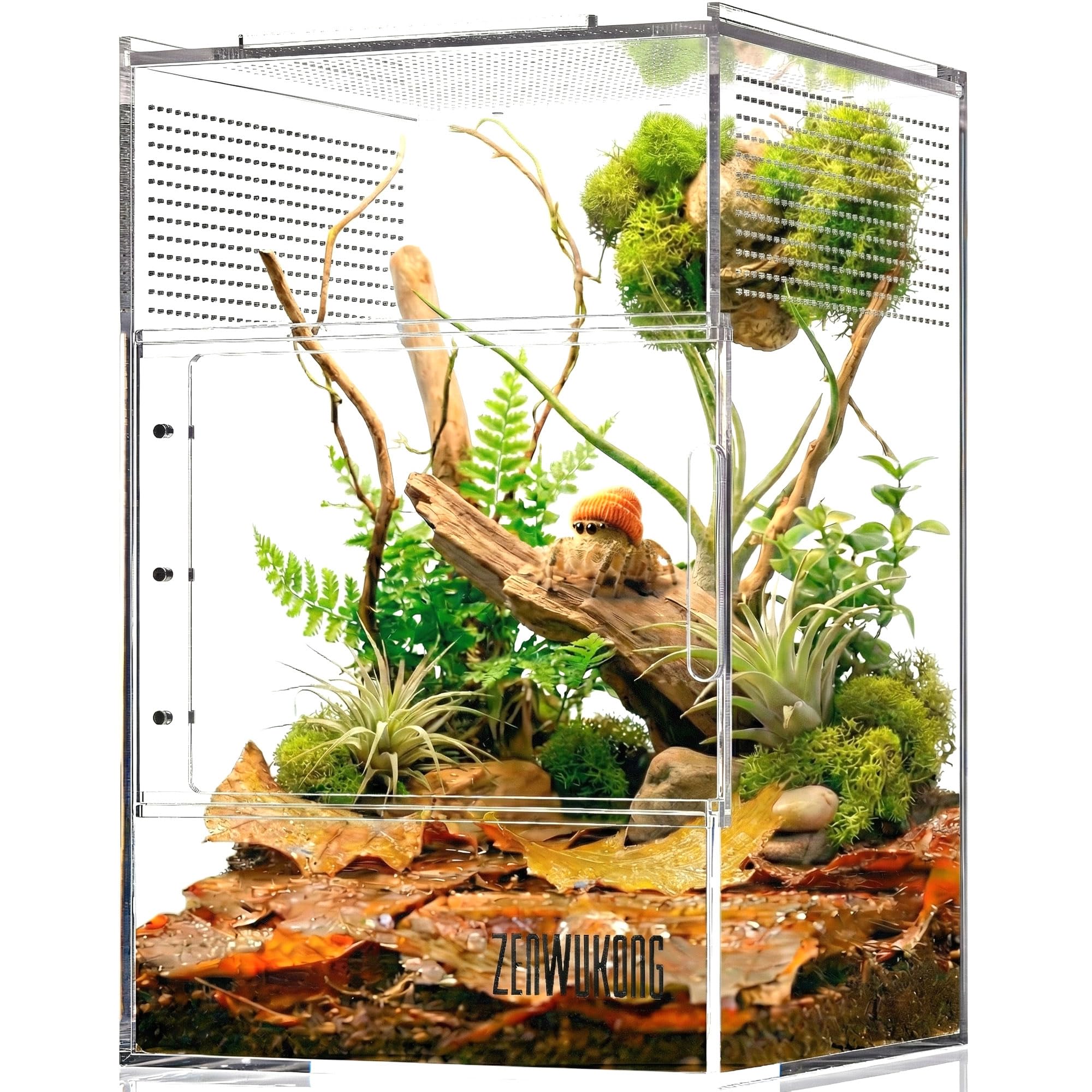
This 6x6x9 inch cubic enclosure nails the essential specs that experienced keepers prioritize: 264 precision-drilled micro-vents at 0.8mm diameter that allow continuous 360-degree airflow while physically blocking fruit flies and pinhead crickets from squeezing through. The optical-grade acrylic hits 98% light transmittance, meaning you can watch your spider stalk prey without the haze that plagues cheaper acrylic enclosures.
The dual magnetic doors are the standout feature — each magnet closes with a firm, gap-free seal that passes the paper-slip test, and the front door lets you feed without disturbing the web structure your spider has built near the top. At 1.1 pounds with a 290 cubic inch volume, it’s light enough to stack multiple units on a shelf without worrying about weight load.
Stackability is built into the design — the flat top and bottom plates lock together securely, making this a strong choice for keepers who plan to expand their collection over time. The lack of included decor is the only reason it doesn’t come as a complete starter kit, but the enclosure shell itself is near-flawless for its tier.
Why we love it
- 264 micro-vents at 0.8mm prevent feeder escapes
- Dual magnetic doors with zero detectable gaps
- 98% optical clarity for distortion-free viewing
- Stackable design saves shelf space
Good to know
- No decor or accessories included
- Limited to 9-inch height for larger species
2. EctoTherm Jumping Spider Enclosure
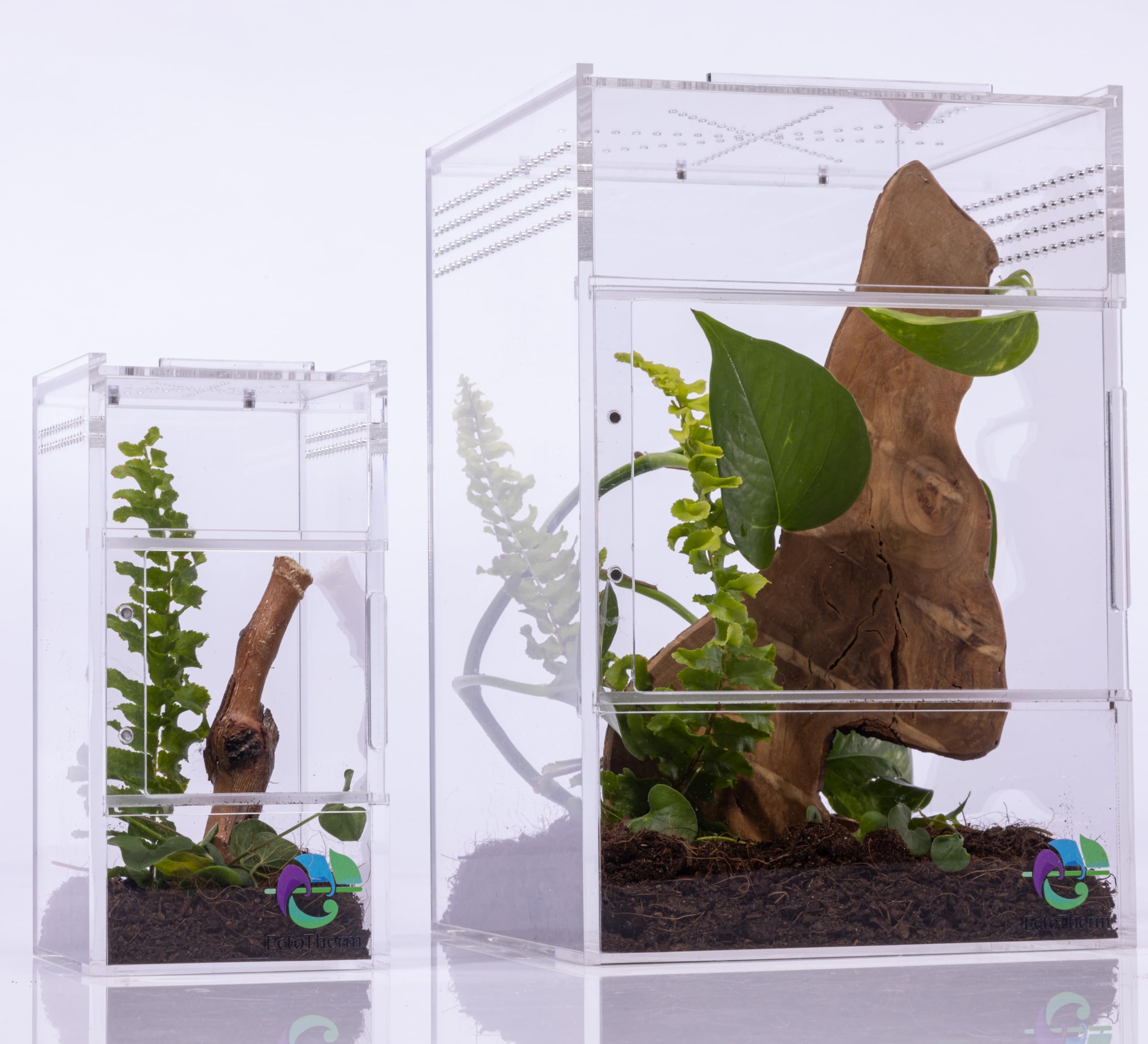
EctoTherm’s 6x6x9 inch enclosure arrives fully assembled with seamless acrylic plates that eliminate the crack-based escape routes found in snap-together designs. The dual sliding door system — one front-facing for daily feeding without disturbing webs, plus an overhead door for deep cleaning or rearranging decor — is the most keeper-friendly access setup in this roundup.
The enclosure comes with climbing branches and cozy shelters included, which saves you the hunting trip to find appropriately sized cork rounds and silk plants. The acrylic thickness feels substantial at roughly 3.5mm, resisting the flex that thinner acrylic develops around the door track over months of daily use. The sealed construction means no gaps at the corners, a weak point on cheaper enclosures where jumping spiders have been known to wedge their carapaces through.
At 0.8 kilograms, it’s slightly heavier than comparable acrylic enclosures, but that weight comes from the thicker panels that provide better insulation against rapid temperature swings near windows. The pre-assembled nature means you can unbox, add substrate, and introduce your spider in under five minutes.
Why we love it
- Dual sliding doors preserve webs during feeding
- Comes with climbing branches and shelters
- Pre-assembled with seamless edges
- Thicker acrylic resists long-term flex
Good to know
- Heavier than other acrylic options
- Premium pricing for the built-in accessories
3. NCYP Glass Enclosure House Shape

The NCYP breaks from the acrylic crowd with a 7.5×4.9×9 inch glass house-shaped design that sits equally well on a coffee table or a shelf as it does in a dedicated bug room. The metal mesh vents on opposing triangular roof panels create natural cross ventilation that prevents fogging, a common issue with fully enclosed glass terrariums that don’t have active airflow pathways.
This enclosure is explicitly not designed to hold standing water — the soldered glass panels have small gaps at the joints that will leak if you pour water directly into the base. It’s best suited for dry or lightly misted setups where a small hidden inner planter (like a condiment cup) can keep moss or fern roots moist without wetting the entire substrate layer. The vintage aesthetic makes it a conversation piece, but the 1.5 kilogram weight means you won’t want to stack multiples.
The front-opening door is hinged rather than magnetic or sliding, which some keepers find more predictable for one-handed operation. Just be aware that the metal mesh vent openings are larger than the acrylic micro-vents on other enclosures, so fruit flies can exit if you’re culturing your own feeders.
Why we love it
- Beautiful house-shaped display aesthetic
- Metal mesh roof vents prevent fogging
- Hinged front door for simple access
Good to know
- Not water-tight — cannot hold standing water
- Vent mesh holes can allow small feeder escape
- Heavy glass construction at 1.5 kg
4. NANEEZOO Tall Barrel Acrylic Enclosure

This 6x6x12 inch tall barrel enclosure offers the most vertical space in the mid-range tier, giving arboreal species like adult female regal jumpers the ceiling height they need to build multi-level hammock structures. The all-in-one design requires zero assembly — peel the protective film off both sides of the acrylic and it’s ready to accept substrate and decor immediately.
The front magnetic door uses a snap closure that sits flush against the frame, and at 6 inches wide it provides generous access for placing larger climbing branches or rearranging the interior layout. Ventilation holes run along both sides and the top, creating a cross-flow pattern that prevents humidity from pooling at the substrate level while keeping the upper region drier where the spider hangs its hammock.
The round cylindrical shape gives 360-degree visibility with no corner blind spots, which is particularly useful for observing a spider that tends to hide behind square-cornered decor. The water-tight base is sealed properly — you can add enough substrate for moisture-retaining species without worrying about leakage onto your shelf.
Why we love it
- 12-inch height for multi-level hammock building
- Zero assembly required out of the box
- Round design eliminates corner blind spots
- Water-tight base for substrate moisture
Good to know
- Round footprint uses shelf space less efficiently
- Magnetic closure may weaken over extended use
5. AZV Large Jumping Spider Clouds Kit
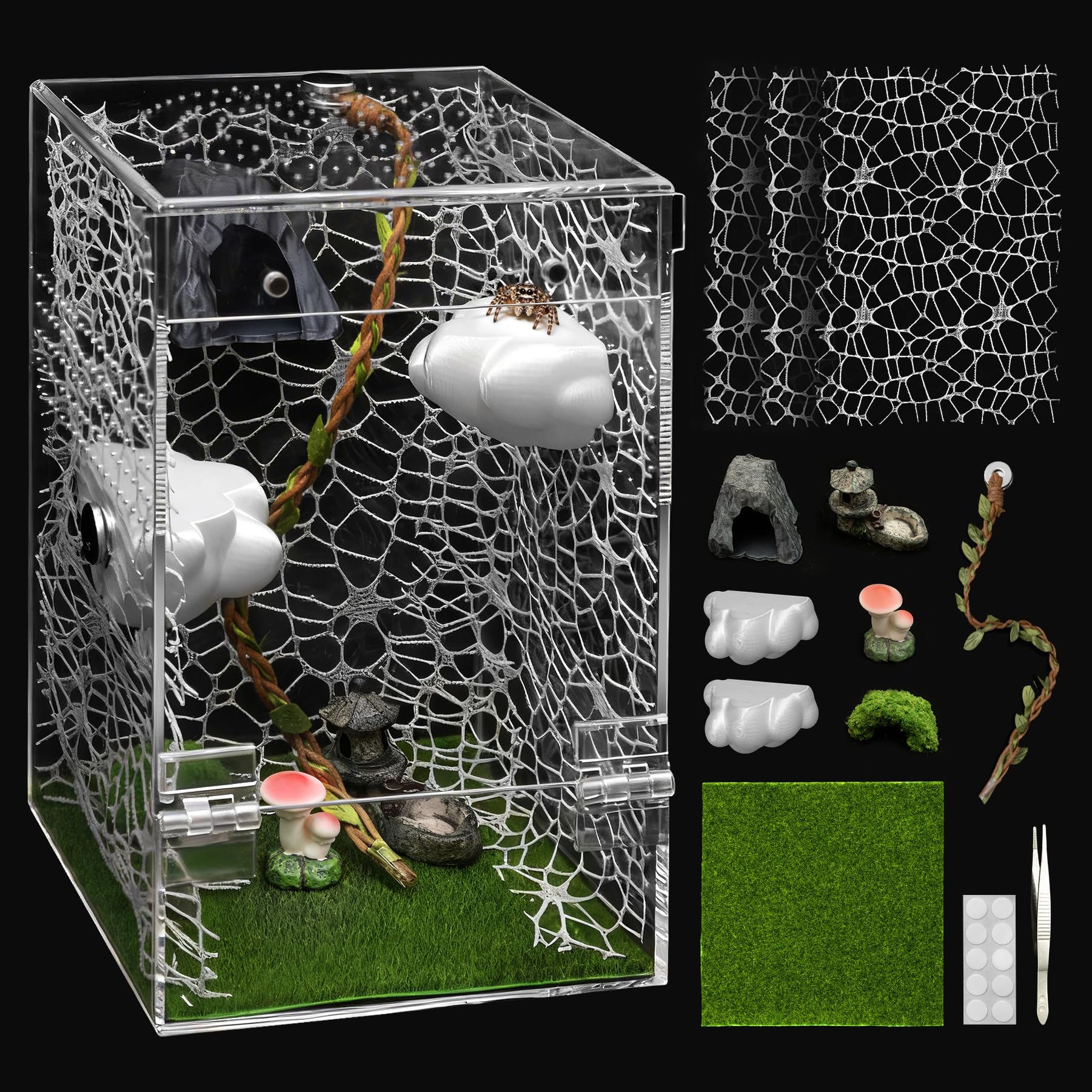
The AZV Clouds Kit comes as a complete habitat package at 5.2×5.2×7.8 inches, making it the most approachable option for first-time jumping spider keepers who don’t want to source individual components. The magnetic front door locks tight with no visible gaps, and the seamless one-piece construction eliminates the assembly step that frustrates beginners with snap-together enclosures.
Included in the box are feeding tweezers and a magnetic climbing rope, both of which reduce the learning curve for new keepers. The micro-dense ventilation holes on top and sides create a cross airflow system that keeps the environment fresh even in the smaller volume. At 0.7 kilograms, it’s the lightest enclosure in this lineup, which makes it easy to reposition or transport.
The 7.8-inch height is on the shorter side for adult jumping spiders, so this enclosure is best suited for sub-adults, smaller species like Habronattus, or as a temporary molt-safe enclosure. The rectangular shape with a white trim gives it a clean modern look that fits well on a desk or nightstand.
Why we love it
- Complete kit with tweezers and climbing rope
- Seamless one-piece construction
- Magnetic door with gap-free seal
- Lightweight at 0.7 kg
Good to know
- 7.8-inch height is tight for adult jumpers
- Small footprint limits decor options
6. MYGIIKAKA Large Square Acrylic Terrarium

The MYGIIKAKA measures 13.78 inches wide by 7.48 inches deep by 7.87 inches tall, giving it the largest floor area of any enclosure in this review. This wide footprint is useful for keepers who want to create a bioactive setup with a pronounced moisture gradient from one side to the other, or for housing multiple small invertebrates in a shared display.
The top clamshell design opens wide for hands-on access, and the side ventilation holes provide cross airflow. There’s also a feeding hole on the top that lets you drop in prey without opening the main lid, which reduces escape risk. The locking handle adds an extra layer of security against clever spiders that learn to push at the lid seal.
The trade-off is the 7.87-inch height — at under 8 inches, this enclosure doesn’t offer the vertical space that jumping spiders naturally prefer for hammock building. It’s better suited for terrestrial or semi-arboreal species, or as a molt-safe grow-out enclosure for spiderlings that will later move to a taller habitat. The rubber band assembly system holds the acrylic plates together but can feel less permanent than bonded or one-piece designs.
Why we love it
- 13.78-inch width for large bioactive layouts
- Top feeding hole reduces escape risk
- Locking handle secures the lid
Good to know
- Under 8 inches of height — not ideal for jumpers
- Rubber band assembly less permanent than bonded
- Requires protective film removal before use
7. smartang Tall Cylinder Arboreal Enclosure

The smartang tall cylinder offers 12 inches of height in a 6-inch diameter round footprint, making it the most affordable path to vertical space for budget-conscious keepers. The traditional latch door — a horizontal sliding lock rather than a magnet — eliminates the vibration that magnetic closures can transmit when snapping shut, which matters for nervous spiders that bolt at sudden tactile sensations.
The fully cylindrical shape provides unobstructed 360-degree viewing, and the included cross ventilation ports on the sides and top maintain airflow without requiring any assembly. At 1.65 pounds, the 3mm-thick acrylic feels solid in hand, and the latch mechanism engages with a positive click that gives clear feedback that the door is secure.
The round footprint means you lose some usable shelf depth compared to square enclosures, and the 6-inch diameter limits how much hardscape you can fit inside. The lack of included accessories means you’ll need to source your own climbing branches and hides separately, but for keepers who already have a decor stash, this enclosure delivers the vertical volume that jumping spiders need at a price that won’t strain your budget.
Why we love it
- 12-inch height at an entry-level price point
- Traditional latch avoids magnetic vibration
- Solid 3mm acrylic construction
- 360-degree cylindrical viewing
Good to know
- Round footprint wastes shelf depth
- No decor or accessories included
- 6-inch diameter limits hardscape options
FAQ
What is the minimum height for an adult jumping spider enclosure?
How do I prevent fruit flies from escaping the enclosure?
Can I use a glass enclosure instead of acrylic for my jumping spider?
Why does my jumping spider keep building its hammock near the top vent?
Final Thoughts: The Verdict
For most keepers, the best jumping spider enclosure winner is the ZENWUKONG Dual Magnetic Enclosure because it combines 264 precision micro-vents, 98% optical clarity acrylic, and dual magnetic doors that seal completely — all in a stackable 6x6x9 inch format that works for the majority of common species. If you want the convenience of a kit with climbing accessories and dual sliding doors that preserve web architecture during feeding, grab the EctoTherm Enclosure. And for budget-conscious keepers who need maximum vertical height without assembly, the smartang Tall Cylinder Enclosure delivers 12 inches of climbing space that will keep your jumper active and exploring.