
A Labrador Retriever at full pull on a standard nylon leash turns a peaceful evening walk into a shoulder-wrenching battle of wills. The constant tension, the risk of the clasp failing under sudden load, and the raw chewing force of those jaws demand a lead built for the specific physics of a 70- to 90-pound dog that was literally bred to pull. The wrong lead here doesn’t just wear out — it fails when you need it most.
I’m Mo Mahin — the founder and writer behind Furric. I’ve spent years cross-referencing tensile-strength ratings, hardware metallurgy data, and owner-reported failure points to isolate which leads actually survive the daily grind of a Labrador’s strength and enthusiasm.
This analysis zeroes in on the exact combination of clasp integrity, strap thickness, and handle ergonomics that separates a smart buy from a recurring expense. Here is the definitive guide to choosing the best lead for a labrador that will outlast your dog’s chewing phase and pulling peak.
How To Choose The Best Lead For A Labrador
A Labrador is not a generic dog, and a generic leash will not hold up to one. You need to match three specific parameters to your dog’s weight, pulling style, and environment. Ignore any one, and you will be replacing the lead inside three months.
Clip Hardware That Survives A Lab’s Escape Attempts
Look for a locking carabiner or an auto-lock frog clip — both prevent the clasp from popping open when the ring shifts angle under tension. Standard snap hooks can twist and release when a Lab lunges sideways after a squirrel. The clip should be made of solid zinc alloy or stainless steel, not plated pot metal.
Strap Width And Material Against Bite Force
A Labrador’s jaw can exert over 230 PSI. A 0.5-inch nylon strap will shred or be chewed through in days. You need a minimum 1-inch width with a thickness of at least 2.8mm. For dogs that actively chew their leash, a metal chain section or a core of welded rings is the only reliable solution.
Dual Handles For Traffic Control vs. Relaxed Walking
A single handle at the end gives you no leverage when you need to pull your Lab close at a curb or past another dog. A second handle positioned 12 to 18 inches from the clip allows you to shorten the lead instantly without grabbing the strap. This is non-negotiable for any Lab over 60 pounds that hasn’t completed formal obedience training.
Reflective Visibility For Low-Light Walks
Labradors are low to the ground relative to their mass, making them hard for drivers to see during dusk and dawn walks. Choose a lead with reflective threads woven into the full length of the strap, not just a single reflective strip at one point. Stitching that runs the entire length provides 360-degree visibility regardless of how the leash hangs.
Quick Comparison
On smaller screens, swipe sideways to see the full table.
| Model | Category | Best For | Key Spec | Amazon |
|---|---|---|---|---|
| Tuff Pupper Hands Free | Premium | Active joggers with pullers | 500lb tensile bungee | Amazon |
| Roam Gear 6ft | Premium | Secure carabiner lovers | 0.5in thick rope + lock clip | Amazon |
| TUG 360° Retractable | Mid-Range | Controlled free-range sniffing | 16ft nylon tape | Amazon |
| Heydoggy Heavy Duty | Mid-Range | Traffic control + daily walks | 2.8mm nylon + auto-lock clip | Amazon |
| HOMIMP Metal Chain | Value | Chew-obsessed Labs | 3.5mm welded chain | Amazon |
In‑Depth Reviews
1. Tuff Pupper Heavy Duty Hands Free Dog Leash

The Tuff Pupper twists the entire premise of handling a Labrador on a walk: instead of fighting the pull with your shoulder, it transfers that force into your core via a thick lumbar-support waist belt. Two separate shock-absorbing bungee sections tame sudden lunges from a 75-pound dog without jerking your lower back. The belt adjusts from 28 to 50 inches and the dual stainless steel attachment points create a safety net if one clip fails.
Owners of strong-pulling breeds like the Pit Corso and Bernese Mountain Dog report that this lead eliminated the shoulder strain that made daily walks painful. The elastic does soften after about two years of daily hour-long use, but the stitching and hardware remain intact. The padded handle near the dog lets you switch from hands-free to close-quarters control in one movement.
The downside is length: the bungee extends the effective reach, which can feel too long for tight urban sidewalks. At 29.96, it sits at the premium end of the market, but the tensile strength rating of 500 pounds gives a clear margin of safety for any Labrador short of a professional sled dog.
Why we love it
- Transfers pulling force to your core, saving shoulders and neck from injury
- Dual bungee sections absorb jerks without letting the dog feel a hard stop
- Premium reflective stitching across the full width and length of the lead
Good to know
- Extended bungee length can feel cumbersome in tight, crowded spaces
- Elastic properties naturally degrade after roughly two years of heavy daily use
2. Roam Gear 6 Foot Dog Leash
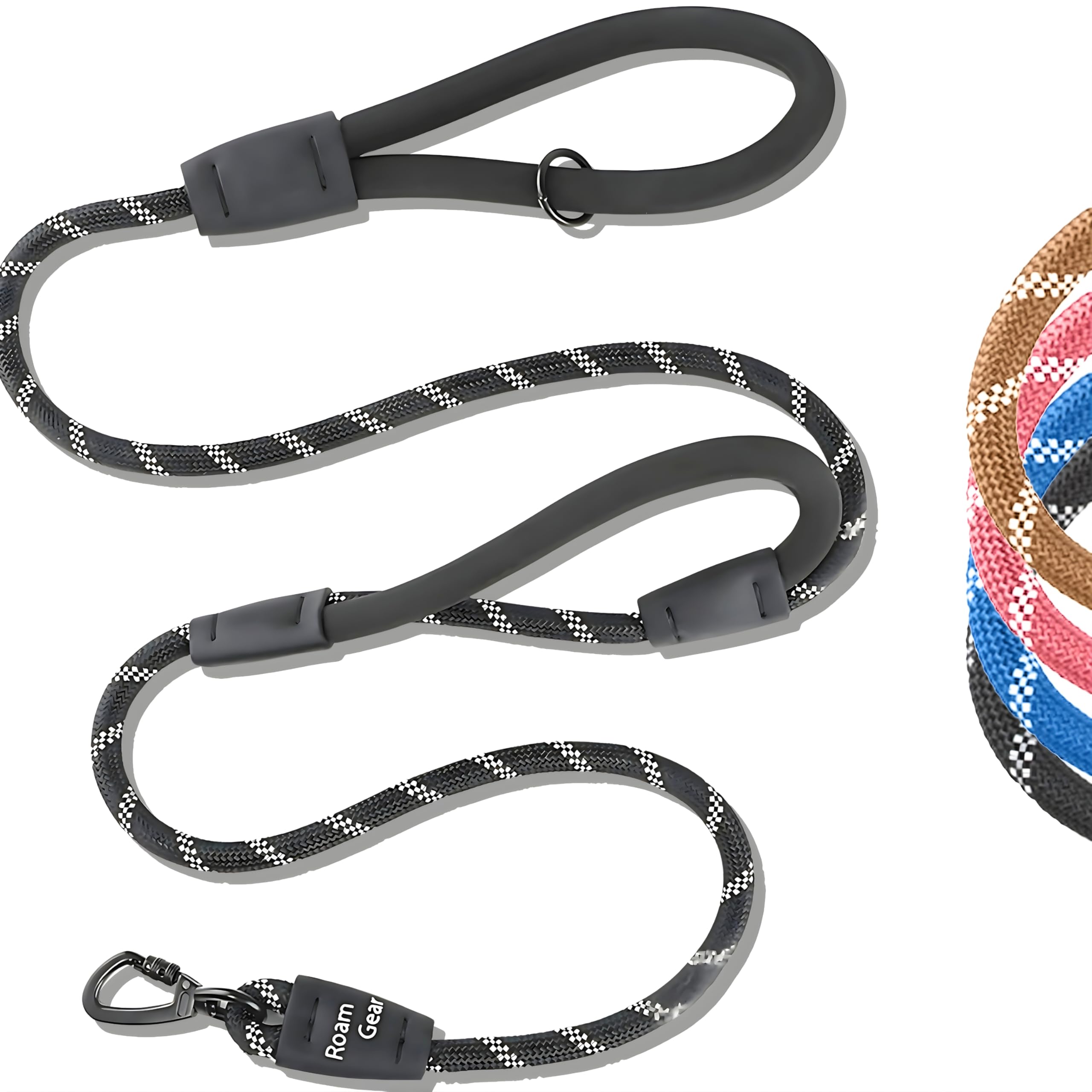
The Roam Gear 6ft solves the single most common Labrador leash failure: the clasp coming undone. A lockable metal carabiner clip with a sliding gate provides a positive mechanical lock that a standard snap hook cannot achieve under the constant pressure of a 70-pound dog leaning into the collar. The 0.5-inch thick rope core with reinforced O-rings resists the lateral forces that cause flat nylon straps to fray at the attachment point.
Two foam-padded handles give you the standard 6-foot length for relaxed walking and a second handle 18 inches from the clip for traffic control. Owners of large Malamutes and strong-pulling mixed breeds confirm that the foam handles hold up longer than typical neoprene wraps, which tend to slide or break down within weeks. The silicone clamps reinforce the stitching at stress points, adding a layer of security against fraying.
The carabiner’s sliding lock mechanism is not as permanently secured as a twist-lock setup, and some users note that the second handle can make the leash feel slightly bunched when the dog stretches to full length. At 29.99, this lead competes directly with the Tuff Pupper, but the Roam Gear wins for owners who prefer a traditional in-hand grip over a waist-belt system.
Why we love it
- Locking carabiner clip eliminates accidental release from a D-ring twisting
- Reinforced O-rings and silicone clamps hold up to daily strain
- Second handle at 18 inches provides instant close control without having to grab the strap
Good to know
- Sliding lock on the carabiner may not feel as permanent as a screw-type lock
- Second handle can create bunching when the dog pulls at full 6-foot extension
3. TUG 360° Tangle-Free Retractable Dog Leash

Retractable leashes polarize the Lab community, but the TUG 360 earns its spot here because the nylon tape rotates a full 360 degrees, eliminating the twisting and tangling that makes other retractable leads useless. The tape is flat and wide at 1.8 inches, which distributes force better than a round cord and resists cutting through foliage. The Large variant supports dogs up to 110 pounds, comfortably covering the full Lab weight range.
The one-handed thumb brake allows locking the lead at any length, which is essential when you need to suddenly shorten the range near a street. Owners of 70-pound mixed breeds report the lock holds against reactive bolts and sudden lunges. The ergonomic handle fits both large and small hands, and the casing feels solid without the cheap plastic rattle of budget retractables.
The retraction mechanism is the weak point: after 2.5 years of daily one-hour use, one owner reported the retraction failing on a 70-pound dog. TUG does not sell replacement parts, so this becomes a disposal-and-replace scenario. At 21.99, it is a solid mid-range bet for Labs that have graduated from basic obedience and need controlled free-roam during decompression walks.
Why we love it
- 360-degree tape rotation prevents the tangling that plagues traditional retractables
- One-hand brake system locks instantly without fumbling for a button
- Flat tape design is significantly stronger than round cord at the same width
Good to know
- Retraction mechanism is not repairable — failure means full replacement
- Not suitable for dogs that actively chew, as the tape is not bite-resistant
4. Heydoggy Strong Heavy Duty Dog Leash
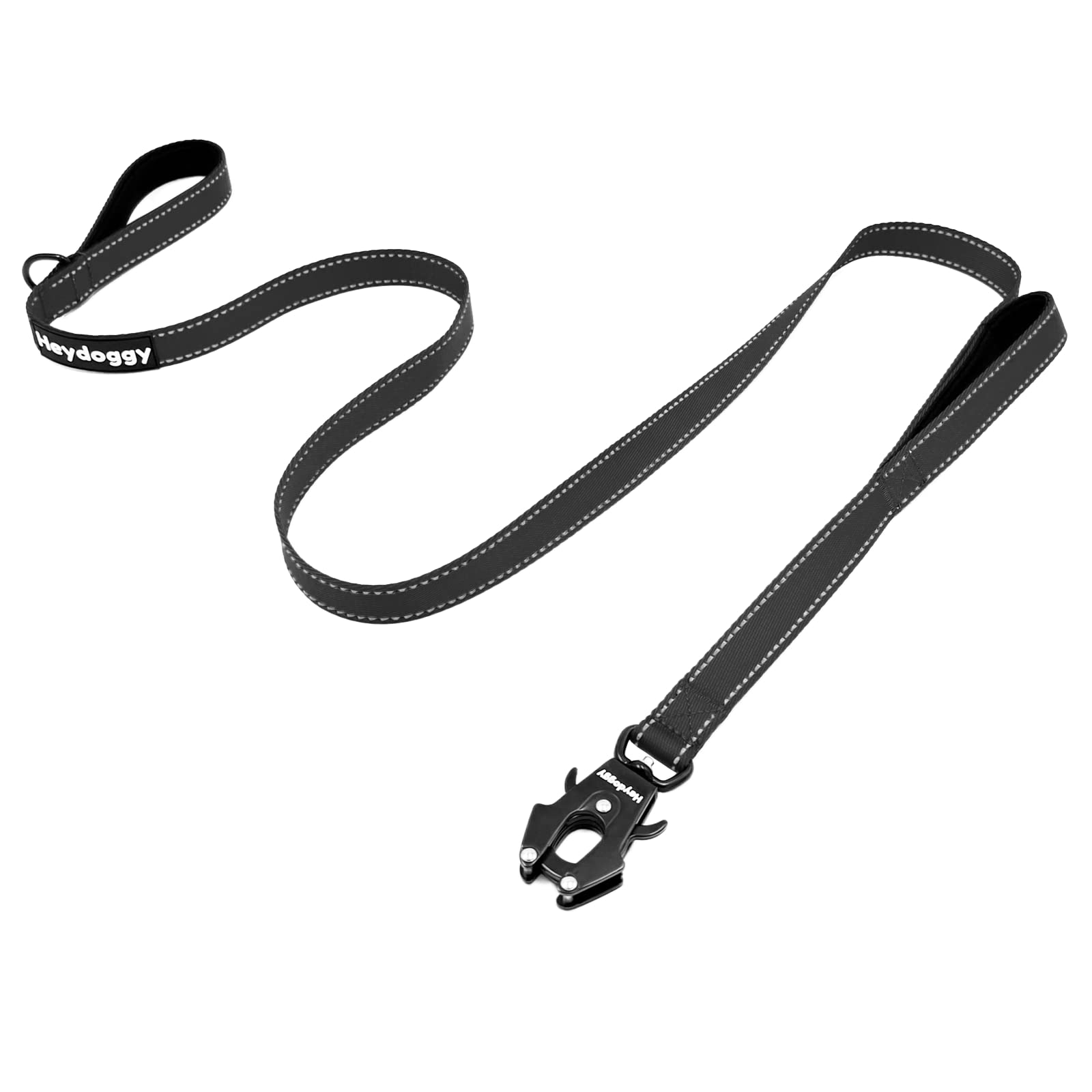
The Heydoggy lead brings the most practical hardware innovation to a standard 6-foot flat leash: an auto-lock frog clip that snaps shut automatically when it touches a D-ring or V-ring. This eliminates the single most common scenario where a Lab escapes — the owner failing to fully close a traditional snap hook. The clip is made of rustproof space aluminum and swivels 360 degrees to prevent the leash from twisting into a tight corkscrew.
The 2.8mm thickness and triple-stitched nylon strap provide almost twice the material density of a standard pet-store leash. The second padded handle sits 12 inches from the clip, giving you a short lead option for crowded sidewalks or dog training classes. The reflective stitching runs the full length on both sides, and the metal D-ring near the end handle lets you attach a clicker or a poop bag dispenser without creating a separate dangling weight point.
One reviewer correctly noted that calling this a “no-pull” leash is misleading — it is not a head collar or a front-clip harness. It is a durable standard lead with excellent hardware. At 15.99, it is the most affordable option in the mid-range tier, and the auto-lock clip alone justifies the purchase for any Lab owner who has ever chased a dog across a parking lot after a clip failed.
Why we love it
- Auto-lock frog clip engages automatically, preventing accidental release
- Triple-stitched 2.8mm nylon is nearly twice as thick as standard leashes
- Second handle at 12 inches offers instant short-leash control
Good to know
- Not a true no-pull training tool — it is a heavy-duty standard lead
- Large frog clip may not fit through smaller collar D-rings
5. HOMIMP Chew Proof Dog Leash
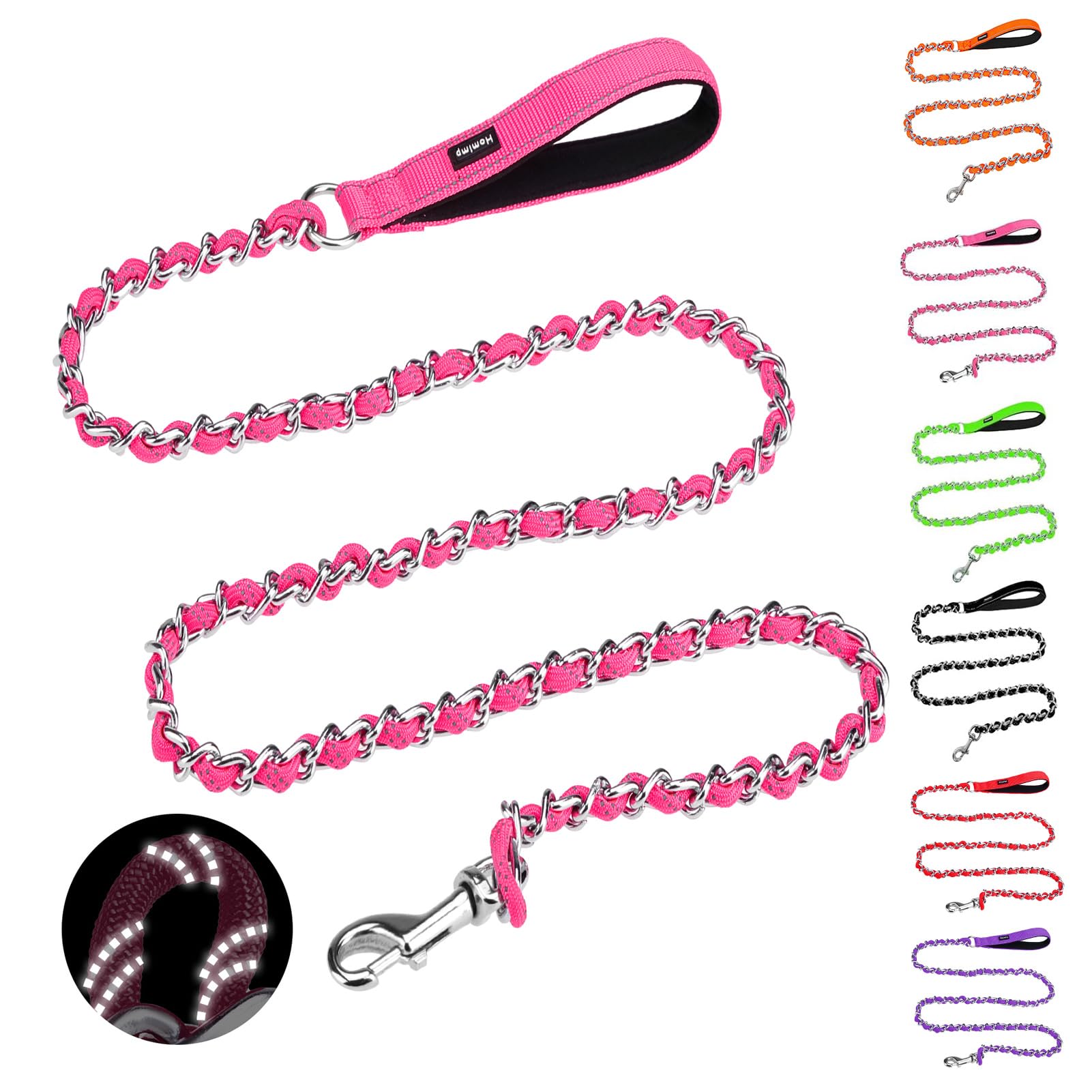
If your Labrador has already chewed through four nylon leashes and one leather lead, the HOMIMP Metal Chain leash is the final solution. The chain is made of welded 3.5mm rings that resist both discoloration and rust, but more importantly, they cannot be cut through by even the most determined chewer. The round rope section woven through the chain reduces metal-on-metal noise and prevents the chain from jamming fingers during handling.
The reflective threads woven into the handle and rope section provide nighttime visibility, and the 360-degree rotatable hook prevents the chain from twisting. At 1.08 pounds, it is noticeably heavier than a nylon lead, but owners of Golden Retrievers and Pit Bulls confirm that the weight is a reasonable trade-off for a leash that survives where bitter sprays and bitter apple failed.
The webbing handle is lined with a submersible, non-slip material that stays grippy even in rain. One issue: the metal chain can scratch or dent painted door frames and car interiors if the dog shakes the leash against them. At 18.99, it is the most effective chew deterrent on this list and a solid value pick for any Lab that treats leashes as chew toys.
Why we love it
- Welded metal chain is completely immune to Labrador bite force and chewing
- Reflective threads and 360° rotation hook maintain safety and tangle-free use
- Submersible non-slip handle material stays grippy in wet conditions
Good to know
- Heavier than nylon leashes — 1.08 pounds may feel bulky on short walks
- Chain can scratch painted surfaces if the dog shakes the leash near a car or door
FAQ
Is a retractable leash safe for a Labrador that pulls?
Can a Labrador chew through a metal chain leash?
How long should a lead be for a Labrador on daily walks?
What type of clip is most secure for a strong Labrador?
Final Thoughts: The Verdict
For most Labrador owners, the best lead for a labrador is the Roam Gear 6 Foot because the locking carabiner clip and 0.5-inch thick rope handle the daily strain of a strong puller without adding unnecessary weight or complexity. If you want hands-free convenience and need to save your shoulders from strain, grab the Tuff Pupper Hands Free. And for a Labrador that chews through everything, nothing beats the HOMIMP Metal Chain.