
High nitrate levels turn glass green, stress fish, and trigger stubborn algae blooms that resist scrubbing. A purpose-built nitrate remover for freshwater breaks this cycle without the daily chore of massive water changes.
I’m Mo Mahin — the founder and writer behind Furric. I compare the pore structures, flow rates, and biological claims of these media against owner-reported ppm drops after 30 days of use.
This guide analyzes the top contenders so you can confidently choose the right nitrate remover for freshwater that matches your tank size, bio-load, and maintenance habits.
How To Choose The Best Nitrate Remover For Freshwater
The right freshwater nitrate remover depends on your filtration type — canister, HOB, or sump — and how many fish you feed. Porous ceramic blocks give bacteria more surface area than smooth plastic balls, while chemical pouches bind dissolved nitrogen compounds until saturation. Understanding the phsyical form and placement depth is critical for success.
The Science of Anaerobic De-Nitration
True nitrate removers create low-oxygen zones inside the media where anaerobic bacteria convert nitrate (NO₃) into harmless nitrogen gas. Dense ceramic media with interconnected micro-tunnels — like 2-5 mm pore paths — establish those zones naturally. Loose gravel and open-cell sponges let too much oxygen through, allowing only aerobic nitrification (ammonia to nitrite to nitrate) without solving the nitrate endpoint.
Pore Size vs. Water Flow
Fine pores (<1 mm) trap debris quickly and clog canisters within weeks, while macro-pores (>3 mm) let water rush through without enough contact time. The sweet spot sits between 1.5–3 mm average pore diameter, which balances bacterial colonization with unrestricted flow. Media like pumice or sintered glass in this range deliver measurable ppm reductions within 7–14 days.
Chemical Pouches vs. Biological Media
Pouches containing ion-exchange resins or zeolite absorb nitrate chemically until saturated — usually 4–8 weeks depending on bio-load. Testing reveals rapid initial drops (20–30 ppm in days) but requires replacement or recharging, which adds recurring cost. Biological media, in contrast, develop a self-sustaining colony that lasts 6+ months with only periodic rinsing, making it more economical for busy keepers with stable tanks.
Quick Comparison
On smaller screens, swipe sideways to see the full table.
| Model | Category | Best For | Key Spec | Amazon |
|---|---|---|---|---|
| Seachem de*nitrate | Granular Media | Long-term biological control in canisters | Anaerobic pore structure for N₂ gas conversion | Amazon |
| Fluval BIO-FX | Ceramic Blocks | Large capacity sumps & FX series filters | 5L matrix with 2.61 kg micro-porous mass | Amazon |
| API Nitra-Zorb | Chemical Pouch | Quick emergency nitrate drops | 240 mL ion-exchange resin per pouch | Amazon |
| Algone Pouch | Combination Pack | Green-water clearing plus nitrate reduction | 18 pre-dosed pouches for multi-month use | Amazon |
| Juwel Nitrate Sponge | Drop-In Insert | Juwel filter users needing simple swap | Granule-filled sponge for 2-month cycles | Amazon |
In‑Depth Reviews
1. Seachem de*nitrate (2L)

Seachem engineered de*nitrate as a graded, porous substrate designed specifically to host anaerobic bacteria in canister filters and sumps. At 2 Liters, this bag fills roughly one compartment of a Fluval FX4 or Eheim Classic without displacing mechanical media. The particle density creates a natural flow restriction that slows water enough to develop low-oxygen zones — critical for converting nitrate to nitrogen gas instead of merely trapping it.
In planted tanks with moderate bio-load (e.g., a 75-gallon with 12 tetras and a handful of corydoras), owners report nitrate stabilizing below 20 ppm within three weeks after replacing generic ceramic rings with this media. The anaerobic zone forms about 2 inches deep inside the bed, so a minimum 3–4 inch layer in the filter is necessary. Rinsing gently with tank water every 4–6 months prevents detritus buildup without killing the colony.
Unlike ion-exchange resins that exhaust after weeks, de*nitrate continues working as long as the filter runs. Recharging is never needed — the bacteria self-regulate. For hobbyists seeking a set-and-forget biological fix, this is the definitive choice. The only catch is installing enough depth to form true anaerobic conditions; shallow HOBs may not accommodate the required media height.
Why we love it
- Permanent biological remediation — no recharging or replacement pouches
- Graded pore sizes balance flow with denitrification zone formation
- Economical per-liter compared to monthly pouch refills
Good to know
- Requires at least 3 inches of media depth for effective anaerobic activity
- Not ideal for HOB filters that hold less than 0.5L per compartment
2. Fluval BIO-FX 5 Liters

Fluval BIO-FX delivers 5 liters of inert ceramic media with a deep pore architecture that rivals premium sintered glass at a mid-range cost. Each irregular block contains interconnected micro-tunnels — visible under 20x magnification — that maximize surface area for both aerobic and anaerobic bacteria. The 2.61 kg weight indicates a dense, non-floating media that stays submerged and productive in the last stage of the filtration train.
The included mesh bag simplifies placement in sump chambers or FX-series canisters, where the 5L volume replaces roughly two standard trays. Several long-term hobbyists with 40+ years of experience have switched to BIO-FX from name-brand pumice and Seachem Matrix, citing better porosity consistency across the batch. In a 120-gallon heavily stocked cichlid tank, weekly nitrate readings dropped from 80 ppm to 30 ppm within 20 days after switching to this media.
Monthly rinsing with aquarium water prevents detritus clogging, and partial replacement every six months keeps the colony healthy. The ceramic does not alter pH or hardness, making it safe for sensitive species like discus and cardinal tetras. For keepers with large filters who want bulk media without paying per-liter premiums, this is the volume champion.
Why we love it
- Exceptional pore density supports massive bacterial colonies
- 5L bag delivers the best cost-per-cubic-inch in the category
- Inert ceramic composition — zero pH or alkalinity shift
Good to know
- Large 5L volume may overwhelm small canisters under 1.5L
- Requires a well-established cycle before denitrification kicks in (2–4 weeks)
3. API Nitra-Zorb (2-Pack)

API Nitra-Zorb offers two 240 mL pouches packed with ion-exchange resin that binds ammonia, nitrite, and nitrate from the water column. Unlike biological media that requires a cycle to develop, this pouch starts removing nitrogen within hours — verified by owners who saw nitrate drop from 60 ppm to 25 ppm overnight in a 30-gallon community tank. The pre-dosed mesh bags fit snugly into Aquaclear, Tidal, and other HOB filter baskets without modification.
The real tradeoff is lifespan. Most users report effective removal for 4–6 weeks under moderate bio-load, after which the resin saturates and nitrate levels creep back up. Recharging by soaking in a salt solution is possible but rarely as effective as a fresh pouch. Keepers managing temporary spikes — during new tank syndrome or after adding new fish — find this response speed invaluable compared to waiting for a biological approach.
One notable finding: the pouch has removed some 48mm in thickness and can overflow smaller compartments if it swells after water absorption. Sizing your filter basket before installing is essential. For chronic nitrate issues lasting beyond two months, a biological media like de*nitrate will ultimately prove more economical and reliable.
Why we love it
- Immediate nitrate reduction within 12–24 hours of installation
- Works in any freshwater filter type — no canister or sump needed
- Triple-target: removes ammonia, nitrite, and nitrate in one pouch
Good to know
- Pouch swelling can block HOB intake if the compartment is narrow
- Requires replacement every 4–6 weeks, increasing long-term cost
4. Algone 18-Pack Filter Pouches

Algone combines a water clarifier with a nitrate-removing powder in each pre-dosed pouch — an unusual dual-action design that targets both green water algae and dissolved nitrogen. The 18-pouch bundle (3 packs of 6) covers roughly 3–6 months of treatment depending on tank size and bio-load. A 72-gallon bow-front keeper reported their nitrate plummeting from 50 ppm to 5 ppm after one month with a single pouch in the filter, confirming the product’s capacity to handle heavy tetra loads.
The powder inside swells significantly as it absorbs water, so placing the pouch in an area with clearance is important. Some early reviews note a temporary fungal spore smell within the first week if the pouch sits in stagnant water — keeping it fully submerged in moving filter media prevents this. Algone is safe for planted tanks and does not strip micronutrients needed by stem plants like rotala and ludwigia.
For aquarists fighting both high nitrates and unsightly green haze simultaneously, the Algone pouches offer a single-step solution that separates them from single-purpose media. The clarifing ability comes from natural polymers that bind fine particulates, so expect visibly clearer water within 48–72 hours alongside measurable nitrogen reduction. Just budget for replacement pouches every 3–4 weeks under normal stocking.
Why we love it
- Simultaneously clarifies green water and reduces nitrate levels
- 18 pouches provide multi-month supply without reordering
- Safe for planted freshwater aquariums — no plant damage reported
Good to know
- Powder swelling can restrict flow in tight filter compartments
- May produce a musty smell during the first week of use
5. Juwel Nitrate Removal Sponge Jumbo
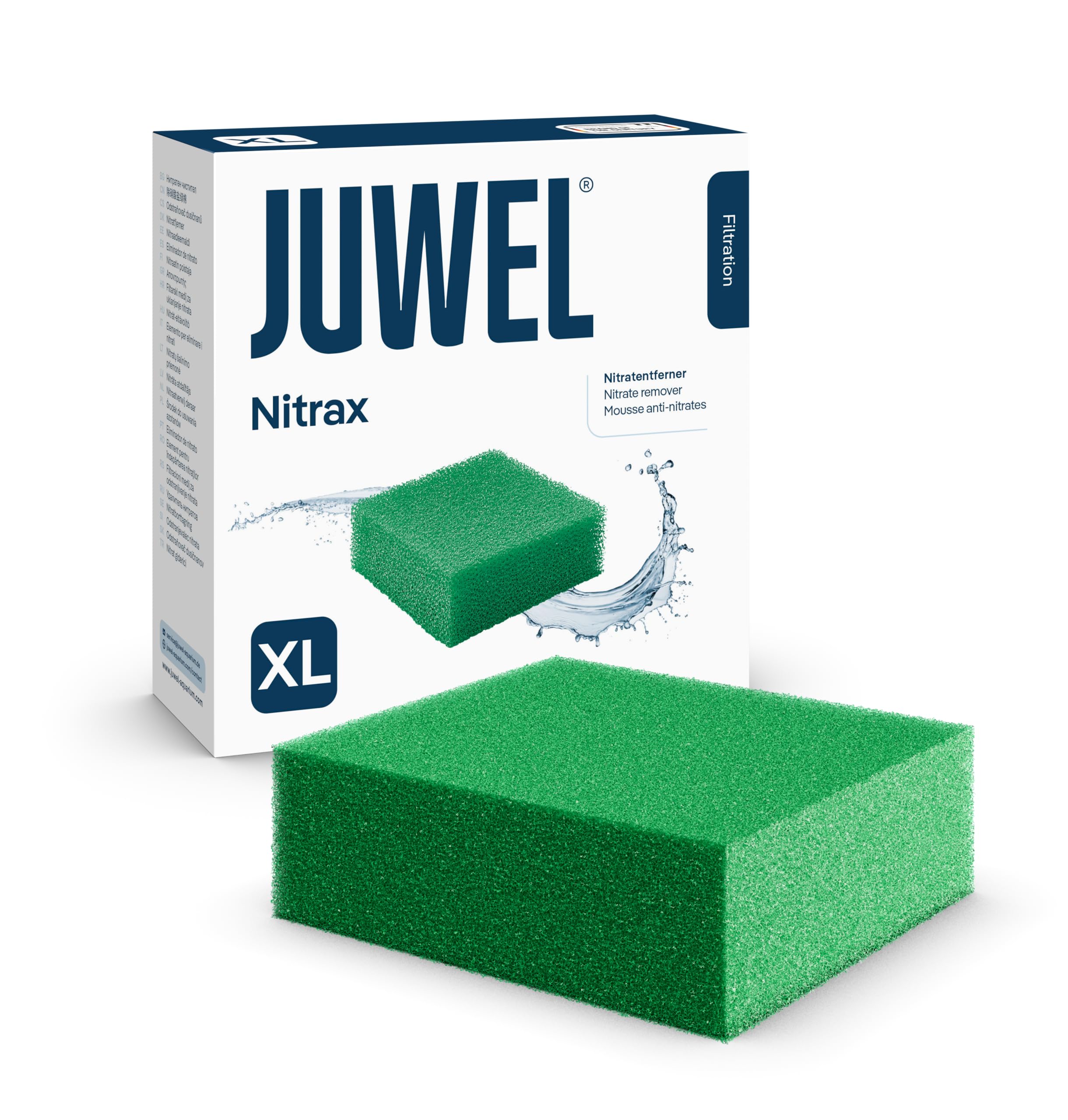
Juwel’s Nitrate Removal Sponge is a drop-in replacement designed specifically for Juwel’s internal filter systems — the Jumbo size fits the 120-liter and 240-liter models without modifications. The sponge houses nitrate-absorbing granules that begin working immediately upon contact with water. Owners who have used these continuously for two years confirm that nitrate levels stay low as long as the sponge is replaced every 2 months, though the cost of replacement adds up compared to biological media.
The sponge format is the easiest to maintain in the category: no ceramic blocks to arrange, no pouches to wedge in — just swap the insert. However, the effective lifespan is notably shorter than premium biological options. A seasoned keeper noted that while the reduction is rapid (visible ppm drops within 48 hours), the granule saturation point arrives around week 8, after which nitrate climbs back unless the sponge is replaced.
For Juwel filter owners who prioritize simplicity over long-term economy, this sponge eliminates guesswork. Alternative options like adding Seachem de*nitrate in a mesh bag behind the Juwel pump may achieve similar results at lower recurring cost. The sponge itself remains physically intact for months, but the chemical media inside exhausted — meaning the polymer substrate holds shape while losing functional capacity.
Why we love it
- Zero-installation drop-in for Juwel internal filters
- Immediate nitrate reduction within 48 hours
- Sponge is safe for fish and plants — no chemical release
Good to know
- Short 2-month effective lifespan per sponge
- High per-unit cost relative to bulk biological media
FAQ
How deep must biological nitrate media be to create anaerobic zones?
Can I use a nitrate remover with live plants in the same tank?
Why did my nitrate level not drop after 24 hours with a new pouch?
Final Thoughts: The Verdict
For most freshwater aquarists, the nitrate remover for freshwater winner is the Seachem de*nitrate (2L) because it establishes a self-sustaining anaerobic colony that reduces nitrate biologically without monthly refills. If you need immediate relief from a spike or rely on HOB filters, grab the API Nitra-Zorb (2-Pack) for overnight results. And for bulk coverage in large sump or canister systems, nothing beats the Fluval BIO-FX 5 Liters for pore density per dollar.