
Choosing the wrong substrate turns a serene aquarium into a frustrating cycle of cloudy water, stressed fish, and failed plants. The texture matters, but the chemistry matters more — sand that leaches, buffers incorrectly, or traps debris undermines everything else you do. A single bag can either stabilize your biotope or crash it.
I’m Mo Mahin — the founder and writer behind Furric. I’ve spent years comparing specification sheets, studying aquatic geochemistry data, and analyzing aggregated owner feedback to identify which substrates actually perform as claimed.
Whether you’re keeping shrimp, cichlids, or a planted community, the best sand for fish tank is the one that matches your water goals, grain size tolerance, and stocking density without introducing variables you don’t want.
How To Choose The Best Sand For Fish Tank
Substrate selection hinges on three variables: buffering activity, grain size distribution, and inertness. A sand that lowers pH for soft-water species will stress hard-water fish, and a sand that clumps or floats dust ruins visibility. Start by defining your target water parameters, then evaluate the physical properties.
Active vs Inert Substrates
Active substrates like volcanic or baked clay lower pH and general hardness (GH) by exchanging ions. These are ideal for Caridina shrimp, discus, and Amazon biotopes. Inert sands — typically silica-based or natural river pebbles — do not alter water chemistry. They are safer for African cichlids, livebearers, and beginner tanks where stable pH is critical. Testing with a GH/KH kit confirms whether an active sand is actually working.
Grain Size and Shape
Sub-1mm grains pack tightly and trap detritus, which can create anaerobic zones if not regularly vacuumed. Grains between 1mm and 3mm allow water flow and root penetration without injuring bottom-dwellers like Corydoras. Sharp, angular grains abrade barbels and fins; rounded or smooth grains are safer. For heavy root feeders like swords or crypts, a larger particle sand provides better mechanical anchorage.
Dust and Preparation
Even factory-washed substrates release pulverized fines during shipping. Rinsing in a bucket until runoff runs clear is the only reliable method. Skipping this step causes a white or tan haze that can take days to settle and may coat fish gills. Kiln-dried products typically produce less dust than naturally dried sand.
Quick Comparison
On smaller screens, swipe sideways to see the full table.
| Model | Category | Best For | Key Spec | Amazon |
|---|---|---|---|---|
| Brightwell Aquatics FlorinVolcanīt Rio Escuro-F | Active Buffering | Caridina shrimp, low-pH planted tanks | pH drop range 5.5–6.0 | Amazon |
| Seachem Fluorite Onyx Sand Substrate | Active Porous | Cichlids, heavy-root plants, shrimp | Porous clay; raises pH slightly | Amazon |
| U.P. Aqua Shrimp Sand | Active Pellet | Nano shrimp tanks, micro fish | Uniform 1mm buffered pellets | Amazon |
| Aqua Natural Midnight Pearl 20lb | Inert Gravel | Community tanks, Corydoras, root-tab plants | 2–4mm rounded river pebble | Amazon |
In‑Depth Reviews
1. Brightwell Aquatics FlorinVolcanīt Rio Escuro-F

This volcanic ash substrate is specifically formulated to drive pH down to 5.5–6.0, which is exactly the sweet spot for Caridina shrimp biotopes. Owners report clear water param shifts within days when paired with remineralized RO water, and the dark brown color produces a natural blackwater aesthetic without leaching tannins.
The 2lb bag is modest — it suits a 5.5-gallon nano tank at a depth of about 2 inches. Larger setups require multiple bags. The grain size is larger than standard sand, so very small plants like monte carlo may struggle to anchor initially. Some units arrive with minimal dust, but a rinse is still advised. The material is made in the USA and backed by Brightwell’s reputation for science-driven aquatic products.
Several long-term users note that the buffering capacity is finite — after roughly 12 to 18 months the pH may drift upward, signaling replacement time. This is typical for active volcanic substrates and not a defect. For anyone keeping Caridina shrimp or other soft-water species, this is the most reliable sand in its size class.
Why we love it
- Predictable pH suppression down to 5.5 without chemicals
- Porous structure supports beneficial bacterial colonization
- Long-lasting structural integrity beyond one year
Good to know
- Small 2lb bag is insufficient for tanks over 10 gallons
- Buffering capacity depletes after 12–18 months
- Granules are larger than typical sand; not ideal for carpeting plants
2. Seachem Fluorite Onyx Sand Substrate

Seachem’s Fluorite Onyx Sand is a fired clay substrate that provides exceptional cation exchange capacity (CEC) for plant roots. Unlike inert sand, this material holds onto nutrients and releases them gradually, reducing the frequency of liquid fertilization. The onyx color is a dark grey — not pure black — and the grain size is fine enough for Corydoras but porous enough to avoid compaction. Multiple owner reports confirm that heavy root feeders like Amazon swords establish quickly in this sand.
The primary tradeoff is dust. Rinsing requires five to six bucket cycles before the water runs even partially clear. Despite the dust, the sand does not cloud the tank permanently if properly prepared. A second consideration: this sand tends to raise pH slightly, making it better suited for African cichlids, livebearers, and hard-water planted tanks than for soft-water biotopes. A water softener pillow can offset the pH shift for shrimp tanks.
At 7.7lb, the bag provides substantial coverage — roughly 1 inch across a 20-gallon long. The texture is smooth enough for barbel-safe browsing by bottom-dwellers once settled. Owners who switched from standard gravel to Fluorite Onyx report noticeably better plant color and growth within three weeks, especially when combined with root tabs.
Why we love it
- High CEC holds plant nutrients for gradual release
- Smooth grain shape is safe for sensitive bottom-dwellers
- Generous bag weight offers good coverage per dollar
Good to know
- Requires aggressive rinsing to remove excess fines
- Raises pH slightly; not ideal for soft-water biotopes
- Color is dark grey rather than true black
3. U.P. Aqua Shrimp Sand

U.P. Aqua Shrimp Sand is a buffered pellet substrate designed specifically for shrimp colonies. The grain shape is spherical and uniform at roughly 1mm diameter, which creates excellent water flow between particles and prevents dead zones. Multiple owners confirm that this sand does not cloud the tank when added slowly — it is one of the cleanest active substrates on the market straight out of the bag. The buffering capacity supports stable water parameters for Neocaridina and Caridina species.
The biggest limitation is coverage. A 4.4lb bag fills roughly three-quarters of an 8-gallon tank to a modest sloping depth. Larger tanks will require multiple bags, and the per-pound cost is higher than many benchmarks. Because the grains are light, heavy-rooted stem plants may dislodge during maintenance. The sand is most effective in nano tanks with low-flow filters and minimal digging behavior.
Trace mineral content is advertised and backed by reports of enhanced shell growth in shrimp and snails. The pellet form does not degrade into mud over time, which is a common complaint with cheaper baked clay products. For dedicated shrimp breeders working with small tanks, this sand offers a clean, predictable start with almost no prep work.
Why we love it
- Exceptionally low dust — rinsing is minimal
- Uniform spherical pellets prevent compaction
- Trace mineral content supports shrimp exoskeleton health
Good to know
- Expensive per pound compared to inert alternatives
- Lightweight grains do not anchor heavy-rooted plants well
- Insufficient for tanks larger than 10 gallons without multiple bags
4. Aqua Natural Midnight Pearl 20lb
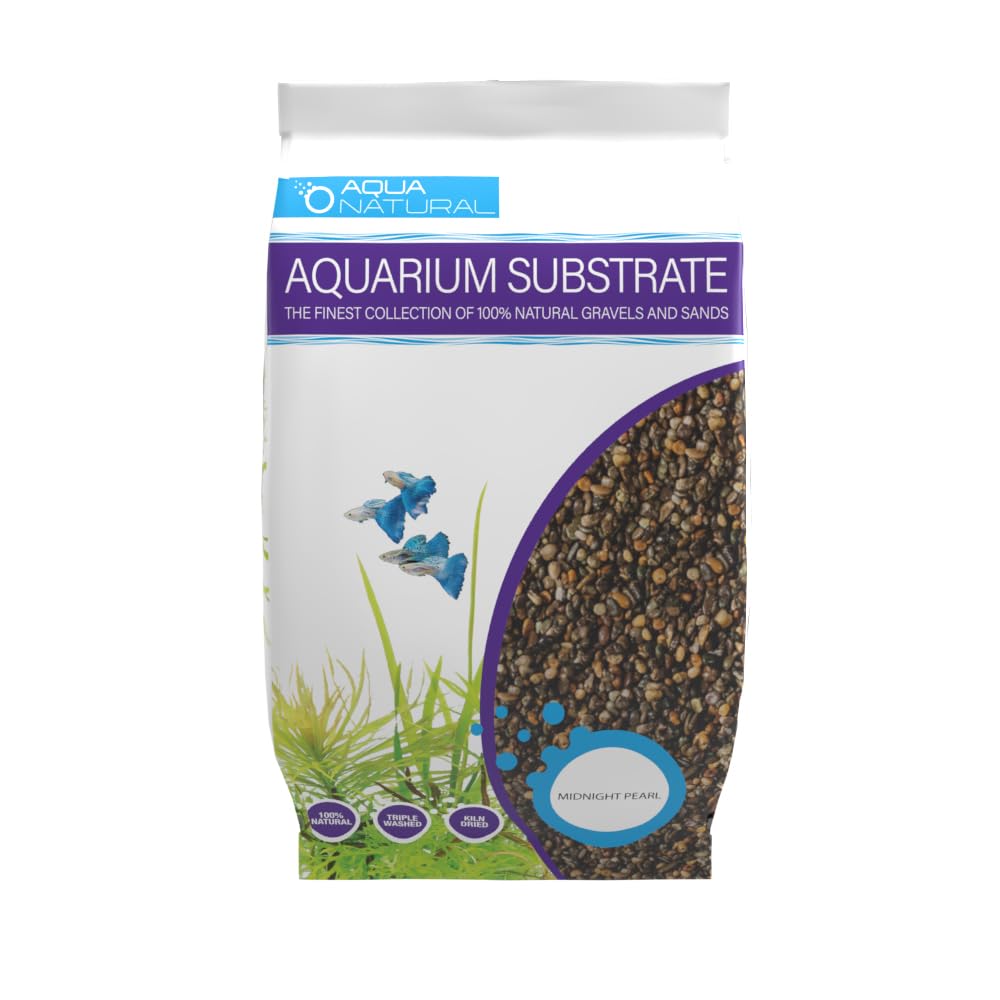
Aqua Natural Midnight Pearl is an inert river pebble graded between 2mm and 4mm with a high proportion of rounded edges. The color blend mixes dark charcoal with lighter brown highlights, producing a natural riverbed appearance that suits community tanks, biotope aquascapes, and vivariums. Because it is inert, it will not alter pH, GH, or KH — making it a safe default for mixed-species tanks where water chemistry stability is the priority. The 20lb bag provides generous coverage; a 55-gallon tank needs about four bags for a 2-inch depth.
Despite the “triple washed” claim, owners consistently report that rinsing is still necessary. Transit friction generates fine dust that can cloud the tank if introduced directly. However, the dust settles quickly after a thorough bucket rinse, and the final water clarity is excellent. The grain size is too large for true sand-dwelling species but safe for Corydoras and loaches because the edges are predominantly smooth. Heavy-rooted plants hold well due to the weight of the pebbles.
This substrate is ethically sourced from New Zealand under license, which appeals to aquarists concerned with sustainability. Because it has no inherent nutrient content, root tabs are mandatory for planted setups with heavy feeders. For pure aesthetic value combined with chemical neutrality and a reasonable price per pound, Midnight Pearl is difficult to beat.
Why we love it
- Completely inert — zero impact on water chemistry
- Rounded edges safe for bottom-dweller barbels
- Sustainable sourcing and large bag size reduce cost per gallon
Good to know
- Not sand-grade; 2–4mm pebbles are larger than advertised by many users
- Requires rinsing despite “triple washed” packaging
- No nutrient content; root tabs required for planted tanks
FAQ
Will volcanic sand lower my pH permanently?
Can I mix inert sand with active sand for a planted tank?
How do I choose between sand and gravel for Corydoras?
Final Thoughts: The Verdict
For most aquarists, the best sand for fish tank winner is the Brightwell Aquatics FlorinVolcanīt Rio Escuro-F because it delivers precise pH suppression for Caridina shrimp and soft-water plants in a durable volcanic format. If you want a plant-friendly substrate with high CEC and cichlid-safe pH, grab the Seachem Fluorite Onyx Sand. And for a budget-friendly, chemically neutral option with a natural riverbed look, nothing beats the Aqua Natural Midnight Pearl.