
Ticks don’t just annoy horses—they transmit Lyme disease, equine piroplasmosis, and anaplasmosis, making a reliable defense non-negotiable for any owner. The market is flooded with sprays, pour-ons, and concentrates, but the difference between a product that works for a day and one that breaks the life cycle often comes down to a single active ingredient percentage or application method.
I’m Mo Mahin — the founder and writer behind Furric. I spend my time cross-referencing technical labels, comparing active ingredient concentrations, and analyzing real owner reports across equine pest control categories to separate marketing claims from proven results.
After reviewing seven top contenders, the clearest path to effective parasite control is choosing the right tick treatment for horses that matches your specific turnout conditions and application preferences.
How To Choose The Best Tick Treatment For Horses
Selecting the right equine tick control starts with understanding three variables: the active ingredient and its percentage, the application method (spray versus pour-on or concentrate), and the duration of residual activity. A product that works wonders on a stall-kept horse in Colorado may fail completely on a pasture-rotated horse in Florida.
Active Ingredient Concentration
Permethrin is the most common effective agent in equine tick treatments, typically ranging from 0.5% in ready-to-use sprays up to 10% in livestock concentrates. Higher concentrations offer longer residual protection but require careful dilution and handling. Products with multiple active ingredients—such as combining permethrin with piperonyl butoxide—can enhance knockdown speed against resistant tick populations.
Spray vs. Pour-On vs. Concentrate
Ready-to-use sprays provide immediate knockdown and are ideal for daily application before turnout or trail rides. Pour-on formulations deliver systemic protection along the animal’s topline and persist even when the horse sweats or gets wet. Concentrates must be diluted with water and applied with a sprayer, offering the most economical route for large herds but requiring careful measurement to avoid under- or over-application.
Residual Duration and Climate Factors
A label claiming “up to 14 days of protection” typically assumes dry, temperate conditions. In high-humidity environments or during heavy rain, residual activity may drop to 3–5 days. Water-based formulas often have shorter residual windows but are gentler on sensitive skin, while oil-based or concentrated formulas adhere longer to the coat and hair shaft.
Quick Comparison
On smaller screens, swipe sideways to see the full table.
| Model | Category | Best For | Key Spec | Amazon |
|---|---|---|---|---|
| Absorbine UltraShield Red | Spray – RTU | Heavy daily use across multiple horses | 5 active ingredients, 7-day residual | Amazon |
| Farnam Tri-Tec 14 (Gallon) | Spray – RTU | Horses with heavy tick exposure | 14-day residual protection claim | Amazon |
| Merck Ultra Boss Pour On | Pour-On | Systemic protection without daily spraying | 946 mL pour-on, systemic action | Amazon |
| Country Vet FarmGard 13.3% | Concentrate | Multi-species farms wanting a stronger concentrate | 13.3% permethrin, 32 oz (case of 6) | Amazon |
| Pyranha Nulli-Fly | Spray – Water-Based | Sensitive-skinned horses in dusty climates | Water-based, citronella scent, quick-dry | Amazon |
| Durvet Permethrin EC 10% | Concentrate | Large herds or premise-wide spraying | 10% permethrin, 16 oz concentrate | Amazon |
| GORDON’S Permethrin 10 | Concentrate | Budget-friendly large-property use | 10% permethrin, 1 quart concentrate | Amazon |
In‑Depth Reviews
1. Absorbine UltraShield Red Fly Spray
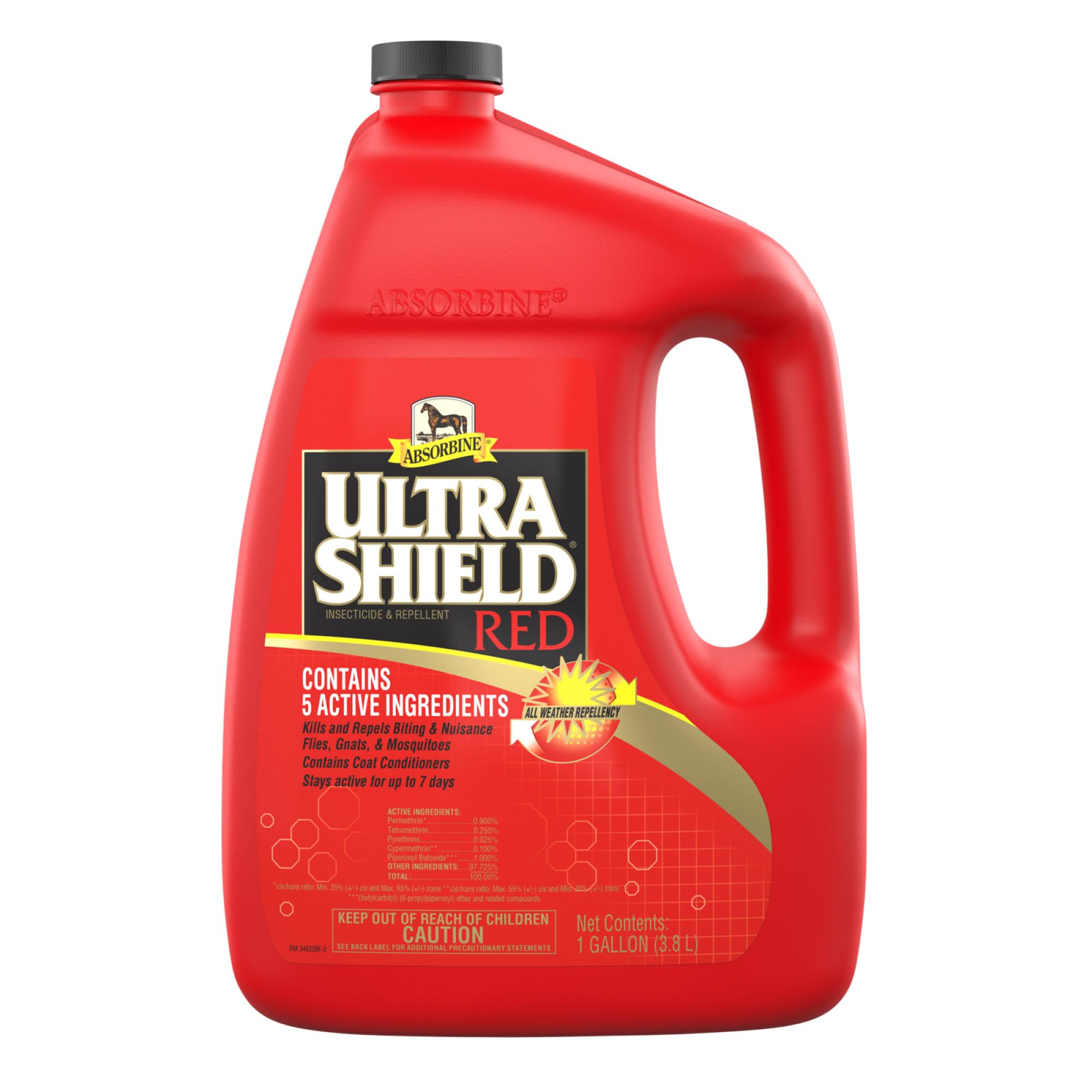
The Absorbine UltraShield Red combines five active ingredients—a broad-spectrum cocktail that targets ticks, flies, mosquitoes, and gnats in a single pass. The 128-ounce gallon refill delivers exceptional value for multi-horse barns, and the formula includes non-greasy coat conditioners that keep the coat looking healthy rather than stripping oils.
Real-world reports from Florida and Hawaii owners confirm that daily application breaks persistent tick cycles, with several users noting a visible reduction within the first week. The product holds its residual activity for up to seven days under normal turnout conditions, though heavy rain may shorten that window. Owners appreciate that it works on horses, ponies, llamas, and donkeys, making it a versatile stable staple.
The sprayer attachment on the gallon jug is functional but can drip if stored sideways. For large operations, transferring to a pump sprayer is the more efficient application method. The scent is mild and doesn’t linger heavily on the horse, which helps during trailering or showing.
Why we love it
- Five active ingredients provide broad-spectrum knockdown against ticks and flying insects
- Seven-day residual reduces reapplication frequency in dry conditions
- Compatible with multiple livestock species, not just horses
Good to know
- Gallon size requires transferring to a sprayer for best coverage
- Residual duration drops in humid or rainy climates
2. Farnam Tri-Tec 14 Fly Spray (128 oz)

Farnam’s Tri-Tec 14 is a long-standing favorite among equestrians who deal with heavy tick and fly pressure. The concentrated permethrin formula claims up to 14 days of protection, and real reviews from horse owners with chronic tick issues—one reported pulling 10–15 ticks daily before switching—show it reduces infestations dramatically within days of use.
The 128-ounce gallon refill is the most economical way to buy this product, and the easy-pour design allows for quick refilling of smaller spray bottles. Multiple active ingredients work together for rapid knockdown, and the coat conditioners leave a pleasant sheen without stickiness. Owners in Hawaii and the southeastern US consistently rank this as the only spray that truly breaks the tick cycle.
The sprayer nozzle on the 32-ounce bottles tends to fail over time, which is a known frustration, but the gallon refill bypasses that issue entirely. The scent is mild and well-tolerated by most horses. Farriers have commented on the visible reduction in tick attachment when this product is used consistently.
Why we love it
- Longest label claim at 14 days of residual protection
- Proven effectiveness against heavy tick infestations in humid climates
- Economical gallon refill size for multi-horse barns
Good to know
- Small spray bottle nozzles are prone to failure
- Daily reapplication may still be needed in extreme tick pressure areas
3. Merck Ultra Boss Pour On

The Merck Ultra Boss Pour On takes a fundamentally different approach from sprays: you apply a measured dose along the horse’s topline, and the active ingredient spreads through the skin’s oil glands for systemic tick control. This method eliminates the need for daily spraying and ensures coverage even on hard-to-reach areas like the neck and withers.
The 946-milliliter bottle treats multiple horses, and the pour-on design means the product stays active even when the horse sweats, rolls, or gets rained on—a critical advantage for pastured horses that can’t be brought in for daily reapplication. It targets lice, ticks, and horn flies, making it a solid choice for comprehensive ectoparasite management rather than tick-only defense.
Because it’s a systemic product, it doesn’t provide immediate knockdown of ticks already on the horse—you’ll still want a spray for instant relief during active infestations. The pour-on requires careful dosing by body weight, so owners should read the label thoroughly before first use. It’s a premium option best suited for owners who prioritize convenience and long-lasting coverage over daily treatment.
Why we love it
- Systemic action persists through sweat, rain, and rolling
- Treats multiple horses quickly without daily spraying
- Effective against lice and horn flies in addition to ticks
Good to know
- Does not provide immediate knockdown of existing ticks
- Requires accurate dosing by body weight
4. Pyranha Nulli-Fly Horse Fly Spray

The Pyranha Nulli-Fly is specifically formulated for horses with sensitive skin that react to oil-based or high-concentration sprays. The water-based formula dries quickly and repels dust and dirt from the coat, which is especially valuable in arid climates where dry, dusty conditions can exacerbate skin irritation.
It kills and repels ticks, stable flies, deer flies, gnats, and mosquitoes in a ready-to-use format that requires no shaking or mixing. The citronella scent is pleasant to handlers and generally well-tolerated by horses, though some individuals may still object to any spray application. Owners report that it leaves the coat clean and dust-free even after a full day in dry turnout.
The trade-off for the gentle formula is a shorter residual window compared to permethrin-heavy concentrates or systemic pour-ons. In wet or humid conditions, reapplication every 1–2 days may be necessary to maintain full tick protection. For horses with known skin sensitivities or for use during competition season when coat appearance matters, this is the better choice over harsher alternatives.
Why we love it
- Water-based formula is gentle on sensitive equine skin
- Dries quickly and repels dust, keeping the coat cleaner
- Pre-mixed and ready to use with no stirring required
Good to know
- Shorter residual protection compared to concentrate-based sprays
- May need daily reapplication in wet or high-tick-pressure areas
5. Country Vet FarmGard Permethrin Concentrate (13.3%)
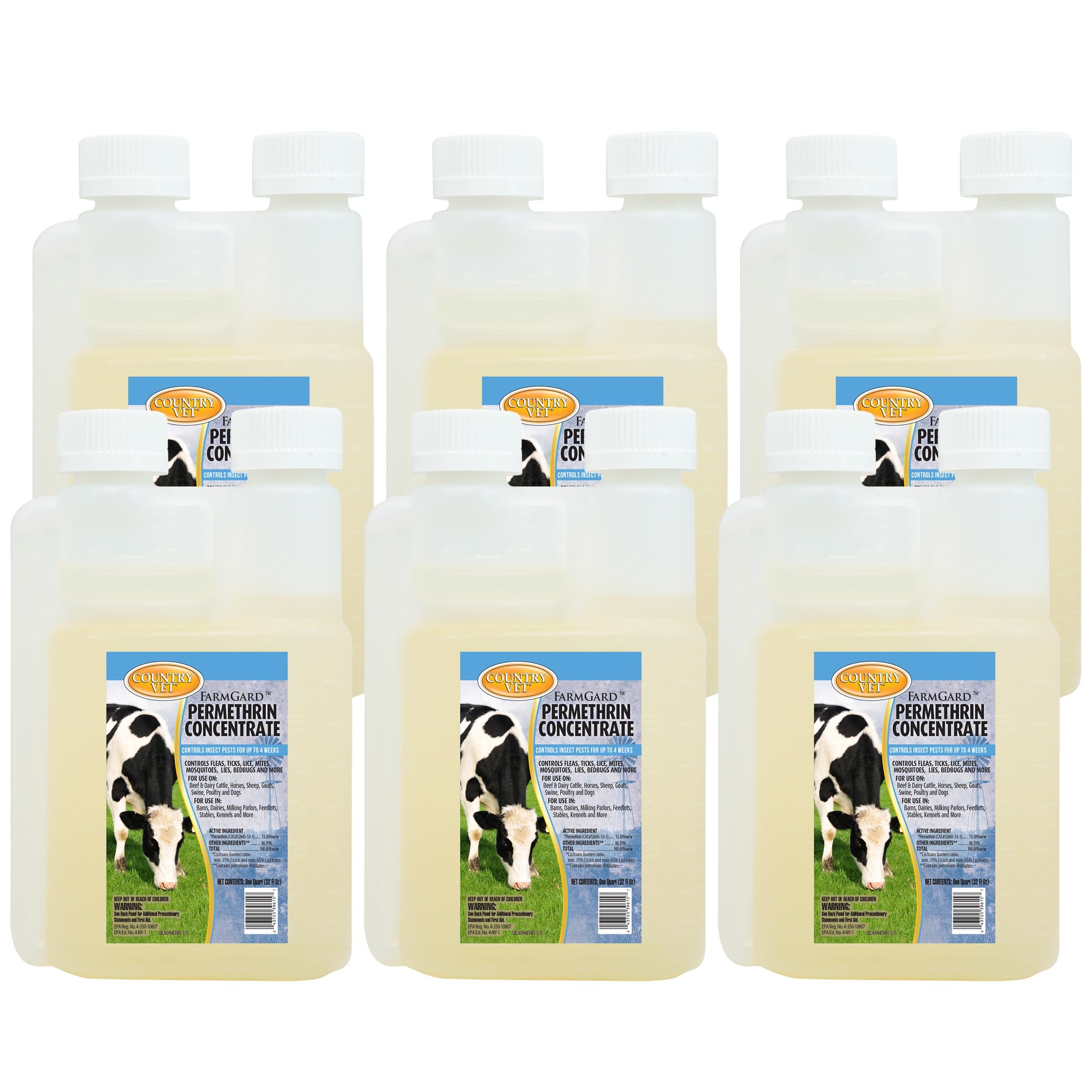
Country Vet FarmGard steps up the concentration compared to the 10% concentrates elsewhere in this lineup, delivering a 13.3% permethrin mix that the label states yields more finished, diluted spray per bottle than standard 10% products. It’s sold as a 32-ounce bottle in a six-pack case, making it a practical option for owners or small farms who go through concentrate regularly.
The label lists horses alongside beef and dairy cattle, sheep, goats, swine, poultry, and dogs as approved use species, and covers ticks and lice in addition to flies, mosquitoes, and gnats. Like other concentrates in this guide, it must be diluted with water before use and applied with a sprayer, dip, or sponge-on method—it is not a ready-to-use spray.
Because it ships as a case of six bottles, the upfront cost is higher than a single ready-to-use bottle, so it suits owners who want to stock up rather than those looking for a one-off purchase. As with any concentrate, read the dilution chart carefully and match the mix ratio to the target species before applying.
Why we love it
- Higher 13.3% permethrin concentration than standard 10% concentrates
- Labeled for horses plus multiple other livestock species
- Six-bottle case suits owners who use concentrate regularly
Good to know
- Case-pack format means a larger upfront purchase than a single bottle
- Requires dilution and a sprayer—not a ready-to-use product
6. Durvet Permethrin EC 10-Percent

The Durvet Permethrin EC 10% is a concentrated livestock and premise insecticide that delivers the highest active ingredient percentage in this lineup. At 10%, a single 16-ounce bottle goes a long way when diluted per label instructions—making it the most economical option for owners with large herds or those who want to spray barns, stalls, and pastures alongside treating individual horses.
Owners report excellent results against ticks, mosquitoes, chiggers, and flies, with many calling it the best insecticide they’ve used. The concentrate can be applied directly to horses (following the dilution rate on the label) or used as a premise spray for perimeter tick control. It’s approved for use on horses, cattle, sheep, goats, swine, and poultry, giving it unmatched versatility.
The major caveat is the environmental impact: undiluted or improperly timed application can kill beneficial insects including bees and butterflies. Owners must read the label carefully and apply only during low-bee-activity hours (dawn or dusk). The concentrate also requires mixing equipment and a sprayer, which adds a step compared to ready-to-use products.
Why we love it
- Highest permethrin concentration (10%) for maximum efficacy and value
- Versatile for on-animal and premise tick control
- Approved for multiple livestock species beyond horses
Good to know
- Requires careful dilution and proper spray equipment
- Can kill beneficial insects if misapplied during daylight hours
7. GORDON’S Permethrin 10 Livestock & Premise Spray

GORDON’S Permethrin 10 is essentially the same product category as the Durvet concentrate—a 10% permethrin livestock and premise spray that must be diluted before use. The quart size offers a slightly larger volume for owners who anticipate treating multiple horses or larger barn areas, providing a solid price-per-ounce value for entry-level budgets.
The concentrate targets cattle, horses, goats, sheep, swine, and poultry, making it a practical multi-species solution for mixed-animal farms. When diluted at the recommended rate, it provides effective tick control on horses while also serving as a premise spray for stalls, fences, and turnout areas. The quart bottle stores well and mixes easily with water in a pump or hose-end sprayer.
Like any concentrate, the application process is less convenient than a ready-to-use spray—you need measuring tools, mixing water, and a sprayer that delivers consistent coverage. The label does not include specific horse tick dosing instructions as prominently as some equine-specific products, so first-time users should cross-reference with veterinary guidance. It’s a solid budget entry point for owners willing to trade convenience for cost savings.
Why we love it
- Large quart size provides excellent per-application value
- 10% permethrin concentration for effective tick knockdown
- Works as both on-animal and premise spray
Good to know
- Mixing and measuring required before each use
- Equine dosing information is less detailed than horse-specific brands
FAQ
Can I use a permethrin concentrate meant for cattle on my horse?
How often should I apply tick spray during peak season?
What should I do if my horse has a reaction to tick spray?
Final Thoughts: The Verdict
For most owners, the tick treatment for horses winner is the Absorbine UltraShield Red because it combines five active ingredients with a seven-day residual and a gallon size that serves multi-horse barns cost-effectively. If you want systemic protection without spraying chores, grab the Merck Ultra Boss Pour On. And for heavy tick pressure that demands the industry’s longest residual claim, nothing beats the Farnam Tri-Tec 14 gallon.