
The difference between a successful birding morning and a neck-ache by noon often comes down to the weight of the glass around your chest. Birders who carry optics for hours quickly learn that a half-pound saved on a pair of binoculars translates directly into steadier hands, longer sessions, and far more field marks identified before the bird flits away into the brush.
I’m Mo Mahin — the founder and writer behind Furric. I’ve spent countless hours cross-referencing optical specifications from prisms to coatings, studying light transmission data, and analyzing aggregated owner feedback to separate the genuinely featherweight from the merely over-marketed.
After evaluating dozens of pairs across multiple price tiers, I’ve narrowed the field to the nine most compelling models to help you find the best investment for a true birder’s kit. This guide covers the top lightweight binoculars for birding, balancing optical performance with the portability serious birders demand.
How To Choose The Best Lightweight Binoculars For Birding
Selecting the right pair of compact binoculars for birding boils down to four critical factors: magnification versus weight, objective lens size and low-light ability, the quality of the prism and lens coatings, and the overall build’s weather resistance. These factors will determine whether your binoculars feel like a natural extension of your eyes or a burden around your neck.
Magnification and Objective Lens: The 8×42 vs 10×42 Question
An 8×42 binocular delivers an 8x magnification with a 42mm objective lens. The 4.2mm exit pupil it provides matches the human pupil’s dilation in most daylight conditions, offering a bright, steady image that is easier to hold steady without a tripod. The 10×42 provides higher magnification but a smaller 4.2mm exit pupil that can make the image dimmer in low light and amplify hand shake. For most birders, 8×42 is the sweet spot for lightweight birding because it combines sufficient reach with a wider, more forgiving field of view.
Prism Type and Coatings: BaK-4 and Phase Correction
Roof prism binoculars are the standard for lightweight, compact designs. Look for BaK-4 glass prisms rather than BK-7, as BaK-4 offers a higher refractive index that produces a rounder, brighter exit pupil. Dielectric and phase-correction coatings on these prisms are non-negotiable for serious birding; they eliminate the loss of light and contrast that otherwise degrades image sharpness, especially when you are tracking a fast-moving warbler through dense canopy.
Weight and Ergonomics: Ounces Matter on Long Hikes
A truly lightweight birding binocular weighs at or under 21 ounces. Models around the 11 to 13 ounce mark are pocketable and ideal for day hikes, but they often come with 25mm or 28mm objective lenses, which limit low-light performance at dawn and dusk. Weigh the compromise: a 20-ounce 8×42 with ED glass and dielectric coatings is far more usable in deep woods than a 12-ounce 10×25 that skips phase correction. The best choice always balances total ounces against the optical fidelity your local birding conditions demand.
Quick Comparison
On smaller screens, swipe sideways to see the full table.
| Model | Category | Best For | Key Spec | Amazon |
|---|---|---|---|---|
| Nikon Monarch M5 8×42 | Premium ED | All-day birding in varied light | 19.5mm eye relief | Amazon |
| ZEISS Terra ED 10×42 | High-End | Optical precision with robust build | 88% light transmission | Amazon |
| Carson 3D Series 10×42 | ED Glass Value | High magnification with ED clarity | 1.45 lbs weight | Amazon |
| Celestron Nature DX ED 8×42 | Mid-Premium | Entry-level ED glass performance | 17.8mm eye relief | Amazon |
| Vortex Crossfire HD 8×42 | Mid-Range | Tough build with HD optics | 390 ft field of view | Amazon |
| Nikon TRAVELITE EX 8×25 | Compact | Ultralight travel and backpacking | Die-cast aluminum body | Amazon |
| Timorn HD 8×42 | Starter Kit | Budget-friendly with phone adapter | 5.2mm exit pupil | Amazon |
| Bushnell H2O Xtreme 10×42 | Waterproof | Wet-weather birding on the water | IPX7 waterproof rating | Amazon |
| Nocs Provisions Standard Issue 10×25 | Ultra-Compact | Pocket carry for casual birding | 11.85 oz weight | Amazon |
In‑Depth Reviews
1. Nikon Monarch M5 8×42 Binocular

The Nikon Monarch M5 is the benchmark for an all-day birding binocular that remains genuinely lightweight without cutting optical corners. Its 8×42 configuration with Extra-low Dispersion (ED) glass virtually eliminates chromatic aberration, and the dielectric high-reflective multilayer prism coatings push light transmission to a point where dawn and dusk birding feel effortless. The 19.5mm of eye relief is generous enough for eyeglass wearers to see the full field, and the turn-and-slide eyecups lock firmly into position.
At roughly 22 ounces, this model sits at the heavier end of lightweight, but the weight distribution is excellent thanks to the closed-bridge design. The large center focus knob is smooth and precise, allowing quick adjustments when tracking a moving subject through branches. The close-focus capability down to 8.2 feet means you can inspect a butterfly on a leaf or a hummingbird at a feeder without backing up.
Field of view sits at 335 feet at 1,000 yards, which is adequate but slightly narrower than some competitors at the same price point. Some users note the focus wheel feels a touch stiff out of the box, though it loosens with use. The build is rugged and the nitrogen-purged housing is fully waterproof and fogproof, making this a solid companion for humid marshlands or misty mountain mornings.
Why we love it
- ED glass delivers razor-sharp, color-accurate images with minimal fringing.
- Dielectric-coated prisms provide excellent brightness in low light.
- 19.5mm eye relief accommodates eyeglass wearers comfortably.
Good to know
- Field of view is narrower than some 8×42 competitors.
- Focus wheel can feel slightly stiff during initial break-in.
- Weight of 22 oz is higher than true ultralight compacts.
2. ZEISS Terra ED Binoculars 10×42
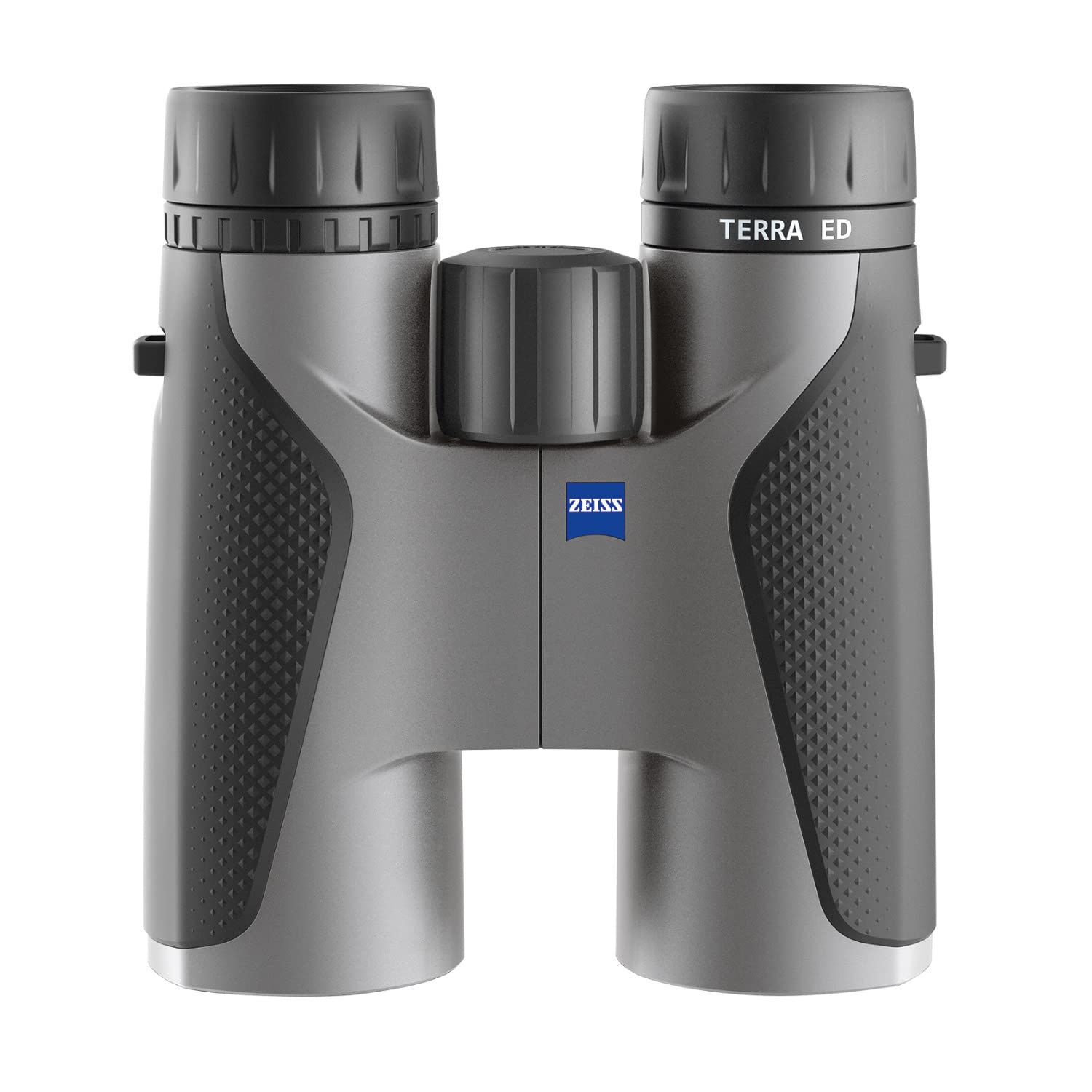
When ZEISS enters the lightweight birding conversation, the Terra ED commands serious attention. This 10×42 model delivers an impressive 60-degree apparent angle of view, which makes the image feel expansive despite the higher magnification. The hydrophobic multi-layer anti-reflective coating on the ED glass is a standout feature for birders who bird in wet conditions — water beads off the lenses instantly, keeping your view clear when a sudden shower rolls in.
The fiberglass-reinforced casing keeps weight manageable while offering outstanding impact resistance. The large, knurled focus wheel is positioned perfectly for your index finger, enabling fast adjustments when a bird suddenly pops into view. The 88% light transmission rating is excellent for a 10×42, ensuring decent performance in crepuscular conditions when warblers are most active along shaded forest edges.
This model is not truly ultralight at roughly 23 ounces, but the weight is well-distributed and the neoprene strap eases neck strain. The 18mm of eye relief is solid for eyeglass wearers, though some shoot for 19mm or more. The bonus is the ZEISS build quality and warranty, which provides peace of mind for years of heavy field use.
Why we love it
- Hydrophobic lens coating sheds water and resists smudging in wet birding conditions.
- Excellent 60-degree apparent field of view for a 10×42.
- Fast, ergonomic focus wheel ideal for tracking moving targets.
Good to know
- At 23 oz, it is not the lightest option for ultralight backpacking.
- Premium price point puts it beyond entry-level budgets.
- Neoprene strap is comfortable but can generate static in dry environments.
3. Carson 3D Series 10x42mm Binoculars with ED Glass

The Carson 3D Series delivers 10×42 performance with ED glass at a price point that undercuts many premium rivals while maintaining strong optical standards. The fully multi-coated lenses and BaK-4 prisms produce a sharp, bright image with very good color fidelity. The 314-foot field of view at 1,000 yards is respectable for a 10×42, and the 16mm of eye relief is sufficient for most eyeglass wearers to see the full image without vignetting.
One of the most appealing aspects of this bundle is the inclusion of a shoulder harness, which distributes weight across both shoulders instead of hanging from the neck. Combined with the rubberized armor, the ergonomics are well-suited for long days in the field. The close focus distance is not specified in the official specs, but user reports place it around 6 to 7 feet, which is fine for butterfly and dragonfly observation.
At 1.45 pounds, it is right around the average weight for a 10×42, so it is not a true ultralight. Some users have reported that the diopter lock could be more secure — it can shift inadvertently if bumped. The warranty is standard for this tier, but it does not match the unconditional lifetime policy of some competitors. That said, for birders seeking a high-magnification ED solution without a triple-digit premium, the Carson 3D is a clever buy.
Why we love it
- ED glass sharpens images and cuts chromatic aberration effectively.
- Included shoulder harness improves comfort on long birding walks.
- Strong value proposition for a 10×42 with premium glass elements.
Good to know
- Diopter adjustment can slip if knocked during use.
- Weight of 1.45 lbs is average for its class, not ultralight.
- Warranty does not cover cosmetic damage or loss, unlike VIP warranties.
4. Celestron Nature DX ED 8×42 Premium Binoculars

The Celestron Nature DX ED is the entry point into true ED glass performance for birders who are not ready to invest in the -plus tier. The 8×42 configuration uses Extra-low Dispersion glass to virtually eliminate color fringing, and the phase-coated BaK-4 prisms ensure that light is transmitted efficiently without ghosting. The 17.8mm of eye relief and twist-up eyecups make it comfortable for glasses wearers, and the 7.5-degree angle of view translates to a wide, immersive image.
At a weight of roughly 21 ounces, it is on par with mid-range 8x42s and strikes an excellent balance between portability and light-gathering ability. The rubber-armored polycarbonate housing is rugged enough for field work, and the nitrogen-purged, O-ring sealed body keeps out moisture and prevents internal fogging. The built-in tripod adapter threads are a thoughtful addition for digiscoping or extended viewing sessions at a bird blind.
Some users point out that the focus knob has slight play before engaging, and the included neck strap is merely adequate. The color fidelity is very good for the price but shows slightly less saturation than premium-tier Nikon Monarchs or ZEISS Terra units. Nonetheless, for the birder who wants ED performance without a major dent in the wallet, the Nature DX ED is a compelling choice.
Why we love it
- ED glass and phase-coated BaK-4 prisms deliver sharp, high-contrast views.
- Generous 17.8mm eye relief works well with prescription eyewear.
- Tripod adaptable design supports stable digiscoping setups.
Good to know
- Focus knob shows slight play before the gearing engages.
- Included neck strap is basic and not padded for extended carry.
- Color saturation is slightly less vivid than top-tier ED models.
5. Vortex Optics Crossfire HD 8×42 Binoculars

Vortex has built a reputation for pairing rugged construction with outstanding customer support, and the Crossfire HD 8×42 is a prime example. The HD optical system uses select glass elements to reduce chromatic aberration and enhance resolution, while fully multi-coated optics maximize light transmission across all air-to-glass surfaces. The 390-foot field of view at 1,000 yards is excellent for an 8×42, giving birders a wide swath of coverage for tracking fast-flying targets.
The rubber armor provides a secure, non-slip grip even in wet conditions, and the o-ring sealed, nitrogen-purged chassis makes it waterproof and fogproof. The binocular is tripod adaptable, which is handy for prolonged viewing at a hawk watch. The included GlassPak case is a thoughtful addition that protects the binos without adding bulk.
At roughly 22 ounces, it is not the lightest 8×42 but is still comfortable for all-day carry with a good strap. The center focus wheel is smooth and precise, though the 14mm of eye relief is on the shorter side for eyeglass wearers — some may not see the full field without pressing glasses close. The real draw is the unlimited, unconditional VIP warranty that Vortex is famous for, covering repair or replacement for any damage or defect.
Why we love it
- Unconditional VIP lifetime warranty covers repair or replacement for any reason.
- 390-foot field of view provides excellent situational awareness for tracking birds.
- HD optics system reduces color fringing and boosts sharpness.
Good to know
- 14mm eye relief is tight for eyeglass wearers, especially with thick frames.
- At 22 oz, it is heavier than some compact 8×42 competitors.
- Focus wheel can be stiff in cold weather until warmed up.
6. Nikon TRAVELITE EX Binoculars 8×25

The Nikon TRAVELITE EX 8×25 is designed for the birder who refuses to leave optics behind due to weight. At just over 11 ounces, it is among the lightest fully waterproof binoculars on the market, sliding easily into a jacket pocket or small hip pack. The multilayer-coated optics and aspherical eyepiece lenses minimize image distortion and deliver good contrast, though the 25mm objective lenses severely limit low-light performance compared to a 42mm model.
The die-cast aluminum body with rubber armoring provides surprising durability for such a small package, and the nitrogen-purged, O-ring sealed construction makes it submersible to two meters for five minutes. The turn-and-slide eyecups with high-eyepoint construction are comfortable for glasses wearers, and the 11.1mm of eye relief is adequate for this compact class. The click-type diopter adjustment is precise and stays set.
Field of view is 47.5 degrees (apparent), which is decent for an 8×25 but noticeably narrower than a full-size 8×42. This is a real limitation when scanning open water for ducks or following a swallow’s acrobatic flight. Some users have reported prism alignment issues in used units, so buying new is recommended. For quick looks during a lunch break hike or as a backup pair, the TRAVELITE EX is a solid choice.
Why we love it
- Extremely lightweight at just over 11 oz, perfect for pocket carry.
- Fully waterproof and fogproof despite its compact size.
- Rubber armoring with die-cast aluminum body offers good shock resistance.
Good to know
- 25mm objective limits low-light performance significantly at dawn and dusk.
- Field of view is noticeably narrower than full-size 8×42 binoculars.
- Some buyer reports of prism alignment defects, especially in used units.
7. Timorn HD 8×42 Binoculars for Adults Bird Watching

The Timorn HD 8×42 is a value-packed entry-level option for birders who want a complete kit without breaking the budget. It includes a smartphone adapter and a compact tripod, making it easy to capture digiscoped images of your sightings. The fully multi-coated green film coating and BaK-4 roof prisms produce a bright, clear image with decent contrast, and the 5.2mm exit pupil delivers strong low-light performance for an 8×42 at this price tier.
The ergonomic bridge design places the focus ring and diopter wheel at the center, which is intuitive and allows single-finger adjustment. The twist-up eyecups with 15mm of eye relief work for most eyeglass wearers. The 430-foot field of view at 1,000 yards is wide, making it easier to locate birds initially and track movement through shrubbery.
Durability is adequate, with the rubber armor and nitrogen-purged waterproofing protecting against basic field use. However, some users note that the diopter ring is too easy to bump out of alignment during normal use, requiring frequent re-adjustment. The included tripod is basic and functional but not for professional digiscoping. For the birder just starting out who wants to experiment with phone photography, the Timorn kit is a smart budget-friendly entry.
Why we love it
- Complete kit with phone adapter and tripod for digiscoping on a budget.
- Wide 430-foot field of view simplifies locating and tracking birds.
- Large 5.2mm exit pupil supports good low-light performance.
Good to know
- Diopter adjustment can be accidentally rotated, requiring frequent checks.
- Included tripod is functional but has limited stability for serious photography.
- Build quality is adequate but not as rugged as premium-tier options.
8. Bushnell H2O Xtreme Binoculars 10×42

The Bushnell H2O Xtreme has been a trusted name for birders who spend significant time near water. The 10×42 configuration is fully multi-coated with BaK-4 prisms, delivering a sharp, contrast-rich image that handles glare and reflections well. The IPX7 rating means these binoculars can be submerged in up to 3 feet of water for 30 minutes without damage, which is excellent for kayaking, boat-based birding, or sudden downpours.
The rugged rubber design includes soft grips that remain secure even when wet, and the nitrogen-purged, o-ring sealed body ensures the lenses never fog internally. The 6.8-degree angular field of view is standard for a 10×42, and the 17mm of eye relief is comfortable for most glasses wearers. The trim, roof-prism body makes it easy to pack into a dry bag or daypack.
There is no tripod adapter socket on this model, which is a notable omission for birders who want to mount binos for steady digiscoping or extended observation at a blind. The weight is right around 22 ounces, not ultralight but reasonable for a waterproof 10×42. Some users note the included strap and case are basic. For wet-environment birding, the Bushnell H2O Xtreme is a durable, proven performer.
Why we love it
- IPX7 waterproof rating for submersion up to 3 feet of water.
- Fully multi-coated BaK-4 optics deliver bright, contrasted images in challenging light.
- Rubber grips remain slip-resistant in wet or rainy conditions.
Good to know
- No tripod adapter socket for mounting or digiscoping.
- At 22 oz, it is heavier than some waterproof 10×42 alternatives.
- Included case and strap are functional but not premium.
9. Nocs Provisions Standard Issue 10×25 Waterproof Binoculars

The Nocs Provisions Standard Issue 10×25 is a modern take on the ultralight pocket binocular, designed for the birder who values go-anywhere portability above all else. Weighing just 11.85 ounces, it disappears into a jacket pocket or small bag. The fully multi-coated optics and Swiss-designed BaK-4P prisms deliver a very bright, crisp image for a 25mm objective, with good edge-to-edge clarity thanks to the anti-reflective coatings applied to every lens surface.
The IPX7 waterproof rating (submersible to 3 feet for 30 minutes) is exceptional for a binocular this small, and the nitrogen gas injection prevents fogging in humidity or temperature shifts. The patented Rugged Wave Grip design is genuinely comfortable in the hand, and the multi-stop twist-up eyecups with 10mm of eye relief have three positions to accommodate both eyeglass wearers and bare eyes. The 315-foot field of view at 1,000 yards is typical for a 10×25.
Low-light performance is inherently limited with a 25mm objective — this is strictly a daylight companion for open habitats. The “No-Matter-What” lifetime warranty is a strong confidence booster. Some users find the center focus wheel slightly stiff for rapid adjustments, and the 10x magnification requires a steady hand to avoid shake. For quick scans during a lunch break or as a backup pair, the Nocs Provisions is a stylish, durable ultralight option.
Why we love it
- Ultra-light at 11.85 oz with IPX7 waterproof and fogproof performance.
- Rugged Wave Grip design provides excellent ergonomics and non-slip handling.
- Lifetime “No-Matter-What” warranty backs the durable construction.
Good to know
- 10×25 configuration limits low-light performance to bright daylight hours.
- 10mm eye relief may be tight for some eyeglass wearers.
- Center focus wheel can feel stiff, making rapid adjustments less fluid.
FAQ
What does the 8×42 or 10×42 number mean on my birding binoculars?
Is a 10×42 too heavy for all-day birding?
How important is eye relief for birders who wear glasses?
What is the difference between BK-7 and BaK-4 prisms in birding binoculars?
Final Thoughts: The Verdict
For most birders, the best lightweight binoculars for birding winner is the Nikon Monarch M5 8×42 because it blends ED glass clarity, dielectric-coated brightness, and comfortable ergonomics into a package that performs in all conditions without weighing you down. If you want the durability of a premium waterproof build with a fast-focus system, grab the ZEISS Terra ED 10×42. And for the birder on a budget who still demands ED glass performance, nothing beats the Celestron Nature DX ED 8×42 for value and quality.