
When your cat’s litter box triggers coughing, wheezing, or watery eyes, the problem is almost always the airborne dust from traditional clay litters. For pet owners with asthma, allergies, or other respiratory sensitivities—and for cats prone to sneezing or upper respiratory issues—finding a litter that traps waste without releasing fine particles into the air is a medical necessity, not a convenience feature.
I’m Mo Mahin — the founder and writer behind Furric. I’ve spent years analyzing the chemical compositions, particle-size distributions, and dust-mitigation technologies across dozens of litter formulas to understand which ones genuinely reduce airborne irritants and which ones just market themselves as “low dust.”
This guide breaks down the top contenders for the cat litter for respiratory problems, comparing clumping performance, dust levels, scent profiles, and overall value so you can find a box that both you and your cat can breathe around.
How To Choose The Best Cat Litter For Respiratory Problems
The first step is understanding that “dust-free” is a marketing spectrum. A clay litter labeled 99.9% dust-free still produces measurable airborne silica particulates when poured. The second step is recognizing that your cat’s respiratory system is as vulnerable as yours—cats with feline asthma or chronic rhinitis need litter that doesn’t coat their nasal passages with fine powder. Here is what to prioritize.
Substrate type: Clay vs. Crystal vs. Plant-Based
Standard clumping clay (sodium bentonite) generates the most dust because the granules fracture during shipping and scooping. Silica gel crystals produce virtually zero dust because they are solid, non-friable beads that absorb moisture without breaking down. Plant-based litters made from tofu, pea husk, or corn sit in the middle—they are less dusty than clay but can still release fine organic particles, especially near the bottom of the bag.
Clumping integrity and scooping frequency
A litter that forms rock-hard clumps lets you remove waste without stirring up loose particles from the box. Soft, crumbly clumps break apart during scooping, releasing dust directly into your breathing zone. For respiratory-sensitive households, the clumping strength matters as much as the initial dust claim.
Scent additives: The invisible irritant
Many litters mask odors with synthetic fragrances that contain volatile organic compounds (VOCs). For someone with reactive airways, a “fresh scent” can trigger coughing or congestion faster than the ammonia smell it is meant to cover. Unscented formulas are almost always the safer choice when respiration is the primary concern.
Quick Comparison
On smaller screens, swipe sideways to see the full table.
| Model | Category | Best For | Key Spec | Amazon |
|---|---|---|---|---|
| Dr. Elsey’s Ultra Unscented | Clumping Clay | Budget-friendly low-dust clay | 99.9% dust-free bentonite clay | Amazon |
| FUKUMARU Tofu Lavender | Plant-Based | Scent-sensitive eco-conscious homes | 2mm vacuum-sieved pellets | Amazon |
| PetSafe ScoopFree Crystal | Silica Crystal | Automatic litter box users | 99% dust-free silica gel | Amazon |
| Catit Go Natural Plant-Based | Hybrid Plant/Clay | Eco-friendly with strong clumps | 70% pea husk / 30% clay blend | Amazon |
| LMJP Crystal Unscented | Silica Crystal | Long-lasting unscented coverage | 17.2 lb lasts up to 4 months | Amazon |
In‑Depth Reviews
1. Dr. Elsey’s Ultra UnScented Clumping Clay Cat Litter

Dr. Elsey’s has been a staple in the low-dust clay category for decades, and the 40-pound bag delivers the highest dust-to-value ratio on this list. The 100% bentonite clay is processed to a medium-grain texture that produces significantly less airborne powder than generic grocery-store clay litters. Multiple long-term users report that it is the only litter that did not aggravate their allergies or their cat’s sneezing over years of use.
The clumping performance is exceptionally strong—clumps set like concrete, allowing you to scoop without crumbling and stirring particles back into the air. Unlike softer clays that leave sticky residue on the pan walls, Dr. Elsey’s lifts cleanly, reducing the need for deep scrubbing that would otherwise release settled dust. The 40-pound size is heavy to haul, but the per-pound price makes this the most economical low-dust option available.
One owner noted that their cat had stopped using the box entirely with other clay litters but returned to regular use after switching to this unscented formula—a behavioral change likely driven by the reduction in nasal irritation. The only real compromise is medium tracking; the medium-grain granules are not oversized enough to stay perfectly in the box, so a mat is recommended.
Why we love it
- Industry-leading 99.9% dust-free formulation with bentonite clay
- Rock-hard clumps that do not break apart during scooping
- Unscented and hypoallergenic for sensitive owners and cats
Good to know
- 40-pound bag is physically heavy to carry and pour
- Moderate tracking that requires a litter mat
- Clumps left too long can become brick-hard and difficult to remove
2. FUKUMARU Tofu Cat Litter, Lavender Scent
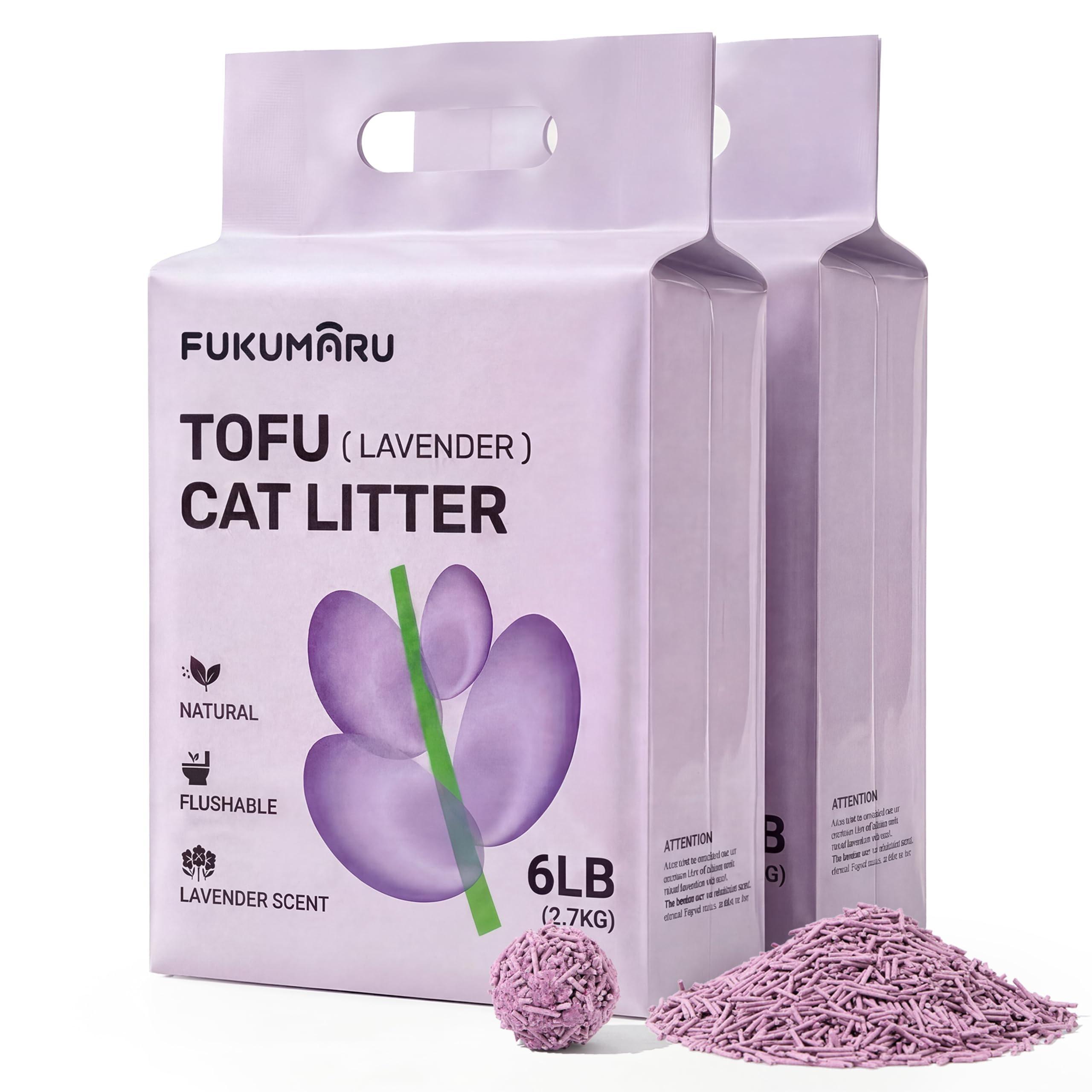
FUKUMARU’s tofu-based litter uses 2mm pellets that have been vacuum-sieved during manufacturing to remove virtually all fine dust and powder. This makes it one of the most genuinely dust-free options on the market—there is almost no visible cloud when pouring, even with a vigorous dump. The okara (soybean pulp) and corn starch base is biodegradable, flushable in small quantities, and completely silica-free, eliminating the respiratory concerns associated with crystalline silica dust found in some clay litters.
Clumping is fast and dense. The high-density plant fibers form 3-second solid clumps that lock in moisture without turning to mud. Owners of cats with chronic rhinitis or feline asthma consistently report zero sneezing after switching from clay to this tofu formula, and the lightweight pellets reduce the muscle strain of carrying and pouring. The lavender scent is mild and derived from natural extracts rather than synthetic VOCs, but for hyper-sensitive individuals, any fragrance—even natural—can be a trigger.
The 12-pound bag (split into two 6-pound bags) is convenient for storage but runs out faster than a 40-pound clay bag in multi-cat homes. A small number of users also note that the pellets can feel slippery under paw, which some cats dislike. Despite the premium per-pound cost, the faster absorption rate means you use less volume per scoop, partially offsetting the price.
Why we love it
- Vacuum-sieved pellets produce near-zero airborne dust
- Plant-based formula with no crystalline silica
- Quick clumping with high absorption capacity
Good to know
- Lavender scent may still irritate extremely sensitive airways
- Higher per-pound cost than clay alternatives
- Some cats reject the slippery texture of the pellets
3. PetSafe ScoopFree Odor Control Crystal Cat Litter
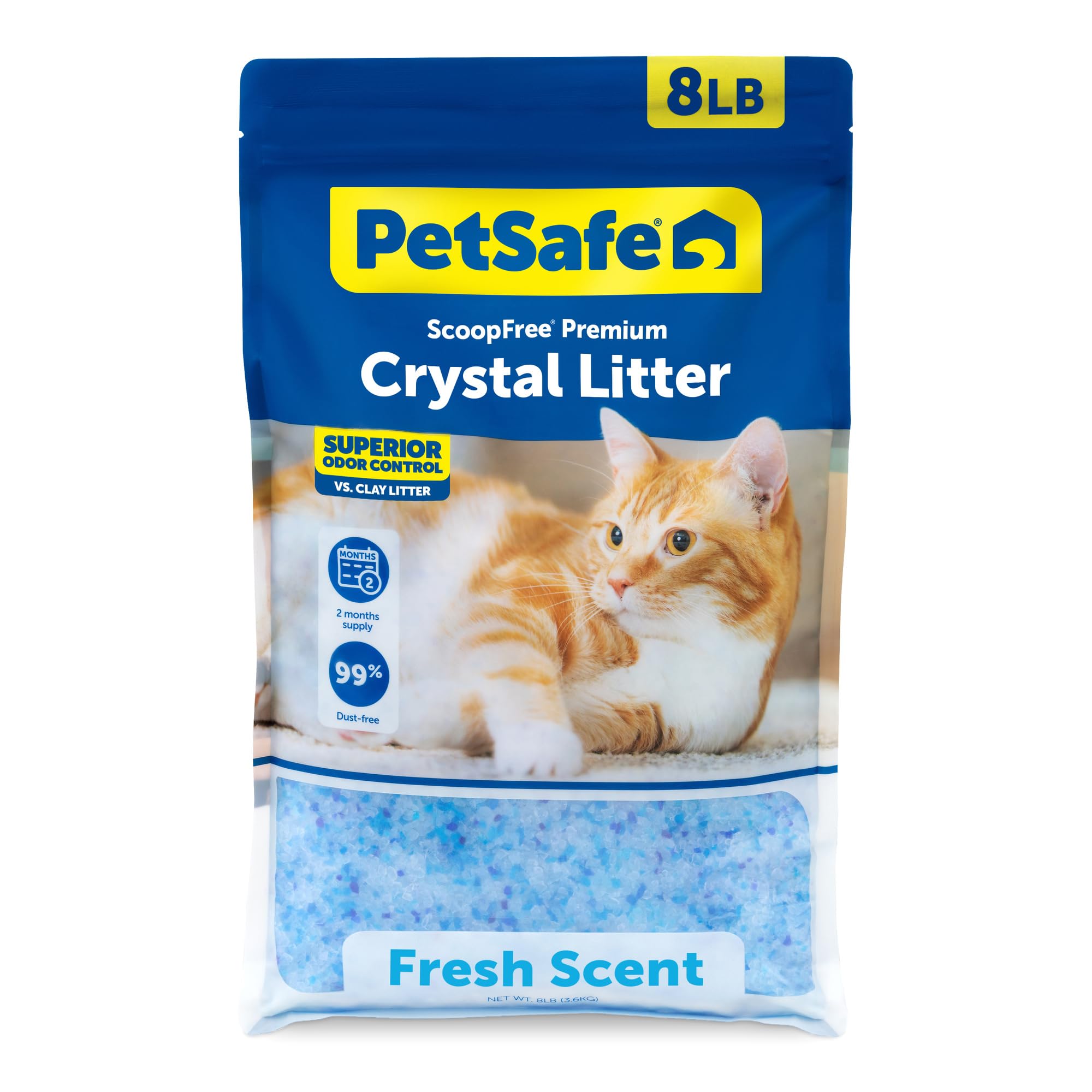
The PetSafe ScoopFree crystal litter is a silica-gel-based formula engineered specifically for automatic self-cleaning litter boxes, but it works equally well in standard pans. Silica crystals are non-clumping—they absorb urine into the bead and dry solid waste through desiccation—which means there is no clay dust from fractured granules. The 99% dust-free claim holds up well in practice; the only airborne particles come from whatever loose debris clings to the crystal surface, which is negligible compared to clay.
Respiratory benefits are significant. One reviewer reported that switching from clay to this silica litter helped their cat’s leg wound heal faster by keeping the air in the box clean and free of clay particulates that had been settling into the wound. Because you do not scoop urine clumps, you also avoid the dust cloud that normally rises when breaking apart a clay clump. The fresh scent is noticeable but less aggressive than many crystal litters, and the 8-pound bag lasts up to two months in a single-cat home, reducing how often you are exposed to dust during refills.
The trade-off is that this litter does nothing to encapsulate stool odors—poop sits on top of the crystals and smells until you scoop it. And although the upfront cost per bag seems high, the two-month lifespan makes it competitive with clay on a daily cost basis. Some cats resist the hard crystal texture on their paws, so a gradual transition period is recommended.
Why we love it
- Silica crystals produce no clay dust during pouring or scooping
- Lasts up to two months per bag, minimizing refill exposure
- Works seamlessly with automatic litter boxes
Good to know
- Does not clump; urine is absorbed into the crystals
- Poop odor remains until manually removed
- Scented formula may bother extremely sensitive individuals
4. Catit Go Natural Plant-Based Cat Litter
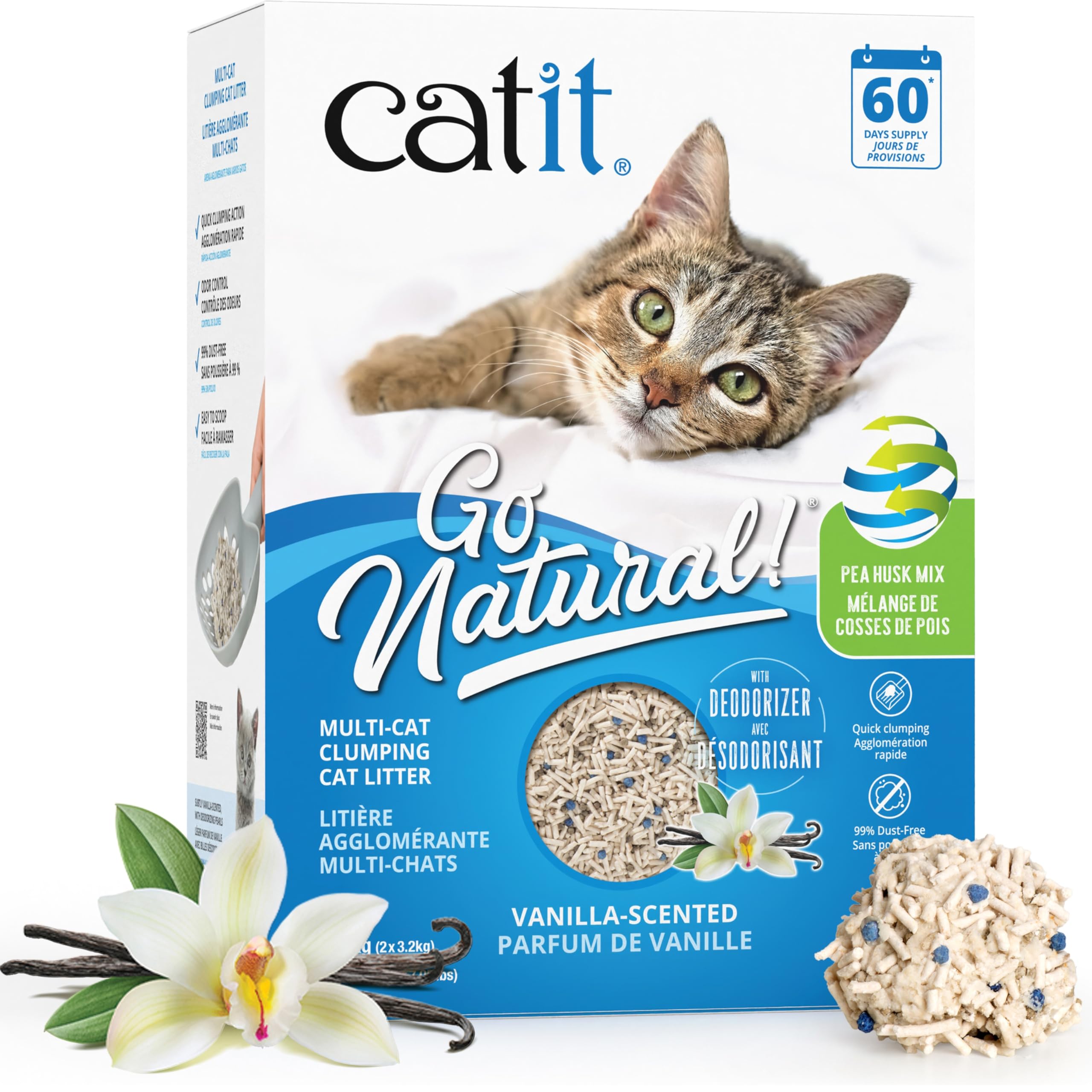
Catit Go Natural is a hybrid that blends 70% pea husk with 30% bentonite clay, aiming to capture the low-dust benefits of plant-based litter while retaining the strong clumping power of clay. The result is a litter that is noticeably lighter than pure clay and produces minimal dust on pour—the pea husk particles are larger and less friable than pure bentonite granules. Owners of cats with sneezing issues consistently mention that this is the first litter that did not trigger their cat’s respiratory symptoms.
The clumping performance is excellent. Clumps form quickly, hold together firmly, and do not stick to the sides of the pan, meaning less scraping and less secondary dust during cleaning. The included deodorizing pearls and gentle vanilla scent help neutralize ammonia without the heavy perfume cloud found in many clay litters. For households where one person has asthma but the other wants a subtle freshness, this strikes a reasonable balance.
Some users report that the litter can become dusty near the bottom of the bag as the pea husk particles break down under weight. The vanilla scent, while mild, is still a fragrance additive—a small percentage of reviewers wish for an unscented version. The 14-pound bag is costlier per pound than Dr. Elsey’s, but the lighter weight makes it easier to handle and pour without stirring up dust.
Why we love it
- Hybrid formula reduces clay dust while maintaining strong clumps
- Lightweight and easy to pour with minimal airborne particles
- Biodegradable pea husk is eco-friendly and low tracking
Good to know
- Vanilla scent may be problematic for the most sensitive users
- Dust can increase near the bottom of the bag
- Higher per-pound cost than pure clay options
5. LMJP Crystal Cat Litter, Unscented

The LMJP crystal litter is a pure silica gel product that competes directly with premium crystal brands at a lower per-pound cost. The 17.2-pound bulk pack contains four 4.3-pound bags, allowing you to rotate fresh crystals without exposing yourself to a single heavy pour. Like all silica crystal litters, this one produces virtually no dust—the beads are solid and do not fracture during handling, making it one of the safest options for anyone with compromised lung function.
Odor control is handled entirely through moisture absorption and desiccation. There are no fragrances, no added deodorizing pearls, and no chemical masking agents. The unscented formula is a major advantage for respiratory-sensitive homes because it eliminates VOC exposure entirely. The crystals last up to four months per bag in a single-cat household, drastically reducing the frequency of litter changes and the associated disturbance of settled dust. Owners of multi-cat homes note that weekly stirring after scooping poop is necessary to prevent ammonia breakthrough.
Because these crystals do not clump, you must scoop solid waste daily and replace the entire batch every few weeks depending on usage. The lack of clumping can be a deal-breaker for owners accustomed to scooping only urine clumps. Some reviews also mention that the initial bag has a mild chemical smell from manufacturing that dissipates after a day of airing out.
Why we love it
- Completely unscented with zero fragrance VOCs
- Bulk pack lasts up to 4 months, minimizing litter change frequency
- Silica beads produce negligible airborne dust
Good to know
- Non-clumping; does not absorb urine into a scoopable mass
- Requires weekly stirring and full replacement every few weeks
- Initial chemical smell may require airing out
FAQ
Is unscented litter always better for respiratory problems?
How often should I change the litter to keep dust low?
Final Thoughts: The Verdict
For most households dealing with respiratory sensitivity, the cat litter for respiratory problems winner is the Dr. Elsey’s Ultra Unscented because it combines proven low-dust clay technology with rock-hard clumping at the best cost per pound. If you want a substrate that produces virtually zero dust, grab the FUKUMARU Tofu Litter—its vacuum-sieved pellets are the closest thing to a particle-free litter box. And for longest-lasting, unscented crystal performance, nothing beats the LMJP Crystal Litter.